Document Type : Review Paper
Graphical Abstract
Highlights
New scientific paradigm for AI-powered nanotechnology innovations and smart designs.
Integrated AI and nanotechnology for improved water resource management.
Integrated AI and nanotechnology for enhanced performance of environmental systems
Sustainability, ethical, and regulatory considerations for AI integration.
⚠️ THE FOLLOWING SECTION IS TEXT-ONLY
No equations, tables, figures, or color graphics are shown below. For the complete version, please use the free PDF available on this page (top right).
1. Introduction
The adoption of artificial intelligence (AI) has continued to gain considerable interest in recent years because of its ability to create machines that can perform complex tasks that historically required higher human intelligence [1]. Increasingly, AI has demonstrated a unique ability to develop devices or computer systems that can learn, reason, solve problems, make decisions, and comprehend languages. This has enabled AI to successfully solve difficult tasks, increase accuracy, and enable automation. The key to this success is the ability of AI to: (a) mimic human abilities such as speech recognition, vision, and decision-making; (b) automate laborious or repetitive processes to speed up processing and lower human error; (c) build systems capable of independent decision-making, pattern recognition, and analysis of massive datasets; and (d) demonstrate extensive abilities beyond basic automation to enable incorporation of specialised expert systems and creativity (generative AI).
A well-established branch of AI that focuses on learning from data with the ability to make predictions or judgments is machine learning (ML) [2-4]. The application of ML in nanotechnology, water, and environmental sciences is often based on five key ML paradigms:
(a) Supervised learning (SL), which enables the prediction of material properties or classification of samples based on labelled data by training models such as neural networks, support vector machines, random forests, and regression frameworks [5-6], where models are trained with labelled datasets that produce the desired outcomes. This approach is useful for classification and regression tasks in manufacturing, where product yields or defects often need to be predicted or classified.
(b) Unsupervised learning (USL) used with unlabelled datasets for clustering, reduction of dimensionality, and pattern discovery (e.g., spectral classification, microstructure identification) [7-8]. USL is often used when the data lacks labels, and it is necessary for the algorithm to identify hidden structures within the data. It is useful for identifying unknown patterns in manufacturing where similar production batches can be grouped.
(c) Semi-supervised learning (SSL) is used when dealing with the combination of large unlabelled datasets with a small amount of labelled data [9];
d) Reinforcement learning (RL) is applied in high-dimensional chemical spaces for autonomous synthesis control, design optimization, and active search [10-11; and
(e) Deep learning (DL) includes recurrent architectures for sequential synthesis data, encoder-decoder models for microstructural segmentation [12-13], graph neural networks (GNNs) for crystal and molecular graphs [14], and convolutional neural networks (CNNs) for image-based characterisation [12].
Figure 1 illustrates the AI hierarchy of algorithms within the larger category [2a] and provides a broader detail of the most-used ML algorithms [2b].
These ML paradigms have enabled remarkable machine-learned interatomic potentials for multiscale simulations, closed-loop robotic laboratories for automated nanoparticle synthesis, accelerated electrocatalyst discovery through active learning loops, and predictive performance approaching quantum-mechanical accuracy [15].
As a consequence of AI’s ability to create machines that can rapidly handle large data sets, scientific discoveries and technological innovations across various disciplines are now rapidly being transformed. This has more rapidly led to a revolutionary change in the way that global sustainability issues are approached and addressed with the increasing adoption of AI in nanotechnology, water, and environmental sciences. AI has now become a catalytic force that is accelerating material discovery, environmental process optimisation, and is increasingly making predictive, adaptive, and autonomous systems possible. It is no longer just a supporting analytical tool, but beyond that, it has now become a strong interdisciplinary ecosystem capable of tackling some of the most difficult problems confronting humanity, such as access to clean water, climate resilience, and environmental remediation.
Water scarcity, environmental pollution, climate change, and ecosystem degradation are just a few of our current complex global issues that demand new scientific discovery and more advanced technological innovations [16, 17]. While our traditional experimental and analytical approaches are very useful, they are increasingly struggling to handle the dynamic, nonlinear, and data-intensive nature of contemporary environmental systems. However, with the ability of AI to analyse high-dimensional data, recognise patterns, and make decisions on its own, a new generation of scientific and technological solutions is now increasingly available [18]. By integrating AI with nanotechnology, water and environmental sciences, a significant revolution will continue to occur in environmental monitoring and intervention techniques, optimisation of biological and chemical processes, and in redesigning materials that enable precise and reliable control at the atomic and molecular scale [19-21]. Such multidisciplinary convergence is capable of fundamentally altering the limits of both scientific research and technological innovations for practical applications for human benefits [22].
2. AI-powered nanotechnology innovations and smart designs
The discovery of advanced materials usually involves a complex and multi-dimensional process that can take a considerable time [23]. In particular, the use of nanotechnology to develop novel materials and optimise functional performance involves extensive experimentation and computational simulations. For this reason, there has been considerable interest in developing a new approach for accelerating the discovery process. The construction of new complex structures [24, 25] and the improvement of 3D nano-printing methods [26,27] have now been made possible by manipulating nanomaterials with unmatched accuracy by AI-controlled robots. Figure 2 illustrates the extent of collaboration between materials scientists, computer scientists, and AI specialists that goes into developing cutting-edge methods for materials design [28].
Specific examples of the benefits of AI integration with nanotechnology are discussed below.
2.1 Forecasting nanomaterial characteristics
With the integration of AI in the discovery process, it is now feasible to forecast the characteristics of nanomaterials before they are synthesised by using AI-based techniques such as generative design algorithms and machine learning models [29]. By using this approach, materials libraries with desired characteristics for specific applications can be created to accelerate the discovery process. For example, based on conductivity, durability, and energy density, machine learning algorithms can be used to predict the optimal nanocomposite materials for energy storage [30]. This approach can also be used to inverse design, which starts with a desired property and works backward to identify a material that meets the needs [31].
As a result of these developments, the integration of AI with nanotechnology has transformed the development of materials and the optimisation of their functional performance, increasingly leading to more innovative and ground-breaking discoveries that are opening up unprecedented opportunities in a wide range of industries, including healthcare, water management, environmental science, manufacturing, energy, sensors, and electronic devices. There is, therefore, a growing consensus that the integration of AI with nanotechnology is significantly accelerating material discovery and design processes [19,20].
2.2 Process modelling and optimisation of nanomaterial behaviour
Another current application of ML is in modelling synthesis processes, segmenting and interpreting microscopy data, predicting electrical, optical, mechanical, and catalytic properties, and inverse design of nanomaterials and nanostructured devices [15]. The prediction and optimisation of the behaviour of nanomaterials often involve extensive navigation through extremely nonlinear, multidimensional interactions between structure, morphology, chemistry, defects, and processing conditions. With the choice of an appropriate machine learning algorithm, it is now possible to analyse data from manufacturing processes to identify optimal parameters for materials synthesis and generate high-quality nanomaterials with minimal resource usage [32,33]. Rapid screening and prediction of the physicochemical properties of numerous nanoscale structures can also be made to identify optimal choices of materials or structures for various applications by using ML and deep learning (DL) algorithms [19-21]. Enhanced reproducibility and scalability can also be achieved by AI-driven optimisation platforms that can further refine synthesis conditions, such as temperature, pressure, reaction time, and precursor ratios [21]. It is really exciting that the production of custom-designed nanomaterials and components is now possible by AI-driven nanoscale additive manufacturing techniques [34].
2.3 Quality control in Nanomanufacturing
The integration of AI with nanotechnology is also beneficial in quality control, particularly for ensuring that new devices and nanomaterials meet stringent performance and reliability standards [35,36]. Figure 3 illustrates some of the ways AI can impact nanomanufacturing and quality control. It also highlights the associated benefits if used with nanorobots for nano-printing, additive manufacturing, and quality control.
AI-powered machine vision systems can analyse nanoscale materials and structures with exceptional precision [37]. These technologies enhance the quality of the final product by identifying defects and variations that the human eye could overlook [38]. AI-driven sensors and monitoring devices built into nanomanufacturing equipment provide real-time quality feedback [39]. Consequently, its ability to facilitate rapid adjustments to industrial processes reduces waste and errors. In this setting, AI can forecast maintenance needs by analysing data from nanomanufacturing equipment [40]. AI-based preventative maintenance minimises downtime and ensures consistent production quality [41]. Furthermore, to achieve optimum process conditions, machine learning algorithms can also be used to monitor and regulate variables such as temperature, pressure, and humidity that can impact nanomanufacturing processes, including nanoimprinting [42]. This method of fine-tuning the variables can lead to reduced costs, improved quality, and increased yield. Also, downtime, delays, and potential financial losses in manufacturing can be minimised by ML-based advanced prediction of future equipment failures [43]. AI can also identify irregularities in the system by analysing data streams from embedded sensors and/or manufacturing processes, thereby warning operators of possible failure. The equipment’s lifespan can be increased, and downtime can be reduced with the ability to perform such predictive maintenance.
2.4 Resolving uncertainty in chemical processes with Artificial Neural Networks
When designing the best operating conditions for chemical processes in uncertain situations, artificial neural networks (ANNs) are a type of AI that can be used to predict properties and make effective decisions. For example, it was discovered that under uncertainty in a multiscale model of thin film formation by chemical vapour deposition (CVD), ANNs achieved orders of magnitude computational savings and accurately predicted product properties [44]. To achieve this goal, the ANNs were trained using several realisations of the unknown parameter to represent the behaviour of the two main characteristics of the thin film: (i) growth rate and (ii) roughness [44]. Also, in an earlier study in our laboratories [45], we successfully designed a computerized approach based on an integrated ANN /conducting polymer biosensor for the detection of trace concentrations of formate. In this approach, the data collected (current signals) from amperometric detection of the polypyrrole formate biosensor were transferred to an ANN-trained computer for modelling and output prediction. Based on the created models and patterns, the resulting integrated ANN/polypyrrole biosensor system enabled reliable prediction of trace formate concentration in real samples [45].
2.5 Material characterisation in nanomanufacturing
Advanced imaging techniques, such as SEM, AFM, and TEM, are often used in nanomanufacturing for material characterization at the sub-micron to nanometer scales. This often generates overwhelming data sets that can now be simplified by using an appropriate AI model [46,47]. ANNs can be used to analyse AFM and SEM data [48,49], and, for complex, high-dimensional data, the analysis can be analysed by DL. For example, DL algorithms can be used to categorise material properties, locate defects, and analyse structural features from imaging data in order to expedite the characterisation process and increase the accuracy of defect detection in nanomanufacturing. Convolutional neural network (CNN) can also be used further to identify particular nanoscale characteristics in SEM images with the appropriate training, allowing for real-time monitoring and quality control [50].
Non-invasive and non-destructive evaluation of product quality in additive manufacturing can also be done by using machine learning algorithms [51]. Table 1 provides a list of ML algorithms that can be applied to defect identification and high-resolution nano and microscale image analysis during manufacturing processes. The diverse range of applications identified in this Table further strengthens the claim that AI is already having positive impacts and benefits for nanotechnology.
2.6 Assessment of impacts of engineered nanomaterials
AI models can also be used for an early assessment and prediction of possible environmental and biological impacts of new engineered nanomaterials. This is most desirable for achieving safer and more responsible innovation [52]. Also, it is possible to develop intelligent nanosystems that can perform real-time sensing, provide adaptive feedback, and autonomous response to chemical, biological, or physical stimuli by integrating AI with nanosensors and other nanodevices [53].
It is obvious from the examples provided in this section that the integration of AI with nanotechnology bridges the gap between molecular design and scaled implementation by reducing the length of the innovation cycle. The key benefits of the integration of AI with nanotechnology are summarised in Table 2. Notably, the integration of AI with nanotechnology will enable a much quicker material discovery process and lead to innovations for much broader applications. Without doubt, AI-enhanced nanotechnology is already transforming the way we previously tackle difficult issues and opening up new possibilities for sophisticated, sustainable solutions that enable the development of more intelligent, effective designs, optimise the production of nanomaterials, and advance nanodevices that can adjust to particular requirements or environmental changes.
3. Integration of AI and nanotechnology for improved water resource management
The issue of water security is a key global challenge of the 21st century, which requires urgent intervention, particularly in relation to the growing population, climate variability, and industrial process demands [54]. In this regard, the achievement of universal access to safe drinking water is also one of the key goals of the United Nations Sustainable Development Goals (SDGs) [55]. There is currently a lot of interest in integrating AI (ML) and nanotechnology to improve the performance and efficiency of water quality control systems. The ability of AI to quickly analyse a significant amount of complex environmental data, such as water quality assessments and predictions [56] and spatiotemporal environmental data prediction [57], is a key advantage. In particular, the ability of various AI systems to efficiently manage large datasets and recognise complex patterns is of significant benefit for water quality management.
As illustrated in Figure 4, nanotechnology has already had several significant impacts and benefits in water treatment [58]. Notable among these are the impacts of the use of various organic, inorganic, and polymeric nanoparticles on filtration, photocatalysis, disinfection, and adsorption. However, considerably more improvement and diversification can be achieved by integrating AI and nanotechnology for water resource management.
In particular, the introduction of new and quick methods, based on ML and other AI systems, for data analysis and interpretation, is having profound effects and benefits in water quality management practices. For example, the use of appropriate ML algorithms in the management of water quality can enhance data processing, identify trends, and provide predictive maintenance for water systems. To date, the application of ML algorithms has greatly benefited critical operations such as contamination event prediction, pollution source evaluations, and water treatment process enhancement [59]. Some of the key areas where the integration of AI can have significant impacts on water management processes are discussed below.
3.1 Enhancing water security
With AI’s ability to facilitate real-time monitoring, predictive analytics, and system-level optimisation throughout the water cycle, it offers unique transformational capabilities that can substantially enhance water security [60] and improve current water treatment practices [61]. It has been estimated that operational expenses for water treatment can be reduced by 20-30% through the use of AI, resulting from the optimal use of chemicals and associated reduction in expenditure [62]. To achieve this goal, the water industries would need to make an estimated investment of $6.3 billion in AI by 2030.
3.2 Improved water treatment process efficiency
Due to its versatility, design simplicity, and easy installation, water treatment processes can benefit significantly from integration with AI. Several studies have shown how to successfully simulate and optimise water treatment processes, including pollution removal, using a variety of AI tools [63]. Some of the possibilities that can be achieved with such integration include processing of continuous streams of data by AI-powered sensor networks to detect contaminants, pathogens, heavy metals, microplastics, and emerging pollutants with high sensitivity and temporal resolution [60]. Dynamic adjustment of operational parameters in water and wastewater treatment systems can also be achieved by AI algorithms. Consequently, enabling the minimisation of energy consumption, while enhancing treatment efficiency, and ensuring regulatory compliance [64].
3.3 Water quality management
AI-powered solutions are now increasingly being used in water quality management operations such as forecasting, monitoring, and response actions development. Threats to public health and ecosystems have significantly decreased as a result of the efficacy of these systems, especially in the early detection of possible dangers [65].
Early detection of leaks, corrosion, and structural degradation in distribution networks can also be facilitated by using Machine learning models, and, thus, reducing water losses and infrastructure failures [64]. Furthermore, the forecast of floods, droughts, aquifer depletion, and rainfall-runoff dynamics can be improved by the use of AI-enhanced hydrological models that integrate satellite, climatic, and ground-based data [16,17].
3.4 Pollution source Identification and removal
Another area where integration of AI with water resource management can be of considerable significance is in identifying pollution sources and developing strategies for their removal. AI-powered predictive analytics can pinpoint pollution hotspots and sources, allowing for the development of focused mitigation strategies [66]. For example, the adsorption capacity and catalytic effectiveness of nanomaterials for the removal of pollutants can be improved by using AI-guided nanomaterial design. It has now been demonstrated that the use of nano-adsorbents and nano-catalysts is more efficient than conventional methods in removing pollutants from air and water [67]. AI-controlled nanorobots and nanoparticles can target and degrade pollutants such as organic compounds and heavy metals to remediate contaminated groundwater and soil with very high precision.
3.5 Self-controlling infrastructure and smart water systems
The integration of AI with water management systems will increasingly lead to the development of robust, self-controlling infrastructures that can make decisions on their own in challenging and dynamic situations, such as smart water systems. Table 3 summarises the key benefits of the integration of AI with water resource management systems. Evidently, substantial improvement can be achieved through the integration of AI with water management processes, resulting in the development and utilisation of smart water systems.
4. Integration of AI and nanotechnology for enhanced performance of environmental systems
The applications of AI and nanotechnology to environmental systems are very promising, especially in the areas of pollution control, climate change mitigation, and wastewater treatment. The complexity, scale, and interconnectivity of environmental systems are particularly suited to AI-based analysis [16]. Processes such as environmental monitoring, prediction, and intervention can be more rapidly and effectively implemented with AI-based models. Also, high-resolution modelling and impact assessment in climate science can be significantly enhanced with AI models to enable effective region-specific adaptation and mitigation strategies [17]. While ecosystem simulations support conservation efforts by predicting how environmental changes affect biodiversity and ecosystem services, climate models help policymakers make well-informed decisions on climate adaptation and mitigation methods. Furthermore, the use of computer vision and bio-acoustic algorithms in ecosystem monitoring will, through the ability to analyse satellite imagery, drone data, and sensor networks, enable continuous tracking of biodiversity and ecosystem health [68]. Some of the specific areas where the integration of AI, nanotechnology, and environmental systems will have significant impacts and benefits are summarised below.
4.1 Ensuring adaptive environmental policy and processes
AI-based models can be used to identify pollution hotspots, trace emission sources, and predict dispersion pathways in air, water, and soil systems by integrating data from multiple sources [68]. The use of machine learning models can enhance and accelerate the discovery of advanced capture materials and optimisation of geological storage strategies for global warming [17,21]. Consequently, governments, industries, and communities will be empowered with these new capabilities that can provide more realistic, actionable insights in support of evidence-based environmental policy and decision-making.
4.2 Environmental monitoring, modelling, and remediation
The integration of AI and nanotechnology in environmental systems has given rise to new approaches to environmental monitoring and remediation. A wide range of contaminants and environmental factors can now be detected in real-time environmental monitoring by AI-powered nano-sensors due to their relatively high sensitivity and selectivity [69]. These sensors are capable of providing useful information for early detection and prompt responses by measuring air pollutants, such as particulate matter, volatile organic compounds (VOCs), greenhouse gases, and toxins in water and soil. Data gathered by nano-sensors can be processed by AI to provide real-time environmental monitoring. Data from soil, water, and air quality sensors can be analysed by AI to facilitate rapid identification of pollution hotspots and predict environmental changes that may have a significant impact on ecosystems or public health. Furthermore, AI-driven environmental modelling based on the analysis of large datasets is increasingly being used to forecast future climate trends, extreme weather occurrences, and ecosystem dynamics.
4.3 AI-designed nanomaterials and nanosystems for environmental intervention
Increasingly, AI-designed nanomaterials and nanosystems are being developed and used to address and find new solutions for various environmental problems. For example, highly efficient removal of persistent contaminants such as PFAS, arsenic, pharmaceuticals, and pathogens from water systems is now being achieved with AI-designed nanomaterials [53, 70]. AI-designed nanomaterials are also being used for achieving more efficient removal of pollutants from the environment. Nanostructures that are capable of removing and neutralising dangerous substances in water or air, such as greenhouse gases or heavy metals, can be designed with the aid of AI algorithms. These nanomaterials could be used to clean up contaminated areas or to reduce carbon emissions during environmental remediation.
Also, continuous real-time environmental monitoring with very high sensitivity and selectivity is being achieved with AI-enhanced nanobiosensors [53]. Furthermore, a shift towards autonomous environmental remediation systems is being guided by predictive AI algorithms aided by the development of self-responsive nanomaterials that can adapt to changes in pH, temperature, or contaminant concentration [53]. Emerging out of this convergence are intelligent environmental engineering systems that can sense, assess, and react to environmental variables in real time.
The key benefits of the integration of AI with environmental processes and systems are summarised in Table 4. Evidently, substantial improvement can be achieved through the integration of AI with various environmental processes and systems, enabling the development of more adaptive planning policies and processes.
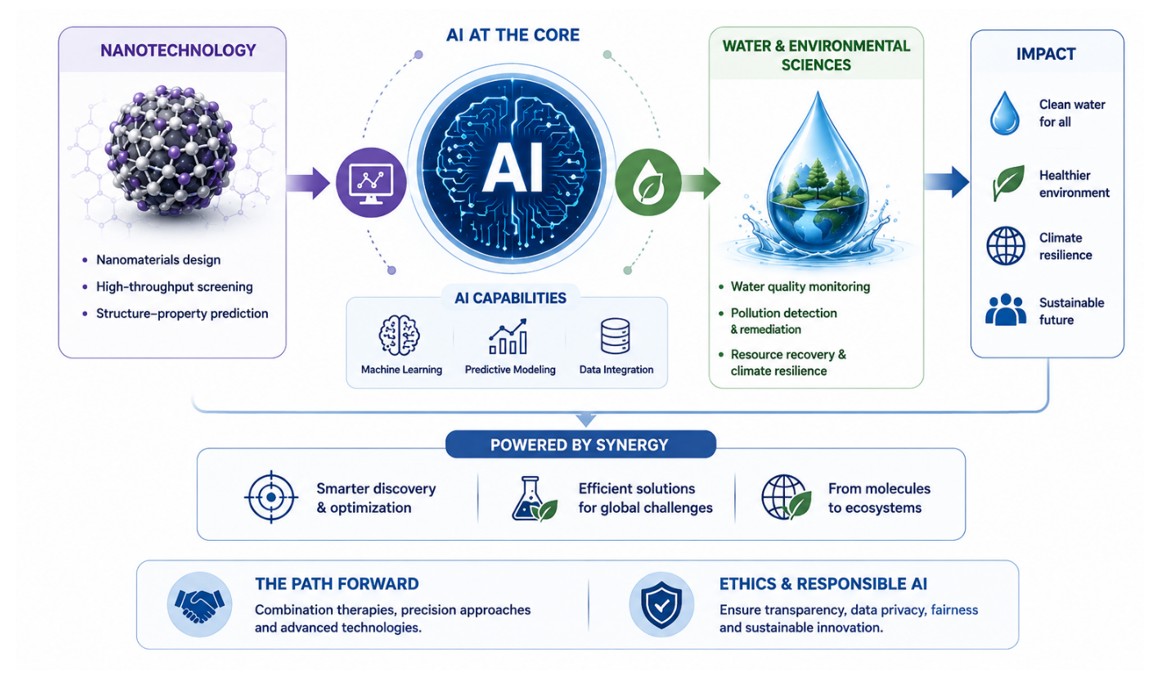
Figure 5 provides a comprehensive overview of the transformative impacts, major benefits, existing challenges, and emerging future directions associated with the integration of artificial intelligence (AI) with nanotechnology, water, and environmental sciences. The figure highlights how the convergence of these disciplines is driving a new era of intelligent and sustainable scientific innovation, enabling accelerated discovery, predictive optimization, advanced environmental monitoring, precision remediation, and enhanced resource management. It also emphasizes critical challenges, including data quality, model interpretability, ethical considerations, scalability, and regulatory integration, which must be addressed to ensure responsible and effective implementation. Overall, the figure underscores the strong potential of AI-integrated nanotechnology and environmental systems to revolutionize scientific problem-solving and, if strategically managed, to significantly accelerate technological advancement, optimize sustainable solutions, and contribute toward building a cleaner, safer, and more resilient future.
5. Sustainability, ethical, and regulatory considerations
Although significant advances have been made and will continue to be made through the integration of AI with nanotechnology, water, and environmental sciences, a significant knowledge gap still exists between the high accuracy ML models can achieve and the interpretation of the results. If not addressed, the danger is that ML models will continue to be used as black boxes [71,15]. But interpretability is crucial because accurate predictions and mechanistic understanding are both necessary for scientific discovery. Particularly in high-stakes fields, such as environmental nanotechnology, water resource management, and energy materials, this lack of transparency in using ML models as black boxes will increasingly raise questions about reproducibility, generalisation, and reliability.
Furthermore, before the transformative benefits of the integration of AI with nanotechnology, water and environmental sciences can be fully and effectively realised, there are critical ethical, regulatory, and governance challenges that must be addressed. To ensure public trust and accountability, it is absolutely necessary that environmental decisions based on the use of AI models are clear, intelligible, and not influenced by data bias [72,73]. Also, long-term ecotoxicological impacts and human exposure risks of nanomaterials must be assessed comprehensively prior to their release and use to ensure public safety is not compromised [52]. Notably, to protect vulnerable and resource-limited regions that often experience acute water and climate stress, access to AI-enabled nano, water and environmental technologies must be equitable and available to all [74]. In particular, concerns about safety, privacy, and ethical ramifications must be addressed as AI-driven nanodevices proliferate. It is crucial to make sure AI-powered nanodevices are safe for both human use and the environment. Therefore, the deployment, safety, and alignment of innovation with principles of sustainability, inclusivity, and precaution must be governed by resilient international standards and regulatory frameworks [72-74].
Table 5 highlights the important considerations to ensure ethical, regulatory, and sustainable use of the integration of AI with nanotechnology and environmental sciences. Transparency, safety, risks, and accessibility must be guided by robust standards and regulatory frameworks without compromise [72-74].
6. Conclusions and future directions
The integration of AI with advances in nanotechnology, water, and environmental sciences has opened up a new scientific paradigm that promises to revolutionise scientific discoveries and technological innovations beyond what we thought was previously possible. Such convergence of intelligent computation, nanoscale precision, and environmental application will provide profound and unimaginable capacity to address complex global challenges. However, despite such great promise, significant challenges that will be encountered in the integration of AI with nanotechnology, water, and environmental sciences cannot be overlooked or understated. For example, it is well known that nanomaterials can exhibit extremely complicated and context-dependent behaviour. It is still very difficult to develop AI models that can accurately forecast and regulate this behaviour. Therefore, more research is still needed to achieve significant improvement in this area and to further enhance the reliability of AI models. Although it is increasingly evident that AI can improve nanomaterial design and production on a small scale, there are still many obstacles to overcome before these advancements can be applied to large-scale manufacturing processes. This is also a particularly promising area for further research.
Furthermore, it is necessary that ethical responsibility, sustainability, and long-term stewardship of the planet for future generations must be at the core of the path forward, rather than creating innovation that is focused only on intelligence and efficiency. Therefore, the integration of AI, nanotechnology, water, and environmental sciences must be directed carefully to produce unprecedented and sustainable breakthroughs in the future, such as fully autonomous environmental monitoring networks, predictive digital twins of ecosystems and cities, AI-designed green nanomaterials, and self-regenerating remediation technologies. By enabling proactive stewardship as opposed to reactive intervention, these new technological developments will radically change how humans interact with the natural world.
The impact of integration of AI with nanotechnology extends beyond benefits for water and environmental sciences; it extends to novel developments in personalised medicine and disease detection. However, that is outside the scope of this paper, but will be considered in a future paper.
Conflict of Interest
The authors declare no conflict of interest.
Funding
This study was not supported by any funding.
AI Statement
The authors confirm that no AI tools or services were used during the
preparation of this work.