Document Type : Original Research Paper
Graphical Abstract
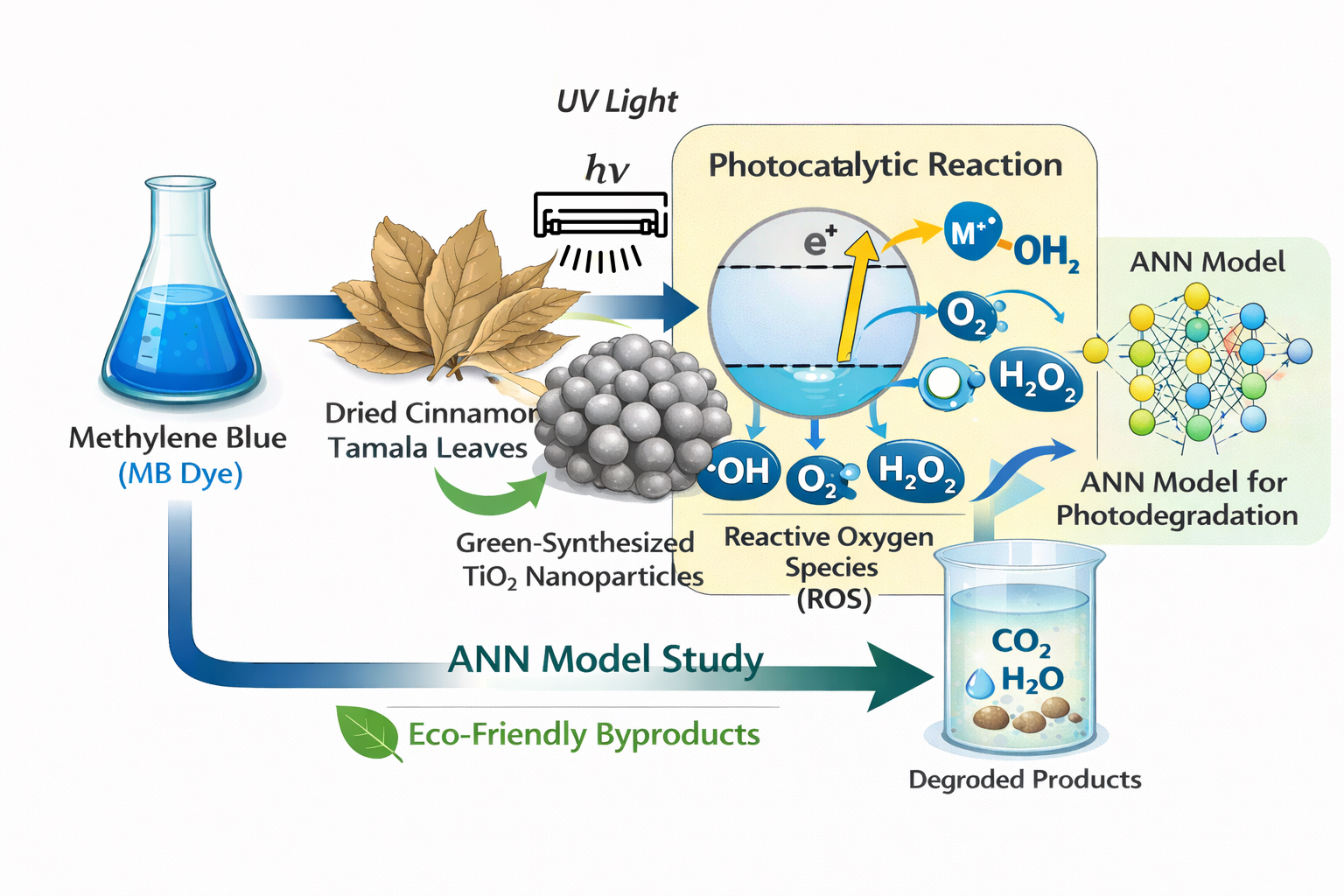
Highlights
Developed an ANN-based model to predict dye degradation efficiency in photocatalytic systems.
Achieved accurate prediction performance using experimental photocatalytic parameters.
Demonstrated the potential of machine learning for optimising environmental remediation processes.
⚠️ THE FOLLOWING SECTION IS TEXT-ONLY
No equations, tables, figures, or color graphics are shown below. For the complete version, please use the free PDF available on this page (top right).
1. Introduction
Artificial Neural Networks (ANNs) have emerged as powerful tools in environmental engineering, particularly for modelling and optimizing complex processes like dye degradation in wastewater treatment. Traditional modelling approaches, such as kinetic and mechanistic models, often require a precise understanding of system dynamics and involve simplifying assumptions that limit accuracy. In contrast, ANNs can learn directly from experimental data, effectively modelling nonlinear relationships without prior knowledge of the underlying mechanisms [1], [2]. One of the key advantages of ANNs in dye degradation is their ability to handle multivariable and nonlinear datasets, which are common in photocatalytic, biological, or advanced oxidation processes [3]. ANNs can integrate various process parameters such as pH, temperature, dye concentration, catalyst dosage, and irradiation time to predict degradation efficiency with high precision [4]. Furthermore, ANNs can generalize well from training data, making them useful for predicting outcomes under new or untested conditions. This feature is valuable for optimizing operational conditions, reducing experimental costs, and enhancing treatment efficiency [5], [6]. They also support hybrid modelling with techniques like genetic algorithms (GA) or fuzzy logic for improved performance [7].
In recent years, the synthesis of titanium dioxide (TiO₂) nanoparticles has garnered significant interest due to their remarkable properties, particularly in the field of photocatalysis. TiO₂ nanoparticles are widely used for applications such as environmental remediation, water purification, and the degradation of organic pollutants. Traditional methods of synthesizing TiO₂ nanoparticles often involve hazardous chemicals and energy-intensive processes, which raise environmental and health concerns. As a result, the development of green synthesis methods, which utilize biological resources like plant extracts, microorganisms, and other eco-friendly materials, has emerged as a sustainable alternative. These green synthesis approaches not only reduce the reliance on toxic chemicals but also offer a cost-effective and environmentally benign pathway for nanoparticle production, aligning with the principles of green chemistry [8,9].
The green synthesis of TiO₂ nanoparticles typically involves the use of plant extracts, which contain bioactive compounds such as polyphenols, flavonoids, and terpenoids that can act as reducing and stabilizing agents. These natural compounds facilitate the reduction of titanium precursors, leading to the formation of TiO₂ nanoparticles under mild conditions. Similarly, microorganisms such as bacteria, fungi, and algae have been employed in the biosynthesis of TiO₂ nanoparticles, taking advantage of their metabolic processes to produce nanoparticles with desirable properties [10,11]. The nanoparticles synthesized through these green methods often exhibit enhanced photocatalytic activity due to the presence of organic moieties on their surfaces, which can improve their interaction with light and increase the generation of reactive oxygen species [9].
The photocatalytic activity of TiO₂ nanoparticles is primarily attributed to their ability to generate electron-hole pairs when exposed to light, particularly in the UV region. This pair of electron and hole can drive oxidoreduction reactions that cause degradation of various organic contaminants into harmless byproducts. The effectiveness of this procedure is determined by various aspects, including the size, shape, and crystallinity of the nanoparticles, as well as the existence of surface modifications applied during the green synthesis process [12,13]. As such, green-synthesized TiO₂ nanoparticles have shown promising potential in photocatalytic applications, offering a sustainable and effective solution for environmental challenges.
Recent studies on the green synthesis of TiO₂ nanoparticles reveal their promising photocatalytic applications. Xie et al. synthesized TiO₂ nanoparticles using Solanum lycopersicum extract and demonstrated 89% degradation of organic compounds under UV light, showcasing the extract’s potential in nanoparticle production [14]. Ahmed et al. employed Acorus calamus extract, achieving 87% degradation of textile dyes, highlighting the effectiveness of this natural source for photocatalytic applications [15]. Khan et al. used Moringa oleifera leaf extract to produce TiO₂ nanoparticles, which achieved a 90% degradation rate of pollutants under UV light, underscoring the extract’s efficiency [16]. Iravani et al. provided a comprehensive review showing that green-synthesized TiO₂ nanoparticles generally achieve 80-95% degradation of pollutants, emphasizing the efficacy of green methods [17]. Sakthivel et al. demonstrated that nitrogen-doped TiO₂ nanoparticles achieved up to 95% degradation of phenol, illustrating enhanced photocatalytic properties [18]. Rao et al. synthesized TiO₂ nanoparticles using Ocimum sanctum extract, achieving 91% degradation of industrial dyes, showing the potential of this extract [19]. Sharma et al. achieved 88% degradation of methyl orange using Aloe vera extract, highlighting its efficacy [20]. Raliya et al. used rice husk for nanoparticle synthesis, achieving 92% degradation of rhodamine B, emphasizing agricultural by-products as a sustainable source [21]. Jain et al. reported an 85% degradation of methylene blue with TiO₂ nanoparticles from Aspergillus niger, showing the viability of fungal sources for green synthesis. These studies collectively affirm that green synthesis methods using diverse natural sources can effectively produce TiO₂ nanoparticles with high photocatalytic activity under UV light [22]. Singh et al. synthesized TiO₂ nanoparticles using Azadirachta indica (neem) leaf extract, achieving an 88% degradation of methyl orange, demonstrating the potential of neem in nanoparticle production [23]. Kalpana et al. reported that TiO₂ nanoparticles derived from Plectranthus amboinicus leaf extract showed 85% degradation of rhodamine B, indicating the usefulness of aromatic herbs in green synthesis [24]. Devasena and Sathya synthesized TiO₂ nanoparticles using Punica granatum peel extract, achieving 90% degradation of congo red dye, showcasing the effectiveness of fruit peels in the green synthesis process [25].
Researchers have also employed ANN in optimizing photocatalytic conditions. For instance, Yonar and Yonar (2020) [26] used ANN to model and optimize dye degradation in photo-Fenton processes, showing that ANN could successfully simulate and predict degradation under varying operational conditions without conducting exhaustive experiments. Similarly, Patil et al. (2020) [27] developed ANN models to predict Congo red dye degradation using TiO₂–ZnO photocatalysts and highlighted their high predictive capability over conventional models.
The integration of ANN with optimization algorithms such as genetic algorithms (GA), particle swarm optimization (PSO), and fuzzy logic systems is a current trend. These hybrid approaches further improve model precision and allow better process control, making them ideal for real-time industrial applications [28][29].
ANNs have become a valuable modeling tool in the field of dye degradation, offering superior prediction, adaptability, and data-driven decision-making compared to conventional kinetic models. Their ability to model nonlinear, multi-parametric systems without the need for mechanistic equations makes them ideal for environmental and chemical engineering applications
2. Materials and methods
Leaves of Cinnamomum Tamala were gathered from West Bengal, Kolkata, India. Titanium isopropoxide and de-ionized water were obtained from Merk. MB (methylene blue) was sourced from Sigma Aldrich. DD(Double-distilled) water was used regularly throughout the investigation. Double-distilled water was used for all of the reaction mixture solutions. All glassware was sterilized before use.
2.2. Synthesis of TiO2 NPs using aqueous extract of Cinnamomum Tamala
The newly dried leaves of Cinnamomum Tamala were properly cleaned with DI(deionized) water in order to remove any remaining debris, followed by a cutting procedure. A total of 50 grams of the chopped leaves was combined with 500 mL of de-ionized water and heated to 60° C for 15 minutes, after which the mixture was allowed to cool. After that, the extract was filtered through Whatman Grade 1 filter paper and kept for further use at 4° C. Subsequently, 5 mL of Titanium Isopropoxide was combined with 50 mL of de-ionized water and stirred vigorously for two hours. Following this, 10 mL of the plant extract was added and stirred with a magnetic stirrer at room temperature for three hours, resulting in a color change of the aqueous solution to light yellow. The TiO2 nanoparticles were collected through filtration and washed multiple times with de-ionized water to remove any residual debris. The isolated TiO2 nanoparticles were then dried at room temperature for 24 hours.
2.3. Characterization of synthesized NPs
Using a Rigaku Ultima-III diffractometer, X-ray diffraction (XRD) was used to analyze the phase of the green synthesized TiO2 powder sample. To obtain morphological and elemental information, field emission scanning electron microscopy (FESEM). Fourier-transform infrared (FTIR-ELICO SL-174) spectroscopy was utilized to verify the presence of chemical bonds within the sample. Additionally, ultraviolet-visible (UV-Vis) spectroscopy was conducted with a Jasco 650 UV-Vis spectrophotometer to determine the band gap of the synthesized TiO2 NPs.
2.4 Photocatalytic and kinetic study under UV light
The photocatalytic performance of the synthesized material concerning the degradation of methylene blue (MB) dye was evaluated using UV-Vis spectroscopy. For the photocatalytic degradation experiment, 5 mg(milligram) of TiO2 NPs were introduced into 50 ml of methylene blue (MB) solution at a concentration of 20,30&40 ppm, contained within a beaker. The beaker was kept in a dark environment for 5 minutes. Following this period, the beaker was exposed to a 500-watt Philips mercury vapor lamp. At specific 10-minute intervals, 5 ml of the solution was extracted for analysis over a total duration of 90 min to assess the degradation of the dye. UV lamp-to-reactor distance was 5.5 cm. A UV-C lamp was used for the photocatalytic experiment. The quantified irradiance for a 500-watt bulb over a 48cm*48cm area is 2170.14 W/m2.
2.5 Artificial Neural Network (ANN) Modelling
Artificial Neural Networks (ANNs) are robust computational frameworks that simulate the behavior of biological neural systems to capture complex, nonlinear relationships between input and output data. In this study, an ANN model was developed in R to predict dye degradation efficiency based on experimental input parameters such as reaction time, pH, dye concentration, and TiO₂ dosage. The following detailed steps were implemented for ANN modeling and validation. Steps for Artificial Neural Network (ANN) Modeling
2.5.1 Data Collection and Preprocessing
The experimental dataset (117 observations) was first compiled in Microsoft Excel, including the variables: Time, pH, Dye, TiO₂, and Degradation. This dataset was imported into the R environment. Since ANN performance is highly sensitive to the scale of input values, all variables were normalized to a range between 0 and 1 using the Min-Max normalization method. This step ensured that variables with different units and ranges did not disproportionately influence the model’s weights.
2.5.2 Data Splitting for Training and Testing
The normalized dataset was divided into two subsets: 70% (82 observations)for training the ANN and 30% (35 observations)for testing its predictive accuracy. A random sampling strategy was employed to ensure reproducibility of the results. The training set was used to fit the ANN, while the testing set was used to validate its performance.
2.5.3 Model Architecture and Training
The neural network was built using the ‘caret’ and ‘neuralnet’ packages. Instead of utilizing a fixed architecture, the ‘Grid Search’ algorithm was employed to determine the optimal number of hidden layers and neurons of the ANN models. The search space included architectures ranging from single-layer to multi-layer configurations. Additionally, a 10-fold cross-validation (CV) technique was implemented to ensure that the model’s predictive power is robust and remains independent of any specific data split.
2.5.4 Prediction and Denormalization
Once the models were trained, predictions were generated for both training and testing datasets. Since the models were trained on normalized data, the predicted output values were denormalized back to their original scale using the inverse of the Min-Max normalization formula. This ensured that the predictions could be compared directly to the actual experimental degradation values.
2.5.5 Model Evaluation
The performance of the developed models was evaluated using statistical metrics such as Root Mean Square Error (RMSE) and Coefficient of Determination (R²). RMSE provides a measure of the average magnitude of error, while R² indicates the proportion of variance explained by the model. The model with the highest R2 and lowest RMSE value in the training phase was selected, and the predictions of that particular model were utilized for further analysis. Separate metrics were also computed for the best-performing model to assess its generalization capability.
3. Results and Discussion
3.1 XRD (X-ray diffraction) Analysis
The crystalline characteristics of the synthesized TiO2 nanoparticles were examined through XRD analysis. The purity and phase (anatase) of the green-synthesized TiO2 nanoparticles are illustrated in Figure 1. The XRD diffractogram revealed peaks at 25.05, 37.85, 47.73, 54.61, 62.98, and 69.03, which correspond to JCPDS Card No. 86-1155, with no evidence of secondary phases or impurity peaks present in the synthesized TiO2 NPs. Strong and distinct diffraction peaks indicate that the product has a well-crystalline structure.
3.2 FTIR Spectra Analysis
The FTIR peaks corresponding to the leaf extract and the synthesized TiO2 nanoparticles are illustrated in Figures 2 and 3. Table 1 shows the analysis of the wavenumber and peak assignments [30,31]. A comparison of these findings with previous studies suggests that phytochemicals significantly contribute to the green synthesis of TiO2 nanoparticles, serving as both capping and stabilizing agents [32]. The FTIR spectrum of the green-synthesized TiO2 nanoparticles indicates the presence of phytochemicals on the surface of the nanoparticles, while the water-soluble organic compounds found in the leaf extract play a vital role in both the reduction and stabilization of the synthesized TiO2 nanoparticles. FTIR spectroscopy confirms the presence of specific surface functional groups that are directly associated with the observed enhancement in photocatalytic activity. The characteristic O–H stretching band indicates surface hydroxyl species, which may serve as active sites for the formation of hydroxyl radicals (•OH) upon light irradiation, thereby accelerating the degradation process [33-35]. Furthermore, the C=C=C bending mode may suggest the existence of conjugated carbon domains that promote interfacial charge transport and reduce electron–hole recombination losses [36–38]. The synergistic effect of these surface features strengthens interfacial reactions and provides a mechanistic basis for the improved photocatalytic performance.
3.3. UV-visible spectroscopy study for Bandgap analysis
The band gap determination of TiO2 nanoparticles synthesized using a green synthesis technique was investigated using a UV-visible spectrophotometer. The findings, depicted in Figure 4, indicate a notable peak at 285 nm, which confirms the effective synthesis of green TiO2 nanoparticles. The Tauc plot can be used to find out the energy band gap of the green synthesized TiO2 nanoparticles [36]. The calculated band gap energy (Eg) is found to be 3.32 eV. The formation of OH radicals, which are in charge of eliminating lead ions, is indicated by the UV-Vis spectra of TiO2, which indicates that the material exhibits considerable reactivity in the presence of UV radiation. [38].
3.4. FESEM analysis of green-synthesised TiO2
The surface morphology and topography of the synthesized TiO2 were examined through FESEM imaging (Figure 6). Figure 7 indicates the particle size (average particle size 38.34 nm) distribution. The analysis indicated that the TiO2 nanoparticles are predominantly spherical and fall within the nanometer scale. Additionally, the nanoparticles exhibit slight agglomeration, a characteristic commonly observed in nanoparticles produced through green synthesis. This phenomenon can be attributed to the higher surface area of biosynthesized nanoparticles, which leads to a stronger affinity among them, resulting in agglomeration.
3.5. Effects of pH and catalyst dosage on the use of green-synthesized TiO2 nanoparticles under UV radiation for the photocatalytic degradation of MB
The medium’s pH level has a significant impact on the photocatalyst’s surface characteristics, methylene blue (MB) charge, the production of free radicals, the valence band’s oxidation potential, and a number of other physicochemical features of the system. In order to determine how pH affected the rate of photocatalytic degradation, a study was conducted in which the initial pH values were varied from 3 to 11 (that is, pH 3, 5, 7, 9, and 11). All other experimental conditions remained unchanged, and the photocatalyst dosage was kept constant at 5 mg of TiO2 nanoparticles in 50 ml. Figure 8 shows that the maximum rate of MB degradation was seen at a pH of 7.
Figure 9 clearly illustrates that the photocatalytic degradation rate of methylene blue (MB) increased as the concentration of TiO2 was raised from 2 mg/L to 6 mg/L. Beyond this point, from 6 mg/L to 10 mg/L, the degradation rate of MB remained relatively constant, exhibiting only minor fluctuations. The initial enhancement in the degradation rate of MB with the increasing TiO2 dosage can be attributed to the augmented surface area and the availability of active sites for photocatalytic activity, which facilitated a higher generation of hydroxyl radicals (•OH) and consequently expedited the degradation process of MB. However, with a further increase in the catalyst dosage, the degradation rate of MB exhibited only slight variations, likely due to reduced light penetration and the deactivation of activated molecules resulting from collisions with ground-state molecules.
3.6 Investigation of the kinetic aspects of the photocatalytic degradation of methylene blue (MB) utilizing titanium dioxide (TiO2) under ultraviolet (UV) light exposure.
The pseudo-first-order kinetics of the effect of initial dissolvable substance (MB) concentration on photocatalytic degradation of different organic compounds, taking into consideration interactions at the solid-liquid interface [37-39]. Experimental data were analyzed using zero, first, and second-order kinetic equations, revealing that the photocatalytic degradation of methylene blue (MB) aligns closely with pseudo-first-order kinetics. In this context, C0 represents the initial concentration of MB (mg/L), while 20 ppm, 30 ppm, and 40 ppm denote the concentrations of MB after irradiation at time t, as illustrated in Figure 10, along with the rate of reaction and R2 values presented in Table 2. Linear regression was used to determine the pseudo-first-order rate constant from the experimental data. The photocatalytic degradation (86.50%, 90 minutes) of MB utilizing the produced TiO2 nanoparticles appears to adhere well to pseudo-first-order kinetics, as indicated by the high regression coefficient (R2 = 0.99). As shown in Figure 11, the degradation efficiency of MB using P25 is limited to 47%, considerably lower than the efficiency observed for green-synthesized nanoparticles.
3.7 Reusability study of green-synthesized TiO2 nanoparticles (NPs)
The treatment of industrial wastewater from textile industries remains a major environmental challenge due to the presence of synthetic dyes, which are often toxic, carcinogenic, and highly stable against conventional biological treatments. Among advanced oxidation processes (AOPs), photocatalysis using semiconductor materials like titanium dioxide (TiO₂) has emerged as a highly promising and sustainable solution for degrading these dyes into harmless end-products such as CO₂ and H₂O [40]. However, for practical industrial-scale applications, the stability and reusability of photocatalysts play a crucial role in determining both operational efficiency and cost-effectiveness. The stability of TiO₂ photocatalysts during dye degradation is influenced by various factors, including photocorrosion under prolonged UV irradiation, leaching of dopants, surface fouling due to accumulation of dye molecules or intermediates on active sites, nanoparticle agglomeration, and variations in pH or ionic strength of the wastewater [41-44]. To enhance stability, several strategies such as surface coating with silica or carbon, immobilization on solid supports like glass beads or membranes, and doping with metals or non-metals have been employed. Furthermore, careful control of operational parameters such as pH, temperature, and light intensity can also mitigate catalyst deactivation. Equally important is the reusability of photocatalysts, which refers to their ability to sustain catalytic activity over multiple cycles of degradation without significant performance loss. In industrial settings, ideal photocatalysts are expected to retain more than 80% of their original activity even after 10 to 50 operational cycles [45]. Various regeneration techniques, including thermal treatment to remove organic residues, solvent washing to desorb dye molecules, and UV self-cleaning to regenerate surface active sites, have been successfully applied. Catalyst loss during recovery is another practical concern, which is addressed by utilizing immobilized TiO₂ systems or magnetic TiO₂ composites that allow for easy separation and reuse. For example, TiO₂ immobilized on supports can retain over 95% of activity across multiple cycles, while magnetic TiO₂ composites typically achieve 90–95% recovery through magnetic separation. In the context of textile dye degradation, common dyes such as methylene blue, reactive black 5, and azo dyes have been extensively studied [46]. The high stability and reusability of these advanced photocatalytic systems contribute significantly to reducing operational costs, improving treatment efficiency, and ensuring compliance with environmental discharge regulations. Recent advancements in catalyst design—including doping, immobilization, and composite formation—have substantially enhanced both stability and reusability, making photocatalytic dye degradation increasingly viable for industrial wastewater remediation [47]. Figure 12 depicts the reusability capacity of green-synthesized TiO2 nanoparticles. TiO2 NPs were used 16 times. 2 times, DI water cleaning was performed before being used again. The reaction condition and dye amount were the same for all the experiments. The MB degradation percentage was the same from 1 to 10 times cleaned and performed under the same reaction conditions. It decreased after 10 times of washing the TiO2 NPs and remained the same after 10 times of the experiment. After 10 experiments, the active site on the surface of TiO2 NPs decreased. After each photocatalytic run, the catalyst was recovered primarily by centrifugation at 6000 rpm for 10 min, followed by thorough washing with deionized water and ethanol to remove residual dye molecules and intermediates. The recovered catalyst was then dried at 60 °C before reuse in the subsequent cycle.
To evaluate catalyst stability, the mass of the catalyst was measured before the first cycle and after each reuse cycle. The observed mass loss was minimal, with an average loss of ~1–1.5% per cycle, which can be attributed mainly to unavoidable handling loss during recovery and washing steps. Importantly, this minor mass loss did not significantly affect the photocatalytic performance, confirming the reusability of the catalyst.
3.8 Artificial Neural Network (ANN) analysis
Figure 13, an Artificial Neural Network (ANN) model was constructed to predict photocatalytic dye degradation based on four experimental parameters—reaction time, pH, dye concentration, and TiO₂ dosage. The neural network architecture plot, generated using the neural-net package in R, offers a structural view of the best-performing ANN model, consisting of the input layer, three hidden layers (with 5, 3, and 2 neurons, respectively), and the output neuron. Visualizing the model architecture is essential for understanding the learning flow and the complexity of interactions between input and output variables [48][49]. This representation confirms the suitability of using a multilayer perceptron (MLP) for capturing nonlinear relationships inherent in chemical and environmental processes like photocatalysis [50][51].
A scatter plot of actual vs. predicted values (Figure 14(a)) was used to visually assess the model’s predictive performance. Data points falling near the 45° reference line (y = x) signify strong agreement between predicted and true degradation values. The scatter plot clearly differentiates between training and testing data, showcasing the generalization ability of the model [52][53]. To further validate the model’s robustness, residual plots (Figure 14(b)) were employed to examine the distribution of errors against predicted outputs. A randomly scattered residual plot with no distinct pattern indicates homoscedasticity and suggests the model is free from systemic bias [54][55].
A histogram of residuals (Figure 14(c)) was also plotted for both training and test sets. Ideally, the residuals should form a bell-shaped curve centered around zero, implying the errors are normally distributed, and the ANN model is neither underfitting nor overfitting [56][57]. This statistical behavior strengthens confidence in the model’s reliability and the appropriateness of the chosen architecture. Furthermore, line plots comparing actual vs. predicted values (Figure 14(d)) across sample indices provide insight into temporal or sequential prediction fidelity. This visual check ensures that the ANN accurately captures fluctuations in degradation values across experiments without lag or structural drift [58]. Table 3 represents the R2 and RMSE values of the best-performing model in both the training and testing phases. Table 4 shows a comparison between ANN-predicted data and laboratory-based experimental data kept for validation of the developed ANN model.
These graphical diagnostics—supported by quantitative metrics such as RMSE and R²—form a holistic validation framework for machine learning models applied in scientific experimentation. They not only verify numerical accuracy but also uncover structural weaknesses, if any, in the modeling process. Such practices are widely encouraged in the application of neural networks to environmental, chemical, and engineering systems [59-61].
3.9 Mechanism of photocatalysis on MB dye
Photocatalysis using semiconductor materials like titanium dioxide (TiO₂) is an effective technique for degrading organic dyes in wastewater. Methylene blue (MB), a widely used dye in textile and biomedical industries, is often selected as a model pollutant due to its known chemical structure and stability. TiO₂, especially in the anatase phase, exhibits high photocatalytic activity under UV light due to its suitable bandgap and stability When TiO₂ nanoparticles are irradiated with UV light (λ < 387 nm), photons with energy equal to or greater than TiO₂’s bandgap (~3.2 eV) excite electrons (e⁻) from the valence band (VB) to the conduction band (CB), generating electron-hole pairs [62,63]
(1)
These charge carriers (e⁻ and h⁺) migrate to the surface of TiO₂ and participate in redox reactions with water and oxygen molecules adsorbed on the surface. The valence band holes (h⁺) oxidize water (H₂O) or hydroxide ions (OH⁻) to produce hydroxyl radicals (·OH), which are highly reactive and responsible for breaking down MB dye molecules [64-69].
(2)
- (3)
The conduction band electrons (e⁻) reduce molecular oxygen (O₂) into superoxide anion radicals (·O₂⁻), which further participate in dye degradation [3]. These radicals may also react to form hydrogen peroxide (H₂O₂) and subsequently hydroxyl radicals. The reactive oxygen species (·OH and ·O₂⁻) attack the MB dye molecules, breaking aromatic rings and chromophoric structures, and eventually mineralizing them into CO₂, H₂O, and inorganic ions:
(4)
(5)
(6)
(7)
(8)
This mechanism results in the complete degradation (mineralization) of methylene blue in the presence of TiO₂ and UV light, making the process efficient for environmental remediation.
3.10 Comparative data of the degradation of MB dye using different photocatalysts and the obtained results in the present work
The present work demonstrates the efficient photocatalytic degradation of methylene blue (MB) dye using TiO₂ nanoparticles under UV light irradiation, achieving 86.50% degradation within 1.5 hours. This performance is highly significant when compared to numerous earlier studies (Table 5) that required either longer irradiation times or achieved lower degradation efficiencies. For example, several studies employing various TiO₂-based composites such as TiO₂-SiO₂, TiO₂-ZrO₂, and TiO₂-Al₂O₃ reported degradation efficiencies ranging between 60% and 75% with reaction times extending up to 4 hours. Even recent advancements using doped or composite photocatalysts like TiO₂/g-C₃N₄ and TiO₂/CuO, while improving visible light activity, often required longer durations or achieved slightly lower efficiencies under comparable conditions. The superior performance observed in this study can be attributed to the high surface area, optimal crystallinity, and efficient charge separation capabilities of the synthesized TiO₂ nanoparticles, which enhance the generation of reactive oxygen species (ROS) responsible for dye degradation. Furthermore, the relatively simple synthesis method, cost-effectiveness, and environmental friendliness of TiO₂ nanoparticles highlight the practical applicability of this approach for industrial wastewater treatment, particularly in the textile sector, where dye pollutants like MB are prevalent.
4. Conclusion
1. TiO₂ nanoparticles were successfully synthesized via a green route using zinc titanium isopropoxide and Cinnamomum tamala leaf extract, as confirmed by XRD, FTIR, and UV–Vis analyses.
2. FESEM revealed predominantly spherical nanoparticles with an average size of ~38.34 nm.
3. FTIR spectra confirmed the presence of characteristic Ti–O bonding, validating TiO₂ formation.
4. The optical band gap of the synthesized TiO₂ NPs was estimated as 3.32 eV from the Tauc plot.
5. The UV/TiO₂ system exhibited high photocatalytic efficiency, achieving 86.5% degradation of methylene blue within 90 minutes at neutral pH (pH 7).
6. Reusability studies demonstrated good stability, with effective photocatalytic performance maintained for up to 10 cycles.
7. The developed ANN model reliably predicted dye degradation behavior, reducing experimental burden and enabling efficient process optimization.
8. Overall, this study highlights the synergistic potential of green synthesis and machine learning for sustainable photocatalytic wastewater treatment, with scope for future extension to ANN models and real-time industrial effluent monitoring.
Declarations
Ethics Approval and Consent to Participate
“This work is original, and it has not been published, submitted to another journal, or accepted for publication anywhere. All ethical guidelines have been fully followed in the submitted paper.”
Disclosure of Potential Conflicts of Interest
“There is no conflict of interest or competing interests in the work.”
Research Involving Human Participants and/or Animals
“This work does not contain any studies with human participants or animals performed by any of the authors.”
Informed Consent
“This research did not involve any human subjects. The authors provide consent for their research work.”
Consent for Publication
The Authors hereby agree to publish this manuscript in the Journal of Electronic Materials. The manuscript has not been submitted or published in any other Journal.”
Conflicts of Interest/Competing Interests
“The authors state that they have no known competing financial interests or personal relationships that could have appeared to influence the work reported in this paper.”
Consent to Participate
“All the authors have made substantial contributions to the final draft of the manuscript.”
Funding
“The authors declare that no funds, grants, or other support were received during the preparation of this manuscript.”
Acknowledgements
“We appreciate the infrastructure facilities that Jadavpur University’s School of Material Science and Nanotechnology has offered.”
Authors’ Contributions
“All authors listed have made a significant contribution to the research reported and have read and approved the submitted manuscript. All those who made substantive contributions to this work have been included in the author list. Conceptualization: [Mr. Chirantan Mukherjee, Dr. Nipu Modak, Dr. Mahua Ghosh Chaudhuri, Formal analysis and investigation: [Mr. Chirantan Mukherjee, Writing-original draft preparation: [Mr. Chirantan Mukherjee, Dr. Dipankar Biswas, Supervision: [Dr. Nipu Modak, Dr. Mahua Ghosh Chaudhuri.”