Document Type : Review Paper
Graphical Abstract
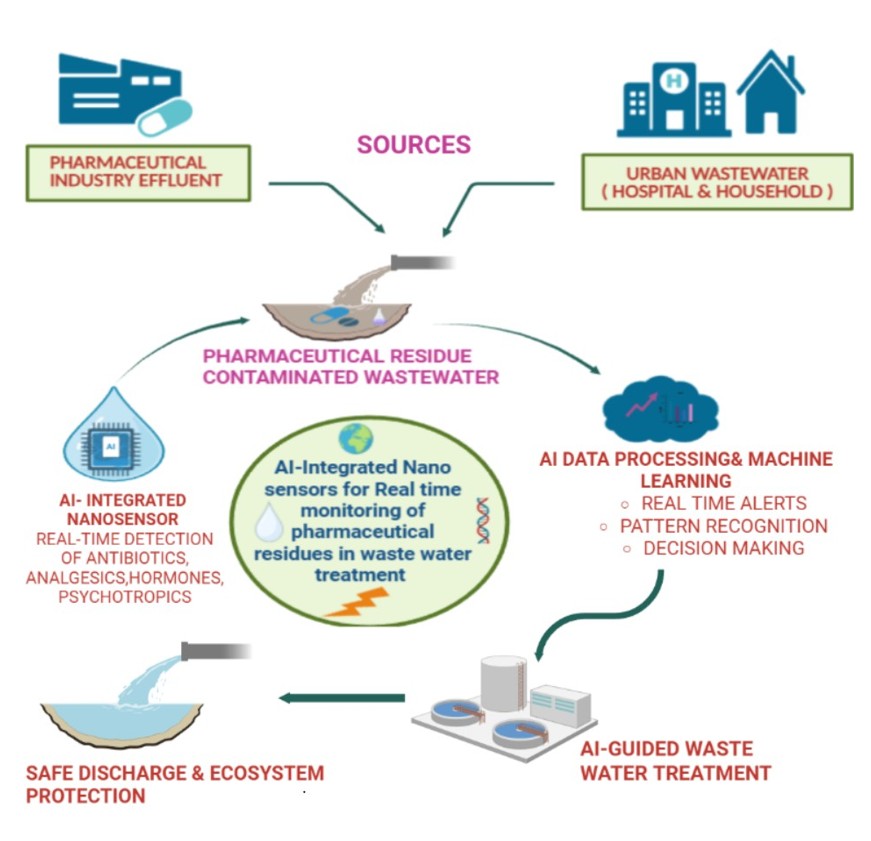
Highlights
AI-integrated nanosensors enable real-time monitoring of pharmaceutical residues in urban wastewater.
Nanosensors utilize advanced nanomaterials and AI algorithms for sensitive and specific detection.
AI facilitates rapid response, ultra-low detection limits, and autonomous operation of nanosensors.
Real-time data from nanosensors is processed using machine learning for reliable detection.
AI enables adaptive calibration, enhancing the long-term stability of nanosensor performance.
Field studies demonstrate strong correlation between nanosensor outputs and reference methods.
AI-integrated nanosensors offer a cost-effective and automated alternative to conventional analytical systems.
⚠️ THE FOLLOWING SECTION IS TEXT-ONLY
No equations, tables, figures, or color graphics are shown below. For the complete version, please use the free PDF available on this page (top right).
1. INTRODUCTION
Urban water systems are fundamental to public health and ecological stability, but are increasingly compromised by pharmaceutical residues like analgesics, antibiotics, and anticonvulsants. These compounds enter aquatic environments through domestic sewage, hospital effluents, and pharmaceutical manufacturing discharges and are partially removed during conventional wastewater treatment processes [1]. Their persistence raises concerns regarding long-term environmental exposure and health risks. The scale of pharmaceutical contamination is global. A worldwide survey of river systems reported that pharmaceutical concentrations exceeded safety thresholds at approximately 25.7% of sampling sites, with the highest burdens in regions lacking adequate wastewater treatment infrastructure [2]. These findings underscore the need for monitoring strategies that capture spatial variability and temporal fluctuations in urban water systems. Conventional analytical approaches, notably liquid chromatography–mass spectrometry (LC-MS), remain the benchmark for pharmaceutical detection due to sensitivity and accuracy. However, their widespread application is limited by high costs, extensive sample preparation, and unsuitability for continuous monitoring [3]. These constraints have driven the development of alternative sensing technologies for real-time surveillance. Nanosensor-based platforms have emerged as promising tools for detecting trace pharmaceuticals in complex water matrices. These sensors use nanomaterials including carbon nanotubes, graphene oxide, and magnetic nanoparticles, providing high surface area-to-volume ratios and tunable functionalities that enhance detection sensitivity [4,5]. Their adaptability supports their growing relevance in environmental monitoring. Advances in artificial intelligence (AI) have reshaped chemical and environmental analysis. AI-driven models estimate chromatographic retention times and collision cross-sections (CCS) in high-resolution mass spectrometry (HRMS), improving identification of pharmaceuticals in water samples [6]. These approaches reduce analytical time and costs while enhancing compound identification [7]. The integration of AI with nanosensor technologies represents a step toward intelligent monitoring systems[8]. Recent studies show that machine learning–assisted sensor platforms enable autonomous operation and trend analysis in aquatic environments [9]. Such systems shift water quality management from reactive to proactive control strategies [10]. This review examines the convergence between nanosensor development and AI-enabled analytics for monitoring pharmaceutical residues in urban water systems, bridging multiple disciplines and providing perspective on intelligent wastewater surveillance.
2. PHARMACEUTICAL RESIDUES IN URBAN WASTEWATER
Pharmaceutical residues, including antibiotics, analgesics, hormones, and psychotropic drugs, are increasingly detected in urban wastewater systems due to continuous inputs from domestic use, hospitals, and healthcare facilities [11]. Hospital wastewater, in particular, has been identified as a concentrated and complex source of pharmaceutical active compounds (PhACs), often containing fluctuating mixtures of parent compounds, metabolites, and transformation products that complicate environmental monitoring [12,13]. Although conventional wastewater treatment plants can partially reduce pharmaceutical loads, reported removal efficiencies vary widely, typically ranging from 10% to 60%, depending on compound class and operational conditions [12]. Even when secondary or advanced treatment stages achieve removal rates exceeding 90%, treated effluents frequently still contain trace-level residues that pose ecological risks, particularly due to chronic exposure and mixture effects [14,15]. These findings underscore the importance of sensitive detection methods capable of identifying low concentrations of pharmaceuticals in treated and untreated wastewater streams. Several regional studies have demonstrated the widespread geographic occurrence of pharmaceutical contaminants in wastewater and receiving water bodies, emphasizing that contamination is not limited to highly industrialized regions [16]. The chemical diversity of pharmaceuticals, coupled with variable influent composition and temporal fluctuations linked to consumption patterns, creates significant challenges for reliable monitoring in real-world wastewater matrices [17]. While numerous studies have explored remediation strategies such as advanced oxidation processes, adsorption, filtration, and hybrid treatment systems [18,19], these approaches are often energy-intensive, costly, and infrastructure-dependent [14]. More importantly, their variable performance highlights a critical gap in continuous monitoring: existing analytical frameworks are often unable to provide real-time feedback on treatment efficiency or detect episodic pharmaceutical discharges. Consequently, the effective management of pharmaceutical pollution increasingly depends on the development of robust sensing and monitoring technologies capable of operating in complex wastewater environments. Key challenges include interference from coexisting organic and inorganic constituents, signal suppression caused by matrix effects, and the need to capture short-term concentration spikes driven by hospital discharge cycles and seasonal drug usage [20]. Addressing these challenges is essential for enabling accurate, real-time surveillance of pharmaceutical residues in urban wastewater systems. Figure 1 illustrates the major classes of pharmaceutical residues commonly detected in urban wastewater.
3. NANOSENSORS, PRINCIPLE & Its TYPES
Recent work in the realm of nanosensor technologies emphasizes their growing importance in precise and sensitive detection applicable to pharmaceuticals, although direct applications in wastewater arsenals may still be underexplored[21]. A Chemosensors feature review delves into nanomaterial-based electrochemical sensors for drug detection (Malode SJ, Ali Alshehri M, 2024). This highlights how devices that leverage materials such as carbon nanotubes or metal nanoparticles provide heightened specificity, stability, and analytical performance, which are instrumental for environmental and clinical monitoring[22]. A review explored nanomaterial-based sensors in the food industry (Abedi-Firoozjah et al., 2024). Although its primary focus is on pathogen detection and microbial toxins, the principles discussed in the use of gold or magnetic nanoparticles, quantum dots, and peptide nanotubes demonstrate the versatility of these materials, implying a strong potential for pharmaceutical analyte detection in complex matrices such as wastewater[23]. In addition, nanomaterial-based wearable sensors, particularly those leveraging piezoresistive and piezoelectric mechanisms (Sengupta and Kottapalli, 2024), have been developed. Although centered on physiological monitoring, these systems, such as PDMS micropillars decorated with ZnO nanowires, illustrate the broader principle of nanomaterial-enhanced sensitivity and fast response, which is foundational for nanosensor design (Kashyap et al., 2024). The different types of nanosensors, their principles, and their applications are listed in Table 1.
4. INTEGRATION OF AI IN NANOSENSING
Artificial intelligence (AI) has substantially advanced the performance of nanosensing systems for detecting pharmaceutical residues in urban wastewater by enabling structured interpretation of complex sensor outputs [34]. In these systems, nanosensors convert molecular interactions occurring at nanostructured transducers into electrical, optical, or spectroscopic signals, which are subsequently processed by AI algorithms to extract chemically relevant information [35]. However, raw nanosensor data are often affected by signal noise, baseline drift, and cross-sensitivity arising from coexisting organic matter, salts, and transformation products in wastewater matrices [36].To address these challenges, supervised and semi-supervised machine learning models such as random forest (RF), support vector machines (SVM), and deep neural networks (DNNs) are commonly employed [37]. These models are trained using labeled datasets comprising sensor responses to known pharmaceutical compounds across varying concentrations and background conditions. Feature engineering typically involves extracting time-domain metrics (signal amplitude, response time, recovery rate), frequency-domain components (via fast Fourier transform or wavelet analysis), and spectral fingerprints from electrochemical or optical signals [38]. Such features enable AI models to differentiate target analytes from interferents with overlapping physicochemical characteristics.
Cross-sensitivity correction is achieved through multivariate learning strategies, where AI models learn interference patterns from structurally similar compounds and background constituents. Ensemble methods and convolutional neural networks (CNNs) are particularly effective in identifying subtle signal variations caused by specific pharmaceuticals, even under high matrix complexity [39]. In addition, adaptive calibration techniques based on incremental learning or reinforcement learning allow models to compensate for sensor aging and environmental drift without manual recalibration.
Noise reduction and signal stabilization are typically implemented using preprocessing algorithms such as Savitzky–Golay filtering, principal component analysis (PCA), and autoencoder-based denoising networks before classification or regression tasks [40]. These approaches enhance signal-to-noise ratios and improve detection reliability under fluctuating wastewater conditions. Once trained, AI models can perform real-time anomaly detection by identifying deviations from learned baseline patterns, enabling rapid identification of episodic contamination events [41]. Recent implementations increasingly deploy AI models on edge-computing platforms, where lightweight neural networks or decision-tree models operate directly on embedded microcontrollers or edge-AI chips. This architecture enables low-latency analysis, reduced data transmission requirements, and autonomous operation in decentralized monitoring networks [42]. Furthermore, AI-driven adaptive sampling strategies dynamically adjust sampling frequency or activate redundant sensor arrays in response to detected anomalies, thereby improving monitoring resolution during critical events [43].
Experimental studies demonstrate that AI-assisted nanosensing platforms, when trained on diverse datasets encompassing multiple water chemistries, can achieve detection limits in the nanogram-per-liter range for various pharmaceutical compounds while maintaining robustness across fluctuating environmental conditions [44]. By enabling intelligent signal interpretation and performance optimization, AI allows compact and cost-effective nanosensors to achieve analytical capabilities comparable to conventional laboratory-based instrumentation [45]. Consequently, AI integration transforms nanosensors into autonomous, self-validating systems capable of continuous optimization and deployment in fully automated environmental monitoring frameworks [46]. Figure 2 illustrates the workflow of AI integration in nanosensing systems, including signal acquisition, feature extraction, model training, and real-time decision-making.
5. CURRENT ADVANCES IN AI-INTEGRATED NANOSENSORS FOR WASTE WATER MANAGEMENT:
Recent years have witnessed significant progress in AI-integrated nanosensors for real-time monitoring of pharmaceutical residues in urban wastewater. Key developments center around the integration of multiple sensing modalities—such as plasmonic resonance, electrochemical detection, and fluorescence—on compact nanoscale sensor arrays. These hybrid platforms, when combined with AI-driven signal processing, can discriminate between structurally similar compounds at trace concentrations, surpassing the sensitivity and specificity achievable with conventional threshold-based sensors [47–49].
The practical deployment of these systems, however, involves several challenges. For instance, IoT-enabled nanosensor nodes facilitate wireless transmission of processed data to cloud or edge servers, but real-world implementations must balance connectivity with power consumption and environmental robustness [50]. Embedded AI modules performing on-site signal preprocessing and anomaly detection reduce transmission requirements, yet they demand careful calibration to avoid false positives arising from biofouling, matrix effects, or fluctuating wastewater conditions [51]. Federated learning represents another promising avenue, allowing decentralized AI model training across multiple wastewater treatment sites while preserving data privacy [52]. Despite its theoretical advantages in improving model robustness, practical outcomes remain largely unquantified, with few field studies demonstrating measurable improvements in detection accuracy or operational efficiency. Similarly, AI-driven self-calibrating nanosensors offer automated baseline adjustments and self-cleaning protocols [53], but long-term studies on their durability, maintenance requirements, and real-world performance under complex wastewater conditions are limited. Innovations in sample preconcentration, such as nano-adsorbent-assisted enrichment before detection, have demonstrably lowered detection limits, enabling the identification of pharmaceuticals at low ng/L levels [54,55]. When combined with AI-assisted spectral fingerprint analysis, these systems can interpret subtle shifts in spectral features, enhancing sensitivity and reducing false negatives. Multi-analyte recognition layers further enable simultaneous detection of multiple pharmaceuticals and metabolites within a single cycle, though signal deconvolution relies heavily on AI robustness under variable wastewater chemistries [56]. Deployment in remote or large-scale environments has benefited from integration with autonomous platforms such as robotic samplers or water-monitoring drones [57]. AI algorithms can prioritize sampling in zones with higher predicted contamination, optimizing resource use. Nevertheless, challenges remain in scaling these systems, including energy efficiency, real-time decision-making under variable field conditions, and cost-effectiveness compared to conventional monitoring approaches [58,59].
Figure 3 illustrates the comparative advantages of AI-integrated nanosensor approaches versus traditional wastewater monitoring, highlighting improved detection sensitivity, multi-analyte capability, and adaptive sampling potential. Collectively, these advancements demonstrate the promise of AI-enhanced nanosensors, while underscoring the need for rigorous field validation, standardized performance metrics, and integration strategies that account for operational constraints in real-world wastewater treatment scenarios.
6. DATA MANAGEMENT AND ANALYTICS
The integration of AI-augmented nanosensors into wastewater monitoring networks produces continuous streams of high-dimensional data, including spectral fingerprints from optical or plasmonic sensors, electrochemical time-series signals, geolocation metadata, and device health indicators such as calibration status and stability [60,61]. Managing these heterogeneous data in real time is challenging due to computational, bandwidth, and analytical constraints [62]. Modern systems address this through hierarchical architectures combining local edge processing with centralized cloud analytics, where embedded AI models at the sensor node perform noise filtering, anomaly detection, and event summarization to reduce latency and prevent transient contamination events from being obscured [63–65]. Once aggregated on central servers, predictive modeling using recurrent neural networks or hybrid statistical–machine learning approaches can forecast contamination surges hours or days in advance, enabling proactive operational adjustments such as treatment plant dosing, wastewater rerouting, or public health advisories [66,67]. Geo-tagged sensor data, combined with AI-driven spatial interpolation and clustering, produce dynamic spatiotemporal contamination maps that identify hotspots and guide targeted sampling and treatment interventions [68–70]. Explainable AI (XAI) enhances transparency by clarifying which features drive predictions, thereby supporting operator trust, troubleshooting, and regulatory compliance [71–73]. Standardized data schemas and communication protocols ensure interoperability across heterogeneous sensors, AI platforms, and municipal water management systems, reducing fragmentation and improving scalability [74,75]. Despite these advances, practical challenges remain, including balancing edge computational load with power constraints, validating predictive models against evolving wastewater matrices, and ensuring XAI outputs are interpretable by non-specialist operators. Overall, this integrated architecture—from edge preprocessing to cloud-based analytics and feedback loops—transforms raw nanosensor data into actionable environmental intelligence, enabling faster, more precise, and transparent management of pharmaceutical pollution in urban wastewater systems[76]. Figure 4 depicts the process of analysing the data by an AI-integrated nanosensor.
7. ENVIRONMENTAL & PUBLIC HEALTH IMPLICATIONS
AI-enhanced nanosensor networks for real-time detection of pharmaceutical residues in wastewater have significant implications for environmental and public health [77]. By continuously monitoring contamination patterns, these systems enable early interventions, allowing wastewater treatment operators to adjust treatment protocols or redirect flows before pollutants reach nearby waterways or drinking water supplies, thereby reducing exposure risks for humans and aquatic ecosystems and limiting the environmental dissemination of antimicrobial compounds that contribute to antibiotic resistance [78,79]. Real-time alerts can inform public health authorities of emerging hazards, supporting rapid responses to contamination events, particularly in densely populated urban areas reliant on shared water sources [80]. Aggregated long-term data from nanosensor networks also provide insights into the fate and transport of pharmaceuticals in sewer systems, informing infrastructure upgrades, adaptive treatment strategies such as UV disinfection or activated carbon dosing, and predictive modeling of downstream exposure hotspots [81,82]. Integration with wastewater-based epidemiology platforms further enables monitoring of community-level antimicrobial resistance trends, complementing traditional public health surveillance approaches [83]. The incorporation of AI-driven dashboards into urban environmental management enhances transparency, fosters public awareness, and facilitates regulatory compliance by providing auditable evidence of pollutant reduction [84,85]. Linking nanosensor networks to smart city frameworks allows cross-sector coordination by correlating water quality data with traffic, weather, and health metrics, improving urban resilience and enabling targeted interventions in high-risk neighborhoods [86]. Moreover, coupling these monitoring systems with community science platforms promotes public engagement and responsiveness, while long-term, spatially resolved datasets can reveal environmental justice concerns by identifying inequities in exposure to water pollutants and informing equitable policy-making [87,88]. Cost-effective, multiplexed nanosensors further expand coverage across diverse urban areas, ensuring that surveillance and mitigation measures reach underserved populations [89,90]. Collectively, these capabilities demonstrate that AI-integrated nanosensor networks not only enhance environmental monitoring but also serve as a proactive tool for safeguarding human health, promoting equitable water management, and supporting evidence-based public health policies. The Figure 5 illustrates the environmental and public health implications of AI – integrated nanosensor
8. CHALLENGES AND FUTURE PERSPECTIVE
Key challenges in the field include maintaining selectivity within complex wastewater environments, preventing sensor fouling, ensuring long-term stability, and managing the high-dimensional data generated by real-time monitoring. Regulatory approval and scalable manufacturing continue to present significant obstacles. Future advancements are anticipated to focus on the development of self-cleaning nanomaterials, multiplexed detection arrays, and the integration with Internet-of-Things (IoT) networks for smart city wastewater management. Progress in artificial intelligence, particularly in areas such as federated learning and explainable models, is expected to further enhance adaptability and trust in data-driven decision-making. Collaboration among scientists, engineers, and policymakers is crucial to ensure the safe deployment, standardization, and global adoption of these intelligent sensing platforms.
9. CONCLUSION
AI-integrated nanosensors represent a transformative approach for the real-time detection of pharmaceutical residues in urban wastewater, combining the high sensitivity of nanomaterials with the pattern-recognition capabilities of artificial intelligence. These systems have demonstrated the ability to detect trace contaminants continuously, differentiate structurally similar compounds, and support adaptive interventions in wastewater treatment, thereby enhancing environmental protection and public health surveillance. Key findings from recent studies indicate that multi-modal sensor arrays, edge-based AI processing, and IoT-enabled connectivity collectively improve detection accuracy, reduce latency, and enable predictive contamination mapping. Despite these advances, several limitations remain: long-term sensor stability in complex wastewater matrices, challenges in scaling networks to municipal levels, energy and bandwidth constraints, and the lack of standardized regulatory frameworks for AI-assisted environmental monitoring. Future research should focus on field validation of multi-site deployments, optimization of federated learning and self-calibration approaches, integration with wastewater-based epidemiology for antimicrobial resistance surveillance, and development of interoperable, low-power sensor networks suitable for smart city applications. Addressing these gaps will be critical to fully realizing the potential of AI-enhanced nanosensors as a robust tool for proactive environmental management and public health protection.
LIST OF ABBREVIATIONS:
1. AI – Artificial Intelligence
2. LC-MS- Liquid Chromatography -Mass Spectrometry
3. CCs- Collision Cross-section
4. HRMS- High Resolution Mass Spectrometry
5. PhACs – Pharmaceutical Active Compounds
6. PDMS – Plant Design Management System
7. SERS – Surface Enhanced Raman Effect
8. FET – Field Effect Transistor
9. MIP – Molecularly Imprinted Polymer
10. LSPR – Localized Surface Plasmon Resonance
11. MOFs – Metal Organic Frameworks
12. IoT – Internet of Things
13. WBE – Water-Based Epidemiology
Conflict of Interest
The authors declare no conflict of interest.
Funding
This study was not supported by any funding.
Author’s Contributions
Study Conception or Design: Silpa Jayaprakash
Data Acquisition: Jagadeesh Chandrasekar and Pradhosh Sakthivel
Data Analysis or Interpretation: Priya Modhugur Sathyanarayanan
Manuscript Drafting: Elizabeth Rani Edwin
Critical Manuscript Revision: Pavithra Bharathy
AI Statement
The authors confirm that no AI tools or services were used during the
preparation of this work.