
Document Type : Original Research Paper
Graphical Abstract
INTRODUCTION
The water bodies have become progressively polluted, due to the rise in population and escalating manufacturing industries. This results in water scarcity and poses a risk to the quality of water. A priority must be given to address this ecological issue to improve human health, ecosystems, standards of water, and drinking water safety [1, 2]. Water is the fundamental basis of all life on earth.
The search for potable water is indispensable not only to solve human necessities but also to ensure the wellness of other species of life. The mounting cause for water contamination is primarily raised by the addition of non-recyclable pollutants from numerous industries [3]. Organic colorants are among the prevalent environmental contaminants. The detoxification of hazardous organic contaminants from sewage as well as water systems is a vital challenge in research on the environment [4]. These dyes not only affect the process of photosynthesis but also influence the health of humans resulting in skin rashes, allergies, and even cancer [5].
Additionally, 10-15% of dyes are released during the textile dyeing process. In the past, studies have been done to degrade dye in polluted wastewater through chemical and physical techniques that include methods like flocculation, activated-carbon sorption, and UV-visible degradation. These Constraints include issues with operational management, poor degradation along excessive operating expenses [5, 6]. Added to that, they are not sustainable for the environment due to the formation of supplementary contaminants. The recent development of nanoparticles has given rise to novel possibilities for the treatment of wastewater [7, 8]. Nanomaterials have distinctive benefits attributed to their individualized characteristics, such as larger area of surface, lower size, and shape. Nanoparticles possess innate features that make them perfect for degradation by photocatalysis [9]. The complete breakdown of organic molecules encountered in the polluted wastewater is carried out efficiently through photocatalytic degradation.
This method results in high active hydroxyl (OH) radicals by using the required photocatalyst and radiation from the sun. These radicals alter the water pollutants into harmless final products such as H2O, inorganic ions, and CO2 [10, 11]. This transition provides well-being to both people and the natural environment. Compared to other typical methods, photocatalytic degradation has numerous benefits [12]. It is safe, simple, and economical. Metal and metal oxide nanoparticles are widely used due to the specific characteristics related to particle shape, size, and structure. Nanoparticles are very small particles having dimensions ranging less than 100 nm. They have intriguing uses in medicines, sensors, solar cells, and nanodevices.
Methylene blue (3, 7-bis (dimethyl amino) phenothiazine chloride tetramethylthionine chloride) is a chemical dye that is utilized extensively as a colorant for papers, wool, silk, and cotton [13]. Methylene blue dyes are also consumed in the fields of medicine, food, and cosmetics. On the other hand, the discharge of unprocessed MB dye into waters might cause severe health threats [14]. In humans, MB dye causes symptoms including cyanosis, Heinz body formation, vomiting, and jaundice. Various new and constructive methods are to be carried out to remove this synthetic contaminant [15].
The present study strives to accomplish that constraint by using a novel procedure. That research plans to improve the rate of degradation of synthetic organic dyes by synthesizing Co3O4 nanoparticles as a photocatalyst from the fruit extracts of Diplocyclos palmatus (L). C Jeffrey through the Co-precipitation method [16]. Among metals, Cobalt Oxide (Co3O4) nanoparticles are used due to their eccentric properties, and higher band gap bettering the catalytic process. Additionally, the comprehensive analysis of the shape, size, and chemical composition of the catalytic material through UV-visible spectrum, XRD analysis, Scanning electron microscope (SEM), and energy-dispersive X-ray spectroscopy (EDX). The research aims are multifaceted. The initial target is to create an affordable, highly efficient catalyst for the degradation of methylene blue dyes that solves the pollution problem. The study eventually focuses on the parameters that impact the efficiency of dye degradation including time, pH medium, catalyst dosages, dye concentration, and recovered catalyst. By carefully examining these factors, the study expects to provide details of dye degradation conditions, which we will enhance, our capacity to combat contaminants in water.
In conclusion, the present study takes an important move from previous research by using metal oxide nanoparticles as an innovative approach for bettering the degradation of photocatalytic compounds. This study stands a chance to have an important impact in the field of water management and environmental sustainability by solving problems found in past techniques and achieving greater effectiveness.
MATERIAL AND METHODS
Preparation of fruit extracts
The D.palmatus fruits were collected, washed with distilled water to remove impurities, and dried under shade for 40 days. Then the dried fruits were crushed into fine powder. To about 25 g of fruit powder, 250 mL of distilled water was added and stirred for 2 hours using a magnetic stirrer. Then the solution was filtered, stored, and used for the synthesis of nanoparticles.
Synthesis of Co3O4 nanoparticles
Cobalt Oxide nanoparticles were prepared through a plant-mediated approach. The D. palmatus fruit extracts acted as a fine capping agent involved in the generation of Co3O4- NPs. To about 30 mL of fruit extract, prepared 1M aqueous solution of CoCl3.6H2O was added and stirred, for 10 minutes. To this mixture, NaOH was added until pH was attained and a change in the color of the solution was observed. The resultant solution was centrifuged at 7000 rpm and the pellet containing Co3O4 nanoparticles was obtained and washed several times with distilled water to remove the impurities from the nanoparticles. The precipitate was dried using a hot air oven, where the temperature was maintained at 70ᵒC. The dried Co3O4-NPs obtained were used for the characterization and photocatalytic dye degradation approach.
Photodegradation of methylene blue dye using Co3O4 nanoparticles
Under sunlight irradiation, the degradation of Methylene blue dye was studied using Cobalt Oxide nanoparticles. To about 0.0025 g of MB dye 250 mL of distilled water was added and the solution was made up using a standard flask. Different ppm of 10, 20, 30, and 40 ppm MB dye solutions were prepared. To each beaker containing 100 mL MB dye solution, 0.005 g of Co3O4- NPS was added. They were kept in the dark for about 1 hour to obtain adsorption-desorption equilibrium.
The solutions were kept in sunlight and different time intervals were noted. The UV-visible spectrophotometer was used to study the degradation of Methylene blue dye. The photocatalytic degradation study includes time, dye concentration, pH of the medium, catalyst dosages, and recovered catalyst dosage using MB dye. Catalyst dosage was studied using various amounts of catalyst. Different concentrations of pH solutions having the values of 5, 7, and 9 were studied for the pH medium of dye solutions. Basic solutions and acidic solutions were prepared using 1M NaOH and 1M HCl solutions that were added to the distilled water before MB dye solution preparation. Various time intervals of 5, 15, 30, 45, 60, 75, 90, 105, and 120 minutes were also studied. Comparably, various dye concentrations like 10, 20, 30, and 40 ppm were also studied for methylene blue photocatalytic dye degradation.
Dye degradation UV-visible analysis
The photocatalytic dye degradation of Methylene blue dye was analyzed using a UV-visible spectrophotometer. The percentage degradation of dye was studied using the following formula,
Degradation rate (%) = (C0 – C / C0) x 100 (1)
Degradation rate (%) = (A0 – A / A0) x 100 (2)
Where C stands for dye concentration, C0 stands for initial dye concentration, A is the absorbance of dye after irradiation with sunlight, and A0 shows the initial absorbance.
CHARACTERIZATION
The Co3O4 nanoparticles synthesized from the fruit extracts of D. palmatus were analyzed using UV-visible spectrophotometer, XRD, SEM, and EDX analysis. The absorption spectra of Cobalt Oxide nanoparticles were studied using UV-visible spectroscopy. A scanning electron microscope (Carl Zeiss USA - Model - Sigma with Gemini Column) was used to analyze the surface morphology and particle size of the Co3O4 nanoparticles. The EDX Studies were used to study the elemental composition of the nanoparticles. The phase and crystalline nature, of the synthesized, were analyzed through XRD.
RESULT AND DISCUSSIONS
UV-visible analysis
Generally, Co3O4 nanoparticles show a strong absorption band around 200-300 nm in the UV-visible spectrum. The synthesis of Co3O4-NPs from the fruit extracts of D.palmatus shows an absorption band at 258 nm [17] that resulted in the formation of Cobalt Oxide nanoparticles as shown in Fig. 1.
XRD analysis
XRD analysis was studied to know the crystalline structure. From the analysis, major peaks were observed at Braggs angles 19.1°, 22.7ᵒ, 31.3°, and 38.8° corresponded to the lattice planes of (111), (202), (220), and (222) which are shown in Fig. 2 are in good agreement with standard XRD data for a face-centered cubic phase of Co3O4 nanoparticles (JCPDS no 42-1467) [18]. The size of the particles can be calculated using the Debye-Scherer formula,
D = Kλ / βcosθ (3)
Where D is the particle size, K is a shape factor (it is constant approximately equal to 0.9), λ is the wavelength of X-ray (wavelength of Cu Kα radiation, 1.5418 A°, β is the full line width at half-maximum (FWHM) of the main intensity peak, and θ is the Bragg’s angle. The average particle size for the synthesized Co3O4-NPs is 28 nm.
SEM & EDX analysis
The surface morphology of Co3O4-NPs was determined using a Scanning electron microscope. The SEM images of Co3O4-NPs are irregular, small particles with stakes of various sizes as shown in Fig. 3(a, b). The elemental composition of synthesized Co3O4-NPs from the fruit extracts of D.palmatus was studied from EDX analysis. In Fig. 3(c), peaks indicate the presence of Co and O in the synthesized Co3O4-NPs [19]. The elemental composition of the nanoparticles shows 39 weight percent Cobalt and 15 weight percent Oxygen corresponding to Cobalt oxide (Co3O4).
Mechanism for photodegradation of methylene dye using Co3O4 nanoparticles
Numerous stages are entailed in the photocatalytic degradation of dyes including electron-hole pair formation, chemical reaction, and adsorptions-desorption process [20]. 1) structured adsorption by the MB dye molecules 2) incident light adsorption, and 3) generation of charge-transfer reaction by oxidizing and reducing molecules [21].
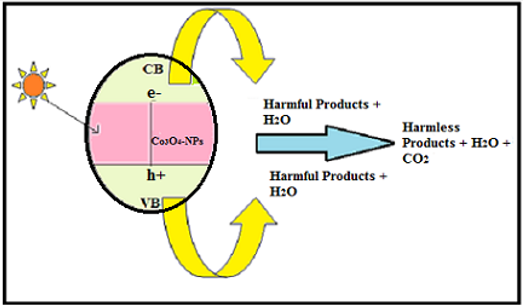
On sunlight irradiation, the electrons (e-) are elevated from the surface of the metal oxide (Co3O4) photocatalyst to the conduction band (CB), which are captured by the positive holes created in the valence band (VB). Through the positive holes, the reactive intermediates are directly oxidized by the dye molecules having a high oxidative nature, or in reaction with water molecules (H2O), hydroxyl radicals (.OH) are formed. On the reaction of electrons present in the conduction band of synthesized Co3O4 nanoparticles and O2 molecules reaction, the superoxide anions are formed.
Co3O4-NPs + hν → Co3O4-NPs (h+ + e-) (4)
h+ + MB Dye → oxidation of dye molecules (5)
h++ OH- / H2O → •OH (6)
e- + O2 → •O2- (7)
The difference in energy between the oxidation and reduction process is determined by the material's band gap. Metals band gap determines the photocatalytic degradation. Higher photocatalytic dye degrading activity is seen in a narrower band gap [22].
Effect of dye concentration of Co3O4-NPs on the photocatalytic dye degradation
Initially, the photocatalytic dye degradation of Methylene blue dye was studied by varying the time concentration between 10 to 40 ppm. At various concentrations, the dilution process of MB dye solution is shown in Fig. 4(a). Degradation conduction of dye was studied for a defined period of 120 mins. The color and intensity of the dye at 10 ppm were in original condition, as the concentration of dye increased to 20 ppm, 30 ppm, and 40 ppm, the color became more concentrated.
On increasing the dye's concentration, the rate of degradation decreased. Fig. 4(b) shows the UV-visible graph of different ppm solutions, which shows that on increasing the concentration of dye, the degradation lowers. According to Beer- Lambert's law, photons entering path length reduce by increasing the concentration of dye leading to the poor absorption of photons and photodegradation. Fig. 4(c) shows the degradation percentage of 91%, 79%, 63%, and 52% for 10, 20, 30, and 40 ppm.
Effect of time of Co3O4-NPs on the photocatalytic degradation
The solution containing 10 ppm of MB dye solution was subjected to dye degradation by Cobalt Oxide nanoparticles for a range of time. The dye color eventually saturated to a lighter shade from a deep color indicating the continuous breakdown of MB dye molecules as shown in Fig. 5(a). On sunlight irradiation, the absorption peak at 665 nm for MB dye reduces for different time intervals of 0, 5, 15, 30, 45, 60, 75, 90, 105, and 120 minutes as shown in Fig. 5(b) of the UV-visible graph. The percentage dye degradation of 21%, 29%, 35%, 41%, 55%, 63%, 76%, 81%, and 91% was observed for 5,15, 30, 45, 60, 75, 95, 105, and 120 minutes respectively as displayed in Fig. 5(c).
Effect of pH concentration of Co3O4-NPs on photocatalytic degradation
The surface properties of the solid catalyst and the behavior of the dissolved ions are determined by the pH of the chemical reaction. The pH impacts the dye degradation. Dyes with different pH levels are released from industries like paints, and textiles.
The pH 5, 7, and 9 have been studied for the degradation rate of dye to examine the impact of pH. In the formation of hydroxyl ions and textile waste photodegradation process, pH plays a vital role. The original solutions before and after degradation at various pH levels are shown in the photographic images in Fig. 6(a). The images show the change in the color of solutions between pre-degradation and post-degradation. The color and intensity of the dye solution become less with increasing pH resulting in the degradation of MB dye molecules due to the formation of highly active ·OH radicals at greater pH levels. This color change and intensity of the dye solution is due to the stronger adsorption of the dye molecules that are to be oxidized during photocatalytic degradation. From Fig. 6(c) the degradation percentage of 68%, 80%, and 93% observed for pH 5, 7, and 9.
Effect of catalyst dosage on photocatalytic degradation
The catalyst dosages also influence the degradation process as shown in Fig. 7(a). In the methylene blue dye degradation, the effect of the catalyst was studied by varying the catalyst dosages from 0.005 g to 0.013 g containing 20 mL of MB dye solution for 120 minutes as shown in Fig. 7(b) in a UV-visible graph. The degradation of MB dye molecules increases on increasing the catalyst dosage due to agglomeration or aggregation of catalyst particles that decreases the active surface site availability. Higher catalyst dosage contains increased surface area leading to efficient interaction of catalyst resulting in higher percentage dye removal. From Fig. 7(c) for 120 mins, the percentage degradation for catalyst dosages 0.005 g, 0.007 g, 0.009g, 0.011 g, and 0. 013 g was found to be 50%, 64%, 73%, 86%, and 92% respectively.
Effect of recovered catalyst dosage on photocatalytic degradation
The activity of photocatalytic dye degradation of MB dye was conducted for a recovered catalyst of 0.013 g, observed at different cycles, as shown in Fig. 8(a).
After filtration, the obtained recovered catalyst was washed many times with distilled water to remove the adsorbed dye molecules and dried in a hot air oven at 50°c for 1 hour. To them was added 20 mL of dye solution. The change in color of the dye solution depends upon the active role of catalysts in dye degradation, showing their potential for contaminant remediation. Fig. 8(b) shows the UV-visible graph of photocatalytic dye degrading activity of the recovered catalyst in degrading MB dye, resulting in lower efficacy compared to the original catalyst. The decrease in degradation activity depends upon the active areas on the surface of the catalyst that have been obstructed by the sediment of photosensitive hydroxides. Fig. 8(c) shows the percentage degradation of MB dye by the recovered catalyst for cycles 1, 2, 3, and 4 were found to be 25%, 44%, 50%, and 81% for 120 min respectively.
Application and future research prospects:
The Co3O4 nanoparticles synthesized from the fruit extracts of D.palmatus used for photocatalytic dye degradation provide distinctive positive aspects compared to conventional removal techniques by using hazardless chemicals and being ecologically safe, contributing to the sustainable remediation process.
The synthesized nanoparticles had greater surface area due to their minute size resulting in good adsorption and reactiveness. Thus in the future, these nanoparticles can be used to remove harmful metal ions, and organic solutes from water, and stand a chance to have a vital role in water management and wastewater remediation.
CONCLUSION
The present study found that Со3O4 nanoparticles exhibited strong photocatalytic activity for degrading methylene blue dye. Within 120 minutes, approximately 91% of the dye was degraded successfully. Moreover, longer irradiation time led to increased degradation of dye. Additionally, the methylene blue dye degradation was enhanced by using higher amounts of the catalyst, as evidenced by degrading 92% of the dye using 0.013 g of the photocatalyst over 120 minutes. Furthermore, increasing the pH of the medium resulted in effective dye degradation with 93% of the dye degraded in 120 minutes at pH 9. Besides, a higher concentration of dye resulted in a decreased photodegradation rate. The recovered catalyst achieved degradation percentages of 25%, 44%, 50%, and 81% for cycle1, 2, 3, and 4 for 120 minutes respectively.
CONFLICT OF INTEREST
The authors declare that they have no conflict of interest.
