
Document Type : Original Research Paper
Graphical Abstract
INTRODUCTION
Water pollution is a global issue that adversely affects both human health and the environment 1-3. The dye industry stands out as a major contributor to water pollution 4. Over the past few decades, the increasing contamination of water due to factors like population growth and human actions has become a significant issue affecting human health 5, 6. Scientists conduct research to improve existing water treatment methods and develop new technologies 7. Dyes are widely used in various sectors, including textiles, food, cosmetics, and medicine 8. Among these, the textile industry significantly contributes to dye emissions into ecosystems 9, 10. The presence of dyes in water hinders sunlight penetration, resulting in a decreased rate of photosynthesis 11. Additionally, dyes disrupt gas solubility, impacting aquatic vegetation and animal life, thus disturbing biological cycles within aquatic systems 12, 13. Methylene Blue (MB), a synthetic dye, poses serious environmental and public health risks due to its toxicity, carcinogenicity, and non-biodegradability. It can even induce cyanosis in humans. Researchers have explored various methods for removing dyes from wastewater, with adsorption being a standout approach 14. Adsorption is favored for its high removal efficiency, ease of operation, affordability, and reusability of adsorbents 15, 16. Nanoparticles hold immense promise for sustainable wastewater treatment 17. Their unique features and versatility make them valuable tools in our quest for cleaner water resources. Their small dimensions, catalytic behavior, high reactivity, and abundant active sites make them ideal adsorbents. These inherent characteristics enhance a surface area, increase available adsorption sites, and contribute to their impressive adsorption capacities 18. Porous materials, including carbon-based adsorbents, metal oxides, bio-based sorbents, metal-organic frameworks (MOFs), zeolites, and silicates, are effective in dye removal from water 19-23. Notably, mesoporous silicates like M41S, SBA-n, and TUD-1 have garnered attention due to their cost-effectiveness, eco-friendliness, and impressive adsorption capacity 24-26 Mesoporous silicates possess substantial surface area and robust thermal and mechanical stability, rendering them excellent candidates for dye adsorption from water. In Table 1 some of the well performed silica-based adsorbents for removing MB are reported. The effectiveness of mesoporous silica adsorption hinges on enhancing surface properties through functionalization with appropriate functional groups 27. TUD-1, an amorphous mesostructured silica first synthesized at the Technical University of Delft, features a three-dimensional, foam-like mesoporous structure 28. TUD-1 is classified as a type of mesoporous silica material and is a member of the M41S family, specifically known for its distinctive cage-like pore structure. TUD-1 framework can be doped with metals to tailor its structure for various catalytic activities. Notably, TUD-1 exhibits several advantages over other adsorbents 29. In this study, we explore the efficacy of Al and Sn-incorporated TUD-1 as adsorbents for Methylene Blue (MB) removal 30, 31. As previously discussed, TUD-1 have demonstrated significant promise in removing dye from water. However, to our knowledge, there are no published reports on the utilization of TUD-1 containing Sn and Al with different ratio for adsorbing dyes like MB, despite their potential effectiveness as adsorbents.
We investigated MB removal from water using a batch adsorption method. The data obtained from adsorption tests were analyzed using the Langmuir and Freundlich isotherm models. Additionally, kinetic models, including the pseudo-first-order and pseudo-second-order, were employed to determine the most suitable kinetic model for explaining the process.
MATERIALS AND METHODS
All chemicals utilized in the experiments were purchased from Sigma-Aldrich Company and used without further purification. Tetraethyl orthosilicate (TEOS, 98%), aluminum isopropoxide (Al (isop)3), tin tetrachloride (SnCl4.5H2O, 99%), triethanolamine (TEA, SRL), and Et4NOH (TEAOH, 35%), 4-oxo pentanoic acid, ethanol, methanol, butanol, and hexanol were used in this work. MB (C16H18ClN3S) was purchased from the pharmaceutical company Merck (Table 2).
Synthesis of the Aluminum doped TUD-1 material (AlTUD-1)
The synthesis of two mesoporous catalysts, AlTUD-1 (Al25-TUD-1 and Al50-TUD-1), followed previously reported procedures 40. A mixture of ethanol, 2-propanol, and TEOS with mmol of 0.60, 0.45, and 0.15 respectively was prepared at 50°C. Aluminum isopropoxide, with two ratios of 1:0.5 and 1:0.25 compared to TEOS, was then added as the metal precursor to the mixture 41.
After a few minutes of stirring, 0.45 mmol of tetraethylene glycol was added and stirred for 1 more hour at 50°C. Subsequently, another solution containing ethanol (1 mol), 2-propanol (0.75 mol), and water (0.50 mol) was slowly added. This mixture was stirred for another 0.5 hr at 50°C. The result was a clear gel that was allowed to age statically at room temperature for 24 hr, followed by drying at 70°C for 12 hr and then at 100°C for 24 hr. It was then gently crushed and transferred to a Teflon-lined autoclave and kept at 180°C for 24 hr and finally incinerated in the air at up to 600 °C with a heating rate of 1°C /min and maintained there for 12 hr. The obtained white crystalline powder was characterized by XRD and BET. Before each catalytic test, the materials were dried at 70 °C for 10 hr.
Synthesis of the Tin doped TUD-1 material (SnTUD-1)
The synthesis of SnTUD-1 was conducted using a sol-gel hydrothermal method as previously reported 42. The synthesis mixture was formulated using tetraethyl orthosilicate (TEOS), tetraethylammonium hydroxide (TEAOH), and triethanolamine (TEA) with mmol ratios of 1, 0.5, and 1, respectively. Tin (IV) chloride pentahydrate (SnCl₄·5H₂O) was incorporated in two mol ratios: 1:0.25 and 1:0.5 compared to TEOS. In practice, SnCl₄·5H₂O was dissolved in 15 ml of 2-propanol and then TEOS was added. The resulting mixture was stirred for 15 min. Subsequently, 15 g of triethanolamine and 20 g of deionized water (TEA: H₂O = 1:11) were added. Further, 20 ml of tetraethylammonium hydroxide solution (35 wt %) was added under stirring. Subsequently, the resulting gel was allowed to age for 24 hr at room temperature followed by drying at 100 °C for an additional 24 hr. The resulting solid was subjected to thermal treatment at 180 °C for 24 hr followed by calcination at 650 °C for 12 hr. The obtained white crystalline powder was characterized by XRD and BET. Before each catalytic test, the materials were dried at 70 °C for 10 hr.
Adsorption test
Three MB solutions with concentrations of 100, 60, and 20 mg L-1 were prepared by adding, 0.001, 0.002, and 0.006 g of MB in 100 mL of distilled. These solutions were individually placed on stirrers, operating at a speed of 300 rpm and room temperature, and 0.1 g of adsorbents was added into each one. Every 10 min, for 70 min, 5 mL of samples were taken and centrifuged at 10000 for 10 min to separate the adsorbent and liquid phases. The concentration of MB in the liquid phase was measured using a UV-Vis spectrophotometer (UNICO-2800) at a wavelength of 665 nm. Adsorption capacity was calculated by the following equation 1:
The initial concentration and equilibrium concentration of MB are C0 (mg L-1) and Ce, respectively. The volume of the CIP solution is V (L), and the M-TUD-1 dosage is w (g).
Point zero charge of M-TUD-1
To find the point of zero charge (PZC) for the absorbents, a series of steps were followed. First, a 0.01M NaCl solution was prepared in a 200 ml volume. Then, using hydrochloric acid and sodium hydroxide, the pH of each sample was adjusted to reach values of 3, 5, 7, 9, and 11. Next, 10 mg of M-TUD-1 was added to each beaker with varying pH levels. These beakers were placed on a shaker at 150 rpm for 24 hours. After this incubation period, the final pH of the solutions was measured. The point of zero charge for the adsorbent is determined by analyzing the ∆pH diagram relative to the initial pH. The ∆pH is calculated using Equation 2:
Kinetic and equilibrium study
For the investigation of the adsorption isotherm in the process, 0.1 g of each adsorbent was individually introduced into MB solutions with varying concentrations of 100, 60, and 20 mg L-1 in 100 mL of distilled water. The mixtures were kept under stirring at a speed of 300 rpm for 90 min. The adsorption isotherm for this study was examined by fitting the obtained results for adsorption with both Langmuir and Freundlich adsorption isotherm models, represented in equations 3 and 4, respectively.
In these equations, Ce (mg L-1) represents the equilibrium concentration of MB in the solution, qe (mg L-1) is the corresponding equilibrium adsorption capacity of MB, qmax (mg g-1) is the saturated monolayer, b (L mg-1) and Kf (mg L-1/n L1/n g-1) are the adsorption constants (Langmuir and Freundlich), and n is the adsorption intensity of MB by adsorbents at the equilibrium state.
To investigate the adsorption kinetics, the pseudo-first-order law and the pseudo-second-order law were applied, as shown in equations 5 and 6, respectively. Studies were done by analyzing the adsorption of MB in 30-minute time intervals (30-60-90-120 min) in different solutions with an initial concentration of 20 mg L-1 MB and also, the concentration of the adsorbent was maintained at 0.1 g in 100 ml.
In these equations, qe and qt (mg g-1) represent the amount of MB adsorbed at equilibrium time and specific time (min). Also, K1 (min-1) and K2 (g.mg-1.min-1) are the rate constants of the pseudo-first-order and the pseudo-second-order kinetic equations.
RESULTS AND DISCUSSION
Characterization of synthesized AlTUD-1 and SnTUD-1
The samples’ morphology was analyzed using scanning electron microscopy (SEM) on an SNE-4500M system, which operated at a voltage of 20 kV Fig. (1). Adsorbents Al25-TUD-1, Al50-TUD-1, and Sn25-TUD-1 exhibited a lumpy structure. However, the Sn50-TUD ‑1 displayed uniform nanoparticles (see Fig. 1d), with the approximate diameter of nanoparticles varying in different parts of the Sn50-TUD-1 adsorbent 43. Increasing the dopant has decreased the size of the particles, which would affect the adsorption by increasing the surface area.
Nitrogen adsorption/desorption isotherm analyses were carried out at 77 K on a MICROMERITICS Asap2020 instrument. As shown in Fig. 2a, the N2 sorption isotherms of the prepared adsorbents were compared to TUD-1. The N2 adsorption isotherms for both AlTUD-1 samples exhibit a type IV pattern with a hysteresis loop, a characteristic feature of mesoporous solids 44. The isotherms of the samples with Sn ratios were also identified as type IV and displayed a type H2 hysteresis, a feature typical of mesoporous TUD-1 solids with random three-dimensional pores 45. The pore size distribution diagram (Fig. 2b) further substantiates the mesoporous nature of the samples, which is consistent with materials possessing a pore size between 2 to 50 nm. The BET surface areas of TUD-1, Sn50-TUD-1, Sn25-TUD-1, Al50-TUD-1, and Al25-TUD-1 were 598, 866, 659, 738, and 534 m2g-1, respectively (Table 3).
The complete XRD spectra of Sn50-TUD-1, Sn25-TUD-1, Al50-TUD-1, and Al-25-TUD-1, as well as that of pure TUD-1, were recorded and presented in Fig. 3. XRD of mesostructured TUD-1 show a peak at 2θ = 20-30. The characteristics peaks for Sn(25,50)‑TUD‑1 labeled at 2θ = 25°, 32°, 39°, and 54° indicate the presence of tetragonal rutile structure of SnO2 increasing in intensity by increasing the Sn doping from 25 to 50. These results provide evidence for the presence of both isolated Sn4+ and crystalline SnO2 in TUD-1. For Al-TUD-1 samples the XRD analysis did not reveal any isolated phases of alumina in any of the samples. However, it was observed that the intensity of peaks decreased with an increase in the content of Al. These findings are consistent with previously reported research 45, 46.
Effect of adsorbent type and MB concentration
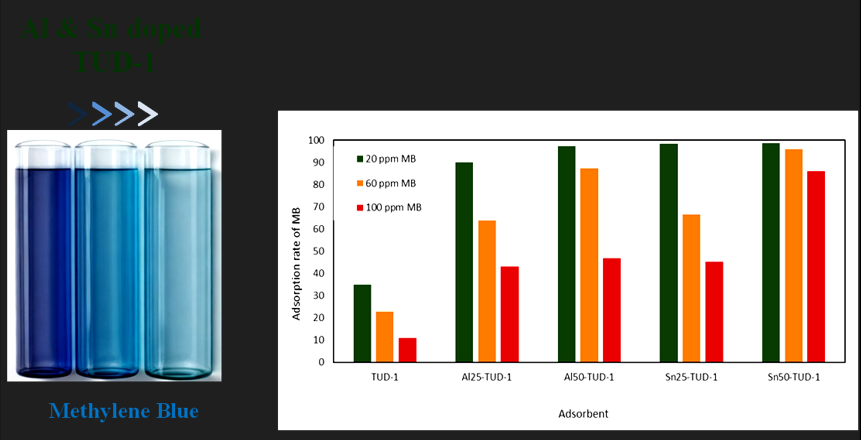
To evaluate the adsorption potential of the synthesized M-TUD-1 materials for MB, solutions of 100 mL with different initial concentrations of MB (100, 60, and 20 mg L-1) were prepared. Each solution was treated with 0.1 g of the adsorbents, and the adsorption time was extended to 70 min to ensure adequate adsorption of MB onto the adsorbents to reach equilibrium. Fig. 4 shows the adsorption rate of MB by Al25-TUD-1, Al50-TUD-1, Sn25-TUD-1, and Sn50-TUD-1 compared to TUD-1. The results revealed that the lower the concentration of the MB solution, the higher the removal rate of the adsorbents, as the adsorption sites on the surface are available to adsorb MB. Consequently, the capacity of all four adsorbents at a low concentration of the solution is significant. However, as the concentration of MB in the solution increases, the available adsorption sites on the adsorbents become saturated, resulting in a lower removal rate. The Sn50-TUD-1 demonstrates superior performance in removing MB for all MB concentrations compared to the other synthesized adsorbents. This might be due to its smaller particle size and higher specific surface area. (See Table 4) 47.
Effect of pH medium on MB Adsorption
The adsorption efficiency of MB by M-TUD-1 is influenced by the pH level, which changes its capacity to adsorb. Investigations were conducted using M-TUD-1 at pH levels of 3, 7, and 11 to study this effect. A sample of 0.1 g of M-TUD-1 was added to a solution of MB at a concentration of 20 mg L-1. As depicted in Fig. 5, M-TUD-1 demonstrated the highest adsorption at a pH of 7.0. To better understand these findings, the point of zero charge (PZC) of the adsorbents was determined, which is the pH at which the surface of the adsorbent is electrically neutral, affecting how it interacts with nearby ions and molecules. The PZC for Sn25-TUD-1, Sn50-TUD-1, Al25-TUD-1, and Al50-TUD-1 were identified to be 6.3, 6.7, 8.8, and 7.8, respectively. At these pH levels, the surfaces of the adsorbents are neutrally charged, with an equal balance of H+ and OH- ions. In acidic conditions (pH<7), MB predominantly exists as a positively charged cationic species, MB+, with a pKa close to 3.8, acquiring a positive charge from the acidic environment. Below the PZC of M-TUD-1, there is an electrostatic repulsion between the positively charged surface of the composite and the cationic MB+. At a near-neutral pH (pH ≈ 7), both the cationic (MB+) and neutral (MB0) forms of MB can be found, with their relative amounts changing depending on the environment. Under alkaline conditions (pH > 7), MB undergoes further oxidation and carries multiple positive charges. It is worth noting that this oxidized form of MB is typically less stable and can decompose 48. Hydrogen bonds form between the surface of M-TUD-1 and the neutral MB0 species, due to the interaction between the hydroxyl groups on M-TUD-1 and the nitrogen atom in MB. Between pH 6.7 and 10, M-TUD-1 carries a negative surface charge due to its PZC, and MB remains cationic up to pH 10. Therefore, the electrostatic attraction is the primary adsorption mechanism.
The adsorption capacity of MB by M-TUD-1 at various pH levels is presented in Table 5. Sn50-TUD-1 demonstrated the highest adsorption capacity, achieving 1785.6 mg g-1 for MB within 50 minutes at a pH of 7.0. This can be attributed to its larger surface area, which provides more available OH groups on its surface. These OH groups facilitate hydrogen bonding interactions with MB molecules, thereby enhancing its adsorption capabilities.
Adsorption isotherms study
The nonlinear adsorption isotherm of MB by Sn25-TUD-1, Sn50-TUD-1, Al25-TUD-1, and Al50-TUD-1 adsorbents was assessed using Langmuir and Freundlich adsorption isotherm models. The parameters derived from this fitting and their regression correlation coefficients are presented in Table 6. As per Table 6, the results demonstrate that the data align better with the Langmuir model for Sn25-TUD-1, Sn50-TUD-1, and Al50-TUD-1 adsorbents than with the Freundlich model. The Freundlich model, however, fits better for the Al50-TUD-1 adsorbent. The maximum adsorption capacity (qm) predicted by the Langmuir model for the Sn25-TUD-1 and Sn50-TUD-1 adsorbers is greater than for Al25-TUD-1 and Al50-TUD-1, indicating that the removal efficiency of Sn doped TUD-1 is superior compared to Al-doped TUD-1. The n values from the Freundlich model fall within the range of 1-10, and thus, the values of 1/n are within the range of 0-1. This indicates the non-linear relationship between the solution concentration and the amount of adsorption 49. In this research, the values of 1/n were between 1 and 0, suggesting that the adsorption process is favorable. The equilibrium constant, b (l mg-1), refers to the bond formation energy of the adsorption process, reflecting the favorability of the adsorption process. It has been demonstrated that there is a stronger interaction between the Sn50-TUD-1 adsorbent surface and MB ions. As a result of this strong interaction, the amount of qmax for this adsorbent is higher than other adsorbents 50.
Adsorption Kinetics Study
To examine the factors influencing the reaction rate, the kinetics of the process were studied. In this research, the adsorption of MB by Sn25-TUD-1, Sn50-TUD-1, Al25-TUD-1, and Al50-TUD-1 adsorbents was evaluated using pseudo-first-order and pseudo-second-order kinetic equations (Figs. 6). The pseudo-first-order kinetic equation, which is based on the adsorbent capacity, is employed when surface adsorption takes place via a penetration mechanism from within a boundary layer. On the other hand, the pseudo-second-order kinetic equation indicates that chemical adsorption is the primary and controlling mechanism in the surface adsorption process. This equation is based on solid phase adsorption and suggests that chemical adsorption is the rate-limiting step in the surface adsorption process 51-50. The parameters of the pseudo-first and second-order models and the correlation coefficients for 20 mg L-1 concentration of MB in the presence of 0.1 g of adsorbents are provided in Table 7. The data revealed that the pseudo-first-order kinetic equation does not fit the data well. In contrast, the pseudo-second-order kinetic model correlates well with an average correlation coefficient of R2=0.99. The obtained qe values are very close to their experimental values. The constant values of the pseudo-second-order equation (K2) generally show a decreasing trend, reflecting the rapid saturation of the active adsorption sites by metal ions. These results suggest that the MB adsorption process with all four adsorbents follows the pseudo-second-order kinetic model 52.
Reusability of the adsorbent
Assessing the feasibility of regenerating and reusing the adsorbents after MB removal is crucial for sustainability and cost-effectiveness. To assess the stability and reusability of the best-performed adsorbent, Sn50-TUD-1, after the first run the adsorbed MB was removed using a 0.2 M HCl solution. Following five rounds of adsorption-desorption, the regenerated adsorbent's effectiveness remained largely unchanged, as depicted in Table 8. Although there was a minor decline in adsorption efficiency in subsequent cycles, Sn50-TUD-1 maintained a substantial adsorption capacity of 1689.6 mg g-1 even after five cycles, demonstrating its robust regenerative ability in eliminating MB from water. Additionally, after five cycles of employing Sn50-TUD-1, its characterization was performed (Figs. 7 a-b). The XRD analysis revealed no notable differences compared to the pre-adsorption XRD data (Fig. 3). The FT-IR analysis post five cycles, shown in Fig. 7b, identified bands at 1170, 1040, and 778 cm-1 as corresponding to the symmetric and asymmetric stretches of the bonds. A faint band at 953 cm-1 indicated Si–O–Sn connections, reaffirming Sn's partial integration into the TUD-1 structure. These observations confirm the adsorbent's stability after five usage cycles.
Possible mechanisms of adsorption
Adsorption encompasses physical and chemical procedures that enable the adsorbent to link with the adsorbate. Physical adsorption occurs swiftly as it doesn't necessitate a chemical bond, unlike chemical adsorption, which requires more time for the adsorbate and adsorbent to bond and stabilize. Initially, the adsorption rate remains relatively stable due to the abundance of available surface sites. Over time, as these sites get occupied, it becomes increasingly challenging for the remaining ones to be filled. In the case of methylene blue, functioning as the adsorbate, its structure, featuring an aromatic ring and an N-H stretch, leads to various interactions like electrostatic, acid-base, ionic exchange, coordination, π-π interaction, and hydrogen bonding. The specific type of interaction depends on the unique properties of the adsorbent. Scheme 1 illustrates a possible mechanism for the adsorption of methylene blue onto synthesized materials, emphasizing primary interactions. It suggests that the lattice oxygen in the silica matrix could interact with the nitrogen in methylene blue. Furthermore, the nitrogen-hydrogen bond in the dye could form stronger hydrogen bonds with the lattice oxygen in the amorphous silica.
Challenges
While the study demonstrates the high efficacy of M-TUD-1 adsorbent for MB removal in laboratory settings, translating these findings to large-scale wastewater treatment facilities may present challenges. Further research is needed to assess the feasibility and scalability of using these adsorbents in real-world applications.
The long-term stability of the synthesized M-TUD-1 adsorbents under continuous operation conditions and with real wastewater is an important consideration. Investigating the adsorbents' performance over extended periods and under various environmental conditions is essential to ensure their reliability and effectiveness over time.
While the study identifies optimal adsorption conditions for MB removal, further optimization may be necessary to enhance the efficiency and effectiveness of the adsorbents under real-world conditions.
CONCLUSION
Mesoporous silica material TUD-1, doped with two different metals (Sn and Al) at two Si-to-metal ratios (25 and 50), was synthesized and employed as an adsorbent for the removal of MB from water. The optimal conditions for adsorption were investigated at different MB concentrations at room temperature. The maximum adsorption of these adsorbents was achieved at approximately 50 min.
Langmuir and Freundlich isotherm models were employed to investigate the adsorption mechanism. By evaluating the results, it is suggested that for Sn25-TUD-1, Sn50-TUD-1, and Al50-TUD-1 adsorbents, the Langmuir model provided a superior fit compared to the Freundlich model. However, for Al25-TUD-1, the Freundlich model was a better fit. Furthermore, all the adsorbents were fitted with the pseudo-second-order kinetic model. Both adsorption mechanism physical adsorption and ion exchange are possible to occur on these adsorbents. According to the calculations, Sn50-TUD-1, with a superior BET surface area of 866 m² g⁻¹, exhibited the best performance compared to other materials in MB removal. The removal capacity for this adsorbent was 1785.6 mg g-1, at pH 7-10. Following five rounds of adsorption-desorption, the regenerated adsorbent's effectiveness remained largely unchanged. This research highlights the potential of TUD-1 adsorbents for efficient MB removal from water.
CONFLICT OF INTEREST
The authors declare no conflict of interest.
