
Document Type : Review Paper
Graphical Abstract
Introduction
Access to clean water resources is crucial for human beings. Not only is non-polluted clean water vital for human health, but it is also a prerequisite for economic and industrial development. Rapidly growing industrialization has led to organic, dye, pharmaceutical, and heavy metal pollutants penetrating surface and groundwater resources. These pollutants are mostly carcinogenic and mutagenic and can have adverse impacts on human health. Today, millions of people have no access to clean water, and little children frequently die from diseases caused by water pollution and poor hygiene [1-4]. In many industries, wastewater contains unused toxic and hazardous substances, the disposal of which into the environment can impose irreversible damage. Wastewater penetration in the environment not only causes human diseases and unpleasant odors but also disrupts wildlife. Dye-containing wastewater causes turbidity in water resources. Such toxic, hazardous substances cover the water surface and prevent sunlight penetration into the water. The photosynthesis and ventilation of living aquatic species are then disturbed [5-9]. The disposal of high-temperature and acidic industrial wastewater causes drastic damage to the environment [10,11]. Moreover, wastewater penetration into forests and farmlands can reduce soil fertility. This facilitates the growth of viruses and bacteria and decreases the quality of water [12]. Therefore, industries must treat their wastewater before its disposal into the environment to avoid major environmental impacts. This leads to two advantages: (i) it prevents toxic, hazardous pollutants from penetrating surface and groundwater resources and soil; (ii) the treated wastewater could be reused in the production cycle, reducing the need for purchasing freshwater for different processes.
Several wastewater treatment techniques have been developed for different types and concentrations of pollutants, e.g., membrane filtration [13], adsorption [14], biological treatment [15], and photocatalysis [16]. Membrane filtration is a high-efficiency technique for separating pollutants from water. However, the separated pollutants remain in the retentate solution and should be removed through a different pathway [13,17,18]. Adsorbents are materials with a large specific surface area and could remove various pollutants from water. Due to its superb efficiency, the adsorption process has been frequently used in the wastewater treatment literature. However, adsorbents are to be recovered and reused after a specific number of cycles. Once an adsorbent has been recovered, pollutant molecules are transferred from the solid surface to another phase and are not destroyed [19-21]. Despite its simplicity and affordability, biological treatment should be used carefully, as living organisms are employed in wastewater treatment. The complexity of predicting the growth rate and reactions remains the major disadvantage of biological treatment [5,22-24].
Photocatalysis—a subset of advanced oxidation processes—is an eco-friendly, sustainable, and simple process with low operation costs and high removal efficiency. This method uses free radicals to completely decompose and oxidize organic materials into simple, non-hazardous substances such as water, carbon dioxide, and mineral acids. Thus, secondary pollution and pollutant toxicity are handled [21, 25-31]. In light of these advantages, many researchers have been interested in using photocatalysis and suitable photocatalysts in the wastewater treatment literature [32-34]. In this paper, we focus on the review of recently developed noble metal-free materials/ZrO2 photocatalysts and the investigation of their potential for water and wastewater treatment, which have not been covered in other published review papers.
Methods
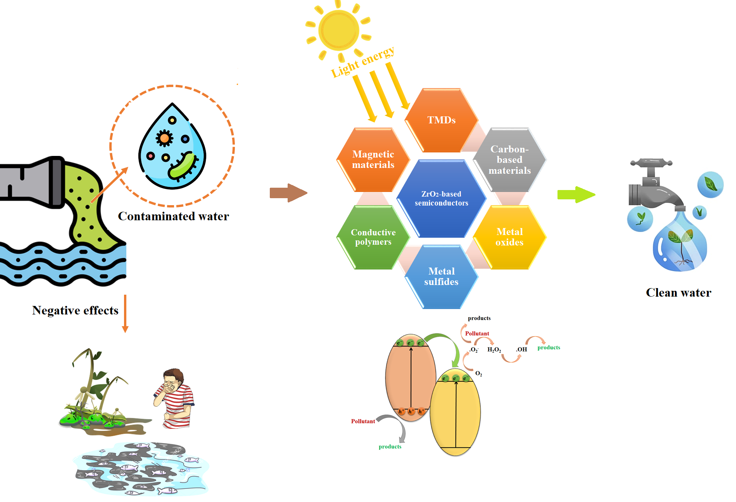
This review paper demonstrates the composition of ZrO2 with noble metal-free materials for the removal of various contaminants such as organic pollutants and heavy metals from water and wastewater. Carbon-based materials, conductive polymers, metal oxides, metal sulfides, magnetic materials, and transition metal disulfides are considered major classes of noble metal-free materials. Our main purpose is to investigate the effect of each of the noble metal-free classes on ZrO2 properties such as bandgap, surface area, ability of visible or UV light absorption, and removal efficiency of pollutants. It should be noted that published papers during the period 2013-2024 were considered in this review.
Photocatalysis process
Photocatalysis is based on the reaction between electron-hole pairs generated in the presence of visible or ultraviolet (UV) light and pollutant molecules. This photocatalytic reaction occurs in three steps [26,35,36]: (i) The irradiation of light at an energy level equal to or higher than the bandgap of the photocatalytic agent, something which induces the migration of electrons from the conduction band to the valence band and generates electron-hole pairs (Eq. 1). (ii) The electrons and holes react with O2 and H2O molecules and produce superoxide (•O2-), hydroxyl (•OH), and hydroperoxyl (H2O•) free radicals (Eqs. 2-4). (iii) The free radicals and holes can react with pollutants and decompose them into non-toxic and non-hazardous substances, e.g., H2O and CO2 (Eq. 5). Fig. 1 illustrates the schematic of the degradation mechanism of pollutants using photocatalyst.
ZrO2 photocatalyst
Metal oxides are semiconductors that have drawn the attention of academics due to their high chemical and thermal stability, oxidation and reduction resistance, simple synthesis, and affordability. ZrO2 is a common metal oxide. It is an n-type semiconductor with unique characteristics, e.g., non-toxicity, excellent thermal stability, and optical properties. In addition, several morphologies of ZrO2 could be synthesized through simple and accessible techniques [26,37,38]. Higher stability in acidic and alkaline media is a major advantage of ZrO2 over other common metal oxides, e.g., TiO2 and ZnO. Furthermore, ZrO2 has more favorable conduction and valence band energy levels than TiO2 and ZnO. Since it has more negative conduction band energy (-1.1 eV), ZrO2 has a higher reductive effect and free radical generation than TiO2 (-0.23 eV) and ZnO (-0.37 eV) [26,39,40]. Free radicals are essential active species in pollutant degradation and play a key role in wastewater treatment [26]. Furthermore, as it has more positive valence band energy (+3.8 eV), ZrO2 induces higher oxidation and greater pollutant degradation by positive holes compared to TiO2 (+2.8 eV) and ZnO (+2.9 eV) [39,40]. However, the wide bandgap remains a major disadvantage of ZrO2. It is activated only in the presence of UV light. Research has shown that surface modification and the synthesis of other ZrO2 morphologies such as ZrO2 nanosheets can narrow the bandgap of ZrO2; however, its bandgap remains wider than 4 eV [26]. Therefore, systematic strategies are to be adopted to improve the photocatalytic activity of ZrO2.
Modification of ZrO2
ZrO2 can be modified through doping and combination with other semiconductors. In these cases, ZrO2 either participates as the main semiconductor in the degradation of pollutants or improves the photocatalytic activity of other semiconductors by serving as an electron receptor. ZrO2/semiconductor heterojunction synthesis is important in a few aspects. Firstly, the disadvantages of ZrO2 concerning activation in visible light are handled. Secondly, the migration of electrons from semiconductors to ZrO2 delays electron-hole recombination and, therefore, improves photocatalytic activity and pollutant degradation [26,41,42]. Furthermore, such synthesized heterojunctions have high thermal stability due to the superb thermal stability of ZrO2 and, therefore, show higher performance at high temperatures in lights of higher energy [26,43]. Materials containing noble metals (such as Au, Ag, and Pt) have been employed by some researchers since they have high conductivity and good photocatalytic performance. They could reduce bandgap, accelerate excited charge transfer, and enhance the response to the near-infrared (NIR) region due to effective functioning when combined with other semiconductors. Their expensiveness and rareness, however, remain disadvantages [44-46]. Noble metals are not cost-effective for large-scale industrial applications [47]. Therefore, we need to find affordable and eco-friendly non-noble metals with good conductivity and availability to enhance the generation of electron-hole pairs and photocatalytic activity.
Multiple photocatalysis containing ZrO2 and non-noble metals with the foregoing advantages have been synthesized. Fig. 2 depicts semiconductors containing non-noble metals combined with ZrO2 synthesized to improve the photocatalytic activity of the final composite. Such composites include carbon-based materials, conductive polymers, metal oxides, metal sulfides, magnetic materials, and transition metal disulfides. This paper reviews various ZrO2/semiconductor photocatalysts synthesized in the literature and discusses their photocatalytic effects.
Carbon-Based Materials/ZrO2 Photocatalysts
There are several reports on the synthesis of carbon-based materials/ZrO2 composites and nanocomposites, e.g., graphitic carbon nitride (g-C3N4), carbon, reduced graphene oxide (rGO), and carbon nanotube (CNT).
Graphitic carbon nitride
G-C3N4 is a recently synthesized and efficient carbon-based photocatalyst. The unique characteristics of this n-type semiconductor have interested many researchers in the photocatalyst process literature [48]. G-C3N4 is a π-conjugated polymer with a short bandgap. Therefore, it can show satisfactory pollutant removal performance in polluted aqueous solutions under sunlight [26,49]. G-C3N4 morphology plays a key role in light absorption and electron-hole pair generation. The thermal or chemical exfoliation of bulk g-C3N4 into thin transparent nanosheets strongly raises its photocatalytic activity [26,50]. However, the rapid recombination of electron-hole pairs remains a disadvantage which prevents a 100% pollutant degradation efficiency rate [26,49]. The deceleration of electron-hole recombination enhances photodegradation and mineralization degree and reduces the generation of intermediate by-products. In other words, a major portion of pollutants is decomposed into CO2 and H2O [51,52]. Many studies have analyzed the role of ZrO2 in delaying electron-hole recombination and enhancing the photocatalytic activity of g-C3N4. ZrO2 was an electron acceptor, and the migration of excited electrons from the conduction band of g-C3N4 to that of ZrO2 accelerated the formation of electron-hole pairs and decelerated their recombination. In some cases, the conduction band electrons of ZrO2 could be combined with the holes in the valence band of g-C3N4, resulting in conduction bands of higher reduction power and valence bands of higher oxidation power [53-59]. Wang et al. [53] synthesized the g-C3N4/ZrO2 composite by directly heating melamine and ZrO2 and used it in the degradation of Rhodamine B (RhB) under visible light irradiation (500 W Xenon lamp, The results demonstrated that the RhB degradation rate of g-C3N4/ZrO2 composites was nearly 14 and 2.3 times as high as those of pure ZrO2 and pure g-C3N4, respectively. The addition of ZrO2 to g-C3N4 increased light absorption, specific surface area, and, most importantly, electron-hole separation efficiency, improving photocatalytic activity.
The hydrothermal modification of hollow g-C3N4 photocatalyst with Fe/ZrO2 was performed, and the efficiency of the modified photocatalyst in the removal of organic pollutants, methyl orange (MO), metsulfuron-methyl and herbicides, from water was evaluated (under 500 W Xenon lamp irradiation). The nanocomposite photocatalyst had a larger light absorption range and twice the light absorption of g-C3N4. Photoluminescence (PL) spectroscopy showed that the addition of ZrO2 and Fe to g-C3N4 effectively inhibited electron-hole recombination. Moreover, the larger specific surface area of the nanocomposite (87.6 m2/g) than that of pure g-C3N4 (62.3 m2/g) provided more reactive sites for reactants and, therefore, higher photodegradation [54].
Many studies have investigated the removal of various pollutants from wastewater using the photocatalysis process based on g-C3N4/ZrO2 composites in 2020. Zarei [55] synthesized g-C3N4/ZrO2 nanocomposites using ultrasonication for the photodegradation of 4-chlorophenol (4-CP) in water under 300 W Xenon light. The photodegradation rate of the synthesized nanocomposite was nearly 2.5 times as high as that of pure ZrO2. Furthermore, ZrO2 in the g-C3N4 lattice dramatically reduced PL, suggesting a substantial decrease in the electron-hole recombination rate. Photocurrent response (PR) analysis verified the PL spectroscopy results. Furthermore, the synthesized nanocomposite showed excellent stability and degradation rate after five cycles. Zhang et al. [56] synthesized S-scheme g-C3N4/ZrO2 through calcination for the degradation of different dye pollutants and water treatment. According to the results, all the heterostructures had a short bandgap (<2.6 eV). Therefore, the synthesized heterostructures could be used for the degradation of dye pollutants in visible light (300 W Xenon lamp). Moreover, positive holes, hydroxyl, and superoxide radicals were found to be active species based on their contributions to degradation, respectively. Zhou et al. [57] deposited tetragonal ZrO2 nanoparticles on g-C3N4 through calcination and used the composite for the degradation of dye and pharmaceutical pollutants (under 300 W Xenon lamp). Density functional theory (DFT) calculations and experimental tests showed that the electronic distribution of the g-C3N4 phase was regulated by the ZrO2 phase. In other words, the large work function difference of ZrO2 and g-C3N4 induced a charge transfer between the two phases, improving the mobility and lifetime of charge carriers and enhancing the reduction and oxidation power of the active species. As a result, the presence of ZrO2 in the g-C3N4 structure caused a 9.4 times higher dye pollutant removal rate and a 2.9 times higher pharmaceutical pollutant removal rate.
The above-mentioned studies used ZrO2 nanoparticles to synthesize g-C3N4/ZrO2 nanocomposites. Chen et al. [58] deposited g-C3N4 on ZrO2 nanotubes through anodic oxidation-thermal vapor deposition sequences and obtained a degradation rate of 90.6% for pharmaceutical pollutants under light irradiation (300 W Xenon lamp) in 1 h. The charge transfer between ZrO2 and g-C3N4 was described using the Z-scheme mechanism. Based on the Z-scheme mechanism, electrons generated in the conduction band of ZrO2 were combined with the holes generated in the valence band of g-C3N4, and the generated •O2- in g-C3N4 and ZrO2 holes implemented the photodegradation process.
These studies combined only one morphology of ZrO2 and only one morphology of g-C3N4 and evaluated their effects on the photocatalytic activity of the synthesized composite. Tanzifi et al. [26] comprehensively synthesized six heterojunctions using different morphologies of ZrO2 (nanosphere, nanorod, and nanosheet) (Figs. 3a-c) and g-C3N4 (nanoparticle and nanosheet) through solution mixing-calcination method and evaluated the effects of morphology on the surface and optical properties of the heterojunctions. The heterojunctions had a bandgap smaller than 2.8 eV and could photodegrade pollutants in visible light (100 W LED lamp). The morphology of ZrO2 had a strong effect on PL intensity. ZrO2 nanosheets in both morphologies of g-C3N4 (nanoparticle and nanosheet) led to a noticeable PL reduction compared to the other ZrO2 morphologies (Fig. 3f). The nanosheet/nanosheet heterojunction (Figs. 3d-e) had the highest degradation rate due to sufficient •O2- generation, among the other heterojunctions, which can be attributed to the suitable integration of two semiconductor nanosheets, the presence of numerous electron-hole pair transfer nanochannels and charge carrier separation (Fig. 3g).
Vattikuti et al. [59] constructed the C3N4/ZrO2 nanostructure through direct thermal pyrolysis and used it in the degradation of a mixture of RhB and crystal violet (CV) dyes and oxidation of methanol. Based on the S-scheme mechanism, the electrons of the ZrO2 conduction band combine with holes of the C3N4 valence band, which is attributed to the Coulombic forces, band-edge bending, and electric field at the contact point. Therefore, the conduction band of C3N4 and the valence band of ZrO2 are responsible for pollutant degradation.
Carbon
Other studies analyzed the combination of ZrO2 with other carbon-based materials and their application in wastewater treatment. Bailón-García et al. synthesized mesopore carbon/ZrO2 nanocomposites through the direct sol-gel process. ZrO2 nanoparticles were effectively distributed on the carbon structure. The nanocomposite was employed for the removal and degradation of orange G (OG) dye. The results showed the positive contribution of carbon to the photocatalytic activity of ZrO2, with the synthesized nanocomposite indicating a much larger degradation rate than pure ZrO2 in visible light. In other words, reactions between the organic (carbon) and inorganic (ZrO2) phases affected non-stoichiometric ZrO2 formation, ZrO2 bandgap reduction, electron-hole recombination, visible light absorption, and photocatalytic activity rate [60]. A carbon-doped ZrO2 photocatalyst with a 3D flower-like structure was synthesized through sol-gel and hydrothermal processes. It was used for water treatment and the removal of methylene blue (MB) in visible light. The synthesized nanocomposite was reported to have a bandgap of 2.37 eV, suggesting light absorption by the photocatalyst in the visible region. The photocatalyst had a water treatment efficiency of 96% in 60 min. It decreased to 11%, 38%, and 89% in the presence of Ethylenediaminetetraacetic acid (EDTA), benzoquinone (BQ), and tert-butyl alcohol (TBA) scavengers, respectively. The results demonstrated that positive holes and •O2- radicals were the main active species in the photodegradation process [61].
Reduced Graphene Oxide
Numerous studies have analyzed the role of reduced graphene oxide in the photocatalytic activity of ZrO2. Gurushantha et al. [62] deposited ZrO2 nanoparticles on rGO through the reflux method and measured the performance of the synthesized nanocomposite in the photodegradation of Reactive blue 4 (RB4) under sunlight. The presence of rGO in the nanocomposite led to a nearly 15 times greater photodegradation rate than that of the pure ZrO2. Furthermore, the total organic carbon (TOC) removal efficiency was 78% in the presence of the synthesized nanocomposite, suggesting satisfactory performance for practical applications.
ZrO2 nanoparticles were deposited on rGO through a solvothermal method, and the composite was used for the removal of a dye pollutant from water. The photocatalyst showed good degradation efficiency after three cycles [63]. rGO/ZrO2/Ag3PO4 multi-heterojunctions were synthesized using a green hydrothermal process and were employed for the adsorptive-photocatalytic removal of p-nitrophenol (PNP). The bandgap of pure ZrO2 was reported to be 4.91 eV, which decreased to 3.31 eV in the presence of rGO and further decreased to 2.3 eV in the simultaneous presence of rGO and Ag3PO4. This bandgap reduction led to a PNP removal rate of 97% in 90 min [64].
Carbon Nanotube
The following works reported the combination of ZrO2 and carbon nanotubes for water treatment. Anku et al. [65] reported the degradation of dye pollutants, eosin Y (EY) and indigo carmine (IC), in water using ZrO2 modified by CNTs and Co. Transmission electron microscopy (TEM) showed a uniform distribution of ZrO2 and Co-doped ZrO2 nanospheres on the lateral wall of CNTs. The nanocomposite indicated a much higher degradation rate towards pure ZrO2, with a degradation efficiency of 98% for IC and 87% for EY in 180 min. The superior photocatalytic performance of the composite photocatalyst is ascribed to the high absorption of visible light due to the effective transfer of charge carriers due to Co-doping and outstanding electrical properties of CNTs.
Shinde et al. [66] synthesized and deposited Ni, C, N, and S multi-doped ZrO2 on CNTs and employed the composite for the degradation of anionic dyes in sunlight. The optimal nanocomposite had a degradation rate 14 times as high as that of pure ZrO2. In other words, the deceleration of electron-hole recombination by CNTs contributed to the formation of free radicals and increased •O2- formation, boosting the pollutant degradation rate.
Conductive Polymers/ZrO2 Photocatalysts
The visible light absorption efficiency and photocatalytic activity of ZrO2 can be enhanced by combination with conductive polymers because such polymers raise the physicochemical, optical, and electronic properties of ZrO2. In other words, the hybrid organic-inorganic complexes of a support material (conductive polymer) and a semiconductor nano-photocatalyst (ZrO2) enhance photocatalytic activity. Most polymer supports show corrosion, UV, and weather resistance. They are chemically inert, affordable, and available. As a result, conductive polymers have been considered by researchers in the photocatalysis process literature in recent years [67-70]. Parveen et al. [67] incorporated ZrO2 nanoparticles into the polypyrrole (PPy) matrix and evaluated the photocatalytic efficiency of the nanocomposite in dye pollutant, Reactive Black 31 and 4-CP, degradation. The synthesized composite removed 98% of the dye and 91% of TOC and showed good stability after multiple cycles. The presence of PPy in the composite improved light absorption in the visible region, delayed charge carrier recombination, increased the surface area, and enhanced dye molecule adsorption onto the photocatalyst surface. This, in turn, enhanced the photocatalytic activity and degradation efficiency of the nanocomposite compared with that of pure ZrO2.
Polyaniline (PAni)/ZrO2 composites were synthesized through chemical polymerization for the removal of dyes from aqueous solutions. The bandgap of ZrO2 was reported to be 4.9 eV, whereas that of the synthesized composite was 3.25 eV. This implies that PAni had a positive effect on the photocatalytic performance of ZrO2 [71]. Velempini et al. [72] doped ZrO2 with C atoms. Then, C-doped ZrO2 was added to the solution during the PAni synthesis process to obtain C-ZrO2-PAni nanocomposites. The synthesized nanocomposite showed higher photocatalytic performance than pure PAni in the reduction of Cr (IV) and water treatment. The Cr (IV) reduction efficiency by the nanocomposite reached 100% under light irradiation for 75 min. The photocatalysis mechanism was described as the transfer of light-excited electrons from the HOMO (occupied molecular orbitals) to the LUMO (unoccupied molecular orbitals) of PAni and then migration to C-ZrO2. The ZrO2 conduction band electrons were adsorbed by oxygen molecules, and •O2- radicals were generated. These radicals reduced Cr (IV) to Cr (III). Furthermore, the conduction band electrons of PAni participated in the Cr (IV) reduction reaction. The C atom in C-ZrO2 accelerated electron generation and reduced the electron-hole recombination.
Sampurnam et al. [73] synthesized a ternary polyaniline–phosphotungstic acid (PTA)@ZrO2 photocatalyst for the degradation of MB, PNP and 2,4-dichlorophenoxyaceticacid (2,4-D). Once the photocatalyst was exposed to visible light, valence band electrons moved from PAni and PTA/ZrO2 to the conduction band, leading to valence band holes. These electrons and holes react with O2 and H2O and generate free radicals. Free radicals are reactive species and can degrade pollutant molecules. Furthermore, PTA is an electron acceptor that can accept electrons from ZrO2, inhibit electron-hole recombination, and enhance light absorption. In general, the charge carrier transmission between the three components of the synthesized composite raised photocatalytic activity, and 90% of the pollutants were degraded in the presence of light and ternary nanocomposite. Detailed information for the photocatalytic activity of carbon-based materials/ZrO2 and conductive polymers/ZrO2 composites for the degradation of pollutants in water has been collected and is presented in Table 1. Also, experimental conditions, e.g., photocatalyst dose, pollutant concentration, irradiation time, and light source, are presented in the table. The results presented in the table revealed that modification of ZrO2 with carbon-based materials causes it to decompose pollutants under visible or solar light with proper efficiency. Indeed, the integration of carbon-based materials with zirconium dioxide helps to the tuning of bandgap and increased redox states which make the composite visible-light active.
Metal Oxides/ZrO2 Photocatalysts
Titanium Dioxide
Many studies analyzed the combination of ZrO2 and TiO2 for water treatment within 2016–2022. Guerrero-Araque et al. [75] synthesized ZrO2/TiO2 heterojunctions and evaluated the performance in the degradation of various pollutants, e.g., phenoxyacetic acid (PPA), 4-CP and 2,4-D. The results indicated that ZrO2 improved the photocatalytic performance of TiO2. Mahy et al. [76] doped the TiO2 semiconductor with different molar fractions of ZrO2 for the degradation of PNP in water. The improved charge carrier separation enhanced the photocatalytic performance of the composite compared with that of pure TiO2. Carbuloni et al. [77] studied the degradation of a pharmaceutical pollutant, metformin, using ZrO2/TiO2. The results indicated that the composite had a metformin degradation rate 1.4 times as high as that of pure ZrO2 and 1.2 times as high as that of pure TiO2. Once degradation had been completed, wastewater toxicity tests were performed. The results showed that the treated water was suitable for plant germination and growth. Yaacob et al. [78] assessed the performance of ZrO2/TiO2 heterojunctions in the simultaneous adsorption and degradation of oily wastewater. The composite photocatalyst had a much larger degradation rate than that of pure TiO2 for oily wastewater. It also showed good stability in three photocatalytic degradation cycles of oily wastewater.
TiO2/ZrO2 nanocomposites were synthesized with the tetragonal ZrO2 phase through the sol-gel process. Their performance in the degradation of alizarin yellow GG (AYGG) under sunlight was evaluated. The results showed that TiO2/ZrO2 had higher degradation than pure TiO2, verifying the positive contribution of ZrO2 to the optical properties of TiO2 [79].
Zinc Oxide
ZnO is also a frequently used metal oxide in photocatalysis and wastewater treatment. Its combination with ZrO2 to synthesize heterojunctions to remove pollutants from water has been reported in the literature. Gurushantha et al. [80] synthesized ZrO2/ZnO composites with various fractions of ZrO2 and ZnO for the degradation of acid orange 8 (AO 8) dye. The optimal composite (ZrO2/ZnO 1:2 mol/mol) removed 93% of the dye in UV light irradiation for 120 min. This removal efficiency was remarkably higher than those of pure ZrO2 (25%) and ZnO (40%). When the nanocomposite was exposed to ultraviolet light, the valence band electrons of ZrO2 and ZnO were transferred to their relative conduction bands, resulting in holes in the valence bands. Electrons and holes reacted with oxygen and water molecules, respectively, and produced superoxide and hydroxyl radicals. The produced radicals eventually attacked the pollutant’s structure and broke their bonds, resulting in complete decomposition.
Wahba et al. [81] studied the performance of ZrO2/ZnO nanocomposites in the degradation of IC and MB dyes. The nanocomposite indicated excellent photocatalytic performance and removed 99% of IC and 97% of MB in 300 min and 150 min, respectively. According to the results, the transfer of charge carriers between the two semiconductors (type II mechanism) formed active species that decompose dye molecules into harmless products.
ZrO2 nanoparticles decorated on ZnO rod-like nanostructures through the microwave-hydrothermal method, and the anti-microbial activity and dye photo-degradation ability of the composite were assessed. The transfer of generated charges between two semiconductors led to the production of hydroxyl and superoxide radicals, which decompose dye molecules into materials with lower toxicity [82].
Cerium Oxide
Some studies have been reported on the combination of ZrO2 and CeO2 for wastewater treatment. Pouretedal et al. [83] synthesized ZrO2, CO2, and SiO2 nanoparticles through sol-gel and calcination sequences at a high temperature and evaluated the photocatalytic activity of pure nanoparticles and their binary composites in the degradation of 2-nitrophenol. The results demonstrated that the composites had higher photocatalytic efficiency than pure metal oxides.
The performance of ZrO2/CeO2 composites was evaluated in water treatment and the removal of RhB [84]. Photodegradation tests revealed that the synthesized composite degraded only 40% of the organic pollutant. However, it had higher RhB removal efficiency than pure ZrO2 (10%) and CeO2 (15%) under the same conditions. Hao et al. [85] synthesized CeO2/ZrO2 composites and investigated their optical and surface properties. Differential reflectance spectroscopy (DRS) indicated that the composite had a shorter bandgap than pure ZrO2, suggesting effective charge carrier transmission between the two semiconductors and, thus, improved photocatalytic performance. The performance of the synthesized nanocomposite in removing dye pollutants from water under UV, visible, and sunlight was also evaluated. In another study, the MB degradation efficiency rates of CeO2/ZrO2 photocatalysts under UV and visible lights were reported to be 93% and 33.3%, respectively [86].
Other Metal Oxides
Other studies have evaluated the synthesis of ZrO2 composites with other metal oxides and the analysis of their optical properties and performance in wastewater treatment. Mekala et al. [87] synthesized ZrO2/V2O2 composites and measured their performance in the degradation of RhB under Xenon light. The higher degradation efficiency of the composite than that of pure semiconductors was explained by the accelerated separation and migration of charge carriers. Furthermore, the composite showed good stability after ten cycles. Noroozi et al. [88] investigated the photocatalytic degradation performance of ZrO2-Cr2O3 heterojunctions towards PNP under UV light. The optimal heterojunction removed 92.72% of PNP in 100 min. Detailed data for the photocatalytic performance of metal oxide/ZrO2 composites for the photodegradation of pollutants in water is presented in Table 2. As can be seen, most of the ZrO2/metal oxide composites can be excited in the presence of UV light, indicating the wide bandgap of these samples.
Metal Sulfides/ZrO2 Photocatalysts
Metal sulfides are a class of semiconductors widely considered by researchers due to their short bandgap, excellent light absorption efficiency, and multiple active sites [89], e.g., CdS, NiS, ZnS, and SnS2. Li et al. [90] reported the two-step synthesis, the microwave-assisted hydrothermal and ion exchange methods, of CdS/ZrO2 nanocomposites for the degradation of various dye pollutants. The charge carrier transmission between the semiconductors and sufficient superoxide radical generation led to higher efficiency than pure semiconductors. Tian et al. [91] showed that the ternary SnS2-ZnS/ZrO2 composite had higher efficiency than ZrO2 in the degradation of MO. Sufficient hydroxyl and superoxide radical generation in the Z-scheme mechanism remarkably enhanced the degradation efficiency and photocatalytic performance of the composite.
El-Hosainy et al. [92] studied the performance of the S-scheme NiS/ZrO2 nano-heterojunction in the degradation of pharmaceutical pollutants. The results indicated a reduced bandgap and PL and enhanced photocatalytic activity and water treatment efficiency upon the modification of ZrO2 using NiS. Omar et al. [93] investigated the performance of ternary NiS/ZrO2/CdS nanocomposites in the removal of tetracycline from water. The results demonstrated that NiS/ZrO2/CdS had much higher performance than binary photocatalysts, NiS/ZrO2 and CdS/ZrO2, and single semiconductors. The ternary photocatalyst yielded a tetracycline degradation efficiency of 97.05% under sunlight in 120 min. Charge transfer between ZrO2, NiS, and CdS (based on the dual Z-scheme mechanism) led to the sufficient generation of active species, improving the degradation of pollutant molecules.
Transition Metal Disulfides/ZrO2 Photocatalysts
Transition metal disulfide (TMD)--based photocatalysts have drawn much attention due to their high surface area, short bandgap, and optical activity under both visible and UV lights. Also, these semiconductors are available inorganic substances that are suitable and economical for operations on large scales [94,95]. Vattikuti et al. [96] deposited ZrO2 nanoparticles on MoS2 and evaluated the performance of the synthesized heterojunction in MO degradation. The heterojunction not only had a much larger surface area than pure MoS2 and ZrO2 but also showed higher photocatalytic efficiency in MO degradation due to the charge carrier transmission between the two semiconductors and delayed electron-hole recombination. Vattikuti et al. [97] synthesized WS2/ZrO2 hybrids for the degradation of organic pollutants and water splitting under UV/simulated sunlight irradiation. The results showed that the synthesized hybrid had much higher photocatalytic performance than pure WS2 and ZrO2 in organic pollutant degradation under both visible and UV lights. This could be attributed to the effective electron and hole transmission between the two semiconductors. Also, the scavenger experiments displayed that the holes had an outstanding role in the photodegradation of organic pollutants.
Magnetic Materials/ZrO2 Photocatalysts
Semiconductors such as CoFe2O4, ZnFe2O4, and MnFe2O4 not only have a short bandgap and photocatalytic activity in visible light but also can be separated from solutions under a magnetic field due to their magnetic characteristics. Some studies have analyzed the combination of such semiconductors with ZrO2 to improve its photocatalytic activity and separation. Popcorn balls-like the ZnFe2O4-ZrO2 microsphere showed high photocatalytic performance in the degradation of 2,4-dinitrophenol pollutants under sunlight and had good stability in five sequential cycles. The composite had much higher photocatalytic activity than pure ZnFe2O4 and ZrO2. Furthermore, it was easily separated from the aqueous solution due to its magnetic effect [98]. Meena et al. [99] synthesized MnFe2O4/ZrO2 magnetic nanocomposites with responsiveness to sunlight. They were used for textile dye wastewater treatment and MB degradation. The results indicated that the photocatalytic activity of MnFe2O4 was enhanced by ZrO2 and that the nanocomposite removed 95% of MB and treated 59% of textile dye wastewater in 90 min. Ghorbani et al. [100] modified ZrO2 with CoFe2O4 and investigated the performance of the nanocomposite in Cr (IV) reduction and water treatment under 400 W metal halide lamp irradiation. The results indicated that CoFe4O2 reduced the bandgap and raised the photocatalytic activity of ZrO2. This could be explained by the effective combination of the two semiconductors and the transfer of electrons and holes between them. Furthermore, the nanocomposite was easily separated from the solution under a magnetic field due to its excellent magnetic properties. As a result, the challenge of separating the photocatalyst from the solution was tackled. Renuka et al. [101] combined ZrO2 with the ZnFe2O4 magnetic semiconductor and compared the synthesized nanocomposite to pure ZrO2 and ZnFe2O4. Effective contact between the two semiconductors and charge carrier transmission improved photocatalytic efficiency. The nanocomposite had removal efficiencies of 98% and 77% toward the dye pollutant and COD in sunlight, respectively. The performance of metal sulfide/ZrO2, TMDs/ZrO2, and magnetic materials/ZrO2 composites for the photo-degradation of various pollutants in water is presented in Table 3.
Other Photocatalysts
There have been reports on the combination of ZrO2 with other materials than the above-mentioned and their applications in wastewater treatment. Rashid et al. [102] doped zinc/cobalt spinel oxides with ZrO2 and used the nanocomposite as an active photocatalyst in visible light for the removal of 2-chlorophenol from wastewater. The ZrO2 dopants dramatically increased the surface area of ZnCo2O4. They also reduced its bandgap and enhanced its degradation efficiency.
The removal efficiency of ZrO2/LDH composites toward 4-CP pollutants was studied [103]. The deposition of ZrO2 on the LDH system raised the hydroxyl radical generation rate and, therefore, improved the photocatalytic activity of the nanocomposite. The nanocomposite removed 99% of the phenol pollutant, with the mineralization degree reaching 87%. In addition, the optimal photocatalyst had 7.6 and 3.4 times the pollutant degradation rates of LDH and ZrO2, respectively. Buvaneswari et al. [104] synthesized ZnWO4 and ZrO2 semiconductors and fabricated the ZnWO4/ZrO4 composite through the dissolution-calcination process for MO degradation. DRS analysis revealed that the pure semiconductors had a bandgap larger than 3 eV, whereas that of the nanocomposite was 2.5 eV. Due to its short bandgap, the ZnWO4/ZrO2 nanocomposite is a promising candidate for light absorption and photocatalytic activity in the visible light region.
Li et al. [105] used ZrO2-COF composite to adsorb and oxidize As(III) pollutants into As(V) with less toxicity under visible light irradiation. Indeed, ZrO2 adsorbed As(III) molecules on its sites, while photo-generated holes of COF oxidized As(III) to As(V) under irradiation.
ZrO2-Based Multi-Component Photocatalysts
The synthesis of ZrO2-based multi-component photocatalysts and their application in the removal of pollutants from water have been frequently reported. These multi-component photocatalysts are a combination of ZrO2 and metal oxide/carbon-based materials, metal oxide/metal oxide, metal oxide/metal sulfide, metal oxide/TMDs, and TMDs/carbon-based materials.
Metal Oxide/Carbon-Based Materials/ZrO2 Photocatalysts
ZrO2/Fe3O4/chitosan ternary magnetic nanocomposites were synthesized as an active photocatalyst in sunlight for Cr (IV) reduction and 4-CP degradation in water. Chitosan served as the absorber in the nanocomposite. The primary amine and hydroxyl groups of chitosan increased the number of adsorptive sites. Pollutant molecules would be adsorbed onto chitosan and reduced and degraded by electrons and active species. Thus, the ternary composite had higher photocatalytic activity than the ZrO2/Fe3O4 binary composite [106]. ZrO2/Fe3O4 was combined by rGO, and the performance of the composite in the removal of dye pollutants from water was evaluated. The presence of rGO in the nanocomposite not only increased the surface area but also improved congo red (CR) removal efficiency, with the ternary nanocomposite having nearly 2.5 times as high as the dye molecule degradation rate of ZrO2/Fe3O4 [107]. Zhao et al. [108] studied the potential of ZrO2-GO-SiO2 nanocomposites in the degradation of toxic phenol compounds. The ternary nanocomposite showed higher photocatalytic activity than binary nanocomposites because it had a larger surface area and a small pore distribution. Moreover, graphene oxide served as the electron acceptor and improved the transfer and separation of charge carriers. Hamed et al. [109] reported that ZrO2-TiO2/carbon core-shell composites had higher photocatalytic efficiency than pure semiconductors (ZrO2 and TiO2) and binary composites (ZrO2/carbon and TiO2/carbon) in the degradation of OG under visible light irradiation. Abumousa [110] synthesized the MgO@ZrO2@g-C3N4 photocatalyst to remove alizarin red (AR) from water. The ternary nanocomposite had a shorter bandgap than pure g-C3N4 and binary ZrO2@g-C3N4 nanocomposites and enabled an effective transfer of electrons and holes between the three semiconductors, improving the photocatalytic performance.
Metal Oxide/Metal Oxide/ZrO2 Photocatalysts
Liu et al. [111] reported phenol removal from water through the Fe2O3 and ZrO2/Al2O3 photocatalysts. The phenol removal rate under optimal conditions was 93%, which declined to 91% after two cycles. Li et al. [112] showed that the ZrO2-CeO2-TiO2 photocatalyst outperformed the pure semiconductors and binary composites greatly in the removal of RhB under light irradiation. This improved photocatalytic activity could be attributed to the larger surface area and shorter bandgap of the ternary nanocomposite. Siwińska-Ciesielczyk et al. [113] analyzed the performance of binary and ternary composites synthesized based on TiO2, ZrO2, and SiO2 in the degradation of RhB. The ternary composite improved the photocatalytic performance. Zhou et al. [114] deposited ZnO quantum dots on ZrO2-TiO2 for the removal of CR from water. ZnO quantum dots had an excellent contribution to the photocatalytic performance of TiO2 and ZrO2-TiO2. The ternary photocatalyst reached a degradation rate of 94.62% under UV light in 120 min.
Metal Oxide/Metal Sulfide/ZrO2 Photocatalysts
Tian (2019) and LV (2023) reported the synthesis of TiO2-ZrO2 composites in combination with CdS. Tian et al. [115] synthesized 3D ternary CdS@3DOM TiO2-ZrO2 composites using a combination of the template and self-assembly methods for the removal of dye pollutants from water and hydrogen production. The ternary composite had a larger pollutant degradation rate than the pure semiconductors and binary composites. Indeed, the difference in energy levels of the three semiconductors caused the migration of generated electron-hole pairs, thereby diminishing the recombination probability into the composite matrix, increasing the charge carrier lifetime, and promoting photocatalytic performance.
LV et al. [116] deposited CdS quantum dots on ZrO2-TiO2 composites and compared the photocatalytic degradation performance of the ternary and binary composites and pure semiconductors toward dye pollutants. The ternary nanocomposite had higher efficiency due to charge carrier transmission between the three semiconductors through the Z-scheme mechanism.
Metal Oxide/TMDs/ZrO2 Photocatalysts
Talukdar et al. [117] synthesized CeO2-ZrO2@MoS2 composites with a nanoflower structure for the removal of pharmaceutical pollutants (naproxen) in a sono-photocatalytic process. The ternary composite was compared with the singular and binary systems and showed better photocatalytic performance. This could be attributed to high active species generation due to charge carrier transmission between the semiconductors. In general, the active species of superoxide, hydroxyl, and 1O2 as well as generated holes had important roles in the superior sono-photocatalytic performance of composite photocatalyst and decomposition of naproxen to carbon dioxide and water.
TMDs/Carbon-Based/ZrO2 Photocatalysts
Vijayakumar et al. [118] deposited ZrO2 nanoparticles on MoS2/g-C3N4 and analyzed the potential of the ternary composite as a visible-light-driven photocatalyst in tetracycline degradation. The ternary composite had a shorter bandgap than the binary composite and pure ZrO2. It also had a much lower PL than pure g-C3N4 and binary composites, suggesting the improvement of photocatalytic performance due to the combination of three semiconductors. The performance of ZrO2-based multi-component composites for the photo-degradation of various pollutants in water is presented in Table 4. In general, the ternary composites and heterojunctions had higher photocatalytic performance than the binary composites, which is attributed to the shorter bandgap, effective charge carrier transmission between the materials, and high active species generation.
Challenges and Future Perspectives
Despite their significant positive outcomes, modernization and industrialization lead to the pollution of the environment and water resources. Therefore, the removal of pollutants from water to provide clean, healthy water resources has long been considered by governments and academics in the water treatment literature. This study reviewed photocatalysis as an advanced oxidation technique where semiconductors can generate active species and free radicals under light irradiation, which could decompose pollutant molecules in water through redox reactions into substances of lower toxicity. The advantages of photocatalysis include high-efficiency biodegradation, secondary pollution prevention, and pollutant degradation with no inter-phase pollutant molecule transmission. ZrO2 was described as a semiconductor with favorable properties for water treatment. The combination of ZrO2 with other semiconductors would improve the photocatalytic activity of the final composite, which could be explained by charge carrier transmission through various mechanisms, including traditional, Z-scheme and S-scheme, the prevention of electron-hole pair recombination, and the shorter bandgap of the composite than that of pure ZrO2. Some materials, e.g., carbon-based materials, conductive polymers, metal oxides, metal sulfides, magnetic materials, and TMDs, were reviewed for integration with ZrO2 into innovative photocatalysts. Activation in visible light, the minimized dosage of photocatalytic agents, and maximized wastewater treatment efficiency are essential parameters in the systematic design of photocatalytic composites. Some of the reviewed materials had intrinsically short bandgaps, and, therefore, their combinations with ZrO2 had a short bandgap and could absorb visible light. Despite contributing to the photocatalytic performance improvement of ZrO2, some materials, e.g., metal oxides, formed composites that could be activated only in UV light. Therefore, future works are recommended to develop composites that can be activated in visible light, as visible light comprises the major portion of sunlight and thus can be simulated by solar irradiation. Furthermore, visible light has lower energy than UV light and does not degrade polymers. The type and power of the visible light source should also be taken into account. LEDs have lower energy consumption, longer lifecycles, and higher efficiency than other light sources. The surface area and reusability are also considered vital parameters in photocatalysts. Photocatalytic efficiency improvement through morphology regulation is also important. Ternary photocatalysts outperformed binary photocatalysts in some cases; however, their cost-effectiveness should be ensured. Overall, the synthesis of ZrO2/semiconductor composites or heterojunctions requires further research on commercial and industrial wastewater treatment systems.
Conclusion
Industrialization, urban expansion, and climate change are major causes of clean water scarcity and concerns for countries. Wastewater treatment not only provides clean water for drinking, agricultural, and industrial purposes but also prevents the destructive outcomes of the penetration of hazardous and non-biodegradable pollutants into the environment. Traditional techniques for the removal of organic pollutants and heavy metals have different disadvantages, such as secondary pollution, inter-phase pollutant molecule transmission, poor efficiency, and high energy consumption. Therefore, an eco-friendly and affordable technology with high pollutant degradation efficiency should be implemented. Photocatalysis tackles these disadvantages and can degrade up to 100% of pollutants. It is also important to select the optimal photocatalytic system with affordability, non-toxicity, simple synthesis, excellent optical properties, and high chemical and thermal resistance. ZrO2 is such a semiconductor and has been widely used for photocatalytic wastewater treatment purposes. This paper reviewed the synthesis of ZrO2 composites and heterojunctions with other semiconductors for the improvement of optical properties and photocatalytic performance. The presence of semiconductors in the ZrO2 structure improved its photocatalytic performance. However, the semiconductor and charge transfer mechanisms are the important determinants of the photocatalytic activity and degradation rate in visible or UV light. Further research should be conducted on the removal of various pollutants from water using novel ZrO2-based photocatalysts in visible light with a shorter irradiation period and a smaller photocatalytic agent dosage.
CONFLICT OF INTEREST
The authors declare no conflict of interest.
