Document Type : Original Research Paper
Graphical Abstract
Highlights
Please note: The following content displays the text-only preview. For the full article, complete with all illustrations, data tables, and equations, please download the free PDF from the sidebar at the top of this page.
INTRODUCTION
The mechanization of many tasks led to the mass production of internal combustion engines. The use of these engines in transportation, industry, and agriculture increased global temperatures and emissions of exhaust gases. Ultimately, this led to an excessive increase in environmental pollutants in big cities [1]. Currently, diesel engines are considered an essential part of providing propulsion power for road and agricultural vehicles. On the other hand, the diesel engine is one of the main consumers of fossil fuels today. Therefore, it is also considered one of the important factors causing noise and environmental pollution [2]. Some of the major challenges facing the world today, such as energy constraints and environmental pollutants, have led to the expansion of research in the field of alternative fuels and the use of renewable resources [3].
Biofuel energy ranks fourth in total energy consumption in the world among different types of renewable energy due to advantages such as lower transportation and storage costs, excellent lubricity, biodegradability, abundant resources, and its important role in reducing dependence on fossil fuels [4-6]. Biodiesel is a liquid biofuel extracted from vegetable or animal triglycerides [7]. This fuel can be considered a partial or complete replacement for diesel fuel not only in transportation, but also in energy production in industry and agriculture [8]. Using this fuel as an alternative fuel can help reduce emissions of air pollutants, such as carbon monoxide, hydrocarbons, and particulate matter [9]. Biodiesel can offer more advantages compared to diesel fuel due to its non-toxicity, lower biodegradability, and reduced environmental pollutants [10]. Today, much research is being conducted around the world to identify a suitable alternative to fossil diesel fuel [11]. One of the most popular methods of biodiesel production in the world is the esterification method. One of the important sources in biodiesel production is the use of waste cooking oil in the production of this fuel [12].
In one study, the effect of adding different proportions of biofuel to diesel fuel was investigated, and the results obtained showed that some properties of the final biodiesel, such as density, viscosity, and flash point, were improved by adding biodiesel to diesel fuel. Other properties, such as pour point and cloud point, increased with higher proportions in the biodiesel blend [13]. In a study, the effect of adding water from 5% to 30% on biodiesel fuel properties such as kinematic viscosity, density, and calorific value of the fuel was investigated. Experimental results showed that by increasing the water ratio in the diesel-biodiesel solution, the dispersed water droplets in the solution become larger and the fuel stability period becomes shorter. The minimum stability time for the fuel solution obtained from the mixture with 20% and 30% water was 2 days. Also, the calorific value of the solution with 5% water was comparable to diesel fuel and biodiesel. The decrease in calorific value was very slight [14].
In a study, the effect of adding ethanol to diesel fuel on engine performance and emissions was evaluated. The results showed that with increasing the percentage of ethanol in diesel fuel, combustion temperature and pressure in the cylinder increased. The results proved that the torque and power increase on average by 4.2% at a fuel blend with a concentration of 8% ethanol (D92E8) as compared with those of pure diesel fuel [15]. Using a blend of diesel and ethanol fuels will increase engine performance and specific fuel consumption, and reduce exhaust emissions. This study also did not provide results on the characteristics of the fuel blend [16]. However, in another study, the effect of adding ethanol to biodiesel fuel on the properties of the fuel blend was studied. The results showed that ethanol-blended biodiesel fuel can reduce smoke emissions by over 50% on both a single-cylinder engine and a four-cylinder engine [17].
The 21st century is considered the century of nanotechnology. At the nanoscale, the physical, chemical, and biological properties of individual atoms and molecules are different from the properties of the bulk of matter. Nanoparticles with such unique dimensions and characteristics lead to the emergence of new applications and achievements in various sciences [18-20]. In limited research, nanoparticles have been used as additives in diesel and biodiesel fuel, which has improved engine performance and reduced some pollutants in diesel engines [21]. The results of one of them showed that adding aluminum nanoparticles to pure diesel fuel increased engine performance and reduced CO and HC pollutants in the diesel engine [22]. A study investigated the effect of adding nanoparticles to a mixture of diesel fuel and biofuel. The results of this study were increased engine performance and reduced exhaust emissions [23]. Nanoparticles have been used as additives in pure diesel and biodiesel fuel blends, and the results show that in all cases, engine torque and power have increased and specific fuel consumption has decreased [24]. The use of carbon nanotubes and nanosilver as additives in pure diesel and biodiesel fuel blends has increased performance and reduced CO and HC emissions from the exhaust [25]. Alumina nanoparticles were used as an additive in biodiesel fuel. This fuel mixture was introduced as a suitable alternative fuel for diesel engines [26]. The addition of graphene nanoparticles to the diesel and biodiesel fuel blend reduced combustion delay and increased thermal efficiency [27].
Green nanotechnology refers to the development of clean technologies to minimize potential human health and environmental threats associated with the manufacture and application of nanotechnology products, as well as to replace existing products with new nanoproducts that are environmentally friendly throughout their life cycle. The use of green nanoparticles can be a new solution for improving the quality of biofuels and introducing new alternative fuels [28]. The expansion of the production of silica nanoparticles has attracted great attention in the world of science and technology due to its widespread application in various fields [29]. One of the nanoparticles that can be extracted from rice waste using a green method at very low cost is silica nanoparticles [30]. Recently, limited research has been conducted to investigate the performance of diesel engines with the addition of nanoparticles in a diesel-biodiesel-ethanol ternary mixture. The research results are summarized in Table 1 [31-34]. The results indicate increased diesel engine performance and reduced exhaust emissions. However, none of these studies have used green nanoparticles (silica and activated carbon) in a ternary mixture.
A review of past research showed that the use of nanoparticles in diesel engine fuel can improve engine performance, but none of them have used green nanoparticles as an additive. Also, the properties and stability of fuel blends, which are important points for introducing alternative fuels, have been investigated in a very limited number of studies and require further study. This research aims to use renewable resources and produce a suitable blend of diesel-biodiesel-bioethanol fuel with green silica nanoparticles and green activated carbon nanoparticles as additives. Then, the properties of the fuel blend were evaluated, and the appropriate concentration of nanoparticles in the blend and their stability period as an alternative fuel were investigated.
MATERIALS AND METHODS
First, three types of base fuels, diesel, biodiesel, and bioethanol, were prepared. Afterward, green-synthesized nanoparticles (silica and activated carbon) were mixed with the base fuels at three different concentrations under standard conditions. Common diesel fuel in Iran (diesel number 2) was used as the reference fuel.
To produce biodiesel fuel, waste cooking oil was first prepared. Then, in the first stage, the oil solids were purified using 500 micron filters, and in the next stage the excess water in the oil was separated. Biodiesel production was carried out by the transesterification method in the Biodiesel Laboratory of the Renewable Energy Research Center of Tarbiat Modares University. In this method, the oil temperature was first raised to 60°C and held at this temperature for 15 minutes. Then, the oil was transferred to a two-phase separation vessel. After 24 hours, the water was completely separated from the oil and, due to its higher density, was separated and drained at the bottom of the container. After preparing the oil, the mixture of alcohol and reagent was added to it. As a result, the transesterification reaction was carried out, and the glycerin was separated from the ester; the ester was separated, and the remaining ester was purified by water washing. In this process, glycerin began to settle due to its high density, and approximately 90% of it settled within the first 3 to 4 hours. Of course, it takes about a week to completely separate glycerin from biodiesel. After this time, the glycerin was easily drained through the drain valve located under the separation container. Finally, pure ester or biodiesel was obtained.
To produce alternative fuel, a blend of pure diesel-biodiesel-ethanol was used. According to previous studies, one of the most effective biodiesel fuel blends is B20 fuel (80 percent diesel fuel and 20 percent biofuel). Therefore, B20 fuel was used in this research [25]. To prepare the diesel-biodiesel-ethanol fuel blend based on previous studies and the effect of ethanol on optimal fuel and engine performance, a D70B20E10 fuel blend (70% diesel fuel, 20% biofuel, and 10% ethanol) was used [35].
The properties of base fuels and fuel blends were measured according to ASTM standards and are presented in Table 1. The results of measuring important properties of the main fuels provided promising technical information for further research [26 and 34].
At this stage, two types of silica nanoparticles from rice husk and activated carbon nanoparticles from rubber waste were produced in the laboratory using green technology and a bottom-up method. The properties and size of the produced nanoparticles were evaluated by various methods such as SEM, DLS, and XRD.
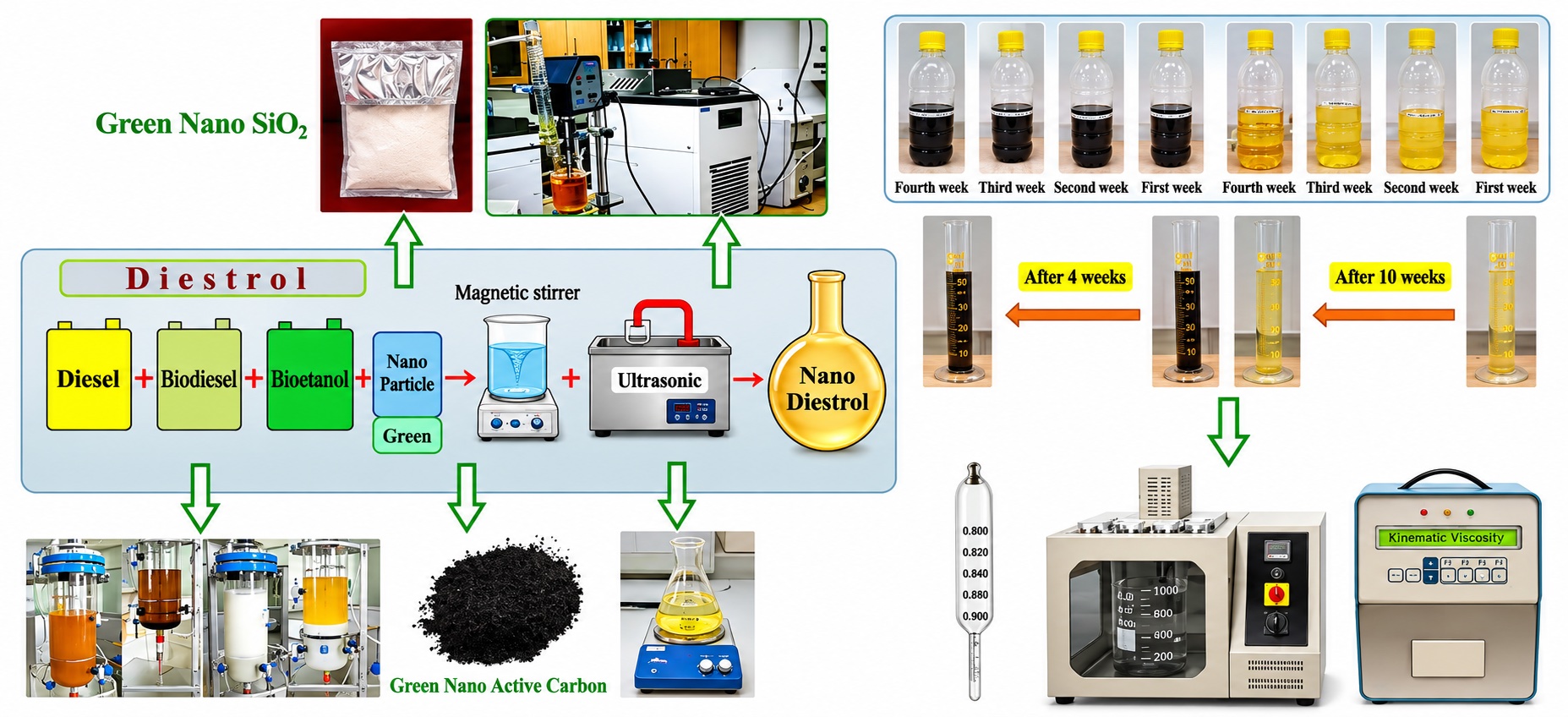
In order to prepare the desired fuel blends, green silica nanoparticles and green activated carbon nanoparticles were used at three concentration levels of 50, 100, and 150 ppm. They were combined in the laboratory with pure diesel and biodiesel (B20) and a blend of diesel-biodiesel-ethanol fuels (D70B20E10) under standard conditions to achieve maximum stability. SDBS surfactant was used at concentrations of 10, 20, and 30 ppm to prepare nanofluids. Before conducting the experiments, a magnetic stirrer was used for 15 minutes, and a 400 W ultrasonic device with a frequency of 24 kHz in cycles of 0.7 seconds for 30 minutes in order to achieve a fuel blend with appropriate stability. In Table 2, each fuel is introduced with a specific number. In this table, D represents diesel, B20 represents biodiesel (80% diesel and 20% biodiesel), E represents ethanol, and the numbers represent the percentage of the desired fuel composition in the fuel blend. The letters Si and AC represent the silica and activated carbon nanoparticles used in the fuel, respectively. The numbers 50, 100, and 150 are the concentrations of nanoparticles in the fuel blend in ppm. The schematic and process for preparing and blending fuel blends are also shown in Fig. 1.
Various properties of the produced fuel blends were tested according to ASTM standards. The viscosity of fuel blends was determined using a Hamagam Azma kinematic viscosity device. A standard glass hydrometer calibrated at 20°C was used to measure the density of the fuel blends. The flash point was measured using a calibrated Grabner closed cup apparatus in the temperature range of 0 to 200°C with a temperature stability of 1°C according to ASTM D93 standard. Fig. 2 shows the apparatus used to measure different fuel properties.
After preparing the fuel blends, in addition to photographing the samples, zeta potential and spectroscopy were also used to examine the stability of the nanoparticles in the fuel blends. One method for examining the stability of nanofluids is to photograph the sediment. In this method, after the suspension was prepared, photographs were taken every 12 hours using a high-resolution camera, and the stability of the nanofuels was determined [36].
In order to investigate the effect of nanoparticle concentration on the properties of fuel blends, statistical analysis was performed using version 12 of Design Expert software and the factorial method. In this method, the nanoparticle concentration factor was performed at four levels of 0, 50, 100, and 150 ppm, and each experiment was repeated three times. The purpose of variance analysis is to obtain the significant effect of nanoparticle concentration on kinematic viscosity, density, and flash point.
RESULTS AND DISCUSSION
There are various methods for identifying and analyzing nanoparticles. One of the most popular of them is microscopic methods. In these methods, magnified images of the sample can be obtained. In order to verify and evaluate the nanoparticles produced in this study, SEM electron images were obtained using transmission electron microscopes. The electron images in Fig. 3 are of silica and activated carbon nanoparticles. The particle size and structural characteristics of the particles were determined using X-ray diffraction (XRD) and dynamic light scattering (DLS) methods. The results of X-ray diffraction and dynamic light scattering spectroscopy methods to determine various properties of nanoparticles are presented in Figures 3, 4, 5, and 6. The various properties of nanoparticles are listed in Table 3. The results showed that nanoparticles produced by the bottom-up method have suitable properties and can have good dispersion and stability in fuel mixtures.
The results of evaluating the stability of fuel blends using the photographic method are shown in Fig. 7. The images showed that the stability of fuel blends with silica nanoparticles is higher than that of fuel blends with activated carbon nanoparticles. Increasing the concentration of nanoparticles in fuel blends will reduce the stability of the mixture. The results also proved that between D, B20 and D70B20E10 fuels, nanoparticles in the D70B20E10 fuel blends are more stable. The most stable fuel blend is also D70B20E10+Si 50 [37]. Evaluation of the results of photography, spectroscopy, and zeta potential showed that using green nanoparticles as an additive increased the stability of fuel blends several times compared to other nanoparticles. The stability time of the nanofluids was observed visually in graduated containers. The sedimentation rate of activated carbon and silica nanoparticles in the fuel blends in mm/week is shown in Figures 8 and 9, respectively. As is clear, the stability of fuel blends using green nanoparticles is higher than that of commercial nanoparticles. In addition, fuel blends with silica nanoparticles have higher stability and a lower sedimentation rate [38].
Kinematic viscosity is a fuel characteristic that plays an important role in the proper functioning of the engine fuel system. The appropriate fuel viscosity affects the creation of appropriate pressure by the fuel pump, the spraying and atomization of fuel by the injectors, and the quality of combustion in the engine [39]. According to ASTM D445, the minimum suitable value for kinematic viscosity is 1.9 mm2/s, and the maximum is 4.1 mm2/s. The results showed that the viscosity of all fuels was within the standard range and suitable for use in diesel engines. Figures 10, 11, and 12 show that B20+AC150 fuel with a value of 3.8 mm2/s has the highest kinematic viscosity, and pure diesel fuel with a value of 3.11 mm2/s has the lowest kinematic viscosity. The results proved that increasing the concentration of nanoparticles in the fuel blend will increase the kinematic viscosity. Adding biofuel to pure diesel increased the kinematic viscosity. The high viscosity of the produced biodiesel can reduce fuel injection and wear of injector pump components and increase exhaust emissions. However, adding ethanol to the biodiesel fuel blend reduced the kinematic viscosity, which can compensate for this factor because the lower viscosity allows the fuel to flow more easily and be atomized by the injectors. Higher fuel viscosity causes larger injection droplets. High kinematic viscosity may affect the atomization process, leading to incomplete combustion and increased deposition of unburned solid particles and ultimately reducing engine efficiency [14]. Therefore, adding ethanol to biodiesel fuel is associated with a decrease in kinematic viscosity and can lead to better injection and increased combustion quality in the engine.
The results of Table 5 and Fig. 13 showed that the concentration of nanoparticles in fuel blends has a significant effect (at the 0.01 level) on kinematic viscosity. The coefficient of determination also shows the dependence of kinematic viscosity on independent variables and the validity of the data.
According to ASTM D6751, the appropriate density range is between 820 kg/m3 and 858 kg/m3. Figures 14, 15, and 16 show that pure diesel and D70B20E10 fuels have the lowest density value, with a value of 780 kg/m3 and B20+ Si 150 fuel with a value of 807 kg/m3 has the highest density value. The results proved that increasing the concentration of nanoparticles in the fuel blend will increase the density. Considering that the fuel density directly affects the amount of fuel injected into the engine, its measurement is of great importance [40]. The addition of biofuel to pure diesel also increased the density. Higher density leads to higher fuel consumption. However, since adding ethanol to biodiesel fuel was associated with a decrease in density, it can reduce fuel consumption and increase combustion quality in the engine.
The results of Table 6 and fig 17 showed that the fuel blends have a significant effect (at the 0.01 level) on density. Also, the coefficients of determination show the dependence of the dependent variables on the factor.
Flash point is a method for determining the fire hazard of fuels during storage and transportation. The flash point for fuels according to the ASTM D6751 standard must be greater than 132 °C, while this is not the case for most fuels. The results in Figures 18, 19, and 20 show that D+ Si 150 fuel with a value of 60 °C has the lowest flash point, and B20 fuel with a value of 92 °C has the highest flash point. Recent research shows that similar fuel blends with low flash points have been used in diesel engines [31-34]. The results proved that the flash point of biodiesel fuel blends is significantly affected by the proportion of ethanol in the final fuel composition. Increasing the concentration of nanoparticles in the fuel blend will reduce the flash point. Blending biofuel into pure diesel fuel increased the flash point, but adding ethanol and increasing the concentration of nanoparticles decreased it. Reducing the ignition temperature of the fuel blend can reduce ignition delay and engine knock and increase the combustion quality of the diesel engine. The reason for this is the increased surface area to volume ratio of nanoparticles, better fuel atomization, and greater absorption of heat from combustion. However, safety precautions in fuel storage and transportation should be observed more [41].
Table 7 and fig 21 show the results of the analysis of variance for the flash point variable. The results indicate that the independent factors have a significant effect (at the 0.01 level) on the flash point. The coefficients of determination also show the dependence of the response on the factors.
Fig. 22 shows an overview of the maximum changes in various parameters of the fuel blends compared to pure diesel fuel. The greatest changes were shown in the B20+Si150 fuel. The kinematic viscosity and density increased by 21.5% and 9.3%, respectively, compared to pure diesel fuel. The flash point of B20 fuel also increased by 31% compared to pure diesel fuel. The D70B20E10+Si 50 was the most stable fuel blend.
CONCLUSION
In this study, fuel blends were produced from a combination of diesel, biofuel, and bioethanol with the addition of green nanoparticles (silica and activated carbon) from renewable sources. Then, the characteristics of the nanoparticles, the stability of the fuel blends, and their various properties such as density, viscosity, and flash point were evaluated. The results showed: