Document Type : Review Paper
Graphical Abstract
Highlights
INTRODUCTION
Global wastewater production has increased rapidly due to population growth, industrialization, and climate change. Recent evaluations show that urban and industrial operations currently cause new amounts of wastewater all over the globe, which has a profound effect on freshwater deposits, environmental conditions, and social health frameworks [1, 2]. Conventional wastewater treatment plants (WWTPs), which were initially intended to improve human health by removing pollutants, work more on a linear paradigm where the water is removed, treated, utilised, and finally released. This linear ‘take-treat-dispose’ model overlooks significant recoverable resources in wastewater streams (water, nutrients, energy, materials) and perpetuates resource depletion and environmental degradation[3, 4]. The effects of this system are being felt more. It is estimated that the amount of wastewater generated worldwide is 380 to 400 billion m³ each year, although only one-fifth of this amount is properly treated, and an even smaller fraction is reused, especially in low- and middle-income countries [5, 6]. Treatment of untreated or partially treated effluent remains a major source of eutrophication, biodiversity reduction, and accumulation of heavy metals, microplastics, pharmaceuticals, and other emerging contaminants in water [2]. To add to these problems, the processes of WWTP are energy-intensive, requiring up to 3% of the national electricity production in certain countries, adding to greenhouse gas emissions and increasing the high cost of operation [7]. With the increase in freshwater shortage, the circular economy (CE) has gained a new perspective as a promising alternative to consider for wastewater management. CE principles promote the regenerative flows of resources by decreasing, reusing, recycling, and recovering resources and thus turning wastewater into a renewable source of clean water, nutrients, and bioenergy [8]. Conventionally, municipal wastewater treatment plants (WWTPs) are gradually seen as a kind of Water Resource Recovery Facility (WRRF) that can recover phosphorus, nitrogen, biogas, bio-solids, biopolymers, and other add-value-based products, thus creating high-quality reclaimed water [9, 10]. The described changes are consistent with the general water-energy-food-materials (WEF&M) nexus approaches, which aim at optimizing the interdependence of resource systems and improving climate resilience [11]. Nevertheless, the application of CE-based wastewater systems is disproportionate across the world, despite the high technological progress. Current studies tend to concentrate on single recovery technology or single-output performance metrics, which do not offer much information about how various recovery processes can be combined successfully at scale [12, 13]. Several recent reviews have examined discrete aspects of circular wastewater management, such as individual resource recovery pathways, life cycle assessment (LCA) outcomes, or region-specific policy developments. However, a consolidated synthesis that explicitly integrates technological performance, circularity indicators, technology readiness levels (TRLs), sustainability outcomes, and governance dimensions within a unified circular economy (CE) framework remains limited. In particular, few reviews systematically map wastewater resource recovery technologies across different maturity levels while simultaneously addressing quantitative performance ranges, cross-pathway interactions, and the effectiveness of policy instruments. This review addresses these gaps by providing an integrative, system-level synthesis of circular economy–based wastewater valorization. It combines evidence on technological performance, environmental and economic outcomes, circularity indicators, and governance frameworks, while explicitly accounting for methodological heterogeneity and variations in technology maturity. The review is guided by the following objectives: (i) to systematically identify and classify wastewater resource recovery pathways and assess their performance across water, energy, nutrient, and material recovery domains, (ii) to synthesize quantitative environmental, economic, and circularity outcomes, highlighting reported ranges, trade-offs, and limitations in cross-study comparability, (iii) to map recovery technologies according to Technology Readiness Levels (TRLs) and evaluate their implications for large-scale implementation and deployment and (iv) to examine governance, policy, and social acceptance factors influencing the transition from conventional WWTPs to WRRFs across different regional contexts. . By bridging technical, sustainability, and institutional perspectives, the review aims to support a more holistic understanding of the transition from conventional wastewater treatment plants (WWTPs) to water resource recovery facilities (WRRFs).
Terminology note:
Throughout this review, we distinguish between:
i. WWTP (Wastewater Treatment Plant): Conventional facilities focused primarily on pollutant removal and discharge, operating on linear ‘take-treat-dispose’ principles.
ii. WRRF (Water Resource Recovery Facility): Advanced facilities designed for integrated resource recovery (water, energy, nutrients, materials) alongside treatment, embodying circular economy principles. This is our primary term for CE-oriented systems.
iii. RRF (Resource Recovery Factory) and Bio-factory: Alternative terms used in some regional contexts (e.g., Saudi Arabia, Chile) to emphasize industrial-scale valorization. Where these terms appear, they refer to WRRF-type systems with intensive recovery operations.
REVIEW METHODOLOGY
This review followed the Preferred Reporting Items for Systematic Reviews and Meta-Analyses (PRISMA) framework to ensure transparency and reproducibility [14]. A systematic literature search was conducted in Scopus, Web of Science, ScienceDirect, PubMed, and Google Scholar for studies published between 2016 and 2025, using Boolean combinations of keywords related to wastewater, circular economy, resource recovery, nutrient recovery, energy recovery, and wastewater reuse [15, 16]. This combination of databases was selected to ensure comprehensive coverage across disciplines and publication types. Scopus and Web of Science provide broad multidisciplinary coverage with robust citation tracking. ScienceDirect captures Elsevier journals prominent in environmental engineering. PubMed includes health-related environmental research. Google Scholar supplements these with additional grey literature and broader coverage, though only peer-reviewed articles meeting inclusion criteria were retained. While overlap exists among these databases, the combination ensures that relevant studies are not missed due to database-specific indexing limitations. The search yielded 1,024 records, of which 276 duplicates were removed. Title and abstract screening of the remaining 748 articles led to 184 full-text assessments, and 108 studies met all inclusion criteria and were included in the final synthesis, following PRISMA-consistent procedures [14].
Data extraction was performed using a structured template capturing recovery pathways, technological performance, environmental and economic outcomes, circularity indicators, governance dimensions, and technology maturity. Evidence synthesis combined qualitative and quantitative approaches, drawing on life cycle assessment (LCA), techno-economic analysis (TEA), and multi-criteria assessment where available, and incorporating circularity indicators such as recovery efficiency, substitution potential, and circular water value [17]. Given methodological heterogeneity across studies, results were synthesized primarily as reported ranges rather than aggregated values.
Studies were included if they addressed wastewater valorization within a circular economy or resource recovery framework; reported performance, sustainability, economic, or governance outcomes; were peer-reviewed journal articles in English; and were published between 2016 and 2025. Studies focusing solely on pollutant removal, non-wastewater systems, or lacking methodological transparency, as well as conference papers and grey literature, were excluded.
Study quality was assessed qualitatively based on methodological clarity and reproducibility. Formal risk-of-bias assessment was not applied due to high heterogeneity; instead, potential bias was addressed through transparent reporting, acknowledgment of comparability limitations, and balanced presentation of findings.
Quantitative data synthesis
Reported performance values (recovery rates, emissions, costs) were extracted and presented as ranges reflecting variability across studies rather than as aggregated statistical measures. When multiple studies reported similar metrics, we present the reported range (minimum to maximum) to reflect diversity in system configurations, operating conditions, and feedstock characteristics. Where single studies report average values, this is indicated explicitly. High-performance cases are identified as such and are not presented as typical values. Given substantial heterogeneity in system boundaries, functional units, technology configurations, and operating conditions across studies, formal meta-analysis or statistical aggregation was not appropriate or attempted. This approach prioritizes transparency about variability and comparability constraints over potentially misleading precision.
RESULTS AND DISCUSSION
WASTEWATER MANAGEMENT CIRCULAR ECONOMY FRAMEWORK
The concept of a circular economy (CE) is a paradigm change in the linear models of resource flows and is a sign of a regenerative closed-loop system. In the wastewater management process, CE principles can be used to transform wastewater as a discarded by-product into a renewable source of water, nutrients, energy, and materials [18, 19]. Such a systems-based model transforms treatment plants into Water Resource Recovery Facilities (WRRFs) that help to reconfigure them in order to maximise resource valorisation and minimise environmental effects [20, 21].
Circular Economy (CE) principle in the Water Sector
The implementation of CE in the water industry is rooted in the 5Rs of sustainable resource management, namely Reduce, Reuse, Recycle, Recover, and Regenerate, applied to various aspects of sustainable resource management [22, 23]. One of the main goals is the reduction of water use and pollutant generation [8]. The treated wastewater is reused, recycled, and, in some instances, is potable through the use of high-technology treatment technologies [5, 24, 25]. The recovery process is aimed at the extraction of embedded resources like nitrogen, phosphorus, biogas, and biopolymers [10, 26, 27]. Regeneration also involves the use of biosolids and biofertilizers in soil systems, which increases the process of carbon sequestration and nutrient circulation [28].
Wastewater Systems Incorporation of Circular Economy (CE)
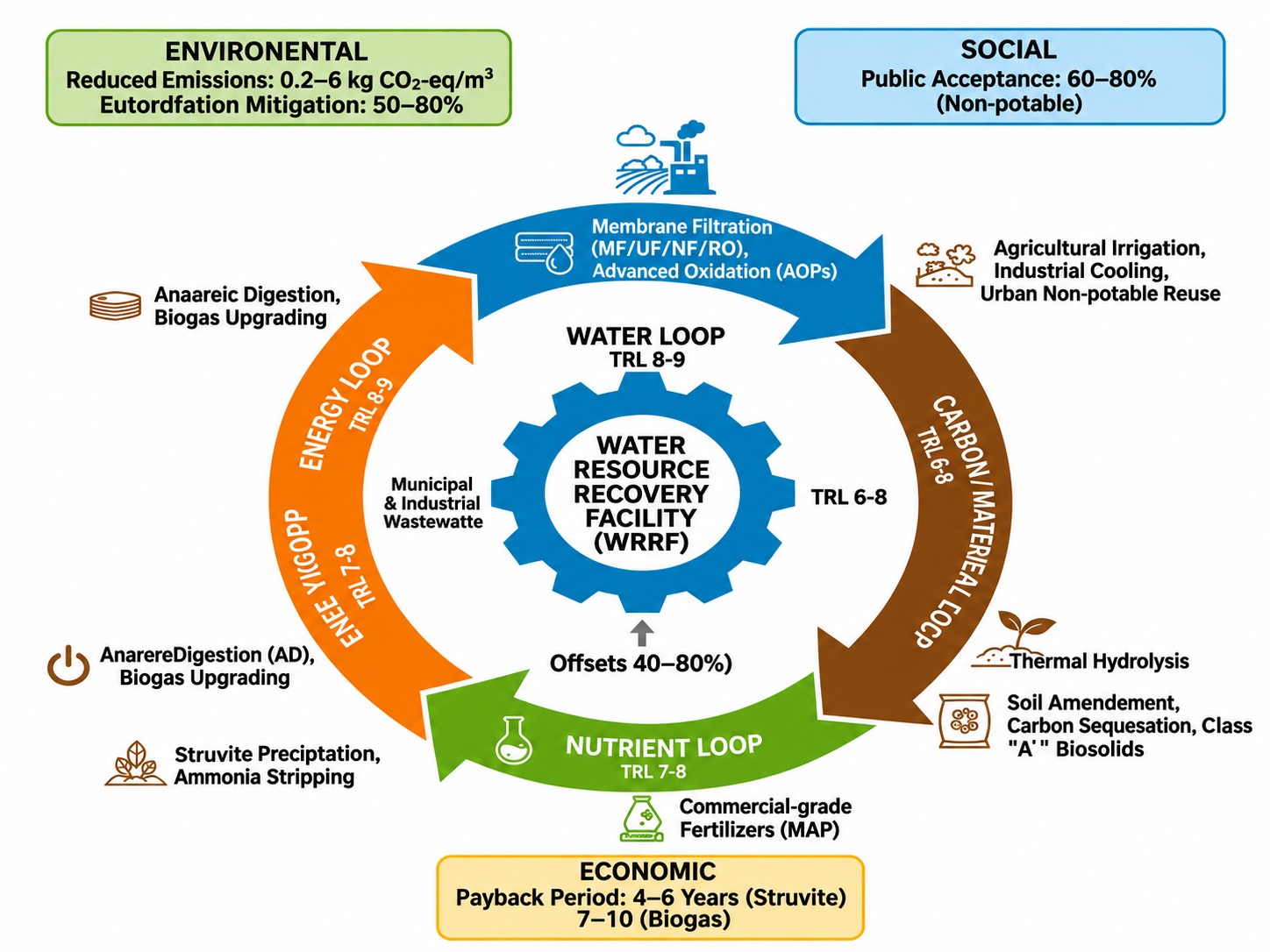
Implementing CE principles in wastewater systems requires redesigning treatment processes to enable closed-loop resource flows. WRRFs coordinate several recovery routes, in agreement with the more general nexus of water, energy, food materials (WEF&M) [28]. Industrial-urban symbiosis models are an example of CE implementation, which connects the wastewater treatment products, including biogas, reclaimed water, or materials derived as a by-product of sludge, to industrial and agricultural inputs [26, 29]. Such sophisticated strategies of sludge valorization as anaerobic digestion and hydrothermal carbonization yield biogas and hydrochar, which can replace fossil fuels and synthetic fertilizers [24, 30, 31]. The reclaimed water is useful in irrigation, industrial cooling, and other municipal non-potable purposes and relieves water-scarce areas significantly [32, 33]. Figure 1 depicts an integrated circular economy framework for wastewater systems. The diagram illustrates four interconnected resource recovery loops operating within a Water Resource Recovery Facility (WRRF). Water loop (blue): Influent wastewater undergoes primary, secondary, and advanced treatment (membrane filtration, advanced oxidation) to produce high-quality reclaimed water for agricultural, industrial, and urban reuse. Energy loop (orange): Organic matter from primary and secondary treatment is channeled to anaerobic digestion, generating biogas that undergoes upgrading and cogeneration to produce electricity and heat for plant operations. Nutrient loop (green): Phosphorus and nitrogen are recovered from sludge and liquid streams via struvite precipitation and ammonia stripping, yielding commercial-grade fertilizer products. Carbon loop (brown): Digestate from anaerobic digestion is converted to biochar or compost for soil amendment and long-term carbon sequestration. Arrows indicate material and energy flows. The integration of these loops exemplifies the transition from linear ‘take-treat-dispose’ models to regenerative circular systems that maximize resource valorization and minimize environmental discharge.
Figure 1 visualizes this integrated framework, showing how wastewater enters the system and flows through interconnected treatment and recovery processes. The four colored loops represent distinct but interdependent resource streams: water (blue) flows from treatment stages to various reuse applications; energy (orange) is captured via anaerobic digestion and returned to power plant operations; nutrients (green) are extracted as valuable fertilizer products; and carbon (brown) is stabilized for agricultural use. The diagram emphasizes that modern WRRFs function not as endpoints for waste disposal, but as resource hubs where materials circulate back into productive use, aligned with CE principles.
Circular Economy (CE) Implementation Conceptual Model
A conceptual model of the circular economy (CE) is a visual illustration of the circulation of water, nutrients, energy, and material between interconnected loops [24]. The inflow of wastewater is subjected to wastewater treatment stages designed to ensure that the water is optimally recovered and not just treated. Reclaimed water flows into agricultural, industrial, and urban systems [32, 33]. Bio-fertilizers are produced by converting nutrients obtained from the sludge or biomass into bio-fertilizers, which help to sustain agriculture [4]. Energy produced through anaerobic digestion increases the neutrality of plant energy [27]. Industrial manufacturing pathways are supplied with cellulose, bio-oils, and other substances obtained in the course of separation and thermochemical treatment [34, 35]. Such indicators as the Resource Recovery Index, Substitution Potential, Closed-Loop Fraction, and Circular Water Value (CWV) allow quantitative evaluation of system circularity [8, 36]. Circularity indicator definitions and calculation are as follows:
i. Resource Recovery Index: Quantifies the proportion of input resources (water, nutrients, energy, materials) that are recovered and reused relative to total inputs. Calculated as:
 (1)
ii. Substitution Potential: Measures the degree to which recovered resources can substitute virgin or conventional resources. For example, struvite’s substitution potential for synthetic phosphate fertilizer, or biogas’s substitution for natural gas.
iii. Closed-Loop Fraction: Proportion of outputs that re-enter productive use within the system or region, rather than being discharged or disposed. Calculated as:
 (2)
iv. Circular Water Value (CWV): Quantifies the economic and resource value created through water reuse, accounting for avoided freshwater abstraction, treatment costs, and environmental externalities [36].
These indicators vary in definition and system boundary across studies, limiting direct comparison. For instance, the Resource Recovery Index may include different resource categories, and the Substitution Potential depends on regional market characteristics and alternative resource quality. Therefore, these metrics are most useful for within-study comparisons or as directional indicators of circularity progress rather than absolute benchmarks.
Resource Recovery Pathways
The treatment of wastewater by resource recovery transforms wastewater treatment plants into multimodal biorefineries that make clean water, nutrients, energy, and useful materials [10, 37]. The reason behind this change is water scarcity, nutrient depletion, climate mitigation, and the overall transition to circular economy (CE) systems. Although certain processes have a high technological level, their wide use is restricted due to economic factors, regulatory issues, and general acceptance [13, 38].
Water Reuse and Recycling
The reuse of water is an element of the wastewater systems of the CE. Several advanced oxidation processes (AOPs), including UV/H2O2 and ozone, are routinely used to remove over 90% of pharmaceuticals and endocrine disruptors [26, 39]. Photocatalysis of TiO2 by solar energy will save as much as 40% of energy. The high-quality reuse systems are based on membrane technologies such as microfiltration (MF), ultrafiltration (UF), nanofiltration (NF), and reverse osmosis (RO). NF technologies eliminate 85 to 95% of trace organics at lower-energy consumption rates than RO, though performance varies with influent composition (pharmaceuticals, hormones, industrial compounds) and membrane fouling management [36, 40]. The implementation of full-scale applications in the NEWater in Singapore and the direct potable reuse systems in Windhoek shows long-term operational stability and meets the drinking water standards [41, 42]. The regulatory environments differ significantly between different regions, such as Title 22 in California, which has some of the strictest standards of potable reuse, whereas the European Union has implemented a unified standard of agricultural reuse, which is established as Regulation 2020/741[13]. The use of IoT, machine learning, and digital twins in smart treatment systems saves 15-25% of energy and chemicals and boosts their resilience to variable influent [43, 44]. Nonetheless, the obstacles to direct potable reuse are still common, such as the yuck factor that should be taken into account by society [31].
Nutrient Recovery
The recovery of phosphorus (P) and nitrogen (N) is at the heart of the process of reducing eutrophication and preserving the essential mineral resources. The most developed pathway is still the precipitation of struvite, and fluidized bed reactors operating onhigh-strength streams (typically >30 mg P/L) from anaerobic digestate have achieved 80-90% P recovery with product purity of >95% in full-scale applications [4, 45]. Selective ammonia capture can be done by nitrogen recovery technologies such as stripping and ion exchange, electro-dialysis, and gas-permeable membranes, which require less than 5 kWh/kg N of energy [45]. N/P/K recovery is still in its infancy, but pilot systems in the Netherlands are recovering approximately 70 % of P, 60% N, and 40% K [8]. Microalgae-based systems, which incorporate the use of strains like Chlorella vulgaris and Scenedesmus obliquus, provide them with a simultaneous nutrient uptake and biomass generation to produce biofuel or bio-fertilizers [26, 28]. Meta-analyses have indicated that P, N, and K recovery efficiencies are 85%, 75%, and 60%, respectively, when applying technologies [39].
Energy Recovery
The main energy recovery process is anaerobic digestion (AD), which generates biogas (55-65% CH4) and eliminates more than 80% of the COD in a high-rate anaerobic sludge blanket (UASB) reactor [27]. With improvements, bio-methane (>95% CH4) can be injected into natural gas grids or as transportation fuel. Energy-excess facilities can be demonstrated by net-positive energy operations like the Strass WWTP in Austria that generates approximately 17 GWh/year [42]. Other varieties of valorisation include microbial fuel cells, anaerobic membrane bioreactors, pyrolysis, gasification, and hydrothermal liquefaction, which are new technologies that have had obstacles in the cost, membrane fouling, and complexity of operations [40]. Life cycle analysis finds that sludge-to-energy programs have the potential to eliminate up to 30-60% of WWTP energy costs, and can be combined with renewable energy to increase sustainability [7]. The fourth stage is material and bio-product Recovery. Wastewater materials are biopolymers, biosolids, metals, and functional carbon materials. Mixed cultures produce 0.4- 0.6 g PHA/g VFA, but have not been economically competitive yet [26, 38]. Biochar produced by sludge is useful in improving soil and sequestration of carbon [46]. The newly formed class “A” biosolids obtained due to composting and thermal drying are safe to use without restrictions in terms of land application [10]. Metals such as Cu2+, Zn2+, and Ni can be effectively biosorbed and electrowinned, and the efficacy of removal can reach over 90% in certain systems [45]. Activated carbon derived from sludge is in performance similar to commercial products [38].
Digital and Smart Technologies in Resource Recovery Optimization
Digitalization is not merely an add-on but an enabling technology that enhances performance, efficiency, and reliability across all resource recovery pathways. Modern WRRFs increasingly integrate IoT sensors, machine learning algorithms, digital twins, and blockchain systems to optimize complex multi-pathway operations.
Digital optimization by recovery pathway
Water reuse systems
Real-time monitoring of trace contaminants (pharmaceuticals, PFAS) enables adaptive treatment intensity, reducing chemical use by 15-20% while maintaining water quality standards [43]. Predictive fouling models for membrane systems reduce maintenance downtime by ~30% and extend membrane lifespan [31].
Energy recovery (anaerobic digestion)
Machine learning algorithms optimize feeding strategies and co-digestion ratios, improving biogas yield by 10-15% [44]. Digital twins enable scenario testing for biogas upgrading and cogeneration systems under variable waste inputs [47].
Nutrient recovery
Automated pH and dosing control in struvite reactors improves P recovery efficiency from 70-75% (manual control) to 85-90% (automated) [48]. Real-time monitoring of NH₄⁺ and PO₄³⁻ concentrations enables dynamic optimization of recovery timing and chemical addition [43].
Integrated multi-pathway systems
System-level optimization algorithms balance trade-offs between competing recovery objectives (e.g., maximizing biogas vs. nutrient recovery) to achieve optimal net benefits [40]. Blockchain-based traceability systems verify quality and provenance of recovered products (biosolids, fertilizers), supporting market development and regulatory compliance [41].
Cross-cutting benefits
Aeration optimization via ML reduces energy consumption by 10-20%, the largest operational cost in many WRRFs [44]. Cybersecurity protocols (OPC UA, IEC 62443) protect critical infrastructure while enabling data-driven optimization [44]. These digital tools transform WRRFs from manually operated treatment facilities into autonomous, self-optimizing resource recovery systems capable of responding dynamically to variable influent conditions and multiple recovery objectives.
Integrated Recovery Systems: Cross-Pathway Interactions and Trade-Offs
Recent water resource recovery facilities (WRRFs) are increasingly integrating the aspects of water reuse, energy output, and nutrient recovery in a single operating model. These integrative architectures encourage synergistic interactions; however, they also involve trade-offs to moderate overall system performance, thus reinforcing the need for a systems-level understanding to realize effective optimization. The coupling of discrete recovery pathways leads to key synergies. Membrane-based water reuse in the water-energy nexus necessitates a high energy contribution, but also reduces energy consumption on abstraction of freshwater, and enables recovery of energy in concentrated residual streams [27, 40]. Nutrient-energy co-recovery focuses on anaerobic digestion that pools nutrients in the digestate, which in turn generates biogas, and can be extracted through further treatment, like the stripping of ammonia or the precipitation of struvite [45, 49]. Through thermal hydrolysis pretreatment, carbon-nutrient interactions can be further enhanced, increasing methane production as well as nutrient potentials for downstream recovery [49, 50]. On the other hand, integrated systems offer trade-offs. To limit the nutrient content of biosolids, maximizing biogas production can be used, but to reduce the total energy potential of residuals, increasing the intensity of the nutrient recovery processes can be considered [51]. Implementation of water of high quality, especially potable, requires more sophisticated treatments that demand significantly larger energy-consumption burdens, which in turn may undermine the energy recovery benefits [40, 41]. These technical dilemmas are compounded by economic factors where the introduction of multiple recovery trains increases not only capital complexity but operational complexity, which restricts feasibility in some market and regulatory situations [38]. These dynamics are illuminated by full-scale implementations. The Brunswick wastewater treatment facility in Germany combines thermal pressure hydrolysis, enhanced anaerobic digestion, and nutrient recovery, with a recovery of phosphorus, nitrogen, and a yield of methane increase of 18 % [49]. Conversely, Singapore’s NEWater system focuses on membrane-based water reclamation to support water security, where energy recovery is given a relatively weaker focus [41]. Finally, the best WRRF structure is determined by regional priorities, regulatory requirements, and economic incentives, which lend credibility to the importance of optimizing systems at the highest level to balance competing interests and to achieve a maximum net output [38, 40].
RESOURCE RECOVERY PATHWAYS: SYNTHESIS AND QUANTITATIVE ANALYSIS
Recovery Route Comparative Performance.
Municipal wastewater treatment facilities are normally better in terms of nutrient and energy recovery compared with those of industrial facilities, which can be explained by the fact that municipal wastewater quality received is usually higher. According to a recent meta-analysis, municipal water reclamation and reuse plants (WRRFs) were able to retrieve about 80% of phosphorus and 70% of nitrogen, whereas in the industrial context, recovery rates are about 60% and 50%, respectively [39, 45]. Anaerobic digestion of energy can typically generate 0.3 to 0.5 m3 CH4 per kilogram of food, which meets the energy needs of a plant by about 40 to 80% [27]. In addition, advanced treatment technologies attain treatment efficiencies of greater than 99% and hence allow the safe agricultural and industrial reuse of treated water [41]. However, the fact that the inter-study differences were very high highlights the importance of standard reporting protocols in order to have a systematic comparison [42]. Table 1 gives a comparative analysis of key resource recovery technologies. The differences in the quality of feedstock, operating conditions, and the maturity of technologies have a significant impact on their performance in recovery pathways. Geographic factors also tune the system results; in most of Europe, utilities are reported to be achieving greater energy recovery due to an increased ability to automate their processes, whereas in many Asian facilities, water is being reused as a reaction to the chronic lack of water [41].
Environmental Outcomes
A life cycle analysis reveals that CE-oriented wastewater recovery systems reduce greenhouse gas emissions to 0.2-0.6 kg CO2-eq/m3, offsetting the avoided electricity consumption, nutrient reuse, and methane capture [38]. These reported values derive from studies using varying system boundaries (plant-level vs. regional), functional units (per m³ treated vs. per capita vs. per kg pollutant removed), allocation methods, impact categories, and background data inventories. Direct numerical comparison across LCA studies is therefore constrained. The ranges presented reflect both genuine variability in system performance and methodological differences. Key sources of heterogeneity include: (1) inclusion or exclusion of infrastructure construction; (2) treatment of co-products (allocation vs. system expansion); (3) geographical scope affecting electricity grid carbon intensity; (4) temporal scope (single year vs. lifetime). These values should therefore be interpreted as indicative ranges rather than directly comparable results. Standardization of LCA methodology for wastewater CE systems remains a research priority [39].
Economic Outcomes
Economic viability varies substantially by technology, scale, and regional market conditions. Where possible, costs are presented normalized to common functional units for comparability.
Capital expenditure (CAPEX)
Water reuse systems require $1-3 million per MLD treatment capacity, or approximately $0.30-0.90 per m³/day capacity [7]. Integrated CE retrofits demand higher initial investments of $5-10 million per MLD, or $1.50-3.00 per m³/day capacity [7]. Struvite recovery units range from $0.5-2 million for facilities treating 10-50 MLD, or approximately $0.10-0.40 per m³/day capacity [4].
Operating expenditure (OPEX)
Typical operating costs range from $0.30-0.70 per m³ treated, with energy (40-50%) and labor (20-30%) as dominant components [38]. Advanced membrane systems incur higher costs of $0.50-0.90 per m³ due to increased energy demands and membrane replacement requirements. Mature anaerobic digestion systems achieve lower costs of $0.20-0.40 per m³, partially offset by energy recovery.
Payback periods
Struvite recovery systems demonstrate 4-6 year payback periods at current fertilizer prices (~$500-800/tonne MAP equivalent) [4]. Biogas systems require 7-10 years depending on energy tariffs ($0.10-0.25/kWh) and policy incentives [13]. Water reuse for non-potable applications achieves 3-8 year payback in water-scarce regions with avoided freshwater costs exceeding $0.50/m³.
Revenue diversification
Multiple revenue streams including reclaimed water sales, carbon credits, and recovered product sales improve economic resilience but depend on stable markets and supportive policies. Economic feasibility is highly sensitive to scale, with larger facilities achieving lower unit costs, and regional factors such as energy prices, water tariffs, and fertilizer markets [38].
Normalization limitations
Direct cost comparison across studies remains challenging due to variations in accounting methods (levelized versus annual costs), included versus excluded cost categories (e.g., land, connection infrastructure), currency conversion and inflation adjustment, and technology vendor and geographic labor costs. The values presented represent indicative ranges synthesized from multiple sources rather than statistically aggregated data.
Social and Institutional Results
Public acceptance varies substantially by use type and context. Meta-analyses of public perception studies (n>50 studies, predominantly from developed countries) indicate acceptance rates of 60-80% for non-potable reuse (irrigation, industrial cooling) but lower acceptance of 30-50% for direct potable reuse (DPR), driven primarily by risk perception, trust in water authorities, and transparency of treatment processes [31]. These ranges reflect variation across studies with different survey methodologies, sample sizes (typically 200-2000 respondents), and geographic contexts. Acceptance is consistently higher in water-scarce regions and when communication emphasizes safety data and independent oversight. For biosolids-derived fertilizers, acceptance ranges from 40-70% depending on crop type (higher for non-food crops) and certification schemes [30]. Longitudinal studies suggest acceptance increases over time with sustained safe operation and community engagement, as demonstrated in Singapore (NEWater) and Australia (Western Corridor) [41]. The effectiveness of DPR programs in Singapore and Australia proves the necessity of long-term communication, external verification, and education of the population [41]. Barriers to implementation at an institutional level, such as a lack of coordination and broken governance of water-energy-agriculture sectors, still exist. The policy mechanism that has demonstrated its potential for pacing the adoption is the use of green bonds, tax incentives, and extended producer responsibility on the condition of proper alignment [61].
Technology Readiness Level (TRL) Assignment Methodology
Table 2 derives the TRL values based on the evidence of deployment scale and operational maturity reported through several academic studies, following the voting by the canonical NASA and European Commission-based TRL frameworks. At TRL 4-5, technologies are vetted by laboratory or bench-scale demonstrations where basic functionality has been demonstrated empirically. TRL 6-7 is pilot-scale validation with conditions that resemble relevant operational conditions, and TRL 8-9 is full-size commercial deployment with reliability metrics demonstrable. TRL determinations were made based on an integrative synthesis of the literature rather than using isolated data sources. Consensus levels were adopted using citations that explicitly expressed TRL designations. Where TRLs were not explicitly announced, maturity was determined based on the largest reported implementation regime (laboratory, pilot, or full-scale), the number of operational installations reported, and indications of commercial availability. The resulting TRL allocations are therefore indicative, literature-based estimates of technological maturity in 2025; they can change based on the setup of a particular system or a regional environment. Technologies with wider TRL scopes (e.g., TRL 5-7) indicate heterogeneity in maturity within different applications or geographic locations.
Wastewater recovery technologies have a distribution pattern suggesting that anaerobic digestion, struvite precipitation, man-made wetlands, biomass recovery, and chemical precipitation are all in commercialization (TRL 8-9). Advanced development technologies in the research (TRL 6-7) are microalgae growth, thermal hydrolysis, HTC, photocatalysis, and two-stage anaerobic digestion. At the early stages (TRL 4-5), there are electrochemical recovery, microbial fuel cells, microbial electrolysis cells, and membrane distillation. The most cost-effective is struvite precipitation, which balances affordability and environmental value, with a payback period of between 1 and 5 years depending on the size, and constructed wetlands have the lowest cost of operation [77]. New priorities are on the problem of electrochemical recovery of nutrients as an important development with a chance of commercialization in 3-5 years [64, 72], and integrated multi-product bio-refineries as a problem of economic viability [67].
CIRCULAR WASTEWATER PROJECTS CASE STUDIES
The regional case studies presented were selected based on three criteria: (1) Documentation quality - cases with peer-reviewed published data on performance, costs, and outcomes; (2) Implementation maturity - facilities with operational experience (not just planned projects) demonstrating real-world viability; (3) Regional representativeness - cases illustrating diverse geographic, economic, and governance contexts (Africa, Asia, Europe, South America) and varied technological approaches (water-focused vs. nutrient-focused vs. integrated multi-pathway systems). These cases are not necessarily the most advanced globally but represent well-documented examples that illustrate key success factors, barriers, and lessons learned across different contexts. Cases include both early-stage implementations facing challenges (Africa, India) and mature advanced systems (Germany, Saudi Arabia) to provide a balanced perspective on CE adoption trajectories.
Wastewater Systems Global Circular Economy (CE) Practices
The increasing pressures of water scarcity, population growth, and climate change have increased the rate of shift to the principles of the circular economy (CE) in the wastewater sector. In other parts of the world, wastewater treatment facilities (WWTPs) are being converted into multifunctional water resource recovery facilities (WRRFs) that can generate clean water, renewable energy, and marketable products. Although the technologies that can support the circular systems of wastewater treatment, e.g., anaerobic digestion, nutrient recovery, and bioproduct valorization, are becoming more mature, the real-life application is very diverse because of the disparities in the structure of governance, socio-economic conditions, or environmental requirements [20, 49, 94]. The case studies on several continents indicate accelerated progress and the presence of ongoing obstacles, which are valuable sources of information about the contributing factors and local limitations.
Regional Trends and Drivers of Performance
Africa
In Africa, case studies have consistently shown that water reuse plays a central role in the sustainability of agriculture in the face of severe water scarcity and limited availability of fresh water. In Egypt, recycled sewage is increasingly used for irrigation, together with regulated nutrients and trace elements [95], with a turbidity limit of 10 NTU for cooked vegetables, a total suspended solids limit of 10 NTU for cooked vegetables, and a biochemical oxygen demand limit of 35 mg for cooked crops (15 mg for cooked vegetables and 35 mg for cooked crops). The practice helps to relieve the strain on freshwater resources, as well as increase national food security. The problems, however, have not disappeared, which, among others, include the excessively high level of molybdenum 0.07 mg/L stipulated by the Egyptian Decree that exceeds considerations of safe levels and makes it clear that changes in water-treatment and irrigation standards are needed in the region. In South Africa, water-reuse projects are highly reliant on social trust, confidence, social involvement and feelings of municipal capability. The Malmesbury experiment proves that a proper discussion can bring more people to accept recycled water, and a lack of interaction can lead to substantial opposition in the context of an acute shortage of water [12, 96].
Asia
Asia is characterized by a high rate of technological development and adoption of CE methods based on policy. India is under considerable wastewater production and pollution stress, and there is great potential for pathways to reuse, which remain unrealized in the country because of issues in governance, insufficient infrastructure, and lack of institutional capacity [97]. On the other hand, Saudi Arabia is leading the revolution of converting WWTPs to complete Resource Recovery Factories (RRFs), with a variety of new technologies, including aerobic granular sludge filtration and gravity-powered membranes (AGS–GDM), anaerobic membrane bioreactors (AnMBR), and bio-based material recovery [20, 98, 99]. These systems lead to climate neutrality, lower operating costs, and increased resource self-sufficiency. The Weifang biogas upgrading project is another example of the high level of circularity in China. The project also lowers greenhouse gas emission levels by means of anaerobic digestion and biogas upgrading to biomethane, increases local energy security, and avoids disposal of organic waste [100, 101]. Well-instigated policy incentives toward the dual carbon targets have been instrumental in boosting the rate of adoption.
Europe
Europe has one of the best systems of nutrient and energy recovery in the world. In Germany, the Brunswick model integrates thermal pressure hydrolysis (TPH) to pre-treat the sludge with sulfate ammonium crystallization and ammonium sulfate recovery. This combined solution resulted in an 18 percent increase in methane yield, a significant improvement in digestate dewaterability, and a phosphorus recovery of 80 or more percent and a nitrogen recovery of 85% or more [93]. These benefits are supported by positive EU policies on the CE marking of origin, the certification of recycled fertilisers and the financing of eco-innovation technologies.
South America
The bio-factory project in Santiago, Chile, is an example of how nationwide sustainability can be transitioned into practice. Implementing Life Cycle Sustainability Assessment (LCSA), including LCA, S-LCA, and life cycle costing (LCC), the bio-factory plants realize 30-58% less environmental, economic, and social impact than traditional WWTPs [102, 103,104]. High efficiency sludge valorization in Latin America is reflected by thermal hydrolysis pre-treatment (Plant B) that exhibits superior economic performance.
Cross-Cutting Barriers Case Studies
Case studies show common obstacles to the adoption of circular wastewater systems across regions. The advanced technologies (AnMBR, thermal hydrolysis, and upgrading of biogas) are costly to implement [98, 102]. Improper regulatory frameworks and decentralized governance, especially in relation to obtaining certification of recovered fertilizers and biosolids, make implementation challenging [99, 105]. Among other obstacles, there is mistrust related to drinking reuse, as well as biosolids-based fertilizers [39, 96]. Such technical capacity problems, such as qualified operators and advanced monitoring systems, also represent a big challenge [41, 97]. These barriers point to the fact that technological innovation cannot stand alone, but institutional strengthening, the certification of the process, and the long-term engagement of the population are also needed.
Comparative Insights and Lessons Learned
Cross-regional synthesis indicates a few themes that are consistent. Water scarcity is the most important driver in Africa and in some of the Asian parts, which results in large-scale agricultural reuse. Innovations in Europe and China are motivated by climate targets and strict regulations to achieve nutrient recovery in more complex forms and energy-neutral or energy-positive recovery, respectively. Water-nutrient-energy systems (integrated recovery) provide the greatest benefits to sustainability, as seen in Chile and Germany. Scalability depends on policy coherence and monetary incentives; the most developed implementations can be found in regions with good CE strategies (EU, China, and Saudi Arabia). Public acceptance is the most ubiquitous challenge, irrespective of the degree of economic advancement of a community.
Regional Case Study Table of Summaries
Table 3 summarizes representative circular wastewater management case studies comparatively, reflecting on the key technologies, outcomes, barriers, and enabling conditions in various international settings in order to consolidate the regional insights above.
Together, these case studies are an indication that, under the conditions of sound technological decisions, strong policies and community engagement, circular wastewater management can bring significant environmental, economic, and social advantages. Areas where governance systems are unified and there are financial incentives are making the fastest progress, such as the EU, China, and Saudi Arabia; the African and South Asian settings focus on the necessity of local standards, strategies to engage the public, and low-cost context-specific solutions.
CIRCULARITY AND SUSTAINABILITY EVALUATION
Sustainability assessment provides a general review of the environmental performance, economic performance, and social performance of CE methods of wastewater management. With the shift of wastewater treatment facilities towards Water Resource Recovery Facilities (WRRFs), integrated assessment tools are necessary to quantify trade-offs, increase the efficiency of the system, and inform decision-making [8, 38].
Environmental Sustainability
The environmental analysis always reveals that the CE-based wastewater systems perform better as compared to the traditional linear models in various indicators. Analysis of life cycle assessment (LCA) shows that greenhouse gas emissions will decrease significantly through the avoided production of synthetic fertilizers, increased energy recovery, and decreased emission of effluents [31, 39]. Compared to non-recovery systems, nutrient recovery, particularly phosphorus and nitrogen, can decrease the potential of eutrophication by 50–80% [4]. Reuse of water also reduces abstraction of freshwater, a factor that helps to restore water-stressed ecosystems [32]. Although these are advantages, there are still environmental trade-offs. Membrane systems and advanced oxidation processes usually presuppose energy input and generate concentrated streams of brine or sludge, which need to be adequately handled [40]. The transport faults of biosolids distribution may counterbalance various environmental benefits [31]. These results highlight the importance of life-cycle assessments of systems.
Economic Sustainability
Sustainability in economics depends on the parameter of maintaining balance between capital spending, operational costs, and income generated by the retrieved resources. CE retrofits would normally require moderate to high initial investment, particularly in units of membrane-based nutrient recovery and water reuse [7]. However, in the long run, the benefits are gained in terms of saving chemicals, minimization of sludge disposal expenses, and production of energy through anaerobic digestion [27]. Recovery technologies of struvite can have a desirable breakeven in 46 years under the existing fertilizers market, with these paybacks better than the biogas-to-energy systems that can have a breakeven in 7-10 years given appropriate tariff structures [4]. Water reuse sales, carbon credit, and bioproduct markets can be considered circular business models that promote economic feasibility [38]. However, the lack of an effective market structure for recovered materials, especially those of bio-solids and PHAs, constrains the scale of adoption [41].
Social Sustainability
One of the most essential factors of CE success is social acceptance. The social acceptance of reclaimed water is not universal, and direct potable reuse cannot be readily accepted due to safety and trust issues [31, 33]. The acceptance of recovered nutrients and biosolids in agriculture can be enhanced with the help of certification schemes and transparent communication [30]. The social life-cycle assessment frameworks are increasingly entering the aspect of worker safety, community wellbeing, and equitable access to resources [8].
Multiphasic Sustainability and Trade-offs
Combined analysis shows that there are high trade-offs between environmental, economic, and social aspects. As an example, anaerobic digestion could restore energy at the cost of nutrient recovery, or increased water reuse on a large scale could lower the possibility of recovery [36]. The evaluation of such trade-offs is usually done using multi-criteria decision analysis and recovery configuration optimization [38]. In general, sustainability evaluations reveal that CE-oriented wastewater systems have significant long-term advantages, but their implementation should be context-specific technological solutions, market factors, and social interactions.
POLICY AND GOVERNANCE ASPECTS
The rate, scale, and effectiveness of implementation of a circular economy within wastewater management have a decisive impact on policy and governance structures. The main factors that contribute to an effective shift from linear treatment to the WRRFs are regulatory transparency, institutional capabilities, financial incentives, and coordination among stakeholders [8, 13].
International and Local Policy Frameworks
Several policies in the world and the region offer good regulatory impetus to CE-oriented wastewater systems. Circular Economy Action Plan and Regulation (EU) 2020/741 create a standard of safe water reuse that leads to investment in advanced technologies of treatment [13]. The U.S. EPA encourages recycling of biosolids, reuse of water, and recovering energy using the Water Reuse Action Plan and renewable energy incentives [41]. Certain Asian nations, such as China, India, and Singapore, use CE principles in the strategies of national development, and much of the financing goes to wastewater recycling, nutrient recovery, and initiatives to become carbon-neutral [36, 43].
Institutional Mechanisms and Governance Problems
Institutional coordination has always been a problem. Different responsibilities that are fragmented between water authorities, environmental authorities, and agricultural regulators tend to block implementation [33]. Inadequate certification of recovered nutrients and biosolids reduces market adoption [30]. Also, regulatory uncertainty over new recovery technologies, e.g., PHAs, biochar, and membrane concentrates, further slows down commercialization [31]. The quality of effluent is not effectively monitored and enforced in many countries, and this has an impact on both the safety of the environment and the general confidence of the population [32]. Areas with low income have capacity shortages that limit effective monitoring of decentralized and advanced treatment systems [27].
Policy Instruments and Economic Incentives
Economic incentives and policy instruments play a significant role in driving the economy. There are numerous policy tools to facilitate CE. These include:
i. The feed-in tariffs and renewable energy credits enhance the economic viability of biogas-to-energy [42].
ii. Tax benefits and subsidies on technologies of nutrient recovery and water reuse infrastructure [7].
iii. The nutrient trading programs that have been implemented in select regions of the United States and Europe establish financial markets to trade phosphorus and nitrogen cuts.
iv. Circular procurement, which would see the encouragement of buying products based on wastewater, like biofertilizers and reclaimed water [26].
In spite of these tools, there are still economic obstacles. Low demand for recovered materials in the market and fluctuating prices of fertilizer and energy pose a threat to financial sustainability in the long term [38].
Stakeholder Engagement and Models of Collaboration
Collaboration between the stakeholders is necessary to close the technical, regulatory, and societal gaps. The use of advanced reuse and recovery systems has been quickened in areas like the EU and Southeast Asia, through a combination of the activities of the public and the private [35]. The models of industrial symbiosis where wastewater discharge is used as an input to industrial processes can be characterized by a high level of potential local CE loops (Sousa et al., 2023). Community acceptance is still one of the largest factors to success, in particular, potable reuse and biosolids implementation. Clearly displayed risk communication, participative governance, and third-party certification help in increasing social trust and adoption [31, 33].
Comparative Effectiveness of Policy Instruments
Table 4 summarizes key policy instruments and their observed effectiveness across regions.
BARRIERS, RESEARCH GAPS, AND FUTURE
Technical Barriers
The significant issue of wastewater valorization is the technical constraints. There are engineering, operational, and economic challenges of scaling laboratory- and pilot-proven recovery technologies to full-scale operations [106, 107]. The effect of the integration of several recovery processes aiming at water, nutrients, as well as energy in the water present in the wastewater treatment plant (WWTP) infrastructure would often necessitate intricate system overhauls. PFAS, microplastics, and other trace contaminants that are considered contaminants of emerging concern (CECs) are known to be very dangerous to the safety and quality of recovered outputs, requiring sophisticated and energy-consuming treatment and monitoring [28, 39, 45, 94]. Such technological barriers limit the scalability and flexibility of circular wastewater solutions.
Economic and Policy Barriers
Circular wastewater systems are economically unviable due to the immaturity of the market, fluctuating prices on recovered resources, and poor valorization incentives, and linear wastewater strategies are relatively more attractive [105]. The disjointed nature of legislation, the absence of harmonized certification standards, and supportive regulations also hinder investment and development of markets. The full adoption of resource recovery technologies will not be guaranteed unless there are stable markets and stable policy frameworks, despite their beneficial effects on the environment [105].
Research Gaps
Several important gaps in research slow down the development of circular wastewater systems:
i. Standardized Circular Economy (CE) Indicators: Indicators covering the environmental, economic, and social performance are required to allow a consistent assessment of circular strategies [108, 109].
ii. Field-Scale and Long-Term Studies: Most of the recovery technologies can only be tested at the laboratory scale or pilot scale. Large-scale and long-term experiments are needed to determine both operational reliability and environmental effects [107].
iii. Combined LCA Economic Models: Integrated models are not yet fully developed, and the life-cycle assessment (LCA), material flow, and economic analysis have not yet been sufficiently integrated to determine interdependencies at the system level [110].
iv. Multi-Cycle Resource Assessment: Circularity analyses can be improved by using infinite LCA models that offer techniques to estimate multi-cycle flows of resources [111].
Future Perspective
Circular wastewater systems will be developed as a result of new technologies and digital applications; the AI architecture and IoT monitoring can be developed to improve real-time resource recovery and operational efficiency [112]. The shift towards net-positive water resource recovery plants (WRRFs) envisages WWTPs producing excess water, nutrients, and energy to the adjacent communities [10, 106]. It is envisioned that innovative solutions, including microbial electrochemical systems (METs), will aid resource recovery further and make wastewater treatment an energy-generating process in line with sustainable development objectives [45, 94].
CONCLUSIONS
This systematic review of 108 studies shows that ideas based on the circular economy can convert wastewater treatment from a linear waste disposal paradigm to a paradigm of resource recovery. Although it can be seen that circular wastewater systems are technically achievable and beneficial to the environment, their mass adoption needs to be enhanced at four levels: technology, economics, policy, and society. The different possible ways of recovery show disproportionate technological readiness; accepted commercial processes like anaerobic digestion, structuring agro-scholars have been identified; such processes include stunningly reclaiming 70 to 90 % of the water through structural agro-scholarships, like struvite precipitation and membrane-based reuse of water, agro-scholarships have been discovered, like microbial fuel cells and electrochemical recovery (TRL 4–6); such agro-scholarships have captured our interest, still need Multi-pathway systems are becoming more important to maximize recovery, and as they improve the overall performance, they also add complexity and trade-offs to the operation.
Circular water resource recovery facilities can significantly positively impact the environment, with a reduction in greenhouse-gas emissions (0.2 to 0.6 kg⁻¹ CO 2-equiv per cubic metre) and a neutral or positive energy input. Depending on the situation, financial performance differs; the payback time of nutrient recovery is between 4 and 6 years, and biogas systems can pay off in between 7 and 10 years, with much of this difference depending on the markets and policy support. However, the differences between life-cycle and economic assessment of studies include methodological differences that hinder direct comparison of studies.
Non-technical barriers are still strong. There is moderate public acceptance of reused water and biosolids-based fertilisers. Product commercialization is further blocked by regulatory fragmentation where there are no harmonised product standards and underdeveloped market structures. Overall, wastewater treatment plants can be turned into facilities that save more water than they use both technically and financially, provided that the right conditions are satisfied. Large-scale change requires the engineering of integrated systems, consistent evaluation systems, definite frameworks of policies, and cross-sector efforts. Circular wastewater systems need to be seen as a crucial infrastructure to ensure long-term water security, mitigation of climate change, and sustainability of resources.
AUTHOR CONTRIBUTIONS
Okpo S.O. developed the study concept, designed the methodology, and oversaw the review process. Tachere, O.Z. carried out the literature screening, data extraction, and analysis of resource recovery approaches. Oyem, M.N. contributed to data interpretation, validated the findings, and revised the manuscript for intellectual content. All authors approved the final manuscript.
CONFLICT OF INTEREST
The authors declare that they have no conflicts of interest.
CONSENT FOR PUBLICATION
All authors have read and approved the final version of the manuscript for publication.
ACKNOWLEDGMENTS
The authors thank the researchers whose contributions in the field informed this review and supported the exploration of circular economy pathways for wastewater valorization.