Document Type : Review Paper
Graphical Abstract
Highlights
Please note: The following content displays the text-only preview. For the full article, complete with all illustrations, data tables, and equations, please download the free PDF from the sidebar at the top of this page.
1. Introduction
In this era of the twenty-first century, the challenges for human survival are progressing day by day. The current imbalance between demand and availability of water has become a sensational topic nowadays. The factors contributing to this imbalance are growing industrialization, continuous economic development, and a rise in global population, leading to a surge in concentration of myriad pollutants in water [1, 2]. Wastewater consists of various hazardous and toxic components arising from a diverse range of sources, including commercial waste, sewage waste, industrial waste, and agronomic waste, which can be distinguished based upon their physical appearance and chemical composition [3, 4]. There is a great threat to human health and the integrity of the ecosystem due to increased concentration of organic and inorganic compounds in the aquatic environment, including heavy metals, pesticides, pharmaceuticals, and dyes. Cadmium is a highly toxic and hazardous effluent whose major sources include phosphate fertilizer, cadmium-nickel battery stabilizers, plating, and alloy industries. It causes “Itai-itai” disorder, which is characterized by intense bone pain [5]. Mercury, another hazardous pollutant, belongs to the class of dangerous effluents which mainly exists in three forms, i.e., elemental mercury (Hg0), mercuric ions (Hg2+) and mercurous ions (Hg22+). It hampers the biological activities of the living organisms even in small concentrations. The poisoning effect of lead in humans is associated with epilepsy, mental retardation, and encephalopathy. Over the past few decades, pharmaceutical contaminants have been increasing continuously in the wastewater. Few of such compounds include carbamazepine (22-8200 ng/l) (apsychoactive), atenolol (192-13800 ng/l) (antihypertensive), and triclosan (145-4890 ng/l) (antimicrobials), ibuprofen (834-4460 ng/l) and acetaminophen (4500-86800 ng/l) (analgesics), and caffeine (16-102840 ng/l) (stimulant), trimethoprim (3-4010 ng/l), sulfamethoxazole (3-2260 ng/l), sparfloxacin (22.49 ng/l), metoprolol ciprofloxacin 20- 12900 ng/l), ampicillin (104.2 ng/l)), gatifloxacin (2.74 ng/l), (11800-35500 ng/l), cefuroxime (3.42 ng/l) (antibiotic/ fungicide), amphetamine (238-4720 ng/l) (illicit drug), and saccharin (14-389000 ng/l) (artificial sweetener) triclocarban (515-8880 ng/l) which are extremely hazardous and dangerous [5-8]. In addition, organic pollutants released from the colouring dye industry, such as 4-nitrophenol, di-nitro phenol, picric acid, possess high irritation and inflammation effects [9]. They react with blood cells and form methemoglobin, which causes abdominal pain, cyanosis, unconsciousness, vomiting, etc. Many research groups are working tirelessly to develop improved methods for the treatment of contaminated water. The conventional methods for treatment of contaminated water include adsorption, coagulation, electrocoagulation, flocculation, reverse osmosis, membrane exchange, ion exchange, and desalination. The chemicals consumed in these conventional approaches mainly include ammonia, chlorine, ferric salts, permanganate, and sodium hydroxide. The conventional methods adopted failed to eliminate toxins, phosphate, and heavy metals [10]. Thus, there is a continuous need to improve the water treatment technologies in order to achieve the water quality standards. The investigation and innovation in the field of nanotechnology widens the possibility for utilization of nanomaterials in food conservation, solar energy, textiles, healthcare and wastewater treatment [11-14]. Nanomaterials can be efficiently utilized to remove pathogens, organic contaminants, heavy metals and sediments from surface and ground water. This may be attributed to their large adsorption surface area, chemical reactivity, lower temperature alterations, significant permeability and active atomicity [15]. They can be utilized as nano-membranes, nano-photocatalysts and nano-adsorbents to remove contaminants from wastewater [16, 17].
This review critically analyzes the metal, metal-oxide, and carbon-based nanomaterials for the removal of a wide range of organic and inorganic pollutants from contaminated water along with their comparison and toxicity. Moreover, it covers various mechanisms for wastewater treatment along with the discussion of limitations caused by the metal/metal oxide nanomaterials and the research gap, which requires attention for future analysis. Most of the review articles focus on specific metal or metal-oxide nanomaterials for the treatment of wastewater. However, this article covers a variety of metal/metal-oxide and carbon-based nanostructured materials, the applications, limitations, and future perspective regarding the treatment of wastewater systems.
2. Wastewater-specific applications of Nanomaterials
2.1. Different mechanisms for wastewater treatment
Nanomaterials can be utilized in various forms for wastewater treatment, such as nanophotocatalysts, nanobiosorbents, filtration membranes, and disinfectants.
2.1.1. Nanophotocatalyst
Nanophotocatalysts show their application in degrading harmful organic pollutants. The mechanism of photocatalytic degradation involves the following steps: [i] photocatalyst activation, [ii] production of e−/h+, [iii] ionization of water, [iv] ionosorption of oxygen, [v] superoxide protonation, and [vi] the degradation of pollutants as shown in Figure 1 [18].
When an electron jumps from the vacant conduction band to the valence band in ZnO upon exposure to UV light, it results in the formation of an electron-hole (e-/h+) pair [19]. Afterwards, a redox reaction takes place on the surface of ZnO where e- interacts with O2 to produce O2- ions, and H+ ions react with H2O and OH- ions to form OH• radicals, which are an oxidizing agent capable of degrading the organic pollutant on the ZnO surface. The general mechanism of pollutant degradation followed by the ZnO photocatalyst is given in Scheme 1.
Chandhru et al. bio-fabricated Mexican mint-derived silver nanoparticles (MM-AgNPs) which exhibit photocatalytic degradation of three dyes, i.e., toluidine blue, congo red, and pyronine Y within 15 min, present in industrial wastewater utilizing pseudo-first-order kinetics [20]. MM-AgNPs transformed 4-nitrophenol to 4-Aminophenol within 8 min while behaving as a photocatalyst. In the mechanism of degradation of dye molecules, NaBH4 acts as a nucleophile and transfers its electrons to MM-AgNPs, dye molecules act as electrophiles and accept the electrons from MM-AgNPs, and then degrade to form OH radicals, CO2, and H2O byproducts. Figure 2 describes the proposed mechanism of photocatalytic degradation for MM-AgNPs.
2.1.2. Nanosorbents
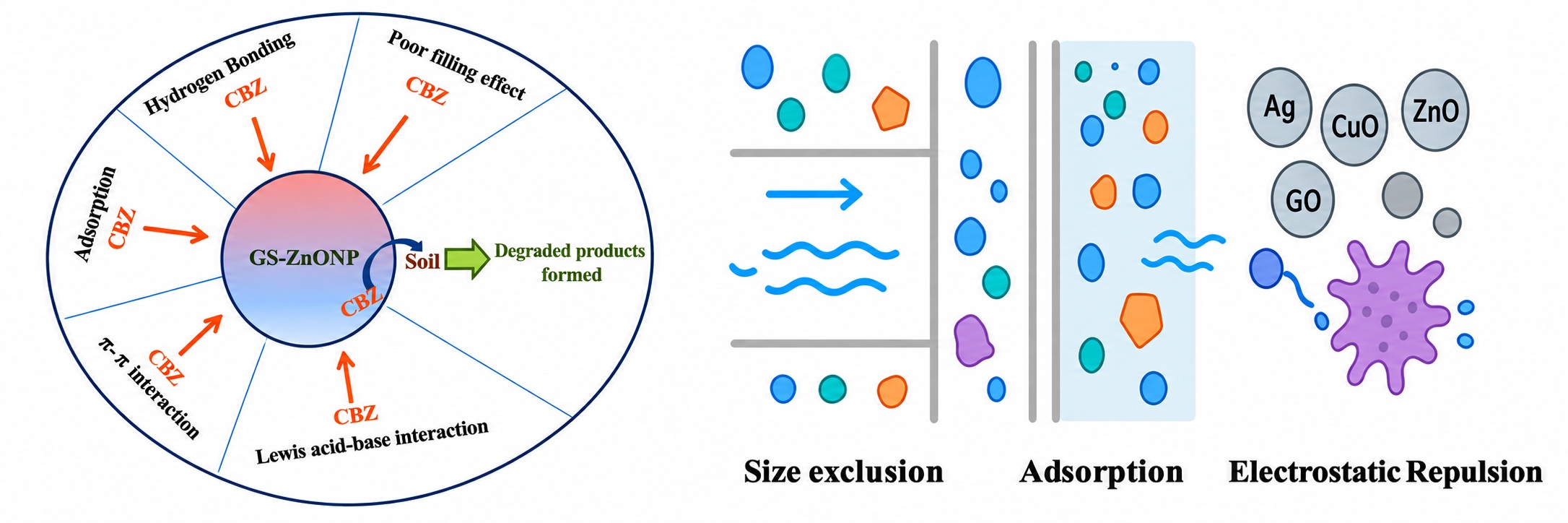
Nanomaterials show fast adsorption rates as nanosorbents with decreased treatment times due to their nanoscale dimensions; hence, these can be used to remove the organic and inorganic pollutants from wastewater. Green-synthesized zinc oxide nanoparticles (GSZnO NPs) follow an adsorption mechanism for degrading the carbamazepine (CBZ) pollutant, which includes various interactions such as hydrogen bonds, π-π electron interactions, electrostatic interactions, and hydrophobic interactions, as shown in Figure 3. These interactions were investigated by FTIR and XRD spectroscopy techniques [21]. Further, a leaching experiment was performed to evaluate the CBZ toxic behaviour to GSZnO NPs through soil columns.
Anis et al. proposed the mechanism for catalytic reduction of organic dyes Methyl orange (MO) and Methylene Blue (MB) in wastewater using ZrO2-Au nanocomposite and NaBH4 as reductant [22]. This mechanism includes the adsorption of BH4- and MO (or MB) dyes on the surface of ZrO2-Au nanocomposite, and electrons are transferred from BH4- through ZrO2-Au nanocomposite to MO (or MB) dyes. Afterwards, the degraded dyes leave the surface of the ZrO2-Au nanocomposite.
2.1.3. Membrane filtration
Membrane filtration technologies are vital in water and wastewater treatment because of their high efficiency in removing a wide spectrum of pollutants, including trace metals, organic compounds, pharmaceuticals, and microorganisms. Various techniques such as microfiltration (MF), nanofiltration (NF), ultrafiltration (UF) and reverse osmosis (RO) can be utilized to eliminate pathogens, dissolved salts, suspended solids, heavy metals and complex organic micropollutants such as endocrine-disrupting compounds (EDCs) and pharmaceutical residues from contaminated water in an effective manner. These processes are accomplished through three vital mechanisms: pore-size sieving (size exclusion), adsorption, and electrostatic repulsion, as demonstrated in Figure 4 [23-25].
Pore size sieving (size exclusion)
The size exclusion mechanism depends on the dimensions of the membrane pore, where contaminants bigger than the pores are blocked, allowing selective filtration [26]. Membranes with nanopores are adjusted to target pollutants, permitting purified water to pass while keeping out larger molecules, with efficiency determined by the relationship between contaminant dimensions and pore size [27]. For instance, Samari et al. reported that introducing a zirconium-based metal-organic framework (MOF) in a PES ultrafiltration (UF) membrane increases the porosity from 61.2% to 94.02% [28].
Adsorption
Elfiky et al. [29] reported that adsorption is largely driven by electrostatic and hydrophilic interactions between the membrane and pollutants. Embedded nanomaterials capture contaminants through van der Waals interactions, π–π stacking, electrostatic forces, and hydrogen bonding, while hydrophilicity further enhances efficiency. This mechanism is extensively used for removing dyes, trace metals, and antibiotics depending on the strong affinity between contaminants and adsorbent sites for efficient wastewater treatment [30, 31]. In addition, PAN/TiO₂ composite nanofiber membranes have demonstrated higher adsorption capacities for Cd(II) and Pb(II) ions (55 mg/g and 109 mg/g, respectively) compared with pure PAN membranes (28 mg/g and 53 mg/g for Cd and Pb, respectively). This enhancement is ascribed to the extra adsorption sites given by TiO₂ nanoparticles, which substantially enhance the overall removal efficiency [32].
Electrostatic repulsion
The mechanism of electrostatic repulsion functions by modifying the surface of the membrane to contain a specific charge, which resists the contaminants of similar charge. This prevents the same-charged pollutants from coming into contact or passing through the membrane, thereby further enhancing filtration efficiency and reducing fouling. Mousavi et al., for instance, demonstrated that a thin-film nanocomposite (TFN) membrane comprising chitosan-wrapped multiwalled carbon nanotubes achieved a high rejection rate of ~97.5% for malachite green (MG) dye. This higher performance was ascribed to electrostatic repulsion between the cationic dye molecules and the positively charged carbon nanotubes [33].
2.1.4. Disinfectant
Nanostructured materials with high antimicrobial properties possess great potential for treating pathogenic bacteria and virus-contaminated water. Unlike conventional chemical treatment methods, nanomaterials provide various advantages, as they remain comparatively stable in water and release the least toxic by-products. Among several options, silver, TiO₂, ZnO, and carbon-based nanomaterials are the most widely investigated antimicrobial agents [34, 35]. Nanoparticles can exert antimicrobial effects either via direct interaction with microbial cells, such as interrupting transmembrane electron transfer, disrupting or entering the cell envelope, and oxidizing important cell components, or indirectly by producing secondary products, including dissolved metal ions and reactive oxygen species (ROS), which further bring on cellular damage [36]. The mechanism of antimicrobial effect by nanomaterials is shown in Figure 5.
Nanostructured materials such as silver, ZnO, TiO₂, and C₆₀ produce hydrogen peroxide (H₂O₂) and reactive oxygen species (ROS) within microbial cells, leading to membrane disruption and protein damage, ultimately resulting in cell death. Similarly, carbon-based materials, including carbon nanotubes and graphene, are highly effective in disinfection and microbial control, as they induce oxidative stress and kill microbes by oxidizing essential cellular components [37, 38].
2.2. Metal / Metal oxide-based nanoparticles for wastewater treatment
Various metal / metal-oxide based nanocatalysts have found their application in wastewater treatment due to their excellent catalytic properties and high surface area, which enhances the faster adsorption and degradation of pollutants from wastewater [39-42]. Some examples of metal/ metal oxide-based catalysts for wastewater treatment are as follows:
2.2.1. Ag-based nanoparticles
Various nanoparticles such as silver nanoparticles, titanium dioxide, chitosan, fullerenes, and carbon nanotubes show excellent antibacterial action [41, 43]. It may be attributed to their weak oxidizing power and inertness in water [44]. Ag nanoparticles can also be employed for removing various heavy metal ions from contaminated water [10]. Sumesh et al. synthesized a novel adsorbent utilizing dimercaptosuccinic acid-protected Ag nanoparticles and activated alumina for removal of mercuric ions from water [10]. El-Tawil et al. synthesized a nanocomposite based upon Ag nanoparticles and quartz nanoparticles using the sol-gel process, where table sugar was used as a chelating agent. The synthesized nanocomposite was also utilized to remove mercuric ions from water and perfectly aligns with Langmuir adsorption, following pseudo-second-order adsorption [45, 46]. Zhao et al. synthesized Ag nanoparticles which were utilized for removing copper from contaminated water with maximum adsorption of 25.25 mg/g. Wu et al. utilized Ag nanoparticles for adsorption of cadmium from wastewater, showing a maximum adsorption capacity of 19.6 mg/g. Silva-Holguίn et al. explored the size, morphology, and surface charge of Ag nanoparticles that influence the antimicrobial activity, sensor design, and photo-catalysis towards pollutants [47]. Although the use of Ag nanoparticles helps in removing metal ions from aqueous media, various adsorbent materials functionalized with different sizes and concentrations of Ag nanoparticles improve the adsorbent capacity. The functionalization with Ag nanoparticles produces changes in textural properties of adsorbent materials. These properties vary with the concentration utilized during the functionalization process. For instance, in 2021, Kaur et al. explored that there is an increase in textural properties when Ag nanoparticles of concentration 5mM used in functionalizing chitosan-polyvinyl alcohol hydrogel [48]. Similarly, in the subsequent year, Jing et al. reported that with an increase in the percentage of Ag nanoparticles from 1-5% during functionalizing bamboo-based cellulose carbon aerogel, there is an increase in the surface area [49].
Ag NPs are widely studied for antimicrobial, adsorptive, and catalytic properties in wastewater treatment due to large surface area, antimicrobial action, and ability to interact with microbes. Most of the reported Ag NPs have high removal efficiencies for organic pollutants. The following Table 1 shows the limitations of Ag NPs and research gap [50, 51].
2.2.2. Iron-based Nanoparticles
Magnetic iron-based nanoparticles are mainly represented as nano zero-valent iron (n-ZVI), hematite (α-Fe2O3), maghemite (γ-Fe2O3), and magnetite (Fe3O4) [52]. Several studies revealed the impact of magnetic iron-based nanoparticles on the growth and metabolism of algal-bacterial consortia. It was found that a variety of potential mechanisms involved during material transfer and signal transmission of iron-based nanoparticles affect the algal-bacterial symbiotic establishment [52]. Therefore, magnetic iron-based nanoparticles can be successfully employed in the algal-bacterial wastewater treatment field via an eco-friendly, cost-effective, and convenient technology. Nowadays, algae-bacteria symbiosis technology has displayed significant results in the removal of nitrogen and phosphorus from wastewater. Recently, iron oxide nanoparticles, magnetite (Fe3O4), have gained attention in the field of biotechnology due to their strong magnetism, low toxicity, and high physicochemical adsorption ability. Ali et al. successfully cultivated granular sludge by addition of Fe3O4 and Fe2+, which promotes the formation of algal-bacterial symbiotic granules via electrostatic action and chemical bonding [53]. The presence of heavy metals in water is a matter of concern as it can severely impact aquatic ecosystems, wildlife, and human health. Iron-based nanoparticles can be successfully employed for the removal of heavy metals from sewage effluent due to their large surface areas, distinct shapes, and strong stability for heavy metal adsorption from wastewater [54]. Devatha et al. utilized Fe2O3 nanoparticles coated over Bacillus subtilis for adsorption of Cd (II). The adsorption was tried at a range of pH, temperature, and pollutant concentration and was found to follow pseudo-second-order kinetics [55]. Hao et al. synthesized Fe3O4 nanoparticles via a simple, green, and efficient method. For the synthesis, a natural biomass such as wheat straw is used as a precursor. Thereafter, ferric nitrate is added, and water acts as the solvent during hydrothermal carbonization. After being subjected to hydrothermal treatment for several hours, the solid product obtained is heated in a CO2 atmosphere, which results in crystallization of Fe3O4 within the porous carbon matrix. The synthesized nanoparticles were employed for adsorption of Cr (VI), showing maximum adsorption of 17mg/L [56]. V’elez et al. synthesized Fe2O3 nanoparticles, which were stabilized using Aloe Vera, and utilized for mercury removal with a maximum removal rate of 85%. The removal of lead was also carried out using Fe3O4 nanoparticles modified via tangerine peel extract [57]. Kadi et al. utilized α-Fe2O3/g-C3N4 nanoparticles as a photocatalyst to minimize the Hg (II) concentration in water in the presence of visible light. The synthesized nanocatalyst was found to transform Hg(II) completely in aqueous solution of concentration 100 mg/L in a time span of 60 min [58]. Mohamed et al. synthesized iron oxide nanoparticles via a greener approach utilizing clove and green coffee extracts for removing Cd2+ and Ni2+ ions from wastewater with average adsorption rates of 76 mg/g and 70 mg/g, respectively [59]. Chiavola et al. synthesized Fe3O4 nanoparticles via mixing of FeCl3 solution, HCl solution, and Na2SO3 solution followed by addition of ammonia solution on a rotating disc reactor. They were shown to remove 100% As from aqueous solution at a pH of 3.4 [60]. Zhu et al. synthesized Fe(OH)3@cellulose nanoparticles via the electrospinning method to remove heavy metal ions from contaminated water. The synthesized nanocomposite displayed high mechanical strength and excellent adsorbing capacity via hollow nanofiber structure of cellulose [61].
Iron-based NPs possess high efficiency in removing heavy metals, organic dyes, and contaminants by adsorption and advanced oxidation processes. Compared to the noble metal systems, iron-based NPs are more sustainable alternatives due to their low material cost and environmental compatibility. However, there exist a few limitations and research gaps which shown in Table 2 [62].
2.2.3. ZnO-based nanoparticles
ZnO nanoparticles can be successfully employed as nano photocatalysts for eliminating nitrogen oxides (NO) and organic pollutants when exposed to visible light. Moreover, photocatalytic activity of ZnO NPs improves with the addition of certain dopants such as metal, metal oxides, N-type semiconductors, and carbon derivatives. Vo et al. synthesized p-n CuO/ ZnO heterojunctions via a one-step greener approach utilizing rosin as the main agent [63]. The synthesized nanocatalyst was found to degrade tetracycline and ciprofloxacin in a better way. Thus, it can be utilized to degrade both pharmaceutical and industrial wastewater containing dyes and other pollutants such as phenol and nitrogen oxide (NO) [63, 64]. In addition to this, ZnO nanoparticles derived from Azadirachta Indica proved to be an excellent adsorbent for antiepileptic drug carbamazepine (CBZ). Thus, the synthesized nanoparticles were utilized for successfully removing CBZ from wastewater and soil. It was found to remove 92.89% of CBZ from wastewater at optimum conditions of pH 5.0, 100 mg of adsorbent, and 12 mg/L of CBZ at 25 ℃ ± 2 ℃ [65]. The utility of ZnO nanoparticles can also be seen in the removal of heavy metal ions such as Ag (I), Cu (II), and Pb (II) from wastewater, which may be attributed to their large surface area to volume ratio. Chukwuemeka-Okorie et al. synthesized ZnO NPs using Costus afer leaf extract via a greener approach and found to adsorb Cd(II) and Pb(II) from contaminated water in an efficient way [10].
Numerous work has been reported for photocatalytic properties of ZnO NPs. However, the results directly do not relate to the real wastewater conditions, which contain mixtures of heavy metals, surfactants, and organic matter that reduce the photocatalytic rates [66]. Several research study still lacks normalized performance metrics such as quantum yield under solar radiation. A few limitations of ZnO photocatalysts are observed, such as restriction of absorption in the UV range due to constraints in bandgap (~3.37 eV); however, the electronic structure of ZnO can be enhanced to absorb UV-visible light by doping it with Ag, Fe3+, Mg2+, etc. Another major limitation of ZnO NP is the photogenerated electrons and holes, which reduce the number of reactive oxygen species produced to break down pollutants. ZnO NPs also tend to agglomerate, which further reduces the surface area and hence decreases the photocatalytic efficiency [67]. The recovery and reuse of ZnO NP as a catalyst is seldom discussed since these NPs in colloidal form are difficult to separate post-treatment, with incomplete recovery, which may pose risks and raise ecological concerns. There is a growing concern over the release of ZnO NPs, which contribute to ecotoxicological risks in aquatic systems that include toxicity to algae, invertebrates, and microbes. However, systematic life-cycle and environmental fate assessment must be studied as a part of future perspective. In the future, it is necessary to standardize metrics for photocatalytic performance. There must be a shift in evaluation from pollutant studies to real wastewater system which, includes organic, inorganic, and biological contaminants. Furthermore, incorporation of techno-economic and life cycle assessments must be there for environmental impacts of ZnO systems. Table 3 describes the key limitations of ZnO NPs and the research gap [67].
2.2.4. TiO2 based nanoparticles
TiO2-based NPs have been widely studied as a photo-catalyst for the treatment of wastewater due to high oxidative potential, chemical stability and non-toxicity. In the presence of photons or UV radiation, TiO2 produces reactive oxygen species, which are able to degrade pathogens, micro-pollutants and certain heavy metals through advanced oxidation processes (AOP) [68]. The synthesis of TiO2 involves the sol-gel hydrothermal process, chemical vapor deposition method, and photochemical process. TiO2 usually follows the electron-hole pair mechanism, which leads to the formation of hydroxyl radicals and superoxide ions that eventually help in the degradation of pollutants into smaller molecules such as CO2, H2O, and other ions [69]. In recent years, researchers have doped TiO2 with metals or non-metals and sometimes combined it with graphene oxide or carbon nanomaterials, which improves its light absorption and charge separation capacity [70]. In 2024, the mixture of zero-valent iron and TiO2 hetero nanocomposites has been used to remove chromium in the wastewater by reducing Cr(VI) to Cr(III) [71]. Rojas in 2025 discussed TiO2 nanocomposites that achieve a higher percentage (approx. greater than 90%) of degradation of compounds such as triclosan, diclofenac, etc. under solar radiation [72]. Most TiO2 research remains at laboratory scale with small reaction volumes. However, the key scalability issues include catalyst recovery. The suspended TiO2 NPs are usually difficult to recover after treatment. Filtration at larger scales is expensive and energy intensive, followed by incomplete recovery, which can pose a risk of NPs being released into the ecosystems [73]. Due to the large bandgap of TiO2 (~3.2 eV), this limits the absorption to the UV region, which accounts for a small fraction of solar radiation, reducing the visible light utilization that is required for solar-driven energy systems [74]. However, this can be overcome with doping of TiO2 with metals or non-metals coupled together with other semiconductors or carbon-based materials. Regarding the stability of TiO2 NPs, it has been observed that TiO2 is chemically and thermally stable; however, in wastewater, surface fouling and catalyst deactivation are observed due to the presence of organic matter. Hence, protective coatings and surface stability are required for a longer time period stability [75]. To make TiO2-based photocatalysis viable for wastewater treatment, future research must prioritize standardized metrics which adopts a common benchmarks such as normalized degradation rate and robustness in various wastewater types. This will enable a fair cross-study comparison. TiO2 must integrate with biological treatment and membrane systems to address various pollutant classes. Furthermore, incorporation of Life cycle assessment to assess the sustainability and cost implications is required. Although TiO2-based NPs show photocatalytic processes under laboratory conditions, their real-world application is hindered by the cost, scalability, and environmental impacts. The limitations of TiO2 based NP and research gaps are shown below in Table 4 [75].
2.2.5. Miscellaneous
Various other metal oxide-based nanoparticles can also be utilized as potent adsorbents and oxidizing agents for removal of pollutants from wastewater [10]. Zhang et al. synthesized manganese dioxide-coated magnetic nanoparticles via a redox precipitation technique involving deposition of MnO2 nanoparticles onto charcoal. The synthesized NPs were found to remove cadmium from wastewater and were further explored for removing other heavy metal ions such as Cu (II), Pb (II), Cd (II), and Zn (II) [76]. Al2O3 NPs synthesized via the hydrothermal method were utilized to remove lead and cadmium ions from wastewater in an efficient manner [77]. Ghanbari et al. synthesized nanofiltration-embedded membranes via incorporation of ferrite nanoparticles, i.e., CoFe2O4, NiFe2O4, and ZnFe2O4 onto polyethersulfone (PES). The synthesized nanomembranes were found to efficiently remove chromium, copper, and lead ions from contaminated water due to a decrease in their pore size [78].
2.3. Carbon-based nanomaterials for wastewater treatment
Carbon-based nanomaterials are a broad class of substances composed of carbon atoms, known for their unusual versatility and diverse applications. Due to carbon’s unique ability to form numerous types of bonds and structures-like chains, rings, and frameworks-these materials display a wide range of physical, chemical, and electronic properties. These materials play a crucial role in the development of materials science [79-83]. Extending from traditional industrial forms like activated carbon and carbon black to advanced materials such as carbon fibers and graphite, together with emerging carbon nanomaterials like graphene and carbon nanotubes (CNTs), these materials keep on drawing significant interest. Their extensive application and ongoing research are driven not only by their distinct structural and functional properties but also by their environmental friendliness. Due to their selectivity and high surface area, they can be used for photocatalytic degradation and adsorption of myriad pollutants from contaminated water. Metal ion adsorption occurs through electrostatic interactions, ion exchange, complexation, pore filling, hydrogen bonding, and π–hydrogen interactions, while organic pollutant adsorption is mainly driven by hydrophobic, n–π, π–π, and Lewis acid–base interactions. π–π interactions arise between aromatic regions of carbon nanomaterials and target pollutants [84, 85]. The mechanism for photocatalytic degradation involves the generation of electron–hole pairs upon light absorption, which produces hydroxyl radicals that oxidize pollutants. Thus, carbon nanomaterials remove contaminants through adsorption, photocatalysis, or their synergistic combination, depending on adsorbent properties and pollutant type [86, 87]. As a result, carbon-based materials remain a central focus in chemistry, materials science, and various interdisciplinary fields [79-83]. Few examples of carbon-based nanoparticles utilized for wastewater treatment are as follows:
2.3.1. Carbon nanotubes (CNTs)
Carbon nanotubes (CNTs) are cylindrical nanostructures comprising six-membered carbon atom rings and can be represented as rolled-up sheets of single-layer graphene. Depending on the number of concentric graphene layers present, CNTs are categorized as single-walled carbon nanotubes (SWCNTs) and multi-walled carbon nanotubes (MWCNTs). SWCNTs typically have a diameter of around 1 nm and resemble a rolled-up sheet of sp²-hybridized carbon, such as graphene. In contrast, MWCNTs consist of multiple concentric layers of sp² carbon sheets, forming elongated hollow cylinders with diameters ranging from 3 to 30 nm [87, 88]. Since the discovery of carbon nanotubes (CNTs) by Iijima et al. in 1991, various technologies have evolved to synthesize them in considerable quantities [89]. CNTs combine extraordinary mechanical strength, electrical conductivity, and thermal stability, making them extremely valuable for energy storage applications. Their hexagonal lattice allows efficient charge transport, while their large surface area and electrochemical stability improve performance in applications like lithium-ion batteries (LIBs) and electrochemical supercapacitors (ESCs). Due to these distinct structural and functional properties, CNTs are broadly used in both scientific research and industrial applications. Bhanjana et al. [90] employ multi-walled carbon nanotubes (MWCNTs) for removing Cd from polluted water with the highest adsorption capacity of 181.8 mg/g. In addition, CNTs were found to exhibit strong adsorption affinity for Tl, Cr, Pb, Cu and Mn due to their large surface area and fast adsorption kinetics [91].
2.3.2. Carbon dots
Carbon dots (CDs), in general, are defined as quasi-zero-dimensional carbon-based nanomaterials with sizes below 20 nm. This category includes carbon nanodots (CNDs), carbon quantum dots (CQDs), and graphene quantum dots (GQDs). Carbon quantum dots contain nanocrystalline cores or spherical structures enclosed by amorphous carbon shells. In contrast, carbon nanodots are established from aggregates of nanoscale polymers and usually show a lower degree of carbonization. Graphene quantum dots, in contrast, are comprised of one or a few layers of graphene or graphene oxide (GO), merging the structural features of graphene with nanoscale quantum effects [92]. CDs have gained significant interest due to their remarkable and tunable photoluminescence (PL), low toxicity, high quantum yield (QY), excellent biocompatibility, small size, and availability from ample, inexpensive sources. These properties make them highly promising for a wide range of applications, including biomedicine, catalysis, optoelectronic devices, and anti-counterfeiting technologies [93-96]. In addition to this, carbon dot-composites are easy to regenerate and possess various functional moieties in addition to a massive surface area, making them more efficient for removal and degradation of pollutants in contaminated water. Miao et al. synthesized a CDs-AuNCs-based sensor which was found to selectively detect tetracycline (TC) in a wastewater sample [97]. Similarly, CDs-AgNCs proved to be potent sensors for colorimetric detection of phoxim in contaminated water with high accuracy and reproducibility [98]. Recently, an Au/CDs based nanocluster was synthesized comprising a multi-colourful fluorescent nanoprobe for colorimetric and fluorescent sensing of Hg2+ and Cr6+ separately and simultaneously [99].
2.3.3. Graphene family
Graphene is a two-dimensional (2D) material composed of a single layer of carbon atoms bonded through sp² hybridization, arranged in a tightly packed honeycomb lattice [100]. Graphene oxide (GO) is an oxidized form of graphene that is yellow in colour and a hexagonal lattice-like solid containing carbon, oxygen, and hydrogen in varying proportions. The incorporation of oxygen-containing functional groups enhances GO’s suitability for energy storage by improving its interaction with electrolytes and boosting electrode performance. However, chemical modification of these groups enables tuning of GO’s electrical, mechanical, and thermal properties [101]. Owing to its structural diversity, low-cost production, and functional tunability, GO is extensively utilized in wastewater treatment and different energy storage devices, including batteries, supercapacitors, and fuel cells [102-105]. Dizaj et al. utilized graphene oxide for removing mercury from contaminated water, showing utmost adsorption capacity, i.e., 68.03 mg/g. The generated graphene oxide, when combined with Fe3O4 to form magnetic graphene oxide (GO/Fe3O4), was found to effectively remove Cu2+, Pb2+, Zn2+, Cr3+, and Ni2+ from the wastewater [101].
2.3.4. Fullerene
Fullerene is a carbon-based nanomaterial with zero dimensions and an average diameter of approximately 0.7 nm. It contains 60 or 70 carbon atoms, which are arranged in a highly symmetric, spherical, cage-like structure. This geometry, looking like a hollow sphere, can be imagined as a single-layer graphene sheet seamlessly enclosed into a closed shell. Owing to their large surface area, strong electron-accepting capability, and ease of synthesis further enhance their ability as efficient adsorbents for the removal of pollutants from wastewater. [106, 107]. The interaction between target contaminants and the π-electrons of fullerenes serves as a crucial driving force for the adsorption of pollutants from wastewater. Incorporating trace amounts of fullerenes into other materials, such as activated carbon (AC), lignin, and zeolites, has been shown to yield nanocomposites with significantly enhanced adsorptive capacities toward various pollutants [108].
2.3.5. Nanodiamond
Nanodiamonds (NDs) are a prominent class of zero-dimensional (0D) carbon-based nanomaterials, typically ranging in size from 1 to 150 nm. Structurally, NDs can be viewed as small clusters of sp³-hybridized carbon atoms, where each atom-except those at the boundary-is covalently bonded to four nearest neighbors, forming a robust and symmetric lattice [109]. NDs were first synthesized in the early 1960s through explosive shock methods [110]. Nanodiamonds (NDs) are synthesized mainly by two methods: the static method, which uses high pressure and temperature to yield high-purity particles, and the dynamic method, a more economical approach that employs carbon-rich precursors and explosive reactions for large-scale production [111]. Nanodiamonds (NDs) are highly biocompatible and low in toxicity, with a stable diamond core and tunable surface that allow functionalization for applications in adsorption, drug delivery, imaging, and composite materials [112]. Brenner et al. [113] utilized ND-based materials for the first time for adsorption of fluorescent dyes via electrostatic forces of attraction. ND-based nanomaterials were utilized as activators for peroxymonosulphate (PMS), which resulted in the generation of sulphate radicals degrading myriad water pollutants [114]. Ulla et al. synthesized activated carbon adsorbents from seeds of Albizialebbeck and Melia azedarach trees, which were utilized for the removal of Pb and Cd metals from contaminated water [115].
3. Comparison between metal and carbon-based nanomaterials
Carbon-based nanoparticles include carbon nanotubes, carbon black, nanodiamonds, fullerenes and their derivatives, graphite nanoparticles, and graphene oxide. Owing to their versatile morphologies and diverse properties such as exceptional electronic and thermal conductivity, these nanomaterials find applications across a broad spectrum, ranging from biomedicine and nano-electronics to mechanical engineering, as shown in Table 5 [116, 117]. In comparison, metal nanoparticles are among the most extensively employed nanomaterials and are widely used in areas including solar cells, cosmetics, UV-blocking agents in sunscreens, paints, coatings, and environmental remediation, as demonstrated in Table 5.
In the wastewater treatment context, both carbon- and metal-based nanomaterials have shown remarkable pollutant removal capabilities, with carbon-based materials excelling in adsorption-driven processes and metal-based nanoparticles exhibiting high catalytic degradation ability [116, 117]. The efficiency of wastewater removal using carbon-based and metal-based nanomaterials depends on the type of pollutant, operational conditions, and treatment method, as demonstrated in Table 6.
Carbon-based nanomaterials, in general, shine in providing stable, reusable adsorption capabilities with comparatively low toxicity, making them appropriate for long-term and eco-friendly applications. On the other hand, metal-based nanomaterials show superior catalytic degradation performance, allowing rapid breakdown of contaminants. The crystalline structure of metal oxide nanoparticles, created by arranging metal and oxygen atoms, governs vital properties like conductivity, reactivity, and size, making them appropriate for targeted applications such as wastewater treatment [136]. The performance of MONPs in antibacterial action and dye removal depends on their stability, morphology, and aggregation behavior, whereas their magnetic properties further improve their ability for efficient pollutant removal [136, 137]. Lately, carbon-metal nanocomposite hybrids have turned up as highly favourable candidates for wastewater treatment, as they merged the high adsorption capacity of carbon materials with the amplified catalytic activity of metal-based counterparts, thereby achieving both increased efficiency and diversity in pollutant removal.
4. Toxicity of Nanomaterials
The projected growth in nanoparticle production and applications is likely to increase both environmental and human exposure. The nanomaterials that are present in the environment may lead to accumulation in soil and water, which may disrupt the photosynthesis process. For instance, ZnO nanoparticles translocate/ transport in plant tissue and further initiate oxidative stress in ecosystem species [138]. In addition to this, nanomaterials may exhibit unique sensitive patterns, from inhibiting growth to improper reproduction processes in case of various aquatic species such as fish, algae, and various invertebrates. This may result in ecological risk assessments. Algae are sensitive to nanoparticle-induced oxidative stress, inhibiting photosynthesis and growth [139]. Invertebrates such as Daphnia magna have disrupted reproductive behaviour and growth due to aggregation of NPs [140]. In humans, nanoparticles can enter the body through multiple routes, including inhalation through the respiratory system, ingestion via the gastrointestinal tract, skin contact, and direct injection into the bloodstream. Once entered into the body, they can penetrate cellular barriers and accumulate in vital organs such as the liver, lungs, and kidneys, leading to mitochondrial dysfunction, DNA damage, and ultimately causing cell apoptosis or death. The major mechanism underlying this toxicity is the excessive production of reactive oxygen species (ROS), which causes oxidative stress, inflammation, and successive damage to proteins, cell membranes, and DNA [141-145]. The degree of ROS production caused by nanoparticles depends on various factors, which include particle size, surface characteristics, shape, chemical composition, degree of aggregation/agglomeration, solubility, cellular uptake, and the presence of mutagens or transition metals linked with the particles [130-134]. However, certain other mechanisms associated with toxicity caused by nanomaterials generally include membrane disruption and cellular uptake, inflammation, and genotoxicity. The size, shape, and surface properties of NP dictate the preferred uptake route and efficiency. Smaller nanoparticles, less than 50 nm, enter the cell more efficiently, whereas larger-sized particles are often engulfed through phagocytosis. The positively charged particles readily bind the cell membranes, enhancing uptake [146].In addition to this, nanoparticles also trigger immune responses. NPs can activate neutrophils, macrophages, and dendritic cells, which may lead to the release of inflammatory cytokines such as Interleukin-1 beta (IL-1β), Interleukin-6 (IL-6), etc. [147]. In general, hydrophobic and positively charged nanoparticles induce inflammation compared to neutral or hydrophilic particles. In some cases, due to interference and exposure of metal/metal oxide based NP, chromosomal abnormalities and replication interference occur, and hence, the double helix strands of DNA break [148]. A few nanoparticles displaying toxic effects are explained in this section. Ag NPs in wastewater undergo chemical transformations and lead to the formation of Ag2S precipitate [149]. Ag NP toxicity reduces the survival and growth of algal species such as Skeletonema costatum by damaging their cell membrane [150]. The mechanism of toxicity involves oxidative dissolution of Ag NPs, which generates reactive Ag+ that are responsible for inflammation, DNA damage, and cell rupture of biological species present in water [151]. The use of TiO2 NPs in wastewater treatment is because of its large photocatalytic activity. However, there is an increase in toxicity to aquatic life and human health due to bioaccumulation. TiO2 NPs lead to accumulation in wastewater sludges, which are used as soil amendments; however, impacting during downstream sludge treatment. TiO2 NPs disrupt the cell membranes of biological species in water due to the production of reactive oxygen species (ROS) [152]. These NPs are also responsible for inhibition of enzyme activities and lead to organic degradation. Large amounts of nanoscale ZnO and TiO2 in the aquatic environment delay zebrafish embryo and larval development [153]. Furthermore, behavioural changes are seen in the case of zebrafish along with lethal impacts in other aquatic species due to high exposure of Fe3O4 nanoparticles [154]. Gliga et al. revealed size-dependent cytotoxicity of silver nanoparticles since only the 10-nm silver nanoparticles were cytotoxic for the human lung cells starting at doses of 20 μg/mL [155]. Rizk et al. found that the liver function enzymes, oxidative stress markers, and liver histological pattern were greatly influenced by dose and time of titanium oxide nanoparticles (21 nm), while the genetic disturbance started at the high dose (500 mg/kg body weight) of exposure and for long duration (45 days) [156]. Shipelin et al. investigated the effects of fullerene dispersion on the iliac mucosa and liver at doses of 0.1, 1.0, and 10 mg/kg body weight over 92 days in vivo, and observed hepatic toxicity at the highest dose of 10 mg/kg [157]. Similarly, an in vitro study by Horie et al. reported that exposure to C70 fullerene for 24 h at a concentration of 25.2 µg/mL induced intracellular ROS generation in human keratinocyte and lung carcinoma cells [158]. Various efforts of coating nanomaterials with biocompatible materials are in progress to make the nanomaterials ecologically friendly and to increase their stability and durability. Researchers are designing safer nanomaterials by using coating or capping agents and using artificial intelligence and machine learning to forecast toxicity based on physicochemical properties.
5. Limitations of metal and carbon-based nanomaterials in wastewater treatment
Metal and carbon-based nanomaterials are extensively studied due to their wide range of properties and high reactivity. However, various critical drawbacks limit their large-scale application.
5.1. Scalability challenges
While synthesis at the laboratory level is well-established, the scaling of both metal and carbon nanomaterials with consistent size, morphology, and reactivity to industrial production faces significant difficulty. For metal nanomaterials, batch-to-batch variability, aggregation, and the requirement of controlled synthesis environments are major challenges [159]. On the other hand, carbon nanomaterials are more scalable than metal nanomaterials, but still some hurdles persist at industrial scale. These include agglomeration during synthesis on a large scale, and difficulty in shaping carbon nanomaterials into beads, membranes, or fixed beds limits their practical implementation in continuous treatment systems. These scalability challenges continue to hinder the wide industrial adoption of advanced nanomaterials for treatment of water [160].
5.2. Cost constraints
The economic feasibility of nanomaterials is restricted by extensive production costs. Metal-based nanomaterials depend on costly precursors and energy-intensive synthesis and often need expensive post-treatment steps like functionalization and stabilization. Also, recovery and regeneration processes further decrease economic feasibility [161]. In the same way, carbon-based materials involve purification, complex and costly production, and functionalization. Consequently, carbon nanomaterials remain expensive for widespread wastewater treatment applications [162].
5.3. Long-Term Stability and Regeneration
The sustainable, long-term utilization of nanomaterials is challenged by environmental risk and decay in performance. For metal-based nanomaterials, operational degradation through dissolution, oxidation, and structural breakdown results in difficult recovery, while metal leaching shows nanotoxicity concerns that obstruct regulatory acceptance [163]. Carbon nanomaterials, though more stable, undergo surface degradation and structural damage during regeneration cycles. The energy-intensive methods for regeneration themselves can be destructive, and compared to metal counterparts, carbon nanomaterials face serious concerns regarding their potential ecotoxicity and environmental fate [164].
5.4. Effects of Real Wastewater Matrices
The switch from controlled lab studies to the treatment of real wastewater signifies a substantial performance barrier for nanomaterials. In complex matrices, the presence of natural organic matter, competing ions, diverse salts, and pH fluctuation compromises functionality via various mechanisms. For metal-based variants, this type of environment facilitates particle surface passivation, agglomeration, and fouling, which together reduces the number of available active sites and diminishes adsorptive or catalytic efficiency. Moreover, these conditions can enhance the unwanted leaching of metal ions, introduce secondary contamination, and increase ecotoxicological concerns [165]. In the same way, carbon-based nanomaterials experience a marked decrement in efficiency due to blockage in pores by organic matter, competition from co-pollutants, and variation in surface charge under distinct ionic strength and pH. These matrix effects decrease adsorption selectivity and capacity, specifically for trace contaminants [166].
6. Conclusion and Future Direction
Nanomaterials are potent materials for wastewater remediation due to their massive surface area and significant reactivity. They can be utilized for the removal of various organic and inorganic pollutants from wastewater, ranging from organic dyes, pharmaceutical and agricultural compounds, and heavy metal ions posing a great threat to our environment. Zero-valent metals, metal oxides, and carbon-based NPs can be successfully deployed in the recovery of wastewater containing myriad pollutants. One of the most promising approaches also includes the utilization of nanocomposites of multifunctional polymers and inorganic solids for wastewater remediation. There is a need of expense control and proper scaling up of nanomaterials in wastewater treatment before it is commercially used on a large scale. In addition to this, health hazards associated with nanomaterial toxicity must be considered. Materials such as TiO2, ZnO, Fe3O4, and Ag NPs have shown promising results in the removal of contaminants, organic pollutants, heavy metals, dyes, etc. from water. Mechanisms such as adsorption, redox reactions, photocatalysis, etc. enable these nanomaterials to treat water samples. The integration of a TiO2 photocatalyst with electrochemical treatments can help in reducing pollutants. Despite having advantages, challenges still exist due to the toxicity of nanoparticles, agglomeration of particles making them persistent in the environment and affecting aquatic species. Future research must focus on eco-friendly synthesis of nanoparticles using plant extracts or microorganisms. The development of hybrid nanocomposites such as metals and their oxides with carbon-based materials (graphene) enhances the stability and reusability of materials. It is essential to study the environmental and health impacts of nanoparticles before their usage in the treatment of water. With continuous research and development, nanomaterials would play a vital role in treating water samples in the future.
Author's Contributions
Study Conception or Design: Vineet Verma, Vivek Das
Data Acquisition: Priyanka Yadav, Himshikha Sharma
Data Analysis or Interpretation: Vineet Verma, Vivek Das
Manuscript Drafting: Vineet Verma, Priyanka Yadav, Vivek Das, Himshikha Sharma
Critical Manuscript Revision: Vineet Verma, Vivek Das
All authors have approved the final manuscript and are responsible for all aspects of the work.
Conflict of Interest Statement
The authors declare no conflict of interest.
Funding Declaration
No funding has been received.