Document Type : Original Research Paper
Graphical Abstract
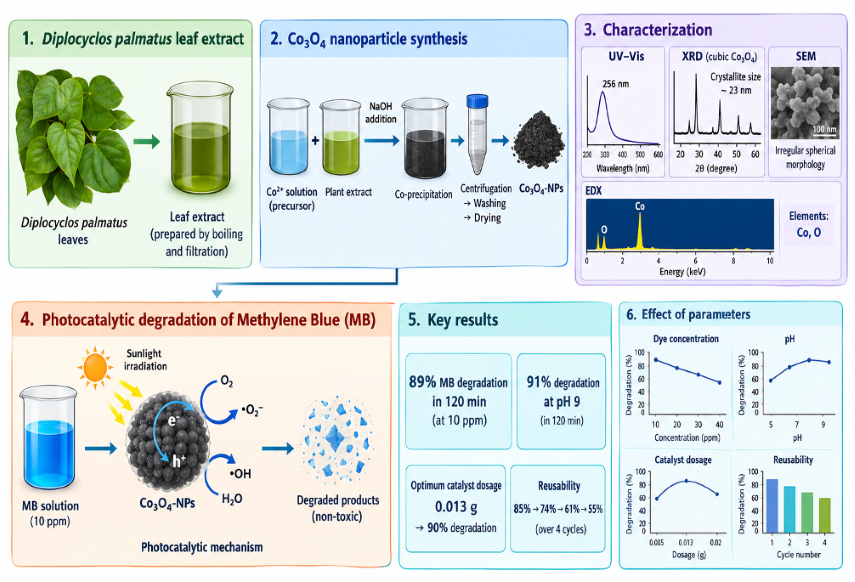
Highlights
Please note: The following content displays the text-only preview. For the full article, complete with all illustrations, data tables, and equations, please download the free PDF from the sidebar at the top of this page.
INTRODUCTION
Water pollution has intensified due to population growth and industrial expansion, leading to both water scarcity and deteriorating water quality. Addressing this challenge is critical for safeguarding human health, ecosystems, and drinking water safety [1, 2]. Since water is essential for all forms of life, ensuring its quality is vital not only for humans but also for other living organisms. A primary contributor to water contamination is the persistent discharge of non-recyclable industrial pollutants [3], with synthetic dyes representing a major environmental concern. These dyes impede photosynthesis and pose serious health risks, including skin irritation, allergic reactions, and even cancer [4, 5].
Textile industries alone release 10–15% of dyes during the dyeing process, contributing significantly to water pollution. Purifying textile waste effluents, especially dyes, is vital for both human health and the environment. Textile dyes can be purified using a variety of processes, including biological, filtration, adsorption, sedimentation, ion exchange, UV treatment, and ozonation [6]. However, many of them are expensive, scarce, and useless in certain instances. At the moment, scientists are drawn to photodegradation as a potential method for these uses due to its high accessibility and efficiency. Conventional treatment methods such as flocculation, activated carbon adsorption, and UV-based degradation often face limitations, including high operational costs, low efficiency, and secondary pollution, rendering them environmentally unsustainable [7]. Recent developments in nanotechnology offer promising alternatives for wastewater remediation [8]. Nanoparticles possess unique properties—small size, large surface area, and tunable morphology—that make them highly effective in photocatalytic applications, enabling complete degradation of organic pollutants [9].
Photocatalytic degradation relies on sunlight-activated catalysts to produce reactive hydroxyl (•OH) radicals, which oxidize contaminants into harmless end products such as CO₂, H₂O, and inorganic ions [10, 11]. This approach is environmentally friendly, cost-effective, and more efficient than traditional techniques [12]. Among nanomaterials, metal oxide nanoparticles are particularly attractive due to their size-dependent physicochemical properties and broad applications in medicine, sensors, solar energy, and environmental technologies. Methylene blue (MB) [3, 7-bis (dimethyl amino) phenothiazine chloride tetra methylthionine chloride] is a synthetic dye widely used in textiles, paper, silk, and wool, as well as in medicine, food, and cosmetics [13]. Untreated MB discharge poses serious health risks, including cyanosis, Heinz body formation, jaundice, and vomiting [14]. Therefore, effective and sustainable removal methods are essential [15].
Despite extensive reports on green-synthesized photocatalysts for dye degradation, most studies have focused on TiO₂, ZnO, and CuO nanoparticles, while green routes for Co₃O₄ nanoparticles remain comparatively underexplored [16–18]. Moreover, many existing approaches rely on artificial UV or visible light sources and provide limited insight into catalyst stability and reusability, restricting their practical implementation [19]. The role of plant-derived phytochemicals in tailoring Co₃O₄ nanoparticle morphology and enhancing sunlight-driven photocatalytic activity has also received minimal attention. In this context, the present work addresses these gaps by employing Diplocyclos palmatus leaf extract for the green synthesis of Co₃O₄ nanoparticles via a simple co-precipitation method and systematically evaluating their sunlight-assisted degradation of methylene blue. This study demonstrates a cost-effective, sustainable, and scalable photocatalytic system with improved efficiency and reusability for environmental remediation.
In this study, Co₃O₄ nanoparticles were synthesized using leaf extracts of Diplocyclos palmatus (L.) C. Jeffrey via the co-precipitation method [20]. Co₃O₄ was selected for its favorable physicochemical properties, including a high band gap that enhances photocatalytic activity. The nanoparticles were characterized using UV–visible spectroscopy, XRD, SEM, and EDX to determine their structure, morphology, and composition. Their photocatalytic performance for MB degradation under sunlight was evaluated, examining key factors such as irradiation time, pH, catalyst dosage, dye concentration, and reusability.
This study presents a green, cost-effective approach for dye removal, demonstrating the potential of Co₃O₄ nanoparticles to overcome the limitations of conventional wastewater treatment and offering valuable insights into optimizing photocatalytic processes for environmental remediation.
MATERIAL AND METHODS
Preparation of leaf extracts
The leaves were first washed thoroughly with tap water, followed by rinsing with double-distilled water, and then air-dried at room temperature for 20 days. Once dried, the leaves were ground into a fine powder. For extract preparation, 10 g of the leaf powder was placed in a glass beaker, and 200 mL of distilled water was added. The mixture was stirred continuously on a magnetic stirrer for 3 hours. After stirring, the solution was filtered, collected, and stored for subsequent use in nanoparticle synthesis.
Synthesis of Co3O4 Nanoparticles
The mixture was stirred for 5 minutes, after which NaOH solution was added dropwise until the desired pH was reached, accompanied by an observable colour change. The resulting mixture was then centrifuged at 5000 rpm for 10 minutes. The supernatant was discarded, and the pellet containing the Co₃O₄ nanoparticles was collected and washed with distilled water to remove impurities. The purified precipitate was dried in a hot air oven at 50°C for 3 hours. The resulting fine powder was subsequently used for further characterisation.
Sunlight-driven photocatalytic degradation of MB
All experiments were carried out at Government Arts College, Coimbatore, Tamil Nadu, India (GPS coordinates: 11.0168° N, 76.9558° E) during the summer (pre-monsoon) season in May. The photocatalytic activity was evaluated under natural sunlight, and the effects of irradiation time, pH, catalyst dosage, and dye concentration were systematically studied.
Photodegradation of methylene blue dye using Co3O4 nanoparticles
The photocatalytic degradation of methylene blue (MB) dye was evaluated under sunlight using Co₃O₄ nanoparticles. MB solutions of 10, 20, 30, and 40 ppm were prepared by dissolving the dye in 250 mL of distilled water and adjusting the volume in a standard flask. For each experiment, 100 mL of MB solution was placed in a beaker, and 0.005 g of Co₃O₄ nanoparticles was added. The mixtures were kept in the dark for 1 hour to achieve adsorption–desorption equilibrium before exposure to sunlight.
The degradation of MB was monitored at various time intervals using a UV–visible spectrophotometer. The study investigated the influence of several parameters on photocatalytic efficiency, including irradiation time, dye concentration, pH, catalyst dosage, and reusability of the catalyst. Different catalyst amounts were tested to evaluate the effect of dosage. The effect of pH was studied using solutions with pH values of 5, 7, and 9, prepared by adding 1 M HCl and 1 M NaOH to distilled water prior to dye dissolution. Time-dependent degradation was monitored at intervals of 5, 15, 30, 45, 60, 75, 90, 105, and 120 minutes, and dye concentrations of 10, 20, 30, and 40 ppm were compared to assess their impact on photocatalytic activity.
Dye degradation UV-visible analysis
The photocatalytic degradation of methylene blue (MB) dye was monitored using a UV–visible spectrophotometer. The percentage of dye degradation was calculated using the following formula:
Degradation rate (%) = (C0 – C / C0) x 100 (1)
Degradation rate (%) = (A0 – A / A0) x 100 (2)
Where (C) represents the dye concentration at a given time, (C0) is the initial dye concentration, (A) is the absorbance of the dye after sunlight irradiation, and (A0) is the initial absorbance before irradiation.
CHARACTERIZATION
The Co₃O₄ nanoparticles synthesised from the fruit extracts of D. palmatus were characterised using UV–visible spectroscopy, FTIR, X-ray diffraction (XRD), scanning electron microscopy (SEM), energy-dispersive X-ray (EDX) analysis and particle size analysis. UV–visible spectroscopy was employed to study the absorption spectra of the nanoparticles. SEM (Carl Zeiss, USA, and Model Sigma with Gemini Column) was used to examine the surface morphology and particle size. EDX analysis provided information on the elemental composition, while XRD was used to determine the phase and crystalline structure of the synthesised Co₃O₄ nanoparticles.
RESULT AND DISCUSSIONS
UV-visible analysis
Typically, the UV–visible spectrum of cobalt oxide nanoparticles exhibits a strong absorption in the visible region between 200 and 350 nm. The Co₃O₄ nanoparticles synthesised from the leaf extracts of D. palmatus displayed a prominent absorption peak at 256 nm [21], corresponding to the characteristic presence of cobalt oxide, as illustrated in Fig. 1.
Fourier Transform Infrared Spectroscopy (FTIR)
FT-IR spectroscopy has been used to determine the surface functional groups, as well as their interaction with the Co3O4-NPs. The spectrum was examined for the biomolecules responsible for the stabilization of Cobalt oxide nanoparticles.
Fig. 2 shows the FT-IR spectra of Co3O4-NPs that exhibit strong peaks at the wavelength of 2916 cm-1 corresponding to the O-H stretching vibration of phenolic compounds. The peak at 1614 cm-1 is due to C=C stretching. The peak at 1411 cm-1 is due to S=O stretching. The absorption bands at 563 cm-1 correspond to the stretching vibration of the Co-O bond [22].
XRD pattern analysis
X-ray diffraction (XRD) analysis was performed to confirm the successful synthesis of Co₃O₄ nanoparticles and to investigate their crystalline structure. The XRD pattern exhibited major peaks at 2θ values of 19.1°, 31.3°, 38.8°, and 55.8°, corresponding to the (111), (220), (222), and (422) lattice planes, respectively, as shown in Fig. 3. These peaks are in good agreement with the standard XRD data for cubic-phase Co₃O₄ nanoparticles (JCPDS No. 42-1467) [23]. The average particle size was estimated using the Debye–Scherer equation:
D = Kλ / βcosθ (3)
Where (D) is the particle size, (lambda) is the X-ray wavelength (Cu Kα radiation, 1.5418 Å), (K) is the shape factor (≈0.9), (beta) is the full width at half maximum (FWHM) of the main diffraction peak, and (\theta) is the Bragg angle. Using this method, the average particle size of the synthesized Co₃O₄ nanoparticles was found to be 23 nm.
Particle Size Analysis
The distribution of the particle sizes has been studied using dynamic light scattering (DLS). The average particle size was found to be around 70 nm.
SEM & EDX analysis
The morphology of Co₃O₄ nanoparticles was examined using scanning electron microscopy (SEM). The SEM images revealed that the nanoparticles are irregularly spherical in shape, as shown in Fig. 5(a, b). The elemental composition of the synthesized Co₃O₄ nanoparticles, obtained from the leaf extract of D. palmatus, was analyzed using energy-dispersive X-ray (EDX) spectroscopy. The EDX spectrum (Fig. 5c) displayed distinct peaks corresponding to cobalt and oxygen, confirming the formation of cobalt oxide. Quantitative analysis indicated that the nanoparticles contain approximately 27 atomic percent of cobalt and 11 atomic percent of oxygen, consistent with the composition of Co₃O₄ [24].
Mechanism for photodegradation of methylene dye using Co3O4 nanoparticles
The photocatalytic degradation of dyes involves several key stages, including electron–hole pair formation, adsorption–desorption processes, and subsequent chemical reactions [25]. The process can be summarized as: (1) adsorption of MB dye molecules onto the catalyst surface, (2) absorption of incident light, and (3) generation of charge-transfer reactions through oxidation and reduction processes [26].
Upon sunlight irradiation, electrons (e⁻) in the Co₃O₄ photocatalyst are excited from the valence band (VB) to the conduction band (CB), leaving behind positive holes (h⁺) in the VB. The photogenerated holes can directly oxidize dye molecules or react with water to produce highly reactive hydroxyl radicals (•OH). Simultaneously, electrons in the CB react with dissolved oxygen molecules to generate superoxide anions (O₂⁻•). These reactive species work synergistically to degrade the dye molecules into harmless end products, such as CO₂, H₂O, and inorganic ions.
Co3O4-NPs + hν → Co3O4-NPs (h+ + e-)(4)
h+ + MB Dye → oxidation of dye molecules(5)
h++ OH- / H2O → •OH(6)
e- + O2 → •O2-(7)
•OH + •O2- + MB dye → degradable / less-toxic(8)
The energy difference between the oxidation and reduction processes is determined by the material’s band gap. The band gap of a metal oxide plays a crucial role in its photocatalytic activity, with narrower band gaps generally exhibiting higher efficiency for dye degradation [27].
Effect of dye concentration of Co3O4 NPs on the Photocatalytic Degradation
The effect of initial dye concentration on methylene blue (MB) degradation was investigated using concentrations ranging from 10 to 40 mg/L. The photographs illustrate the colour change of MB solutions at 10, 20, 30, and 40 mg/L after 120 minutes of photocatalytic treatment. Initially, the 10 mg/L solution exhibited a lighter hue, which intensified with increasing dye concentration. The results indicate that higher dye concentrations lead to a slower degradation rate, demonstrating an inverse relationship between dye concentration and photocatalytic efficiency.
The UV–visible spectra indicate that increasing the dye concentration reduces the photocatalytic degradation of methylene blue (MB). According to Beer–Lambert’s law, higher dye concentrations decrease the penetration of photons into the solution, resulting in lower photon absorption and reduced photocatalytic efficiency [28]. Consequently, the percentage of MB degradation decreases with increasing dye concentration. After 120 minutes of sunlight irradiation, the degradation efficiencies for 10, 20, 30, and 40 mg/L MB solutions were 89%, 65%, 49%, and 35%, respectively, as illustrated in Fig. 6.
Effect of Time of Co3O4 NPs on the Photocatalytic Degradation
Co₃O₄ nanoparticles were used to degrade a 10ppm methylene blue (MB) solution under sunlight. The absorption peak of MB dye at 665 nm gradually decreased over time, indicating photocatalytic degradation. Visual observation through photographic images shows the progressive color change of the dye at different time intervals: 0, 5, 15, 30, 45, 60, 75, 90, 105, and 120 minutes. Initially (0 min), the solution exhibited a deep blue color, characteristic of unaltered MB. Over time, the color progressively lightened, reflecting the ongoing breakdown of dye molecules due to photocatalytic activity. The degradation percentages at the respective time intervals were 0%, 11%, 25%, 37%, 46%, 55%, 60%, 68%, 77%, and 89%, as illustrated in Fig. 7. This gradual increase confirms the sustained and steady photocatalytic decomposition of MB under sunlight irradiation, demonstrating the efficiency of Co₃O₄ nanoparticles as a visible-light-responsive photocatalyst.
Effect of pH concentration of Co3O4 NPs on Photocatalytic Degradation
The pH of the solution plays a significant role in influencing the surface properties of the catalyst and the availability of dissolved ions, thereby affecting dye degradation. Industrial effluents from paints, dyes, and textiles are often released at varying pH levels, making pH an important factor in photocatalytic processes. In this study, the photocatalytic degradation of methylene blue (MB) was investigated at pH values of 5, 7, and 9. The pH is particularly important for the generation of hydroxyl (•OH) radicals during degradation, which are key to breaking down dye molecules. Photographs of MB solutions before and after sunlight-driven photodegradation at different pH values are shown, illustrating the effect of pH on the degradation efficiency.
The figures show the initial MB solutions before degradation, characterized by their dark and intense coloration corresponding to the unaltered dye at different pH levels. The lower panel displays the solutions after photocatalytic treatment, which appear lighter and less intensely colored, indicating dye breakdown. Higher pH values promote the generation of active hydroxyl (•OH) radicals, enhancing the degradation of MB molecules [29]. As shown in Fig. 8, the degradation efficiencies at pH 5, 7, and 9 were 32%, 75%, and 91%, respectively, demonstrating that alkaline conditions favor photocatalytic dye degradation.
Effect of Catalyst Dosage on Photocatalytic Degradation
The effect of catalyst dosage on MB degradation was studied using Co₃O₄ nanoparticles at 0.005, 0.007, 0.009, 0.011, and 0.013 g per 20 mL of dye solution over 120 minutes.
Photographic images and UV–visible spectra show that increasing the catalyst amount enhances the degradation of MB dye. Higher catalyst dosages provide a larger surface area and more active sites, facilitating greater interaction with dye molecules and increasing the generation of photogenerated electrons. However, at excessively high dosages, aggregation or agglomeration of nanoparticles can reduce the number of accessible active sites. Overall, the degradation efficiency of MB improves with increasing Co₃O₄ nanoparticle dosage. Fig. 9 presents the percentage degradation of MB dye using different catalyst dosages over 120 minutes. The degradation efficiencies were 52%, 62%, 67%, 88%, and 90% for 0.005 g, 0.007 g, 0.009 g, 0.011 g, and 0.013 g of Co₃O₄ nanoparticles, respectively, indicating that higher catalyst amounts significantly enhance photocatalytic activity.
Effect of Recovered Catalyst Dosage on Photocatalytic Degradation
The reusability of Co₃O₄ nanoparticles was evaluated by performing photocatalytic degradation of methylene blue using the recovered catalyst. The previously optimized dosage of 0.013 g was reused after filtration and thorough washing with distilled water to remove impurities. The degradation study conducted over 120 minutes showed a gradual decline in photocatalytic activity, attributed to the partial blockage of active sites on the catalyst surface by deposited photosensitive hydroxides. The percentage degradation for cycles 1, 2, 3, and 4 was 85%, 74%, 61%, and 55%, respectively, as illustrated in Fig. 10, indicating that the catalyst retains significant activity but gradually loses efficiency upon repeated use.
CONCLUSION
Co₃O₄ nanoparticles synthesized from D. palmatus leaf extracts exhibited excellent photocatalytic activity for the degradation of methylene blue dye. After 120 minutes of sunlight irradiation, 89% of the dye was degraded, with longer exposure times further enhancing the degradation. Increasing the catalyst dosage improved degradation efficiency, with 90% of the dye degraded using 0.013 g of photocatalyst. Conversely, higher dye concentrations reduced photocatalytic efficiency. Additionally, alkaline conditions favoured dye removal, with 91% degradation achieved at pH 9, demonstrating that higher pH values enhance the photocatalytic breakdown of organic dyes.
Conflict of Interest
The authors declare no conflict of interest.
Funding
This study was not supported by any funding.
Author’s Contributions
G.T. Parethe involved in manuscript drafting, data analysis and interpretation. G. Subashini involved in manuscript revision. All authors have approved the final manuscript and are responsible for all aspects of the work.
AI Statement
The authors confirm that no AI tools or services were used during the preparation of this work.