Document Type : Original Research Paper
Graphical Abstract
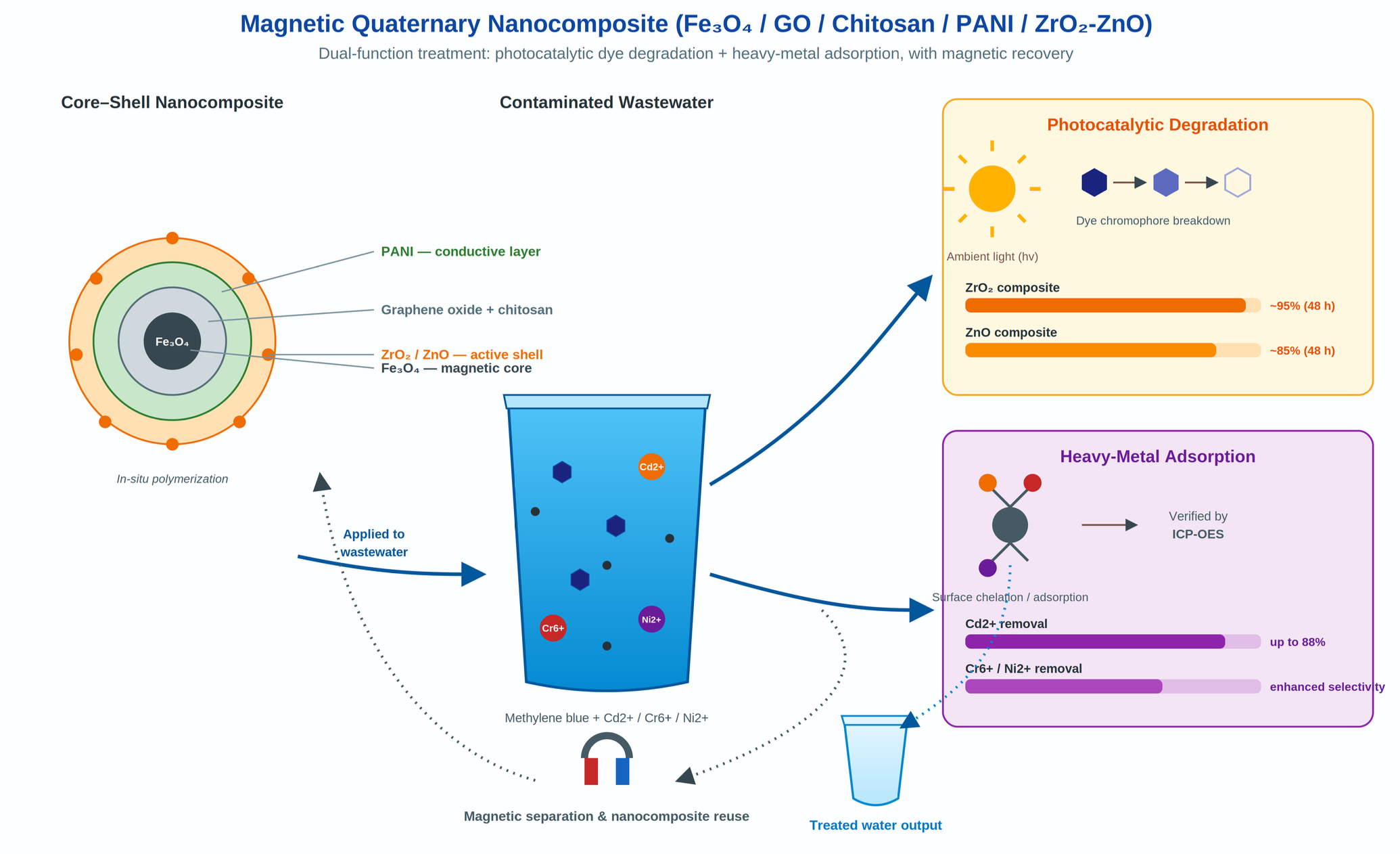
Highlights
Please note: The following content displays the text-only preview. For the full article, complete with all illustrations, data tables, and equations, please download the free PDF from the sidebar at the top of this page.
Introduction
The increase in industrial activities has contributed to an increase in hazardous loading in the aquatic environment. In this regard, it is important to consider synthetic dyes and toxic heavy metals, such as cadmium (Cd), chromium (Cr), and nickel (Ni), as these contaminants disturb aquatic ecosystems when they persist in the environment for long periods of time, are toxic, and exhibit bioaccumulation potential in living organisms [1, 2]. Methylene blue (MB), for example, is a synthetic dye known for its use in the textile, printing, and pharmaceutical industries. The discharge of methylene blue in wastewater potentially can occur simultaneously with the same heavy metals that originated from electroplating, mining, and the chemical industries, which usually include cadmium, chromium, and nickel [3]. Conventional methods for treating wastewater include chemical precipitation, coagulation–flocculation, and membrane filtration and often have limitations, including low treatment efficacy, increased treatment costs, and the by-products (secondary waste). As a result, there have been a lot of new and innovative efforts in producing advanced, sustainable, and multifunctional materials for concurrent dye and heavy metal removal [4, 5].
On the other hand, nanotechnology may provide a unique opportunity for wastewater remediation processes due to the high surface area, tailored surface chemistry on nanomaterials, and improved reactivity [6]. Graphene oxide (GO) has abundant oxygenated functional groups and has a high surface area, allowing for strong interactions with organic dyes and metal cations through electrostatic forces, hydrogen bonding, and π–π stacking [7, 8].
Moreover, magnetic Fe₃O₄ nanoparticles are suitable for catalytic and adsorption processes due to their superior superparamagnetic properties, biocompatibility, and ease of recovery with magnetic force [9]. Metal oxides such as zirconium dioxide (ZrO₂) and zinc oxide (ZnO) improve photocatalytic activity, stability, and (re)usability [10, 11]. Plus, chitosan (CS), a naturally available biopolymer, can better adsorb metal ions in wastewater due to the additional amine and hydroxyl groups [12]. Conducting polymers, such as polyaniline (PANI), possess excellent adsorption ability due to their conjugated backbones and chemical stability, in addition to the potential to form strong interfacial interactions with other nanomaterials [13]. Selecting these properties from each component to integrate into a single quaternary nanocomposite would form a synergistic effect and create nanocomposites with higher adsorption ability, effective photocatalytic degradation, and easy recyclability for wastewater applications [14, 15].
In this study, we have synthesized and evaluated two multifunctional nanocomposites, PANI/Fe₃O₄–GO/CS–ZrO₂ and PANI/Fe₃O₄–GO/CS–ZnO. Each composite was carefully characterized using many spectroscopic and microscopic assessment techniques to demonstrate their structural, optical, and morphological properties. Their demonstrated adsorption and photocatalytic activity were analysed through methylene blue (MB) degradation and the elimination of Cd²⁺, Cr⁶⁺, and Ni²⁺ from aqueous solutions utilizing UV–Vis spectrophotometry and inductively coupled plasma optical emission spectroscopy (ICP-OES). This research aims to advance the development of environmentally friendly and magnetically recoverable nanocomposites for effective wastewater treatment.
Experimental
Materials and Chemicals
Graphene oxide (GO) and Fe₃O₄ nanoparticles were purchased from local Iraqi markets. Nano chitosan (Cs), zirconium oxide (ZrO₂), acetic acid, hydrochloric acid (HCl), aniline, ammonium persulfate (APS, (NH₄)₂S₂O₈), sodium alginate (SA), sodium dodecyl sulfate (SDS), ethanol (EtOH), and distilled water (DI) were used as received without further purification.
Synthesis of Fe₃O₄–GO Nanocomposite
The Fe₃O₄–GO nanocomposite was prepared using a simple impregnation method. Briefly, 0.15 g of graphene oxide (GO) was dispersed in 100 mL of distilled water and ultrasonicated for 30 min using a bath sonicator operating at room temperature (25 °C) to achieve complete exfoliation of GO sheets. The pH of the suspension was approximately neutral (pH ≈ 6.8) without further adjustment.
Subsequently, 0.15 g of Fe₃O₄ nanoparticles was gradually added to the GO suspension under continuous magnetic stirring. The mixture was further ultrasonicated for 30 min to ensure uniform impregnation of Fe₃O₄ nanoparticles onto the GO sheets. The resulting homogeneous Fe₃O₄–GO suspension was used directly for subsequent composite fabrication without additional drying or calcination steps.[9].
Synthesis of ZrO₂/Chitosan (CS–ZrO₂) Nanocomposite
Chitosan–zirconium dioxide (CS–ZrO₂) nanocomposite was synthesized via physical interaction and electrostatic binding. Initially, 0.5 g of chitosan nanoparticles was dissolved in 25 mL of 1% (v/v) acetic acid to obtain a 2% (w/v) chitosan solution under magnetic stirring at room temperature until complete dissolution. The solution pH was approximately 4.0–4.5.
Separately, 0.8 g of ZrO₂ nanoparticles was dispersed in the chitosan solution and ultrasonicated for 20 min to promote uniform dispersion. The suspension was then magnetically stirred at room temperature (25 °C) for 8 h to allow effective interaction between chitosan functional groups (–NH₂ and –OH) and ZrO₂ surfaces.
After completion, the composite was purified by repeated ultracentrifugation and washing with ultrapure water until neutral pH was reached, removing excess acetic acid and unbound chitosan. The final CS–ZrO₂ nanocomposite was dried at room temperature for 24 h and stored in a desiccator for further use [10].
Preparation of Fe₃O₄–GO/CS–ZrO₂ Hybrid Nanocomposite
The Fe₃O₄–GO/CS–ZrO₂ hybrid nanocomposite was prepared by combining the previously synthesized components. The CS–ZrO₂ suspension was slowly added to the Fe₃O₄–GO suspension under vigorous magnetic stirring and maintained for 1 h at room temperature to promote homogeneous mixing.
The resulting mixture was subsequently ultrasonicated for an additional 60 min to prevent aggregation and ensure uniform distribution of CS–ZrO₂ over the Fe₃O₄–GO framework. The obtained Fe₃O₄–GO/CS–ZrO₂ hybrid dispersion was directly used for in-situ polymerization of aniline.
Synthesis of PANI/Fe₃O₄–GO/CS–ZrO₂ Quaternary Nanocomposite
In-situ oxidative polymerization of aniline was employed to synthesize the final quaternary nanocomposite.
The Fe₃O₄–GO/CS–ZrO₂ dispersion was first ultrasonicated for 30 min to ensure complete dispersion. Then, 1 mL of aniline monomer was dissolved in 30 mL of 1 M HCl and added dropwise to the dispersion under continuous stirring. The mixture was ultrasonicated for 2 h to enhance monomer adsorption onto the composite surface.
Polymerization was initiated by the slow addition of 2.5 g of ammonium persulfate (APS), previously dissolved in 40 mL of 1 M HCl, maintaining an APS/aniline molar ratio close to 1. The reaction was carried out under continuous stirring in an ice bath at 0–5 °C for 2–4 h to control polymer growth and prevent over-oxidation.
After polymerization, the dark green suspension was aged overnight at 4 °C to ensure complete polymer formation. The resulting PANI/Fe₃O₄–GO/CS–ZrO₂ nanocomposite was collected by filtration, washed repeatedly with distilled water and dilute HCl to remove unreacted monomer and oligomers, and finally dried in an oven at 80 °C for 10 h.
Photocatalytic Degradation of Methylene Blue
Photocatalytic degradation experiments were carried out using a conventional laboratory light source under continuous stirring to ensure homogeneous dispersion of the catalyst. In a typical experiment, 100 mL of methylene blue (MB) aqueous solution with initial concentrations of 50, 100, and 200 mg/L was transferred into a glass beaker. The catalyst dosage was fixed at 0.10 g for PANI/Fe₃O₄–GO/CS–ZrO₂ and 0.07 g for PANI/Fe₃O₄–GO/CS–ZnO.
Before light irradiation, the suspension was magnetically stirred and kept in a dark locker for approximately 2 h to establish adsorption–desorption equilibrium between MB molecules and the catalyst surface. Afterward, the suspension was exposed to laboratory ambient light while stirring at room temperature (25 °C). The distance between the light source and the solution was kept constant throughout the experiments.
At selected irradiation times, aliquots were withdrawn from the reaction mixture, and the catalyst was separated using magnetic decantation. The residual MB concentration was determined by measuring the absorbance at 664 nm using a UV–Vis spectrophotometer. The degradation performance was evaluated based on the decrease in absorbance intensity relative to the initial concentration.
Heavy Metal Adsorption Experiments
Batch adsorption experiments were conducted to evaluate the removal of Cd²⁺, Cr⁶⁺, and Ni²⁺ ions from aqueous solutions using the synthesized nanocomposites. In each experiment, 100 mL of single-metal aqueous solution with a known initial concentration was transferred into a beaker and treated with a fixed amount of the adsorbent.
The suspension was continuously stirred at room temperature (25 °C) to ensure uniform contact between the metal ions and the adsorbent surface. The solution pH was maintained at neutral conditions (pH ≈ 7) without further adjustment. After a predefined contact time, the adsorbent was separated from the solution by magnetic decantation.
The residual concentrations of Cd²⁺, Cr⁶⁺, and Ni²⁺ ions in the supernatant were quantified using inductively coupled plasma optical emission spectroscopy (ICP-OES). The adsorption performance was evaluated based on the reduction in metal ion concentration before and after treatment.
Results and discussion
UV–Vis Absorbance Spectrum
The UV–Vis absorbance spectrum of the synthesized PANI/Fe₃O₄–GO/CS–ZrO₂, PANI/Fe₃O₄–GO/CS–ZnO nanocomposite is presented in Fig. 1(A, B).
Fig. 1(A) shows the UV–Vis absorbance spectrum of the synthesized PANI/Fe₃O₄–GO/CS–ZrO₂ nanocomposite. The spectrum displays a broad and intense absorption band spanning the 200–1000 nm range, indicative of strong light-harvesting ability across the ultraviolet, visible, and near-infrared regions. A sharp peak centered on ~225 nm is attributed to π–π* transitions in the benzenoid rings of polyaniline (PANI), confirming its successful integration into the hybrid matrix [11]. Additionally, a shoulder around ~280 nm likely corresponds to n–π* transitions from quinoid units in PANI and oxygen-containing groups in graphene oxide (GO), which are known to contribute to the absorption in this region [12].
The prolonged absorption tail beyond 400 nm is characteristic of inorganic metal oxides like Fe₃O₄ and ZrO₂, suggesting their role in extending the optical activity of the nanocomposite due to scattering and interfacial charge transfer effects [13]. This broad absorption is advantageous in photocatalytic and photothermal processes by enabling better utilization of the solar spectrum [14]. Furthermore, the gradual decrease in absorbance at longer wavelengths is consistent with semiconducting nanostructures, indicating effective interfacial electronic interactions between PANI, GO, Fe₃O₄, and ZrO₂.
Fig. 1(B) illustrates the UV–Vis absorbance spectrum of the PANI/Fe₃O₄–GO/CS–ZnO nanocomposite. Similar to the previous sample, strong absorption is observed in the UV region, with considerable absorption extended into the visible domain. A distinct peak between 270–300 nm arises from π–π* transitions in the conjugated C=C bonds of PANI and GO. A subtle shoulder near ~400 nm is likely caused by n–π* transitions and possible charge transfer interactions between Fe₃O₄ and ZnO components, as previously reported in ternary or quaternary nanocomposite systems [15].
The decline in absorbance beyond 600 nm reflects reduced photon absorption at higher wavelengths, supporting the presence of indirect transitions commonly associated with ZnO-based and Fe₃O₄-based hybrid materials. This behaviour reinforces the material’s potential in optoelectronic, photocatalytic, and solar energy conversion applications through synergistic enhancements in light absorption and charge separation.
The absorption coefficient (α) of the PANI/Fe₃O₄–GO/CS–ZrO₂, PANI/Fe₃O₄–GO/CS–ZnO nanocomposite is calculated from the absorbance data using the relation:
α = 2.303×A /d (1)
Where A is the absorbance and d is the optical path length (assumed to be 1 cm in this study). The resulting α values as a function of wavelength are plotted in Fig. 2(A, B).
Fig. 2(A) presents the absorption coefficient spectrum of the PANI/Fe₃O₄–GO/CS–ZrO₂ nanocomposite. The material exhibits a high absorption coefficient in the ultraviolet (UV) region, with α values reaching approximately 6.8–7.0 cm⁻¹ around 225–260 nm. This strong absorption is primarily attributed to π–π* electronic transitions in the conjugated polyaniline backbone, as well as transitions associated with GO and Fe₃O₄ components. As the wavelength increases, α gradually decreases, falling below 2 cm⁻¹ in the near-infrared (NIR) region. This trend reflects a typical semiconducting behavior, indicating efficient absorption in the UV range and moderate absorption across the visible spectrum, which is advantageous for photocatalytic and optoelectronic applications.
Fig. 2(B) shows the absorption coefficient of the PANI/Fe₃O₄–GO/CS–ZnO nanocomposite. A pronounced absorption peak appears between 230–260 nm, corresponding to π–π* transitions of aromatic C=C bonds within the PANI and GO framework. A secondary shoulder between 280–300 nm is associated with n–π* transitions, likely originating from quinoid structures in PANI and oxygen-containing functional groups in GO [2]. The broader absorption in the 300–600 nm region suggests additional electronic transitions or interfacial charge transfer mechanisms involving Fe₃O₄ and ZnO phases. Beyond 600 nm, the steady decline in α indicates reduced photon absorption, consistent with materials exhibiting indirect or hybrid semiconductor behaviour.
Together, both spectra confirm the broad-spectrum light interaction of these nanocomposites, stemming from synergistic effects between the conjugated polymer matrix, conductive GO sheets, and semiconducting oxide nanoparticles. These features make the materials promising for applications in solar energy harvesting, photocatalysis, and photodetectors.
The transmittance spectrum of the PANI/Fe₃O₄–GO/CS–ZrO₂ and PANI/Fe₃O₄–GO/CS–ZnO nanocomposites is shown in Fig. 3(A) over the wavelength range of 200–1000 nm. Fig. 3(A) presents the transmittance spectrum of the PANI/Fe₃O₄–GO/CS–ZrO₂ nanocomposite over the wavelength range of 200–1000 nm. The material exhibits very low transmittance in the ultraviolet (UV) region, particularly below 400 nm, highlighting strong photon absorption. This behaviour is primarily attributed to π–π* electronic transitions in the aromatic structures of polyaniline (PANI), as well as interfacial charge transfer and electronic excitations involving the Fe₃O₄ and ZrO₂ phases.
As the wavelength increases toward the visible and near-infrared (NIR) regions, the transmittance rises gradually, reaching approximately 0.27 (a.u.) at 1000 nm. This trend reflects a reduced optical absorption at longer wavelengths, characteristic of semiconducting hybrid nanostructures. The material’s ability to strongly absorb UV light while permitting partial transmittance in the NIR supports its potential in solar shielding, optoelectronic devices, and photocatalytic applications.
Fig. 3(B) shows the transmittance spectrum of the PANI/Fe₃O₄–GO/CS–ZnO nanocomposite across the same spectral range. The composite also displays low transmittance in the UV range (200–350 nm), with a minimum value of approximately 0.26 (a.u.) near 270 nm. This strong absorption corresponds to π–π* transitions in PANI and GO, along with n–π* transitions and electronic transitions involving ZnO and Fe₃O₄ nanoparticles.
Beyond 400 nm, the transmittance steadily increases, reaching a stable value around 0.55–0.58 (a.u). In the NIR region (>800 nm). This increase signifies the weakening of absorption at higher wavelengths, consistent with materials that possess indirect band gap behaviour. The observed optical properties confirm the nanocomposite’s suitability for broad-spectrum light filtering, energy harvesting, and environmental remediation technologies.
The optical band gap (Eg) of the PANI/Fe₃O₄–GO/CS–ZrO₂, PANI/Fe₃O₄–GO/CS–ZnO nanocomposite was estimated using the Tauc plot method. The Tauc relation for a direct allowed transition is given by:
(αhν)2 =A(hν−Eg) (2)
Where α is the absorption coefficient, hν is the photon energy, and A is a constant. By plotting (αhν)2 versus hν, the linear region of the curve is extrapolated to intersect the energy axis ((αhν)2=0) to determine the direct band gap.
In addition, the indirect band gap of the nanocomposite was evaluated using the modified Tauc relation:
(αhν)1/2=B(hν−Eg) (3)
Where (αhν)1/2 is plotted as a function of photon energy (hν), and B is a constant. The linear extrapolation of the plot to the energy axis gives the value of the indirect band gap (Eg).
As shown in Fig. 4 (A), the Tauc plot reveals a distinct linear portion in the high-energy region. Extrapolation of this region yields a direct optical band gap of approximately 3.7 eV for the nanocomposite.
This relatively wide band gap reflects the strong electronic interactions and quantum confinement effects resulting from the incorporation of Fe₃O₄, GO, and ZrO₂ within the PANI matrix. The wide gap also implies potential for the material in UV-blocking, photocatalysis, or optoelectronic applications requiring high optical thresholds.
As illustrated in Fig. 4 (B), the Tauc plot for the indirect transition displays a linear region in the lower energy range. The extrapolation of this linear region to the x-axis reveals an indirect band gap value of approximately 1.5 eV.
This lower indirect band gap suggests the presence of sub-band states and defect-induced transitions, which are typical in complex nanocomposite systems. Such features can be beneficial in applications like photocatalysis or broad-spectrum light harvesting, where extended absorption into the visible or near-infrared regions is advantageous.
Fig. 5(A) shows the plot of (αhν)2 versus photon energy (eV), which is used to estimate the direct band gap (Eg). The linear portion of the curve extrapolated to the photon energy axis gives an optical direct band gap value of approximately 2.0 eV. This relatively low band gap suggests efficient light absorption in the visible range, making the material promising for photo-induced applications such as photocatalysis and photovoltaic devices.
Fig. 5(B) illustrates the Tauc plot for the indirect transition, (αhν)1/2versus photon energy. The extrapolated linear portion intersects the energy axis at 1.8 eV, indicating the presence of an indirect band gap. This dual presence of direct and indirect transitions highlights the hybrid electronic structure of the nanocomposite, attributed to the synergistic interaction between the polyaniline matrix, graphene oxide sheets, and the semiconductor nanoparticles (Fe₃O₄ and ZnO).
The optical band gap values obtained for the quaternary nanocomposites indicate a clear synergistic effect arising from the integration of conducting polymer, carbon-based material, magnetic nanoparticles, and metal oxides within a single hybrid system. Pristine ZnO typically exhibits a wide band gap of approximately 3.2 eV, while ZrO₂ possesses an even wider band gap exceeding 4.0 eV. Polyaniline, on the other hand, shows variable optical transitions depending on its oxidation state and protonation level.
In the present work, the reduced effective band gap values observed for the PANI/Fe₃O₄–GO/CS–ZnO and PANI/Fe₃O₄–GO/CS–ZrO₂ nanocomposites suggest the formation of interfacial electronic states and heterojunctions between the polymeric and inorganic phases. The presence of graphene oxide facilitates charge transfer and suppresses electron–hole recombination, while Fe₃O₄ contributes additional electronic states near the conduction band.
This synergistic interaction extends light absorption into the visible region and enhances photo-induced charge separation, which directly supports the improved photocatalytic performance observed during methylene blue degradation. Similar band gap narrowing and hybrid electronic behavior have been reported in polymer/metal oxide/graphene-based nanocomposites, confirming the validity of the proposed mechanism.
Such hybrid optical behaviour enhances charge separation and prolongs carrier lifetimes, which is advantageous for improving the efficiency of photoactive materials used in environmental and energy-related technologies.
XRD Analysis of PANI/Fe₃O₄–GO/CS–ZrO₂ Nanocomposite
The X-ray diffraction (XRD) pattern of the synthesized PANI/Fe₃O₄–GO/CS–ZrO₂ nanocomposite is presented in Fig. 6. The diffraction peaks were carefully examined and indexed to identify the crystalline phases present in the nanocomposite structure.
The XRD pattern shows both sharp and broad peaks, indicating a hybrid structure comprising crystalline and semi-crystalline components. Notably, the characteristic peaks of Fe₃O₄ (magnetite) are observed at 2θ values of approximately 30.1°, 35.5°, 44.1°, 50.5°, and 60.1°. These peaks correspond to the (220), (311), (400), (422), and (440) crystallographic planes of Fe₃O₄, respectively, and are consistent with the standard JCPDS card no. 19-0629 [16].
A broad hump centered on 24.5° is attributed to the presence of amorphous graphene oxide (GO) and the semi-crystalline structure of polyaniline (PANI), a signature feature in similar nanocomposite systems [17].
Additional peaks appear at around 63° and 74.6°, which can be indexed to the (103) and (224) planes of tetragonal and monoclinic ZrO₂, respectively, as per JCPDS card no. 81-1544 [18]. The presence of these peaks confirms the successful incorporation of ZrO₂ into the nanocomposite matrix.
The peak positions and corresponding Miller indices (hkl) are listed in Table 1. These results verify the successful synthesis of a multiphase nanocomposite consisting of Fe₃O₄, ZrO₂, GO, and PANI, with significant crystallinity and phase purity.
The X-ray diffraction (XRD) pattern of the PANI/Fe₃O₄–GO/CS–ZnO nanocomposite displays distinct peaks at specific 2θ positions that confirm the successful incorporation of all components within the composite matrix, as shown in Fig. 7.
A broad peak between 22°–26° corresponds to the (002) reflection of graphene oxide (GO), indicating disordered stacking of the graphene layers with partially retained oxygen functionalities. This broadness is typical for GO and reflects its turbostratic nature [19]. The sharp diffraction peak at ~30° is indexed to the (220) plane of Fe₃O₄, while the peak at 35.5° is assigned to the (311) plane, both consistent with the standard spinel structure of magnetite (JCPDS No. 19-0629)[16]. A diffraction peak at ~50° is attributed to the (422) plane of Fe₃O₄, confirming its crystalline phase. The peak at ~59° can be assigned to the (511) plane, and ~62.6° corresponds to the (440) plane of Fe₃O₄ as well [16]. The appearance of a peak near 74° may be attributed to a minor contribution from the (533) reflection of Fe₃O₄ or overlapping with ZnO planes (e.g., (112)) in its wurtzite structure, consistent with JCPDS No. 36-1451 [20].
The absence of sharp peaks from polyaniline (PANI) is expected, as it is semi-crystalline or amorphous. Its presence is instead inferred from background modifications and interaction with metal oxide nanoparticles, which influence peak intensities and shapes [21].
These findings confirm the co-existence of Fe₃O₄, GO, ZnO, and PANI in a hybrid nanocomposite with both crystalline and amorphous domains, suitable for multifunctional applications such as catalysis, sensing, and energy devices.
The peak positions and corresponding Miller indices (hkl) are listed in Table 2. These results verify the successful synthesis of a multiphase nanocomposite consisting of Fe₃O₄, ZnO, GO, and PANI, with significant crystallinity and phase purity.
The average crystallite size of the crystalline phases in the synthesized nanocomposites was estimated using the Scherrer equation:
where D is the crystallite size, K is the shape factor (0.9), λ is the X-ray wavelength of Cu Kα radiation (1.5406 Å), β is the full width at half maximum (FWHM) of the diffraction peak in radians, and θ is the Bragg angle.
The calculation was performed using the most intense Fe₃O₄ diffraction peak corresponding to the (311) plane at 2θ ≈ 35.5°. The estimated crystallite size was found to be approximately 20 nm for the PANI/Fe₃O₄–GO/CS–ZrO₂ nanocomposite and 25 nm for the PANI/Fe₃O₄–GO/CS–ZnO nanocomposite.
The obtained nanoscale crystallite sizes indicate that the Fe₃O₄ phase retained its nanocrystalline nature after hybridization with GO, chitosan, polyaniline, and metal oxides. The slight peak broadening observed in the composite patterns compared to pristine Fe₃O₄ suggests strong interfacial interactions and partial lattice distortion induced by polymer encapsulation and heterojunction formation. This reduction in crystallite size and peak broadening is commonly observed in multi-component polymer–oxide nanocomposites and is attributed to restricted crystal growth and increased interfacial strain.
The SEM images of the synthesized PANI/Fe₃O₄–GO/CS–ZrO₂ nanocomposite at different magnifications are presented in Fig. 8. The surface morphology appears rough and porous, with visible agglomerates of nanoscale particles forming irregular clusters. This morphology is indicative of the successful integration of polyaniline (PANI), graphene oxide (GO), iron oxide (Fe₃O₄), and zirconium dioxide (ZrO₂) within the composite matrix.
In Fig. 8(A), a layered, sponge-like structure is evident, suggesting a high surface area, which is advantageous for adsorption and photocatalytic activity. The morphology reflects the characteristic granular texture of PANI and the wrinkled sheets of GO, supporting their successful incorporation.
In Fig. 8(B), the image shows a more generalized distribution of the agglomerated particles. The particles range between 50–200 nm in size, while some aggregates exceed this range due to the inherent magnetic interactions and surface energy-driven clustering of Fe₃O₄ nanoparticles. Quantitative particle size analysis was performed using ImageJ software by measuring at least 50 representative particles from different SEM micrographs, yielding an average particle size of 104 nm.
This microstructure confirms that the nanocomposite possesses high surface heterogeneity and interconnectivity among the components, which can facilitate charge transport and provide active sites for photocatalytic or adsorption applications [22.23].
The surface morphology of the synthesized PANI/Fe₃O₄–GO/CS–ZnO nanocomposite was investigated using scanning electron microscopy (SEM), as shown in Fig. 9. The SEM micrographs reveal a heterogeneous and porous structure, characterized by interlinked graphene oxide (GO) sheets decorated with uniformly distributed ZnO nanorods and Fe₃O₄ nanoparticles. The GO appears as wrinkled and layered sheets, providing a high surface area platform for the deposition of other components. ZnO nanorods, distinguishable by their rod-like shapes, are dispersed across the GO surface and embedded within the polyaniline (PANI) matrix. These nanorods are essential for enhancing charge separation and light scattering properties [24].
The Fe₃O₄ nanoparticles, appearing as quasi-spherical particles, are integrated within the composite, likely anchored onto the GO sheets and surrounded by the conductive PANI chains. The presence of chitosan (CS) contributes to structural cohesion and assists in the homogeneous distribution of metal oxides through its polymeric network [25]. The porous and textured morphology observed is consistent with previous studies of multi-component nanocomposites used for photocatalysis and pollutant adsorption [26]. Quantitative particle size analysis was performed using ImageJ software by measuring at least 50 representative particles from different SEM micrographs. The particle size was found to range mainly between 50 and 200 nm, with an average particle diameter of 96 nm.
The SEM results confirm successful integration of all components into a cohesive nanocomposite, with a surface architecture favourable for photocatalytic and adsorption-based applications due to enhanced light absorption, active surface area, and interfacial charge transport pathways.
Photocatalytic Degradation of Methylene Blue
Fig. 10 (A) displays the UV–Vis absorption spectra of methylene blue (MB) at 50 ppm before and after treatment with PANI/Fe₃O₄–GO/CS–ZrO₂ (catalyst 1). The pristine MB solution exhibits a prominent absorption peak at approximately 664 nm, corresponding to the π–π* transition of the aromatic ring structure in MB molecules [27]. Upon the addition of catalyst 1, a noticeable decrease in the peak intensity is observed after mixing, indicating partial degradation of the dye. Following 48 hours of interaction, the peak at 664 nm nearly vanishes, confirming the significant degradation efficiency of the catalyst. The gradual reduction in absorbance signifies the disruption of MB’s conjugated system due to photocatalytic oxidation.
Fig. 10 (B) presents similar absorption spectra for MB degradation using PANI/Fe₃O₄–GO/CS–ZnO (catalyst 3). As with sample 1, a substantial drop in absorbance at 664 nm is recorded upon initial contact, followed by an even more pronounced decline after 48 hours, suggesting that both catalysts effectively decompose MB under ambient conditions. However, catalyst 3 shows faster and more aggressive absorption suppression, especially in the early stages, which could be attributed to the enhanced surface area, light absorption, and electron–hole separation efficiency contributed by the ZnO nanoparticles [28].
Quantitative Comparison of Photocatalytic Degradation Performance
The photocatalytic degradation of methylene blue (MB, 50 ppm) was quantitatively evaluated for both quaternary nanocomposites by monitoring the absorbance intensity at 664 nm, as shown in Fig. 10(A, B). For the pristine MB solution, a strong absorption band was observed at 664 nm with an initial absorbance of approximately A₀ ≈ 0.23–0.24.
After 48 h of treatment with PANI/Fe₃O₄–GO/CS–ZrO₂ (catalyst 1), the absorbance at 664 nm decreased to nearly A₄₈h ≈ 0.01, corresponding to a degradation efficiency of approximately 95%. In contrast, treatment with PANI/Fe₃O₄–GO/CS–ZnO (catalyst 3) reduced the absorbance to about A₄₈h ≈ 0.03–0.04, yielding a degradation efficiency of approximately 85% after the same irradiation period.
The degradation efficiency was calculated using the relation (A₀ − Aₜ)/A₀ × 100, assuming a linear correlation between absorbance and concentration. The higher degradation efficiency observed for catalyst 1 suggests a more effective interaction between the ZrO₂-containing hybrid structure and MB molecules, possibly due to differences in surface adsorption behavior and interfacial charge transfer pathways. Nevertheless, both nanocomposites exhibited strong photocatalytic activity under ambient laboratory light conditions, as evidenced by the substantial suppression of the characteristic MB absorption band.
Figs. 11, 12, and 13 illustrate the preparation of methylene blue (MB) solutions at varying concentrations, beginning with 50 ppm. The images clearly demonstrate the progressive decolorization of MB at 50, 100, and 200 ppm following treatment with the synthesized PANI/Fe₃O₄–GO/CS–ZrO₂ nanocomposite (catalyst 1). Similarly, the fading of the characteristic blue color of MB is observed after treatment with PANI/Fe₃O₄–GO/CS–ZnO (catalyst 3), indicating effective dye degradation across all tested concentrations. This visual evidence supports the photocatalytic efficiency of both nanocomposites in breaking down MB under the applied conditions.
These results indicate that the synthesized nanocomposites act as efficient photocatalysts under light exposure, likely due to synergistic effects among PANI (conductive polymer), Fe₃O₄ (magnetic core), GO (electron mediator), and metal oxides (ZrO₂ or ZnO). The combination promotes strong light harvesting, charge transport, and reactive oxygen species (ROS) formation, leading to the breakdown of organic dye molecules in aqueous media. This demonstrates the potential of such hybrid nanostructures for wastewater treatment applications.
Heavy Metal Ion Removal Performance by ICP-OES
The heavy metal ion removal efficiency of the synthesized nanocomposites was evaluated using inductively coupled plasma optical emission spectroscopy (ICP-OES), focusing on the removal of cadmium (Cd), chromium (Cr), and nickel (Ni) ions from aqueous solutions. Both nanocomposites—Sample 1 (PANI/Fe₃O₄–GO/CS–ZrO₂) and Sample 3 (PANI/Fe₃O₄–GO/CS–ZnO)—demonstrated significant capability in reducing heavy metal concentrations from their initial levels, as shown in Table 3.
The removal performance of Cd²⁺, Cr⁶⁺, and Ni²⁺ ions by the synthesized quaternary nanocomposites was quantitatively evaluated using ICP-OES analysis, and the results are summarized in Table 3. The initial concentrations of Cd²⁺, Cr⁶⁺, and Ni²⁺ were 2.00, 1.00, and 1.00 mg/L, respectively.
For the PANI/Fe₃O₄–GO/CS–ZrO₂ nanocomposite (Sample 1), the residual concentrations were reduced to 0.24 mg/L for Cd²⁺, 0.65 mg/L for Cr⁶⁺, and 0.57 mg/L for Ni²⁺, corresponding to removal efficiencies of approximately 88.0%, 35.0%, and 43.0%, respectively. These results indicate a relatively balanced adsorption behavior toward all three metal ions, with a notably higher affinity toward Cr⁶⁺ and Ni²⁺ compared to the ZnO-based system.
In contrast, the PANI/Fe₃O₄–GO/CS–ZnO nanocomposite (Sample 3) reduced the Cd²⁺ concentration to 0.22 mg/L, achieving a removal efficiency of approximately 89.0%, which is comparable to that of Sample 1. However, lower removal efficiencies were observed for Ni²⁺ (approximately 25.0%), while the Cr⁶⁺ concentration showed no effective reduction under the same conditions, suggesting weaker interaction between Cr⁶⁺ species and the ZnO-containing composite.
The observed selectivity differences between the two nanocomposites can be attributed to the surface chemistry of the metal oxide components. ZrO₂ possesses a higher density of surface hydroxyl groups and stronger affinity toward oxyanion species such as Cr⁶⁺, enhancing adsorption through ligand exchange and electrostatic interactions. Conversely, ZnO-based composites exhibit stronger interaction with divalent cations such as Cd²⁺, resulting in higher Cd²⁺ removal efficiency.
Finally, both nanocomposites demonstrate effective heavy metal removal capability, with the ZrO₂-based system showing superior performance for Cr⁶⁺ and Ni²⁺, while the ZnO-based system exhibits slightly higher selectivity toward Cd²⁺. These results confirm that the choice of metal oxide plays a critical role in tuning adsorption selectivity in multifunctional quaternary nanocomposites.
Comparison with Previously Reported Nanocomposites
Table 4 compares the performance of the present quaternary nanocomposites with previously reported binary and ternary systems used for wastewater treatment. Most reported materials focus on either dye degradation or heavy metal adsorption, whereas the current quaternary systems demonstrate dual functionality within a single platform.
The integration of polyaniline and graphene oxide provides a conductive network and abundant adsorption sites, while Fe₃O₄ enables rapid magnetic separation. The incorporation of ZrO₂ or ZnO further enhances selectivity toward different pollutants, allowing tunable performance depending on the target contaminant. Compared to previously reported ternary systems, the present nanocomposites exhibit higher degradation efficiency for methylene blue and competitive heavy metal removal under ambient conditions, without requiring complex synthesis steps.
These results highlight the advantage of the quaternary design in combining photocatalytic activity, adsorption capacity, and magnetic recyclability, making the developed materials promising candidates for multifunctional wastewater treatment applications.
Reusability, Stability, and Practical Considerations
The reusability and operational stability of the synthesized quaternary nanocomposites are critical factors for their practical application in wastewater treatment. The incorporation of Fe₃O₄ nanoparticles enables efficient magnetic separation of the catalysts from aqueous media, allowing facile recovery without filtration or centrifugation. This magnetic property significantly reduces material loss and simplifies reuse in repeated treatment cycles.
The structural stability of the nanocomposites is supported by the polymeric matrix formed by polyaniline and chitosan, which provides mechanical integrity and prevents excessive leaching of metal oxide components during aqueous operation. Previous studies on similar polymer-based magnetic nanocomposites have demonstrated minimal metal leaching and stable performance over multiple cycles, suggesting that the present systems are expected to exhibit comparable stability.
Although systematic recyclability and leaching experiments were not conducted in the current study, the strong interfacial interactions among PANI, GO, Fe₃O₄, and metal oxides indicate good resistance to structural degradation. Future work will focus on repeated adsorption–photocatalysis cycles and quantitative evaluation of metal leaching to further validate long-term performance.
From a practical perspective, the synthesis route employed in this work involves low-temperature aqueous processes and commercially available precursors, which are favourable for scalability. The absence of high-pressure or high-temperature steps, combined with magnetic recoverability, enhances the economic feasibility of the proposed nanocomposites for large-scale wastewater treatment applications.
Conclusion
In this work, magnetic quaternary nanocomposites based on PANI/Fe₃O₄–GO/CS–ZrO₂ and PANI/Fe₃O₄–GO/CS–ZnO were successfully synthesized and evaluated for combined photocatalytic dye degradation and heavy metal adsorption. Structural and morphological analyses confirmed the formation of hybrid nanocomposites with nanoscale crystallite size and porous surface architecture, which are favorable for both adsorption and photocatalytic processes.
Photocatalytic experiments demonstrated efficient degradation of methylene blue under ambient light conditions, with the ZrO₂-based nanocomposite exhibiting higher degradation efficiency compared to the ZnO-based system. Heavy metal removal studies revealed that both nanocomposites effectively reduced Cd²⁺, Cr⁶⁺, and Ni²⁺ concentrations from aqueous solutions, with distinct selectivity depending on the incorporated metal oxide. The ZrO₂-containing composite showed enhanced affinity toward Cr⁶⁺ and Ni²⁺, while the ZnO-based system displayed slightly higher selectivity for Cd²⁺.
The integration of conductive polymers, graphene oxide, magnetic nanoparticles, and metal oxides within a single quaternary framework provides a synergistic combination of adsorption sites, photoactivity, and magnetic separability. This multifunctional design enables simultaneous treatment of mixed pollutants and facilitates catalyst recovery, supporting the potential application of these nanocomposites in practical wastewater remediation systems.
Conflict of Interest
The authors declare no conflict of interest.
Funding
This study was not supported by any funding.
Author’s Contributions
Study Conception or Design: I.A.
Data Acquisition: I.A., A.A.
Data Analysis or Interpretation: I.A., A.A.
Manuscript Drafting: I.A.
Critical Manuscript Revision: A.A.
All authors have approved the final manuscript and are responsible for all
aspects of the work.
AI Statement
The authors confirm that no AI tools or services were used during the preparation of this work.
Data Availability Statement
The data that support the findings of this study are available from the corresponding author upon reasonable request.