Document Type : Original Research Paper
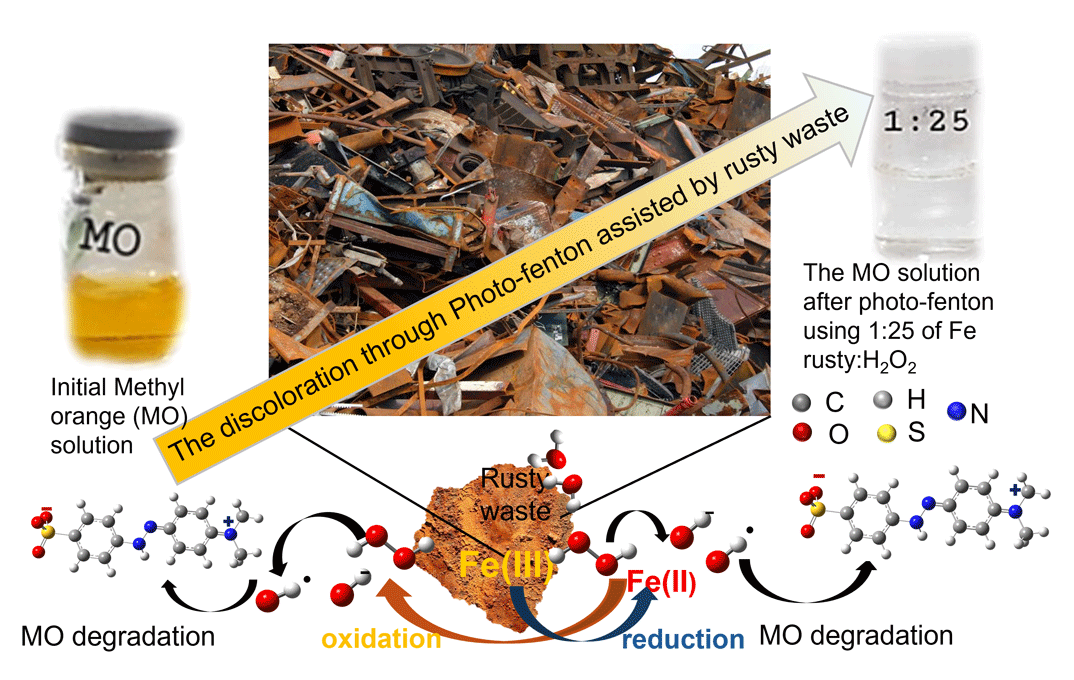
Graphical Abstract
Highlights
· Rusty waste is a promising-low cost materials for enhancing the photo-Fenton process.
· A heterogeneous catalyst of rusty waste improved the degradation of methyl orange.
· The optimum degradation of methyl orange conducted in near-neutral pH.
Please note: The following content displays the text-only preview. For the full article, complete with all illustrations, data tables, and equations, please download the free PDF from the sidebar at the top of this page.
INTRODUCTION
The photo-Fenton process is an advanced oxidation process (AOP) that generates hydroxyl radicals (•OH) from the reaction between hydrogen peroxide (H₂O₂) and ferrous iron (Fe²⁺) as a catalyst, called the Fenton agent [1–29]. The reactions are represented in Eq.1-2, which are cyclically reduced and oxidized [1–23]. In addition, under near-UV to visible region light (hv), up to a wavelength of 600 nm [1,11], H₂O₂ dissociates to form •OH radical at the same time (Eq. 3) [1–5].
(1)
(2)
(3)
The •OH is a very powerful oxidant, having EO = 2.8 V [1,12,15,26], that is non-selective, hence can be used to break down effectively persistent organic contaminants in the water [2–8], as well as to kill microorganisms [1,10,11], forming benign compounds such as H2O and CO2. In addition, the radicals have been reported to be effective in the photo-oxidation of the toxic As(III) into less toxic As(V) [12], and Pb(II) into insoluble harmless PbO2 [13].
Unfortunately, the homogenous photo-Fenton is found to show the most efficient process limited only at pH 2.8-3.2 [2,6,8–13,15,21,23,26] where the highest number of •OH is provided. In contrast, this process is less effective at higher pH, since the iron (III) can form ferric hydroxide (Fe(OH)₃) precipitate (Eq. 4), reducing the efficiency and posing disposal challenges [2,21,26]. These facts restrict the homogeneous photo-Fenton application for wastewater treatment.
(4)
To overcome such a drawback, the heterogeneous photo-Fenton process has been intensively proposed [2–4,14–28]. Heterogeneous photo-Fenton uses solid iron-based catalysts, such as iron oxides, instead of soluble iron ions, where the reaction occurs on the surface of the solid catalyst [30]. The surface of the iron oxide (such as Fe2O3) is often bonded to hydroxide ions (OH⁻) from water, represented as ≡Fe(III)–OH. This compound can react with H₂O₂ to form ≡Fe(II) species and HO₂• radical (Eq. 5) [2,15,20–22]. Later, ≡Fe(II) species generated can further react with H₂O₂, which is oxidized into ≡Fe(III) and produce more •OH (Eq.6) [2,15,20–23].
(5)
(6)
In the presence of applied UV light (represented by hv), the surface of iron oxides (i.e. Fe2O3) acting as a photocatalyst, generates electrons (e⁻) and holes [15,21] (Eq.7). Then the generated e⁻ can reduce the dissolved oxygen (O₂) to produce superoxide radicals (•O₂⁻) (Eq.8), while the h⁺ species can result in •OH due to the reaction with H2O (Eq.9) [31].
(7)
(8)
(9)
The use of iron compounds as solid catalysts can extend the effective pH range of the photo-Fenton process to near-neutral conditions, reducing the formation of iron sludge and enhancing sustainability [2–4,14–28]. This approach also leverages the stable and abundant nature of iron oxides, which remain effective over multiple cycles without significant leaching of ions into the solution [2,21]. Additionally, heterogeneous suspensions are seen to be more efficient, as they provide a greater surface area for the catalyst [2,21,26]. It is also believed that heterogeneous photo-Fenton processes require lower reagent concentrations than those of homogeneous processes. This fact led the iron oxides to become an amicable nature catalyst for photo-Fenton processes [2,21,26].
Many commercial iron oxides, including Fe2O3 [15], FeOOH [15], Fe3O4 [15,19], as well as the Fe zero valent [30], and Zn-ferrite [3] have been applied as solid catalysts in the heterogeneous photo-Fenton. The commercial materials are costly, creating a less economic process that limits their application on a larger scale. A solution to the problem by using cost-effective sources of iron-based compounds, both from nature, such as pyrite [16,18,26], chalcopyrite [17], halloysite [4], and from solid waste, including industrial sludge [25] and rusted iron [27], has been intensively proposed with promising results [33]. Additionally, many papers have reported the use of iron oxide catalysts prepared from useless sludge [25] and iron rust [27], as well as supported on basalt powder [29], biochar [14], kaolin [20], SiO2 [22,23], and TiO2 [24,34] materials which showed the better performance of photo-Fenton process at near neutral pH compared to the homogenous one. A study of using Fe-Cu-Zn/zeolite as a solid catalyst in the heterogeneous Fenton-like process has also attracted attention [28].
Meanwhile, it is well known that the priceless iron rusty waste consists of the main iron oxide, as less crystalline maghemite (γ-Fe₂O₃) [30], but it is also possible to be goethite (α-FeOOH) [32]. Nevertheless, the presence of iron-rusty waste in the environment was prone to distract the aesthetics and potentially cause health risks like tetanus of the open wound [30]. In fact, the use of iron rusty waste as the catalyst in the heterogeneous photo-Fenton is still untraceable. Under the circumstances, in the present research, the authors tried to utilize the iron rusty waste as a catalyst in the heterogeneous photo-Fenton for the degradation of methyl orange dyes.
Methyl orange (MO) is a common anionic azo dye used in various applications, including a titration indicator [23,29], textile and wearable dyeing [23,24,28,29], and biological staining [29]. In fact, MO is resistant to biodegradation [23,24,33], toxic, and carcinogenic [24,29,33], posing environmental challenges if not properly managed [29]. Such a persistent organic pollutant requires proper and effective treatments to remove it from wastewater. The qualified method is photodegradation through advanced oxidation processes, such as photocatalysis over TiO2 [33], as well as heterogeneous photo-Fenton processes by applying Fe-halloysite composite [4], Fe3O4/biochar [14], Fe3O4/SiO2 composite [23], Fe-TiO2 [24], Fe2O3 prepared from sludge [25], Fe-Cu-Zn/zeolite composite [28], and Fe2O3/SiO2 [29] which shows high efficiency. However, the use of rusted iron waste as a catalyst for MO degradation through the photo-Fenton procedure remains underexplored.
Therewithal, this research aims to study the solid phase of iron rusty waste, which consists of iron oxide, that can replace the Fe²⁺ catalyst to increase photo-Fenton performance at near neutral pH. To the best of our knowledge, the preparation of iron rusty waste as a photocatalyst in this research tends to be easier than similar research [30,33,42]. Besides, the utilization of iron rusty waste is also not examined to become a nanoparticle, thus no extra chemicals are needed to handle it, unlike the previous research [33,43]. This will be a clear distinction on how to manage and utilize the waste resource to create the added value of materials, with feasible but still aligns with the green chemistry pathway. The concern for waste management and transforming waste into useful materials remains a challenging procedure [42]. Thus, this research tried to deal with that issue and offers the best scheme of the photo-Fenton process in moderate conditions, which is not considered in the previous report [44]. In addition, this research investigated the optimization of the key parameters, including catalyst dose, H₂O₂ concentration, initial concentration of methyl orange, solution pH, and duration time of irradiation, to determine the conditions giving the maximum degradation efficiency. This parameter is essential to make the process more applicable beyond the laboratory scale. This research may open up other possibilities and strategies to utilize the natural resources and an efficient process for the degradation of the contaminant.
EXPERIMENTAL
a. Chemicals and characterization tools
The materials used in this research included iron rusty waste powder, 30% hydrogen peroxide (H₂O₂), sodium hydroxide (NaOH), sulfuric acid (H₂SO₄), methyl orange (MO) dye powder, and FeCl2 powder, which are in analytical grade from Merck. Equipment for conducting research comprised of a cubical UV reactor with 4 sides of UV-C lamp Philips 20 V 50 Hz 20W. Meanwhile, for iron rusty characterization, the Surface analyzer St 4 on NOVA touch 4LX, Quantachrome is used to investigate the surface properties, including surface area and pore diameter. Electron Probe Microanalyzer (EPMA) EPMA JEOL JXA-ISP100, to observe the morphological features of the iron rusty catalyst. That EPMA machine has its own 18-built specimen standard for calibration. X-ray Fluorescence (Spectro Xepos XRF) to quantify the percentage of composition in iron rust catalyst. The calibration parameters of XRF are linearity, deadtime, energy (wavelength), and energy resolution using a typical standard reference material (SRM). X-ray Powder Diffraction (Malvern Panalytical Empyrean XRD) to assess the crystalline phase of the iron rusty catalyst and compare the quality of fresh and used catalyst, with calibration parameters using a SRM of Si. Fourier-Transform Infrared Spectroscopy (Perkin-Elmer Spectrum Two FTIR Spectrometer LiTaO₃ Detector) to identify the functional group as the character of the iron catalyst related to the photo-Fenton process. The calibration of that FTIR uses the polystyrene standard film to calibrate the wavenumber. The UV-Visible spectrophotometer (SPECORD 200 PLUS) is used to measure the absorbance of pollutants, which is parallel to their concentration. The calibration parameter of that machine is determined using a certain SRM for evaluating photometric accuracy and reproducibility, stray light, baseline noise, and stability; spectral bandwidth and resolution; and photometric range.
b. Iron rusty waste preparation and analysis
Rusty waste was obtained from a natural source of rusted iron found in the fence of the Faculty of Mathematics and Natural Science, Gadjah Mada University, which was crushed to 75 microns and calcinated in a furnace at 450 ℃ for 90 min. The calcination temperature and the duration are chosen from previous reports that enable the transformation of the heterogeneous phase of iron rust to a more crystalline phase with the desirable compound of hematite (α-Fe₂O₃) [45,46]. The comparison between untreated iron rust and after calcination is provided in Supplementary materials (Fig. 2.S and 3.S). The calcinated rusty waste was characterized by using FTIR scanned from 4000-500 cm-1 to identify the functional group of materials and the photo-Fenton process. The samples were pelleted with KBr under high pressure, which acts as a matrix to dilute the powder sample and is not IR active, which would not influence the FTIR result. Meanwhile, the XRD machine with a Cu Kα source investigates the crystalline structure of the main compound in the catalyst over the 20-80° 2θ range using Cu Kα radiation (λ = 1.5406 Å) and operated at 40 kV and 30 mA. Then, the chemical composition was determined using an XRF instrument at 30 kV. Additional characterization using EPMA coating mode with acceleration voltage 15 kV and magnification 1000x is used to help observe the morphological features of the iron rusty waste catalyst. The surface analyzer is conducted using nitrogen gas (N2) and a degassing temperature at 110 °C for 5 h, and the N2 adsorption-desorption isotherm is used to calculate the Brunauer, Emmett, and Teller (BET) surface area and Barrett-Joyner-Halenda (BJH) pore size distribution.
c. Degradation of MO by the heterogeneous photo-Fenton method
The heterogeneous photo-Fenton was preceded by a batch technique. In this process, a mixture of 60 mg of rusty waste, 10 mL of H₂O₂ 600 mmol/L, and 10 mL of MO 10 mg/L at pH 7 was placed in the cubical UV reactor, which was irradiated under a UV lamp. Along with the irradiation, it stirs magnetically within 60 min. Afterward, the solution was taken and analyzed by a UV-Visible spectrophotometer at the wavelength (λ) = 463 nm as the optimum wavelength for MO. The same procedure was repeated for a process by applying a various dose of iron rust catalyst mass (20, 40, 80, and 100 mg), H₂O₂ concentration (200, 400, 800, and 1000 mmol/L), initial MO dye concentration (5, 10, 25, 50, and 100 mg/L), irradiation time duration (5, 10, 30, 60, 90, 120, 150, and 180 min), and solution pH (1, 3, 5, 6, 7, 8, 10). When one variable was varied, the other variables were kept constant. The degradation efficiency is calculated by Eq. 10, where C₀ is the initial concentration of MO and C is the final concentration after MO is degraded.
MO photodegradation = (10)
d. Degradation of MO by homogenous photo-Fenton
The homogeneous photo-Fenton was conducted by irradiating a mixture of 10 mL of FeCl₂ 24 mmol/L, 10 mL of H₂O₂ 600 mmol/L, and 10 mL of MO 10 mg/L at pH 7 under UV lamps, along with magnetically stirring within 60 min, in the reactor with a certain lightening set-up. Then, the solution was taken and analyzed by a UV-Visible spectrophotometer. The same procedure was repeated for a process by applying it at various pH levels (1, 3, 5, 6, 7, 8, 10).
RESULT AND DISCUSSION
Iron rusty waste analysis
The powder calcinated from iron rusty waste as the heterogeneous photocatalyst was subjected to X-ray fluorescence (XRF) analysis, revealing the total iron content of 54.20 wt%. The remaining 45.8 wt% of the components may appear to be organic compounds from moss growing on the top of iron rusty waste and/or inorganic minerals obtained from dirt, sand, soil, iron coating, or paint. Meanwhile, to acquire the physical properties of calcinated iron rusty waste, the EPMA observations and BET-BJH analysis were conducted. These outcomes of characterization are revealed in Fig. 1.
According to Fig. 1, it is clear to note that the calcinated of iron rusty waste has the micro-sized crystalline particle from its morphological image (Fig. 1.a) and the isotherm adsorption is belong to type IV, shown by hysteresis plot in Fig. 1.b which has the character of mesoporous material with unlimited monolayer and multilayer adsorption in the term of interaction between surface of photocatalyst with the contaminant [47]. The mesoporous character of this photocatalyst is also supported by the nature of the metal-iron material that has a pore diameter between 8 and 30 nm [48]. Based on the BJH plot (Fig. 1.c), this calcinated form of rusty waste has the dominant pore diameter at 16.68 nm.
To assess more physical and chemical character of that catalyst, the XRD pattern of the calcined iron rusty waste is displayed in Fig. 2, aligning well with the standard hematite (α-Fe₂O₃) pattern that has characteristic peaks at the 2θ angles of 24.16°, 33.12°, 35.63°, 40.64°, 49.57°, 54.08°, 57.42°, 62.51°, 64.12°, 72.07°, and 75.50°, corresponding to the planes (012), (104), (110), (113), (024), (116), (018), (214), (300), (119), and (220), noted to JCPDS (Joint Committee on Powder Diffraction Standards) card of (00-033-0664) [27,31,32]. Therefore, it is obviously showed that the calcinated iron rusty waste is mainly composed of iron oxide as the crystalline hematite (α-Fe₂O₃), which agrees with the previous reports [27,31,32]. In this diffractogram, it can be shown that the iron rusty waste before (pre-used) and after (post-used) the photo-Fenton process remains the same. It is clearly suggested that the crystalline structure of the Fe2O3 in the iron calcined rusty waste is preserved in post-catalytic application. Moreover, the intensity in the XRD pattern of the post-used catalyst is similar to that of the pre-used one, indicating the iron rusty wastes’ resilience and potential for reuse in catalytic reactions.
Furthermore, the FTIR spectra of the iron rusty waste are shown in Fig. 3. It was observed that there was significant absorption at the 522 cm⁻¹ region, indicating the Fe-O stretching [50]. This confirms the presence of iron oxides such as hematite (Fe₂O₃) and magnetite (Fe₃O₄) [15,19,31]. Moreover, the peaks in the 1083 cm⁻¹ range may suggest the presence of silicon-oxygen (Si-O-Si) bond, but can also indicate phosphates (P-O), and possibly sulfates (S=O). It is important to note that the absorption of Si-O-Si and S=O bonds is in the range of 1000-1100 cm⁻¹, while the P-O bond range is at 900-1200 cm⁻¹ [34]. This FTIR data confirms that the calcinated iron rusty waste contains iron oxides and other inorganic compounds, such as silicates, phosphates, and sulfates, possibly as impurities from metal coating or paint. The result shows no peaks for organic compounds like C-H, C=O, O-H, or N-H bonds, suggesting that the calcinated iron rusty waste is composed purely of inorganic substances. The absence of the organic component may be burned and removed during high-temperature calcination.
As seen in the FTIR spectra of the post-used catalyst displayed in Fig. 3, a new weak peak at 3014-3652 cm⁻¹ indicates O-H and N-H stretching, showing potential hydroxyl groups or nitrogen from MO dyes that attached to the catalyst surface. Furthermore, the post- used iron rusty waste as a catalyst has sharper intensity at the wavenumber 1083 cm⁻¹, which might be translated into C-N bonding area from the absorbed dyes in the surface of the catalyst that overlaps with silicon-oxygen (Si-O-Si), phosphates (P-O), and sulfates (S=O) around the range of 1000-1200 cm⁻¹ [34]. In the spectra, the strong characteristic wavelength at 522 cm⁻¹ regions from Fe-O stretching of hematite. It is implied that the iron oxide is not affected by the photo-Fenton process. This FTIR data highlights the effective catalytic properties of iron rusty waste in degrading MO, reflecting surface chemistry transformations during the process.
Performance of the heterogeneous photo-Fenton with iron rusty waste as a catalyst for MO degradation
The following factors are evaluated and discussed in this study as they affect the efficiency of the photo-Fenton processes. These include catalyst dose, H₂O₂ concentration, initial MO concentration, solution pH, and irradiation time duration. Meanwhile, to compare the performance of this rusty iron waste catalyst in the dark condition, Fig. 4.S is provided. This result shows that, without the catalyst assistance of the photo-Fenton process, as illuminated with suitable light, the effectiveness of MO degradation is not significant.
The effect of the catalyst dose
The effect of catalyst dosage on MO photodegradation is shown in Fig. 4(a). The result indicates that an increase in the catalyst dose raises the degradation efficiency, and it reaches the maximum level at 50 mg of the iron rusty waste, which is equal to 1355 mg Fe/L or 24 mmol/L of Fe. The enhancement of the reaction rate is due to the higher active site availability that is able to produce more •OH, to break down the MO structure in more effectively [14,19,20]. The highest dose of catalyst is found to be 50 mg, hence it is set as the optimum catalyst dose. Above the optimum condition, the excessive catalyst dose may increase the turbidity [14,19,20], reducing UV light penetration, which further leads to less conductive •OH radical production. In addition, there was also a proposed reason, as explained in Eq.11 [14,20,22], that the excess iron oxide having a Fe2+ charged surface, resulting from the reaction Eq.5, is possibly to capture the •OH. This kind of behavior is characteristic of catalytic processes where optimum efficiency is achieved at the ideal catalyst dose [14,19,20,29].
(11)
The effect of H₂O₂
The effect of H₂O₂ concentration, as displayed in Fig. 4(b), demonstrates that the MO photodegradation efficiency enhanced as the concentration of H₂O₂ increased from 24 mmol/L to 600 mmol/L due to the increasing quantity of •OH generated. It is noted clearly that, at 600 mmol/L, the H₂O₂ concentration is in its ideal range, where the MO decomposition efficiency is at its highest. Beyond this optimal concentration range, the additional H₂O₂ does not enhance the degradation process and even considerably reduces the efficiency. A similar finding has been reported elsewhere [1,3,6–9,12–14,22,29]. With the higher level than the optimal concentration, the decrease in the degradation efficiency is observable, which is caused by the fact that the excess H₂O₂ can act as a scavenger of •OH, as shown in Eq.12−13 [1,6–8,12–14,22,29]. This would reduce the amount of •OH, which degrades less MO.
(12)
(13)
The effect on the initial MO concentration
As shown in Fig. 4(c), the decrease in MO concentrations reveals that degradation works best at low levels. The photodegradation efficiency diminishes as the MO concentration increases. This trend shows that the increased MO concentrations reduce the photodegradation efficiency. This inverse relationship is due to the increased availability of the dye molecules, which requires more •OH to complete the degradation process [19,24]. As the concentration of MO increases, the fixed amount of •OH becomes insufficient to degrade all the dye molecules, leading to a lower overall degradation percentage. In addition, the high concentration of MO can enhance the opacity of the solution, limiting the penetration of UV light required to start the photocatalytic process [19,28]. This suggests that, while the catalytic system is effective at lower concentrations of MO, its efficiency decreases as the dye concentration increases, most likely due to catalytic capacity saturation and a limited availability of reactive species required for degradation. To maintain high degradation efficiency, adjust catalyst and H₂O₂ dosages as pollutant concentrations increase. This result matches the other findings reported previously [19,26,28]. Moreover, from the result of the effect on initial concentration, the kinetic model of this photo-Fenton process can be deduced. After plotting the two common kinetic models in the Supplementary materials (Fig. 5.S.), it shows that the photo-Fenton process using a heterogeneous photocatalyst derived from rusty waste follows pseudo-second-order kinetics. It also gives the adsorption capacity during the photo-Fenton process for 4.05 mg/g and the kinetic constant of 18.293 g·mg⁻¹·min⁻¹. By this model, it indicates that the photo-Fenton process using iron rusty photocatalyst depends on the concentration of H2O2 as the initiator of the oxidant agent and the methyl orange as the pollutant. However, as it obeys the pseudo-second order, the rate is proportional to the square of the concentration of reactants involved in the rate-limiting step. In the context of the photo-Fenton process, the factors may be diverse, for instance, the pollutant molecules (substrate, active sites on the iron oxide surface), Fe²⁺/Fe³⁺ cycling sites, and surface-bound hydroxyl radical generation sites. Those factors are influencing simultaneously in the rate-determining step. By applying the pseudo-second order, it means that the photo-Fenton process is correlated to chemisorption. It is assigned by the strong chemical interaction between pollutant and catalyst surface, electron transfer during Fe²⁺/Fe³⁺ cycling, and the adsorption of pollutant to the surface, where the main reaction occurs concurrently [30,52,53].
The effect of irradiation duration occurs
The degradation reaction revealed that irradiation time plays a crucial role in the degradation efficiency, as shown in Fig. 4(d). Initially, efficiency increased sharply, reaching an optimal condition in 60 min of light exposure. The longer time facilitates more effective contact between light and H2O2 as well as with Fe2O3, resulting in a larger number of OH radicals. This condition is favorable for the efficient breakdown of MO. Longer than the optimal condition, that is, 60 min, the efficiency slightly decreased, indicating a plateau effect under further exposure. The slight decline in efficiency beyond the optimal irradiation time may be due to the recombination of the radicals as shown in Eq.14−15 [1,8,12–14,20,22,29] that further causes the depletion of H₂O₂ as the reactive species [8,12–14]
The effect of the solution pH
The effect of solution pH on degradation efficiency, as illustrated in Fig. 5, provides valuable insights into the photo-Fenton photodegradation process. It is noted that in the heterogeneous process, the alteration of pH from 1 to 7 increases the MO degradation and reaches the maximum level. Meanwhile, it was observed that the opposite trend occurs when the pH is further escalated to higher than 7. This trend is in line with the previous research [8,12,13,19,20,26].
At very low pH, it helps many Fe³⁺ ions to dissolve from the solid rusted iron, which can interact with H2O2 to form Fe(H2O2)3 stable complex [8,12,13]. Additionally, it is also possible for H2O2 to be protonated to form H2O2-H+ [1,8]. These Fe(H2O2)3 formed and H2O2-H+ surely dismiss both Fe³⁺ and H2O2 in the media, leading to the less •OH availability and consequently the low degradation efficiency is obtained. In addition, the surface of the iron oxide solid may also be protonated by the excess H+ to form ≡Fe3+ OH2+ [19,20,26], and the MO also changes into a protonated structure [33], inhibiting them from mutually interacting, which results in less effective MO degradation.
When the pH increases to 3, the complex is gradually dissociated to free Fe3+ and H2O2, and reduces the protonation of H2O2 [8,12,13], allowing them to mutually react and generate much more •OH. In this situation, both the Fe2O3 surface and MO structure keep being protonated, since their zero-point charges, pH are 7.6 [29] and 5.52 [33], respectively, preventing one from interacting with the other. It seems that the inhibition of the interaction between MO and the iron oxide is insignificant compared to the effective •OH radical formation, resulting in the high effective degradation. Then, when the solution pH increased from 3 to 7, no dissolved Fe3+ from iron oxide can be generated. Hence, the •OH radical production by H₂O₂ is dependent on the surface availability of the iron oxide catalyst or ≡Fe3+ OH (Eq.5), and on the dissociation of H2O2 stimulated by light (Eq. 3) [33]. Additionally, the OH radicals may also contribute from the results of irradiation of ≡Fe3+-OH through several steps, as presented in Eq. 7 up to Eq.9. In this pH range, the protonation of ≡Fe3+-OH gradually declines, and MO is in an anionic charge, allowing the effective interaction and hence the MO degradation. This inherent advantage facilitates the heterogeneous catalyst to maintain robust degradation performance across a broader pH range, highlighting its resilience and stability.
In the media with a pH higher than 7, an anionic environment in the iron oxide surface ( ≡Fe O- ) may be available, and MO also exists as an anionic species, inhibiting its interaction with others. Also, H2O2 may be dissociated into water and O2 gas (Eq.14) [12,29]. Consequently, the degradation takes place slowly. However, the lowering pace of degradation for heterogeneous catalysts in that range is insignificant compared to the trend in homogeneous catalysts. Thus, it is noteworthy to mention that the working range of the iron rusty waste catalyst is wider, which may push effective and efficient performance.
(14)
In the homogeneous photo-Fenton, the MO degradation reaches the highest level at pH 3, stimulated by the largest amount of •OH radicals available. It is clearly noted that increasing pH from 1 to 3 raises the degradation, which is a similar trend to the heterogeneous result. The findings agree with many previous reports [1,8,12,13]. At pH 1, Fe2+ in the solution is neutralized by H2O2 through Fe(H2O2)2 complex formation, decreasing the number of Fe2+ and H2O2 produced, therefore depleting the •OH radicals [54]. In the solution with a pH higher than 3, more Fe3+ ions would precipitate with OH- ion to form insoluble Fe(OH)3 that screens the light entering the reaction system [1,8,10,12,13]. As a consequence, fewer •OH radicals can be provided, explaining the lower degradation efficiency.
The stability of the post-used catalyst in the MO degradation
The stability of the iron oxide catalyst is important to be checked, which was detected based on the iron dissolved during the photo-Fenton process, by XRD pattern; and FTIR spectra. Fig. 6(a) represents the amount of Fe dissolved during the photo-Fenton process at various times. This figure illustrates that almost no iron dissolved in the reaction time alteration, suggesting that the iron oxide catalyst in the iron rusty waste remains stable after being used. To gain comprehensive attention of discoloration MO via heterogeneous catalyst of iron rusty waste through photo-Fenton process, here Fig. 6(b) is provided. This schematic representation is enclosed with a simple redox reaction mechanism abovementioned to understand the contaminant degradation, which is ultimately run by •OH radicals. As a comparison, several catalysts used iron-based waste, with conventional iron, and current modification iron photocatalysts are represented in Table 1. The performance of the catalyst using iron waste-based is still relatively significant in comparison to the conventional and modified ones for the specific ability of organic compound degradation.
Finally, this work is conducted to demonstrate the effectiveness of using iron-rust waste as a heterogeneous catalyst in the photo-Fenton process for degrading the MO contaminant. It might be to build a sustainable approach to waste management by using another waste that can be considered from a chemical or physical perspective, or by functionalizing it to produce particular advanced materials aimed at discarding the more challenging waste.
CONCLUSIONS
This study confirmed that calcinated iron rusty waste contains crystalline Fe₂O₃, constituting 54.2% of its total iron content. When employed in the heterogeneous photo-Fenton process, this iron rusty waste enhances photodegradation efficiency, achieving a rate of 96% compared to 62% in the homogeneous photo-Fenton process, both conducted at a neutral pH of 7. The optimal conditions for photodegradation of MO can be reached by a Fe to H₂O₂ molar ratio of 1:25 (24 mmol Fe = 50 mg of the iron rusty waste to 600 mmol H2O2), within 60 min of UV light exposure at pH 7, resulting in a 96% degradation rate. Notably, the crystallinity of the iron rusty waste remains stable after usage. These findings suggest that the heterogeneous photo-Fenton process utilizing calcinated iron rusty waste is significantly more effective than its homogeneous counterpart, offering a robust and efficient method for the photodegradation of organic pollutants.
Availability of data and materials
The datasets used and/or analysed during the current study are available from the corresponding author on reasonable request.
CONFLICT OF INTEREST
The authors declare that they have no competing interests.
Funding
This study is supported by the Director of Research and Community Service, Gadjah Mada University, through a Research Grant of Final Project Recognition (RTA) 2024.
Authors’ contributions
CRediT
E.T.W.: conceptualization, data analysis, writing original draft, J.C.R: methodology, data acquisition, writing-review and editing, E.Z.A: data interpretation, visualization, writing-review and editing, S. S.: data acquisition, and N.F. J: data analysis.
Acknowledgements
The great appreciation is directed to Universitas Gadjah Mada for the financial support through the Final Research Recognition (RTA)-Research Grants under the contract number 5286/tNl.P1/PT.0I.0312024, dated May 6, 2024.