Document Type : Original Research Paper
Graphical Abstract
Highlights
· The WO3/GCN heterostructure was successfully synthesized by a simple auto-combustion method and used as a potential photocatalyst.
· Weakly agglomerated tungsten trioxide plates are unevenly distributed on two-dimensional GCN nanosheets.
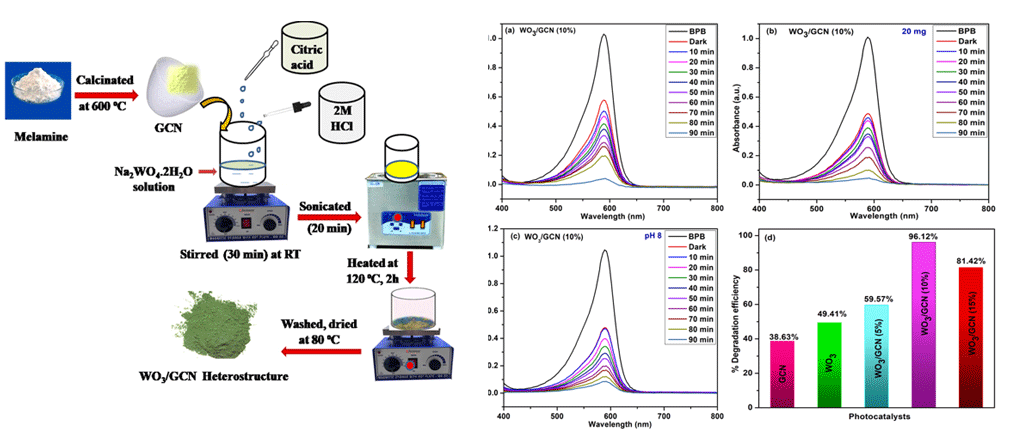
· The WO3/GCN heterostructure photocatalyst showed 96.12 % BPB dye degradation in 90 minutes.
· The enhanced photocatalytic efficiency was due to greater visible light absorption, enhanced e-/h+ pair separation, and strong heterojunction formation between WO3 and GCN.
Please note: The following content displays the text-only preview. For the full article, complete with all illustrations, data tables, and equations, please download the free PDF from the sidebar at the top of this page.
1. Introduction
In recent years, the alarming issue of serious water pollution, particularly due to toxic and hazardous pollutants, has garnered significant attention and concern within the scientific community [1-3]. Therefore, today, the advancement of semiconductor-based photocatalysis harnessing solar energy in the treatment of organic pollutants has been progressing swiftly and garnering augmented interest [4-10]. However, two challenges need to be resolved in the area of semiconductor photocatalyst applications. Firstly, it is essential to broaden the excitation wavelength range of photocatalysts to maximize the utilization of solar energy. The second crucial challenge is the efficient enhancement of photogenerated charge carriers (electrons and holes) separation. [11] Presently, traditional photocatalysts of metal oxide semiconductors, such as zinc oxide (ZnO), dissipate a lot of solar energy since they respond to narrow spectral widths in the ultraviolet (UV) region of the solar spectrum [12,13]. The material’s direct band gap and capacity to absorb high-energy photons in the UV region are the causes of this type of response. Furthermore, the inherent disadvantages of the pristine photocatalysts-poor visible light harvesting and low quantum yield- limit their potential for efficient breakdown of hazardous contaminants [14]. Therefore, it is crucial to understand how to fabricate photocatalysts with excellent efficiency. So, the use of photocatalysts has been improved in this respect by a number of different approaches, such as doping induction, immobilization, copolymerization, and heterojunction fabrication. Among these approaches, heterojunction fabrication of photocatalysts has been applied extensively to deal with photocatalyst limitations. Building heterojunction photocatalysts has mainly emerged as a fascinating and practical approach to mitigate the recombination of photoexcited electrons and holes while maintaining their significant oxidizing and reducing potential [15,16]. Heterojunction photocatalysts are therefore a promising solution to the world’s energy scarcity and previously stated wastewater pollution issues. Numerous photocatalysts, including ZnO-TiO2 [17], ZnO/SnO2 [18], Ag2O/BiVO4 [19], In2O3@TiO2 [20], and Ag2O/Bi2MoO6 [21], have been developed recently. However, the low degradation efficiency and consequently high cost of these catalysts were common challenges for their practical use. As a result, establishing the ideal photocatalyst combination has emerged as a key area of environmental governance.
Tungsten trioxide (WO3) is an n-type semiconductor (Eg=2.7-3.3 eV). It has been widely employed in electrochemical devices, sensors, and batteries because of its exceptional oxidizing power, outstanding optical absorption property, excellent catalytic activity, high physical/chemical stability, and affordability [22-25]. Additionally, it is perfect for photocatalytic applications due to its remarkable absorption of solar energy. However, the photocatalytic efficacy of pristine WO3 towards hazardous organic pollutants is limited due to the high acceleration rate of photoexcited e-/h+ pairs and extremely positive conduction band (CB) edge value [26]. Integrating tungsten trioxide with other photocatalysts like Ag [27], GO [28], BiVO4 [29], CuS [30], rGO [31], and GCN [32]that have a staggered band structure, a narrow Eg, and a less positive value of the CB edge provides an efficient way to overcome these limitations.
Graphitic carbon nitride (g-C3N4) has recently been regarded as the most promising metal-free, environmentally friendly, organic, and sustainable semiconductor photocatalyst because of its high visible light absorption power (Eg = 2.7 eV), low cost, rapid charge transfer ability, excellent chemical and thermal stability, and nontoxicity [30,31] [33-36]. The π-conjugated, two-dimensional layered structure of graphitic carbon nitride substantially increases the active sites on its surface area, enhancing the photodegradation efficacy [37, 38]. However, the photocatalytic efficacy of g-C3N4 under VLI is constrained due to its high pairing rate of photoexcited e-s and h+, which significantly limits the applicability of g-C3N4. Moreover, two visible light-driven photocatalysts with narrow band gaps can be integrated to produce efficient photocatalysts that can help in overcoming problems with conventional photocatalysts [32]. Thus, WO3 and g-C3N4 semiconductors can be mixed in various ways to develop promising and efficient photocatalysts for treating wastewater. For example, Kumari et al. [39]. produced g-C3N4/WO3 catalysts using a facile synthesis method for the degradation of RhB, and they achieved a superior degradation efficiency of 96%. Similarly, to eliminate RhB, Deng et al. [40]. used a simple calcination process to create WO3 nanosheets/g-C3N4 nanosheets’ composite and found the degradation of 78.6% in 100 min. However, Singh et al. [32]. created a coral-like WO3/g-C3N4 nanocomposite using a wet chemical process for the removal of methylene blue (MB) and reactive dyes (RbX). They discovered 97.82% and 92.37% degradation efficiencies for MB and RbX dyes, respectively.
In the previously reported work, the synthesis method used to develop WO3/GCN heterostructure is both laborious and difficult. No research has been reported about the degradation of harmful industrial dyes, such as bromophenol blue (BPB), utilizing a WO3/GCN heterostructure. The objective of this work is to address the shortcomings in existing research by employing a straightforward auto-combustion method for the synthesis of WO3/GCN heterostructures with varying mass ratios for the elimination of BPB pollutants. Additionally, the antibacterial potential of GCN and WO3/GCN heterostructure was evaluated against multiple drug-resistant bacteria, namely S. aureus (NCIM 2654) and E. coli (NCIM 2256).
2. Materials and Methods
2.1. Materials
Sodium tungstate dihydrate (Na2WO4.2H2O; 98%), melamine (extra pure, 98%), citric acid monohydrate (C6H8O7, 99%), hydrochloric acid (HCl), and bromophenol blue (BPB) were purchased from Merck and Loba Chemie Pvt Ltd, India. All experiments were performed using deionized water.
2.2. Preparation of graphitic carbon nitride (GCN)
First, a crucible containing 10 g of melamine was heated in a muffle furnace from RT to 600°C. The crucible was allowed to cool naturally at ambient temperature for four hours. The obtained yellow powder was further ground to yield a fine powder of graphitic carbon nitride.
2.3. Preparation of WO3/GCN heterostructure
The WO3/GCN heterostructure was produced using a simple auto-combustion process. In short, 1 g sodium tungstate (Na2WO4.2H2O) was dissolved in 40 mL of deionized water, and further 0.04 g of GCN powder was added to it. The resultant mixture was stirred for 20 min to get a clear solution. Then, 0.6 g citric acid dissolved in 20 mL of deionized water was added dropwise to the above solution with constant stirring. Then, after, 10 mL 2M HCl solution was added to it and stirred vigorously for 10 min to obtain a precipitate. After that, the precipitate was heated to 120ºC until it was fully dry. The resulting powder was washed several times with deionized water (1L) and dried in an oven at 80ºC. The powder was then ground to obtain WO3/GCN (5%) heterostructure. Similarly, by weighing 0.08 g and 0.12 g of GCN powder, respectively, WO3/GCN (10%) and WO3/GCN (15%) heterostructures were also prepared [41]. The schematic representation of the synthesis of WO3/GCN heterostructure is shown in Fig. 1.
2.4. Material Characterizations
A thorough X-ray diffraction investigation was performed using a Bruker AXS D8 Focus X-ray diffractometer fitted with a Cu Kα radiation source (λ = 1.540 Å) to determine the crystallinity and phases contained in the synthesized samples. The synthesized nanocomposite’s functional groups and metal-oxygen (M-O) bonding were confirmed from FT-IR analysis recorded on a Bruker Optics Alpha-T FT-IR spectrometer. A high-resolution transmission electron microscope (HR-TEM) model JEM-F200(URP) operating at 10kV was utilized to explore the internal structure of the prepared heterostructure. Structural morphology and elements present were investigated utilizing Field emission scanning electron microscopy (FE-SEM) together with an energy dispersive spectrometer (EDS) (Ametek, Octane plus model). Using X-ray photoelectron spectroscopy, the oxidation states and elemental compositions of the WO3/GCN heterostructure were thoroughly examined. The Physical Electronics, PHI 5000 Versa Probe III device was used to conduct XPS analysis. UV-visible DRS spectra were obtained using the UV-visible spectrophotometer (UV-Vis 2600). The surface area of the samples was carefully assessed by means of a thorough examination of the nitrogen adsorption-desorption curve that was acquired from the nitrogen adsorption analyzer (Quantachrome NovaWin). The Shimadzu UV 1800 UV-Vis Spectrophotometer was used to analyze the UV-Visible absorption spectra, and the deionized water was used as the standard reference.
2.5. Photocatalytic degradation study
The photocatalytic degradation experiments were performed under visible light (Xenon lamp- 250 W) for BPB degradation using WO3/GCN heterostructure. Herein, 20 mg of the photocatalyst was dissolved in 50 mL of BPB dye solution (10 mg/L) under constant stirring. The solution was then kept in the dark (30 min.) for maximum absorption of BPB on the surface of WO3/GCN heterostructure. After 30 min of dark agitation, the resultant solution was exposed to visible light radiation to initiate a photocatalytic reaction. The absorbance was measured using a UV-Visible spectrophotometer at 590 nm wavelength after the separation of the photocatalyst by centrifugation [42]. The degradation efficiency was obtained using the equation [43]: Degradation efficiency (%) = [(A0-A)/A0] × 100; where A0 is absorbance of initial dye solution, and A is the absorbance taken at different times.
2.6. Antibacterial activity
The antibacterial activity of synthesized GCN and WO3-GCN nanoparticles was evaluated using the well diffusion method with multiple drug-resistant bacteria, namely Gram-positive S. aureus (NCIM 2654) and Gram-negative E. coli (NCIM 2256), at a concentration of 1 mg/mL. The resulting bacterial suspensions were diluted to a final OD of 0.02 at 600 nm, which corresponds to 2×10⁷ CFU. Under aseptic conditions, wells were formed on the sterile nutrient agar plates, and the sample was added to each well. Antibacterial activity was assessed by measuring the diameter of the zones of inhibition after incubation at 37°C for 24 hours [37] [44]. The minimum inhibitory concentration (MIC) determination was conducted according to a few modifications [45]. The MIC of GCN NPs and WO3/GCN was assessed using the broth microdilution technique. The suspensions of NPs and NCs were made as two-fold dilutions ranging from 25 to 800 µg/mL. The broth microdilution technique was conducted on a 96-well microplate. Aliquots (100 μL) of each dilution of GCN, WO3/GCN, and bacterial suspension, calibrated to a Mac Farland standard of 0.5 (1×10⁸ CFU/mL), were dispensed into each well. In summary, 100 μL of a bacterial suspension with a concentration of 108 CFU/mL was combined with 100 μL of NPs dilutions in 96-well microtiter plates containing Muller-Hinton broth. The plates were incubated at 37°C for 24 h. Comparable assessments were conducted for the negative control (NPs suspension combined with the culture medium) and the positive control (bacterial suspension combined with the culture medium). Subsequently, 100 μL from each well was inoculated onto Muller-Hinton agar, and the plates were incubated at 37°C for 24 hours. The lowest concentration without turbidity in wells or growth on plates was considered MIC [46].
3. Results and discussion
3.1. X-ray diffraction analysis
Fig. 2 shows the X-ray diffraction pattern revealing the crystalline phases of pure WO3 nanoparticles and WO3/GCN heterostructures (5%, 10%, and 15%). Two distinctive diffraction peaks are visible in the XRD pattern of GCN at 2θ values 12.797° and 27.464°, confirming its hexagonal phase [JCPDS no. 87-1526]. The strong diffraction peak at 27.464° corresponds to the (0 0 2) diffraction plane and represents normal interlayer stacking of the benzene ring network, whereas the weak peak at 12.797° can be indexed to the (1 0 0) plane due to ordering of tri-s-triazine units in GCN [47].
The XRD pattern of WO3 showed characteristic diffraction peaks at 2θ = 16.382⁰, 23.724⁰, 25.547⁰, 30.395⁰, 33.451⁰, 34.821⁰, 38.089⁰, 49.514⁰, 52.556⁰, 56.112⁰, and 57.068⁰, corresponding to diffraction planes (0 2 0), (1 2 0), (1 1 1), (0 4 0), (2 0 0), (0 0 2), (2 2 0), (2 0 2), (2 2 2), (3 1 1), and (2 5 1) respectively, of orthorhombic phase JCPDS card no. (84-0886) [48]. No peaks of other impurity phases are detected, demonstrating the high purity of the prepared sample.
Moreover, the XRD pattern of WO3/GCN heterostructures exhibits diffraction peaks at 2θ value 13.871⁰, 23.724⁰, 25.547⁰, 27.192⁰, 30.395⁰, 33.451⁰, 34.821⁰, 38.089⁰, 49.514⁰, 52.556⁰, 56.112⁰, and 57.068⁰ corresponding to (1 0 0), (1 2 0), (1 1 1), (0 0 2), (0 4 0), (2 0 0), (0 0 2), (2 2 0), (2 0 2), (2 2 2), (3 1 1), and (2 5 1) diffraction planes. The diffraction peaks of both WO3 and GCN are observed in the spectra of WO3/GCN, which revealed that the WO3/GCN heterostructure was synthesized successfully [49]. However, the intensity of the XRD peak is contingent upon the extent of the crystalline phase that is directly exposed to the X-ray beam. In the WO3/GCN heterostructure, GCN constitutes 5% of the composition, with the remainder being WO3. It enhances the relative X-ray visibility of WO₃ crystallites, manifesting as high-intensity peaks. While in the 15% heterostructure, the quantity of WO3 was decreased, resulting in broad peaks with low intensity. Moreover, as the GCN content in the 15% composite rises, the atoms of WO3 may get interstitially integrated into the crystal lattice of GCN, therefore reducing the exposure of WO3 to X-ray radiation. This may lead to the broadening of peaks and a decrease in the intensity of the (1 2 0) diffraction peak of WO3 [50].
Additionally, the crystalline sizes of pristine GCN, WO3, and WO3/GCN (10%) heterostructure were calculated using Debye-Scherrer’s equation; Φ=0.9λ/βcosθ; where, Ɵ= Bragg angle, λ- X-ray wavelength, and β-full width at the half maxima. The calculated crystallite sizes for GCN, WO3, and WO3/GCN heterostructure are 57 nm, 114 nm, and 54 nm, respectively.
3.2. FT-IR vibrational analysis
The FT-IR vibrational analysis was performed to explore the functional groups present in the prepared samples in the range of 4000-400 cm-1. The obtained IR spectra are displayed in Fig. 3. The vibrational band at 806 cm-1 is attributed to the characteristic breathing mode of the s-triazine unit of GCN. However, the IR bands appeared at 1222 cm-1 and 1620 cm-1 vibrational frequencies are ascribed to C-N and C=N stretching modes in GCN. The vibrational band at 1550 cm-1 is assigned to the bending vibrations in GCN. Furthermore, the broad band in the range of 3000-3400 cm-1 corresponds to N-H bond stretching in 1º and 2º amine functionality. The other IR bands appeared at 1315 cm-1 and 1392 cm-1, corresponding to deformation mode and bending vibrations of N-H, respectively [40,41] [47, 48]. The FT-IR peaks appeared at 746 cm-1, 815 cm-1, and 950 cm-1, corresponding to tungsten-oxygen (O-W-O) stretching vibrations in the WO3 sample. Additionally, the WO3/GCN heterostructure exhibits all of the distinctive vibrational bands of pure WO3 and pristine GCN samples, confirming its successful synthesis.
3.3. Morphological analysis
The photographs of synthesized samples are shown in Fig. 4a-4c. Synthesized graphitic carbon nitride and WO3 samples showed pale yellow and deep green colour, respectively (Fig. 4a-b). After heterostructure formation, the colour of the obtained sample was turned into bluff dark green, shown in Fig. 4c. SEM pictures indicating the morphology of GCN, WO3, and WO3/GCN heterostructure samples are represented in Fig. 4. Fig. 4d-e confirms that the pristine GCN exhibits sheet-like morphology with solid agglomerates. Fig. 4f-g shows the asymmetrical and massive clusters of tiny tungsten trioxide plate agglomerates. Additionally, the surface of GCN exhibits an uneven distribution of tiny, weakly agglomerated tungsten trioxide plates, shown in Fig. 4h-i.
The WO3/GCN heterostructure’s uneven and rough surface improved its ability to adsorb organic pollutants, which significantly boosts the photocatalytic efficacy. Furthermore, the average particle size (55 nm) of the nanoparticles is confirmed from the histogram (Fig. 5a) of the SEM picture of the WO3/GCN (10%) heterostructure.
The elemental analysis of the GCN and WO3/GCN heterostructure obtained from EDX is shown in Fig. 5b-c. C, N, and C, N, W, and O elements are present in the EDX spectra of the GCN and WO3/GCN samples, respectively. The GCN has 62.45 wt % of carbon and 37.55 wt % of nitrogen, while the WO3/GCN heterostructure has 30.2 wt % of carbon, 13.6 wt % of nitrogen, 43.0 wt % of oxygen, and 13.2 wt % of tungsten elements. In addition, WO3/GCN has purple, yellow, red, and green elemental mappings for carbon, nitrogen, oxygen, and tungsten elements, respectively (Fig. 5d-5g).
The TEM technique was used to further analyse the morphologies and microstructures of the WO3/GCN (10%) heterostructure. Fig. 6a-6d shows the results that were achieved. Additionally, the produced heterostructure’s HR-TEM image (Fig. 6e) revealed the lattice fringes with lattice spacings of 0.320 nm and 0.364 nm, which correspond to the (0 0 2) plane of GCN and the (0 2 0) plane of tungsten trioxide, respectively. The coexistence of the WO3 and GCN phases is confirmed by the presence of these two planes in the WO3/GCN (10%) heterostructure. Furthermore, the crystalline nature of the produced heterostructure is confirmed by the SAED image seen in Fig. 6f.
3.5. X-ray photoelectron spectroscopy analysis
The XPS technique was utilized to explore the surface composition and oxidation states of WO3/GCN (10%) heterostructure, and the obtained spectra are presented in Fig. 7.
It is observed that the synthesized heterostructure consists of W, O, C, and N elements, confirmed from the XPS survey spectrum, shown in Fig. 7a. It is evident that graphitic carbon nitride and WO3 coexist in the heterostructure, and a small shift in the peaks suggests that there is actual interaction between the two components [51]. The high-resolution spectrum of W4f (Fig. 7b) reveals two peaks: the first peak at 35.2 eV is ascribed to 4f7/2, and the second peak at 37.3 eV is ascribed to 4f5/2, which indicates a +6 valence state of tungsten [51,52]. The C1s spectrum is composed of two peaks (Fig.7 ); the peak at 288.4 eV is ascribed to Sp2 hybridized carbon of N=C-N units in GCN, and the peak at 284.8 eV is attributed to C–C and C=C bonds of GCN component [47]. The high-resolution XPS spectrum of N 1s (Fig. 7d) consists of three main peaks located at 398.5 eV, 400.2 eV, and 404.3 eV, which are attributed to C=N-C, N-(C)3, and C-N-H bonding in graphitic carbon nitride, respectively [47]. Additionally, the XPS peaks of O 1s (Fig. 7e) located at 530.7 eV and at 532.1 eV can be attributed to W-O-W and W-O-H bonds in WO3/GCN heterostructure, respectively [51].
3.6. Optical absorption study
The UV-visible DRS analysis was performed to investigate the light absorption characteristics and photocatalytic potential of the synthesized material. Fig. 8a displays the acquired spectra. The absorption edges of the pure WO3 and pristine GCN catalysts are seen at 500 nm and 480 nm, respectively. Compared to the pristine GCN and WO3, the WO3/GCN heterostructure’s UV-vis DRS spectrum shows a shift towards longer wavelength (bathochromic shift) and an increase in absorption intensity in the visible region (560 nm). This was ascribed to WO3 nanoparticles gathered on the surface of GCN nanosheets, which function as a sensitizer to prolong the optical response. Additionally, the band gaps (Eg) of these samples are estimated using the absorption bands in accordance with the Tauc equation: (αhυ)2= B(hυ-Eg), where α, υ, and B stand for the absorption coefficient, light frequency, and the proportionality constant, respectively. GCN, WO3, and WO3/GCN (10%) heterostructures were found to have band gap values (Eg) of 2.70 eV, 1.51 eV, and 2.31 eV, respectively. These findings imply that the WO3/GCN heterostructure is more efficient at absorbing visible light photons than pure GCN and WO3. Evidently, the WO3/GCN heterostructure has a higher visible light absorption intensity than both GCN and WO3, which may lead to good visible light usage.
3.7. Photocatalytic degradation study
Fig. 8a shows the photocatalytic degradation of bromophenol blue dye using the synthesized catalysts. The degradation abilities were found to be 38.63% and 49.41% by using GCN and WO3 catalysts, respectively, in 90 minutes under visible light. On the other hand, the degradation abilities of the WO3/GCN (5%), WO3/GCN (10%), and WO3/GCN (15%) catalysts were 59.57%, 96.12%, and 81.42%, respectively. The higher degradation abilities of the WO3/GCN heterostructure in comparison with pristine GCN and WO3 catalysts are due to their greater surface area. The greater surface area of the heterostructure increases the number of active sites and enhances degradation performance. According to these findings, the produced WO3/GCN heterostructures are highly efficient at removing organic pollutants during the photocatalysis process.
Additionally, the photodegradation of BPB followed pseudo-first-order kinetics, given in Fig. 9b. The rate constant (k) for the catalysts was derived using the formula: ln(C0/C) = - kt, where C0 is the initial concentration, and C is the concentration at time t. The rate constants for the BPB removal catalysts are illustrated in Table 1. The rate constants for synthesized catalysts are in the order: GCN < WO3 < WO3/GCN (5%) < WO3/GCN (15%) < WO3/GCN (10%). For the elimination of BPB, the rate constant of 10% WO3/GCN (0.01449 min-1) is nearly 3.9 and 2.7 times greater than that of GCN (0.00372 min-1) and WO3 (0.00528 min-1), respectively.
3.7.1. Effect of catalyst dose
Fig. 10 illustrates how the photocatalytic breakdown of BPB is influenced by the WO3/GCN (10%) catalyst dosage. As shown in Fig. 10a-10b, the photodegradation ability increased with respect to the dosage of the photocatalyst.
When the catalyst dose was increased from 10 mg to 20 mg, the photodegradation efficacy was significantly improved from 33.26% to 95.35%. The greater availability of the active sites on the surface of WO3/GCN (10%) may be the cause of this remarkable enhancement, since it directly boosted the catalytic breakdown of BPB. Furthermore, as shown in Fig. 10b, there was a significant decrease in photodegradation efficacy (95.35% to 74.83%) when the catalyst dosage was increased to 30 mg. There are two main explanations for the abrupt decline in photodegradation efficacy. First, too much WO3/GCN (10%) made the BPB solution more turbid, which masked the incident radiation and decreased the degrading efficacy. Second, the agglomeration of nanoparticles caused by increased catalyst concentration further decreases the WO3/GCN (10%) catalyst’s surface area and active sites [53]. Moreover, the computed rate constant values of WO3/GCN (10%) for 10, 20, and 30 mg of catalysts are 0.00369 min-1, 0.02107 min-1, and 0.01057 min-1, respectively, based on the linear fit (Fig. 10c).
3.7.2. Effect of pH
The adsorption of dye molecules onto the photocatalyst surface is essential for the effective breakdown and degradation of organic dyes in wastewater. Consequently, we examined the influence of solution pH on the photocatalytic degradation of BPB for the synthesized catalysts. Therefore, WO3/GCN (10%) was used as an ideal photocatalyst to study the photocatalytic degradation of BPB dye solution at three different pH levels (4, 8, and 12), and the findings are shown in Figures 10d-10f. The maximum degradation efficiency (91.88%) of WO3/GCN (10%) photocatalyst was obtained at a slightly alkaline pH value (pH=8) for BPB. The adsorption of BPB dye onto the catalyst surface increased with increasing pH to 8. This effect occurs as an increase in solution pH raises hydroxyl ion concentration, hence augmenting the negative charge on the catalyst surface and improving its electrostatic attraction to cationic BPB dye molecules. Therefore, dye adsorption on the photocatalyst surface increased at pH 8.
Furthermore, the observed rate constants for BPB degradation at various pH levels (4, 8, and 12) are 0.00428 min-1, 0.01914 min-1, and 0.00746 min-1 according to Fig. 10f. At pH=8, the maximum rate constant of 0.01914 min-1 was attained, indicating that BPB has a stronger photocatalytic degradation ability in slightly alkaline solution (pH=8)
3.7.3. Degradation efficiency of WO3/GCN (10%) catalyst
Fig. 11a-11c displays the time-dependent UV-visible absorption spectra of the breakdown of bromophenol blue at varying pH and catalyst concentrations. The findings indicate that as the duration of irradiation increased, the absorption of the pollutant (BPB) reduced.
The figure shows that, after 90 min of irradiation, the dye was completely degraded in the presence of a catalyst. The bar graphs (Fig. 11d) show the photodegradation efficacy of the as-prepared photocatalysts towards bromophenol blue dye. From the figure, the observed maximum degradation efficiency of WO3/GCN (10%) catalyst was 96.12%. We obtained the increased degradation efficiency (96.12%) at optimum conditions (20 mg catalyst amount and pH 8 ). The enhanced photodegradation efficiency of WO3/GCN (10%) may be due to the efficient separation of photogenerated electron/hole pairs, increased surface area, and consequently active sites on the surface of the generated heterojunction [54].
Table 2 in this study compares the BPB dye degradation efficiency employing a WO3/GCN (10%) catalyst. With a catalyst concentration of 20 mg in 90 min, WO3/GCN (10%) demonstrated an outstanding degrading efficiency (96.12 %) in this work, which is significantly higher than that of the previously published photocatalysts.
3.7.4. Stability study of WO3/GCN (10%) photocatalyst
To ensure the stability of the WO3/GCN (10%) photocatalyst, a reusability study was carried out. Four successful cycles for the degradation of bromophenol blue dye under visible light illumination were used to assess the catalyst’s stability. The results are shown in Fig. 12a. Fig. 12a shows a slight drop in degrading efficiency (91.74%) after four cyclic runs. Moreover, XRD spectra before and after the reusability test are displayed in Fig. 12b. The XRD spectra of the fresh WO3/GCN (10%) and the reused WO3/GCN (10%) were correlated (Fig. 12b). The results validate the good photostability of WO3/GCN (10%) and demonstrate that the sample structure does not change after several uses [65,66]. Consequently, it has been established that the synthesized photocatalysts are suitable for practical environmental remediation.3.7.5. Free radical scavenging study and plausible photocatalytic mechanism of WO3/GCN catalyst
The free radical and hole trapping experiment was undertaken to determine the primary active species involved in the photocatalytic degradation process [47]. Scavengers included benzoquinone-BQ (to capture the superoxide anion radical, O2•-), isopropanol-IPA-IPA (to catch hydroxyl radicals, •OH), and ethylenediaminetetraacetic acid disodium-EDTA-2-Na (to trap hole species, h+). The experimental results are illustrated in Fig. 13. As illustrated in Fig. 13, the degradation rate of WO3/GCN (10%) somewhat diminished following the addition of EDTA-2-Na, indicating that h+ contributed to the BPB degradation to a constrained degree. Nonetheless, the degradation rate significantly diminished with the incorporation of BQ, indicating that O2•- is the primary active species involved in the degradation reaction. Furthermore, the degradation rate was significantly inhibited by the addition of IPA, indicating that •OH also played a crucial role in the photodegradation reaction. Consequently, these findings indicate that O2•- and •OH might serve as the primary active species involved in the degradation of BPB.
Based A potential Z-scheme mechanism (Fig. 14) for the WO3/GCN catalyst may be proposed based on the aforementioned results. Both WO3 and GCN can be stimulated and produce e-s and h+ under visible light irradiation. The e-s in the GCN’s CB would move to WO3’s, and the h+ in WO3’s VB would move to GCN’s, if the transfer channel of photoinduced carriers adheres to the conventional charge transfer mechanism. This is because WO3 has more positive CB and VB positions than GCN. Nevertheless, the accumulated e-s on the CB of WO3 (ECB = 0.84 eV) are unable to reduce dissolved oxygen to generate O2•- (E0(O2/O2•-)= -0.33 eV vs. NHE) [67]. Furthermore, the h+ of GCN is incapable of oxidizing OH- to generate •OH, as the VB (EVB) of GCN (1.64 eV) is more negative than that of OH-/•OH (2.40 eV vs. NHE) [66]. Consequently, the charge transfer pathway contradicts the notion that O2•- and •OH are the primary active species, indicating that the photoinduced charge transfer in the WO3/GCN catalyst adheres to an alternative mechanism [68].
Therefore, a Z-scheme mechanism may be more appropriate for the photocatalytic process. The photoinduced e-s in the CB of WO3 can migrate to the VB of GCN and recombine with the h+. The photoinduced electrons in the conduction band of GCN can reduce dissolved O2 to generate O2•-, while the strong oxidizing h+ in the VB of WO3 oxidize OH- to make •OH, which are potent oxidative species for the breakdown of BPB. In conclusion, the Z-scheme photocatalyst effectively facilitates the separation of photoinduced electrons and holes while maintaining charges with robust redox potential to improve photocatalytic activity for BPB degradation under visible light irradiation.
3.8. Antibacterial activity
The results shown (in Fig. 15 and Table 3) indicate that the WO3/GCN demonstrated a substantial zone of inhibition, and MIC against Gram-positive S. aureus (6.23 ± 0.20 mm, and 200 µg/ml) and Gram-negative E. coli (8.16 ± 0.25 mm, and 400 µg/ml). The potency of antibacterial activity is dependent on particle size. The antibacterial effect of WO3/GCN heterostructure was enhanced due to a decrease in particle size (GCN-57 nm, and WO3/GCN heterostructure- 54 nm). Furthermore, these outcomes may be associated with their composition and morphology [69].
It was noted that the WO3/GCN heterostructure demonstrated superior antibacterial efficacy against S. aureus bacteria in comparison to E. coli bacteria at a concentration of 1mg/ml. This can be due to the variations within cell wall composition, and it is reported in many studies that the electrostatic interaction between positively charged nanomaterials and negatively charged bacterial cells is considered to be crucial in the bactericidal activity [70,71].
The current investigation revealed that the antimicrobial efficacy of GCN was significantly augmented through its conjugation with WO3. The reactive oxygen species, such as hydrogen peroxide (H2O2), hydroxyl radicals (OH-), and peroxides (O22−), interact with the negatively charged surface of the cell membrane, leading to cellular disruption and the subsequent leakage of internal materials, ultimately resulting in cell death. The heightened permeability and cytoplasmic leakage suggest that the functional groups of various components may establish direct interactions with the phospholipids, thereby compromising the integrity of the cell membrane. Their relatively small surface area to volume ratio may facilitate optimal interaction with microbial cells in comparison to other synthesized nanoplates [70, 72,73]. Fig. 16 shows the likely mechanism of the antibacterial action.According to the current study, the WO3/GCN (10%) heterostructure shows great potential for effective wastewater treatment through the photocatalytic breakdown of pollutants, especially bromophenol blue. The study found that the prepared photocatalyst has a remarkable degradation efficiency of 96.12% over 90 min, which is 2.9 times greater than that of pure graphitic carbon nitride and 2.7 times greater than that of pure tungsten trioxide nanoparticles. Improved charge carrier separation and higher absorption of visible light might be the causes of the increased degradation efficiency of the as-prepared photocatalysts. Moreover, WO3/GCN (10%) exhibited consistent photocatalytic performance after four cycles of reuse. Furthermore, the antibacterial study indicates that the WO3/GCN exhibited a significant zone of inhibition and minimum inhibitory concentration (MIC) against Gram-positive S. aureus (6.23 ± 0.20 mm, and 200 µg/ml) and Gram-negative E. coli (8.16 ± 0.25 mm, and 400 µg/ml). However, the WO3/GCN exhibited enhanced antibacterial activity due to improved penetration of bacterial cell walls.
The results indicate that the WO3/GCN photocatalyst provides a practical technique for the degradation of hazardous wastewater contaminants and an affordable option for environmental remediation. This study lays the foundation for future research on the development of bactericidal and photocatalytic materials, together with their use in various environmental contexts for providing antibacterial and sustainable water management solutions.
CRediT authorship statement
SD: Synthesis, Writing-Original draft, Data curation, and interpretation. DH: Formal analysis, Investigation, Review, and editing. KK: Review and editing. KB: Formal analysis and Investigation. VM: Methodology, Supervision, Review, and editing. GP: Resources, Supervision, Review, and editing.
Data availability
Data will be made available on request.
Declarations
Funding: Not Applicable
Conflict of Interest: The authors declare no competing financial interests.