Document Type : Original Research Paper
Graphical Abstract
Highlights
Please note: The following content displays the text-only preview. For the full article, complete with all illustrations, data tables, and equations, please download the free PDF from the sidebar at the top of this page.
1. Introduction
Pharmaceutical antibiotics like Tetracycline (TC) have sparked a lot of attention because of their slow metabolism, excellent chemical stability, and high water solubility, which can lead to significant water contamination [1]. The aquatic ecosystem and human health are significantly jeopardised by these toxins, which can result in severe issues such as chronic toxicity and antibiotic resistance, even at minimal quantities. As a result, remediation of these pollutants from wastewater is very necessary. These hazardous pollutants have been removed from water using several methods, including flocculation [2], adsorption [3], chlorination [4], and biodegradation [5]. Although these approaches demonstrate a certain level of effectiveness, they are hindered by multiple limitations, such as the creation of byproducts, steep expenses, lengthy processes, and insufficient eradication. To tackle these challenges, innovative oxidation methodologies (IOMs), which harness the power of reactive oxygen entities to eradicate contaminants, have captured heightened fascination [6]. Due to the outstanding performance and direct use of solar energy, photocatalyst-based semiconductors are the most effective method for wastewater treatment [7-12].
As an n-type semiconductor (Eg = 3.2 eV), Zinc oxide (ZnO) has superior organic pollutant breakdown efficiency, enhanced photosensitivity, and faster electron mobility [13]. However, its photocatalytic activity is limited by inadequate solar spectrum absorption and rapid recombination of photoexcited electrons (e-) and holes (h+). Therefore, combining it with p-type semiconductors could be the best alternative to resolve the stated limitations [14]. The coupled n-p type heterojunction shows superior photocatalytic efficiency compared to its pristine components. Their photocatalytic effectiveness is increased through improved charge carrier separation and full solar spectrum utilization [15]. Bismuth oxyhalides (BiOX; where X = Cl, Br, I) are widely used photocatalysts among several bismuth-based semiconductors because of their distinct layered structure and outstanding photostability [16,17]. However, BiOCl consists of [Cl-Bi-O-Bi-Cl] layered sheets. The internal electric field between [Bi2O3]2+ and chloride ions (Cl-) improves photocatalytic degradation performance by increasing e-/h+ pair separation [18]. The BiOCl/ZnO heterojunction exhibited an exceptional degrading ability towards TC-HCl compared to pure ZnO and BiOCl nanoparticles [19]. Similarly, Yang and colleagues found that the photodegradation was significantly enhanced by strong BiOCl/ZnO heterostructure formation [20]. The heterojunctions between these two catalysts reduce e-/h+ pair recombination, thereby improving photocatalytic degradation efficacy.
Reduced graphene oxide (RGO) is a 2D graphitic material and consists of a sp2 hybridized network of hexagons [21,22]. Its excellent stability, high electrical conductivity, robust electron transport, and broad surface area make it an efficient photocatalytic material. Additionally, RGO has a 2000 mg/g adsorption capability; thus, it serves as an excellent example of a pollutant adsorbent. On the RGO surface, the organic contaminants are adsorbed through electrostatic, van der Waals, hydrogen bonding, and π-π interactions. [23]. RGO, combined with semiconductor oxides, has attracted enormous attention as it enhances photo-driven reactions by separating the photogenerated e-/h+ pair of photocatalysts at the catalyst/RGO interface [24,25]. Thus, developing a ZnO/BiOCl heterojunction photocatalyst based on reduced graphene oxide is crucial today.
This study’s novelty is the synthesis of the ZnO/BiOCl@RGO heterostructure by a straightforward hydrothermal process and its application in the photodegradation of TC. This study addresses the specific problem of antibiotic concentration utilising ZnO/BiOCl@RGO, in contrast to previous research that investigated several nanocomposites for the breakdown of organic contaminants. Employing the hydrothermal approach, we achieved a homogeneous composite structure characterised by enhanced purity, increased surface area, superior catalytic activity, and reduced photoexcited charge recombination. The loading quantities of ZnO/BiOCl@RGO and pH were crucial in attaining an exceptional photodegradation rate of TC (85.95%) within 80 minutes, surpassing previous research [26,27]. The ZnO/BiOCl@RGO heterostructures, characterised by remarkable stability, robust light absorption, and enhanced photocatalytic performance, present a compelling solution for the remediation of various pollutants beyond TC, including other antibiotics, dyes, and organic pollutants. Our previous study [13] successfully reported a novel S-scheme ternary photocatalyst as a cost-efficient solution for the remediation of contaminated water by degrading the carcinogenic dyes (Methylene blue and Malachite green) in industrial effluents. In view of its photocatalytic potential, the present research reports a ternary ZnO/BiOCl/RGO heterostructure synthesis by a simple, one-pot hydrothermal method, physicochemical characterization, and, for the first time, the photocatalytic breakdown of TC, along with its antibacterial potential against multiple drug-resistant bacteria, namely S. aureus (NCIM 2654) and E. coli (NCIM 2256).
2. Materials and methods
2.1. Materials
Sodium hydroxide (NaOH, 97%, MW:40), zinc acetate dihydrate (Zn (CH3COO)2. 2H2O, 98%, MW:219.51), potassium chloride (KCl, MW:74.15), and bismuth nitrate pentahydrate (Bi (NO3)3. 5H2O, 99.5% MW:485.07) were obtained from Merck chemicals, India and the Hydrochlordie salt of TC (C22H25N2O8Cl, 88% purity, MW: 444.43) was procured from Sigma Aldrich and RGO was acquired from Techinstro Industries, India.
2.2. Synthesis of ZnO nanoparticles (ZnONPs)
First, 1.371 g zinc acetate and 0.6 g NaOH were dissolved separately in 20 mL of deionized water, and the prepared solution was added slowly to the zinc acetate solution. For 12 h, the reaction mixture was autoclaved at 140°C. The precipitate was washed and dried for 6 h at 80°C after cooling to room temperature. ZnONPs were then obtained by calcining the product for one hour at 400°C [16].
2.3. Synthesis of binary ZnO/BiOCl composite
Briefly, 40 mL of deionised water was used to dissolve 0.25 g of KCl and 1.616 g of Bi(NO3)3.5H2O. The aforementioned combination was then supplemented with 0.405 g of synthesised ZnONPs. The solution was then autoclaved for 12 h at 100°C. A binary ZnO/BiOCl composite was then produced by drying the resultant material for 6 h at 80ºC [16].
2.4. Synthesis of ternary ZnO/BiOCl/RGO heterostructure
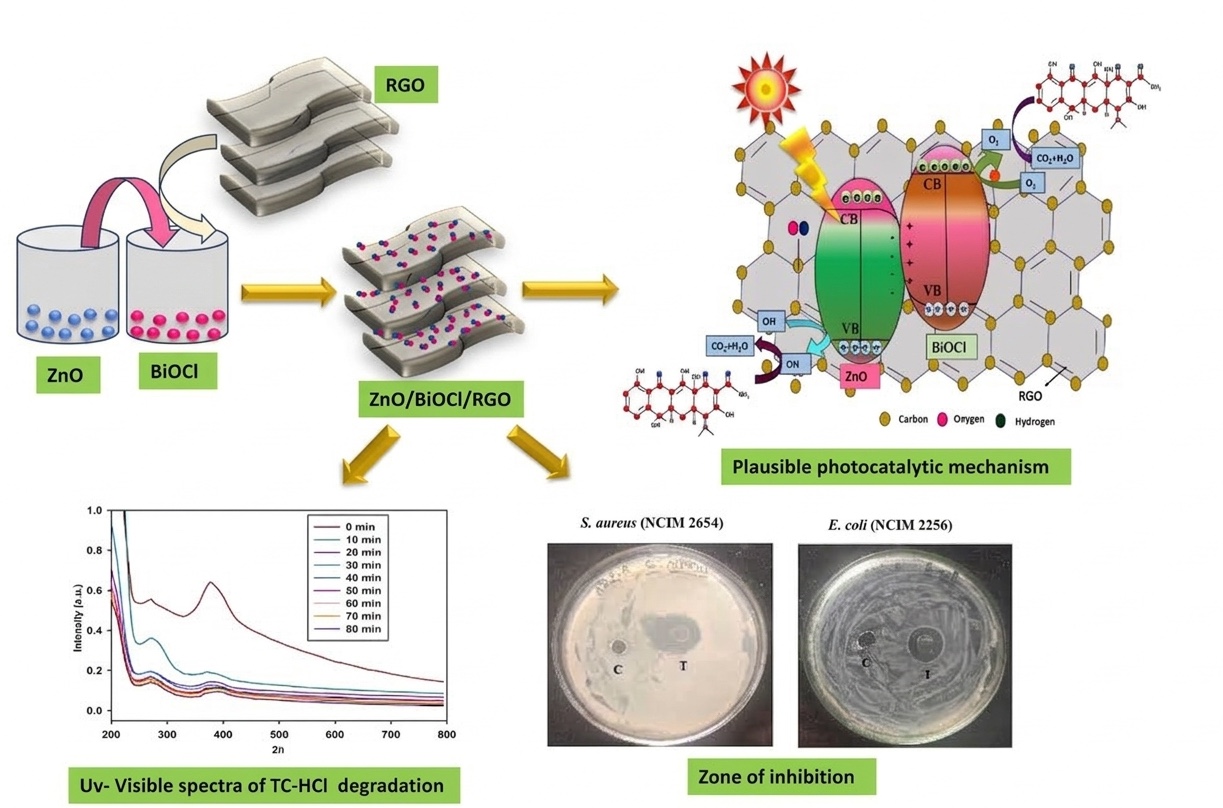
Firstly, 50 mg of the BiOCl/ZnO composite solution in deionized water (80mL) was sonicated at RT for 20 min. 10 mg of RGO was added and stirred into the above-prepared solution for 1 h at RT. The resultant mixture was then autoclaved at 100ºC for 12 h. Ultimately, the precipitate was cleaned multiple times using deionised water, dried for 6 h at 80ºC, and then utilised for further research. Fig. 1 shows the ternary ZnO/BiOCl/RGO heterostructure synthesis schematic design.
2.5. Antibacterial Assay
The well diffusion method was used to assess the antibacterial activity of synthesised ZnO, ZnO/BiOCl, and ZnO/BiOCl/RGO NPs at a concentration of 2 mg/mL against several drug-resistant bacteria, specifically S. aureus and E. coli. The resulting suspensions of bacteria were diluted to a final OD at 600nm of 0.02 using UV-visible, i.e 2*107 CFU. Under aseptic conditions, wells were shaped on the sterile nutrient agar plate, and the 50 µL sample was added to each well. The diameter of the inhibition zones during a 24 h incubation period at 37°C was used to assess the antibacterial activity [28,29].
2.6. Photocatalytic degradation study
TC was degraded photocatalytically at room temperature. Here, 50 mL of deionised water was used to dissolve 10 mg of TC, and 30 mg of the produced catalyst were then added to the mixture. Magnetic stirring was used at room temperature to agitate the resulting reaction mixture to adsorb TC onto the catalyst surface. The mixture was exposed to visible light radiation using a 250W xenon lamp to further start the catalytic reaction. After centrifuging 5 mL of the reaction mixture at regular intervals, the absorbance at λ=379 nm was measured using a UV-visible spectrophotometer. Furthermore, the photocatalytic degradation efficacy (%) of TC was calculated using the following formula [13];
Degradation efficiency (%) = (C0-Ct/C0) × 100;
where C0 and Ct are initial and final concentrations.
2.7. Characterization of synthesized nanomaterial
X-Ray Diffraction (XRD) analysis (Mini Flex 600 X-ray diffractometer) was performed to explore the crystal structure of the ternary ZnO/BiOCl/RGO heterostructure. The FT-IR spectra were recorded on a Bruker Optics Alpha-T FT-IR spectrometer. FESEM (Hitachi SU8010 Series, Japan) equipped with an energy dispersive spectrometer (EDS), and HR-TEM (JEOL, JEM 2100 Plus) analysis were utilized to explore the surface and structural morphology of the catalyst. To explore the elemental oxidation states and binding energies of the different bonds in the prepared catalyst, XPS (Physical Electronics, PHI 5000 Versa Probe III) analysis was performed. UV-visible DRS spectrophotometer (Shimadzu, UV 2600) was used to investigate the band gap energies of the prepared catalysts. The UV–visible absorption spectra of TC were measured on a UV-visible spectrophotometer (Systronics, UV 2202).
3 Results and discussion
3.1. Powder XRD analysis
A Mini Flex 600 X-ray diffractometer was used for the XRD investigation to investigate the crystalline phases found in the ZnO/BiOCl/RGO heterostructure. The obtained XRD patterns are displayed in Fig. 2. The diffraction peaks at 31.78°, 36.26°, 56.58°, 62.84°, 67.94°, 68.99°, and 72.57° correspond to (100), (101), (110), (103), (112), (201), and (004) diffraction planes of hexagonal phase of zinc oxide (JCPDS No. 36-1451) [30]. However, the BiOCl show the diffraction peaks at 12.05°, 24.07°, 25.87°, 32.56°, 33.47°, 40.84°, 46.78°, 49.82°, 54.12°, and 58.74° correspond to (001), (002), (101), (110), (102), (112), (200), (113), (211), and (212) diffraction planes of tetragonal phase of bismuth oxychloride (JCPDS No. 06-0249) [31,32]. However, because of the extremely amorphous nature and extremely low content, the diffraction peaks for RGO were not apparent in the XRD pattern [33]. The developed ZnO/BiOCl/RGO heterostructure is purer, as seen by the lack of additional peaks in the XRD pattern.
3.2. FT-IR analysis
The FT-IR technique is used to study the structural characteristics of the functional groups of RGO and ZnO/BiOCl/RGO nanocomposite; the spectra are shown in Fig. 3. The FT-IR spectra of RGO exhibit peaks at 1150 cm-1, 1511 cm-1, 2374 cm-1, and 3594 cm-1, corresponding to the stretching of C-O, C=C (aromatic), C-H, and O-H bonds [34,35]. The ZnO/BiOCl/RGO composite exhibits IR stretching peaks at 438 cm-1 and 520 cm-1, which correspond to Zn-O and Bi-O bonds, respectively. The vibrations at 1150 cm-1 corroborated the establishment of a chemical connection between reduced graphene oxide and the ZnO/BiOCl combination [36].
3.3. Structural and morphological analysis of ZnO/BiOCl/RGO heterostructure
FESEM analysis characterized the ternary ZnO/BiOCl/RGO heterostructure’s morphology and structural characteristics; the resulting micrographs are displayed in Fig. 4.
The ZnO/BiOCl/RGO heterostructure’s SEM micrographs displayed an irregular shape resembling nanoplates. Magnified SEM micrographs also show the ZnO/BiOCl nanoplates’ coarse surface and monodispersed structure, which suggests a broader specific surface area and more active sites for efficient photocatalytic breakdown of organic pollutants [37].
Energy-dispersive X-ray spectroscopy (EDX) examination also confirms the presence of zinc, bismuth, oxygen, and chlorine in the synthesized heterostructure (Fig. 4c-4d). However, each component is evenly distributed, indicating that the ZnO/BiOCl/RGO heterostructure has been successfully produced. Fig. 5 (a-c) displays TEM images of the ZnO/BiOCl/RGO heterostructure, demonstrating that the sample is composed of irregular plate-shaped structures that range in thickness from 40 nm to 55 nm. TEM images confirmed that the uneven ZnO/BiOCl composite plates are evenly distributed across the RGO surface.
Furthermore, the highly crystalline plates of the ZnO/BiOCl/RGO heterostructure are confirmed by the corresponding SAED pattern, depicted in Fig. 5d.
3.4. X-ray photoelectron spectroscopy analysis
XPS analysed the surface elemental composition and chemical oxidation state of the ZnO/BiOCl/RGO heterostructure (Fig. 6). The survey scan spectra validated the presence of zinc, bismuth, oxygen, chlorine, and carbon elements in the ZnO/BiOCl/RGO heterostructure (Fig. 6a). The high-resolution Zn 2p XPS spectrum (Fig. 6b) reveals two peaks at binding energies of 1044.8 eV and 1021.5 eV, corresponding to Zn 2p1/2 and Zn 2p3/2, respectively, indicating the presence of zinc in +2 oxidation state in the synthesized heterostructure [38]. Additionally, the Bi 4f spectra exhibit two prominent peaks at 159.1 and 164.2 eV, corresponding to Bi 4f7/2 and Bi 4f5/2 (Fig. 6c),
confirming the presence of bismuth in the +3-oxidation state within the ZnO/BiOCl/RGO heterostructure [39]. Furthermore, the Cl 2p spectra exhibited two peaks at 199.8 eV and 198.3 eV, corresponding to Cl 2p1/2 and Cl 2p3/2 of Cl-, respectively (Fig. 6d) [14]. The XPS spectra of C 1s (Fig. 8e) exhibited three peaks: one at 283.8 eV, indicative of carbon-carbon single (C-C) bonds [40]; another at 284.7 eV, attributed to carbon-carbon double (C=C, Sp2) bonds; and a peak at 286.1 eV, signifying C-O-C bonds in hydroxyl and epoxy groups, thereby confirming the presence of reduced graphene oxide [41].
Additionally, in the O 1s spectra of ZnO/BiOCl/RGO (Fig. 6f), the peaks at 532.1 and 531.1 eV were ascribed to C-O-Zn and Bi-O. Consequently, the synthesis of the ternary ZnO/BiOCl/RGO heterostructure successfully integrated oxygen-containing RGO into ZnO/BiOCl, as shown by XPS analysis.
3.5. Ultraviolet-visible diffuse reflectance spectroscopy and band gap analysis
Utilizing the UV-visible DRS technique, the light absorption characteristics of the ZnO/BiOCl/RGO heterostructure were measured; the findings are displayed in Fig. 7a. The absorption capability of the photocatalyst is higher in the solar spectrum’s visible light portion. At 436 nm wavelength, the band edge absorption value increases both the absorption coefficient and the absorption of visible light. Additionally, the Tauc plot equation is used to compute the optical band gap energies (Eg) [42,43]: αhυ = A(hυ-Eg); where Eg is the band gap energy; h is the Planck constant; α is the absorption coefficient; v is light frequency; A is a proportionality constant.
The calculated Eg value for the ZnO/BiOCl/RGO photocatalyst, based on Tauc plot results (Fig. 7b), is 2.84 eV. Accordingly, the ZnO/BiOCl composite hybridization with RGO may improve the optical absorption characteristics in the visible light spectrum, leading to a superior capacity for photocatalytic degradation.
3.6. Antibacterial potential of ZnO/BiOCl/RGO heterostructure
Fig. 8 and Table 1 show the findings of the antibacterial activity study. In comparison to the control, the synthesized ZnO/BiOCl/RGO showed a notable inhibition zone against S. aureus and E. coli. The following order of size-dependent antibacterial activity was observed: ZnO/BiOCl/RGO, ZnO/BiOCl, and ZnO, respectively. Their morphology and composition may also be connected to this discrepancy [44]. It was clear that all ZnO heterostructures had the strongest antibacterial action against S. aureus at a concentration of 2 mg/mL compared to E. coli, most likely due to the different bacterial cell wall compositions [44]. Polar facets on ZnO nanoplates have reportedly demonstrated stronger antibacterial activity. Numerous studies have demonstrated that the action of ZnO is linked to the release of reactive oxygen species (ROS) and zinc ions. Hydrogen peroxide (H2O2), hydroxyl radicals (OH-), superoxide (O₂⁻), peroxide (O22−), and zinc ions are examples of ROS species that attach to the negative surface of cell membranes, disrupting cells and causing internal cellular substances to leak out, ultimately leading to cell death [45–49]. Moreover, Puttaraju et al demonstrated the antibacterial property of tetragonal non-toxic BiOCl NPs against S. aureus and P. aeruginosa [50].
In the present work, we were interested in synthesizing nanoparticles and heterostructures with different sizes and observing their composition-dependent antibacterial activity. Among all synthesized samples, ZnO/BiOCl/RGO with a minimum size of 40-55 nm thickness and 150-300 nm width with evenly distributed RGO sheets showed comparatively significant antibacterial activity against both microorganisms. Their small surface area may also facilitate the maximal interaction with microbial cells to volume ratio [51]. Fig. 9 shows the likely mechanism of the antibacterial action.
3.7. Photocatalytic degradation of TC
Fig. 10 shows the photocatalytic degradation effectiveness of ZnO/BiOCl/RGO towards TC. After 80 min of exposure to visible light, no discernible changes were seen without the catalyst. According to the figure, the highest TC degradation (85.95%) was seen in 80 min, which may have resulted from the combined action of reduced graphene oxide and BiOCl/ZnO composite [52,53]. Additionally, the Langmuir-Hinshelwood (L-H) model was used to calculate the reaction kinetics [54]; -ln(C/C0) = kt, where C0 and C stand for the TC’s starting and final concentrations, respectively, and k and t for the rate constant and irradiation duration.
Fig. 10c depicts the pseudo-first-order kinetics of TC degradation, which were supported by the linear relationship of degradation with time, and the rate constant (k) value of ZnO/BiOCl/RGO is 0.0172 min-1, indicating the greater degradation efficacy of the prepared photocatalyst towards the tetracycline pollutant. Furthermore, the comparison of the degradation efficacy of different photocatalysts towards TC antibiotic is tabulated in Table 2.
3.7.1 Effect of dosage
The concentration of the photocatalyst is crucial in the photodegradation process. Generally, reduced photocatalyst concentration diminishes degradation efficiency due to decreased photon absorption. Nonetheless, increasing the photocatalyst concentration enhances the degradation efficiency owing to a greater number of active sites on its surface [25]. The impact of the initial concentration of the synthesized photocatalyst under visible light was examined by varying the ZnO/BiOCl@RGO concentration from 15 mg to 45 mg per 50 mL of 10 mg L-1 TC solutions. The results are illustrated in Fig. 12. Fig. 11a illustrates that the photocatalytic degradation efficiency significantly increases at a photocatalyst concentration of 30 mg, then declines with further increase in concentration. This observation may result from increased turbidity in the TC solution when the photocatalyst concentration increases [55]. Consequently, 30 mg is the ideal dosage, demonstrating the highest photocatalytic efficiency under VLI.
Furthermore, the reaction kinetics were determined using the Langmuir-Hinshelwood (L-H) model, given as
-ln ( )=kt(1)
Where C0 and C are the initial and final concentrations of the TC; k and t represent the rate constant and irradiation time. From the linear fit (Fig. 11 b), the calculated rate constant values of ZnO/BiOCl/RGO for 15, 30, and 45 mg of catalysts are 0.00947 min−1, 0.0123 min−1, and 0.0207 min−1, respectively.
3.7.2 Effect of pH
The influence of pH on absorption capacity is contingent upon the structure of TC and the functional groups present on the surface of the ZnO/BiOCl/RGO composite. The findings (Fig. 11c) indicate that the elimination of TC is significantly influenced by the pH of the solution. When the pH of TC is less than 3.3, the dimethylammonium group is protonated, resulting in the cationic form of TC. Nonetheless, within the pH range of 3.3 to 7.7, it exists in zwitterionic form, and above a pH of 7.7, TC exists in an anionic state. In acidic conditions, the surface charge is predominantly positive, but in alkaline conditions, it becomes negatively charged [56]. This aligns with the measurement of the pHZpc of the ZnO/BiOCl/RGO catalyst, which was recorded at 8.11 (Fig. 11e). Under acidic and alkaline conditions, the electrostatic repulsion between TC molecules and the ZnO/BiOCl/RGO catalyst diminishes the adsorption capability. Thus, pH 7 appears to be optimal for efficient TC removal [57]. The determined kinetic rate constants (Fig. 11d) for TC at pH levels of 3, 7, and 11 are 0.0129 min-1, 0.0256 min-1, and 0.0160 min-1, respectively.
3.7.3 Reusability study of synthesized photocatalyst
The photostability and reusability of the ZnO/BiOCl/RGO heterostructure were evaluated by a degradation experiment comprising three cycles. Following each cycle, the photocatalyst was subjected to centrifugation, and residual particles were removed using multiple washes with deionized water and alcohol. The material was subsequently dried in an oven at 70°C for 12 hours to produce a reusable catalyst. Fig. 12 illustrates the deterioration performance, with just a minor reduction after three cyclic runs. The catalyst exhibited 80.0 % degradation efficacy after three cycles, thus confirming the exceptional photostability and reusability of the synthesised photocatalyst.
3.6.1. Plausible Photocatalytic degradation mechanism
Pristine ZnONPs display limited absorption capabilities in the visible part of the solar spectrum because of their broad band gap (3.2 eV). However, its band gap decreases when it is linked with n-type bismuth oxychloride semiconductor, allowing it to absorb visible light from the solar spectrum. However, the agglomeration of nanoparticles in the binary BiOCl/ZnO composite also affects the light absorption capacity. Therefore, the BiOCl/ZnO composite can be immobilized on reduced graphene oxide [58]. The immobilization of the BiOCl/ZnO composite on the RGO surface inhibits electron and hole recombination during photocatalytic activity.
Additionally, the electrons in the CB of ZnO and the holes in the VB of BiOCl create an internal electric field (IEF), which facilitates the migration of the electrons in the CB of BiOCl on the RGO surface [40]. These electrons convert the dissolved oxygen on the RGO surface to superoxide (O2•-) radicals, which oxidize TC into CO2 and water. Similarly, the holes from the valence band of ZnO efficiently oxidize hydroxyl anion (OH−) to hydroxyl radicals (•OH), which further reduce tetracycline molecules to water and carbon dioxide products. The plausible degradation mechanism using ZnO/BiOCl/RGO heterostructure is represented in Fig. 10.
Conclusion
The scarcity of clean and pure water is one of the environmental challenges imposed due to urbanization and industrialization. In addition to managing wastewater, researchers are working very hard to provide clean and safe water. The present study attempts to find a socially and economically viable solution to eliminate TC, a major pollutant of environmental contamination, and to find materials that can stop bacteria from growing. In the present research work, a ZnO/BiOCl/RGO photocatalyst was synthesized by a hydrothermal method, and the catalyst was further utilized for the degradation of the tetracycline antibiotic. Adding RGO enhanced the degradation ability of the ZnO/BiOCl composite as it boosted the charge transfer phenomenon. The RGO material surface offers several active adsorption and degradation sites as it hinders the photoexcited charge carriers (e- and h+). ZnO/BiOCl/RGO photocatalyst has a notable degradation efficiency of 85.95% in 80 min. The ZnO/BiOCl/RGO also revealed enhanced antibacterial activity, attributed to improved bacterial cell wall penetration.
In a nutshell, the ZnO/BiOCl/RGO photocatalyst offers a viable method of breaking down hazardous pollutants in wastewater and an affordable solution to clean the environment. This study lays the foundation for further research to improve bactericidal and photocatalytic materials and investigate their uses in various environmental contexts to create sustainable water management solutions and antibacterial applications.