Document Type : Original Research Paper
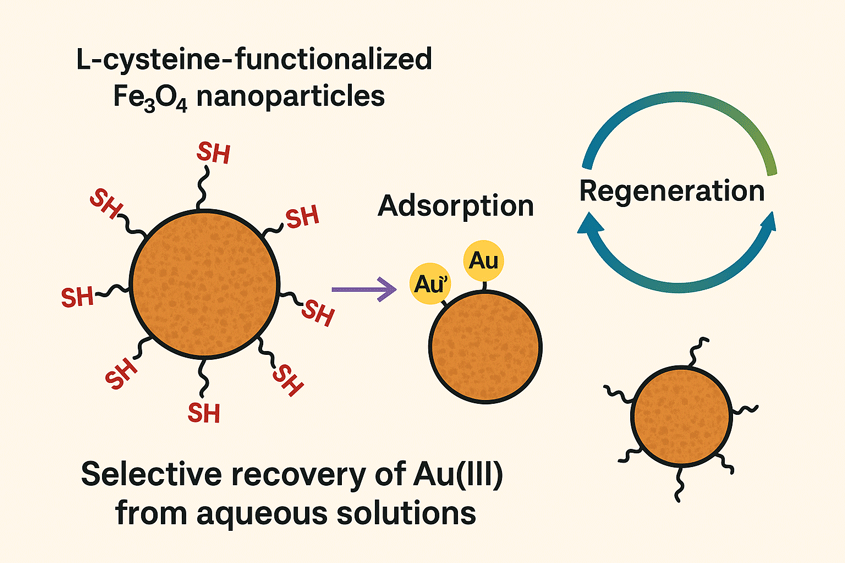
Graphical Abstract
Highlights
· L-cysteine-functionalized Fe₃O₄ nanoparticles were synthesized as efficient, selective, and reusable adsorbents for Au(III) recovery.
· Nanoparticles exhibited small size (6–8 nm), high surface area (78.5 m² g⁻¹), and mesoporous structure, providing abundant active sites for gold adsorption.
· Adsorption followed the Langmuir isotherm (qₘₐₓ = 152.4 mg g⁻¹) and pseudo-second-order kinetics, indicating chemisorption.
· Thermodynamic analysis confirmed that Au(III) adsorption was spontaneous (ΔG° < 0) and endothermic (ΔH° = 26.4 kJ mol⁻¹).
· The nanoparticles demonstrated high selectivity for Au(III) over competing metal ions (Cu²⁺, Ni²⁺, Pb²⁺) and retained >80% adsorption capacity after ten regeneration cycles, highlighting their potential for sustainable gold recovery from aqueous solutions.
Please note: The following content displays the text-only preview. For the full article, complete with all illustrations, data tables, and equations, please download the free PDF from the sidebar at the top of this page.
1. INTRODUCTION
The recovery of precious metals, particularly Au(III), from industrial effluents and electronic waste has gained significant attention due to the scarcity of natural resources and the environmental hazards associated with conventional extraction methods [1]. Traditional cyanidation processes, while effective, involve highly toxic chemicals, generate hazardous by-products, and pose substantial risks to human health and the environment. Consequently, environmentally benign alternatives, such as adsorption using functionalized nanomaterials, have emerged as promising strategies.
Magnetic nanoparticles, especially Fe₃O₄, are widely investigated as adsorbents because of their high surface area, facile surface modification, and magnetic separability [2]. Functionalization with thiol-containing molecules enhances selectivity toward Au(III) ions due to the strong affinity between Au(III) and sulfur atoms. L-cysteine, a naturally occurring amino acid containing both thiol (–SH) and amine (–NH₂) groups, provides dual functionality that facilitates binding and stabilization of Au(III) ions on the nanoparticle surface [3].
Although cysteine-functionalized nanoparticles have been studied previously, systematic evaluation of adsorption kinetics, thermodynamics, selectivity, and reusability remains limited. This study addresses these gaps by synthesizing L-cysteine-functionalized Fe₃O₄ nanoparticles and evaluating their performance for Au(III) recovery under optimized experimental conditions, highlighting their potential for sustainable and practical applications in complex aqueous systems.
2. MATERIALS AND METHODS
Ferric chloride hexahydrate (FeCl₃·6H₂O), ferrous sulfate heptahydrate (FeSO₄·7H₂O), L-cysteine, hydrochloric acid, thiourea, and analytical-grade metal salts were purchased from Sigma-Aldrich. All solutions were prepared with deionized water, and Au(III) stock solutions were prepared from HAuCl₄·3H₂O.
Synthesis of Fe₃O₄ Nanoparticles and Functionalization:
Fe₃O₄ nanoparticles were synthesized via co-precipitation of Fe²⁺ and Fe³⁺ ions in an alkaline medium. FeCl₃·6H₂O (0.1 M) and FeSO₄·7H₂O (0.05 M) were dissolved in deionized water under a nitrogen atmosphere and stirred at 80 °C. Ammonium hydroxide (NH₄OH) solution was added dropwise until pH 10 was reached, yielding black Fe₃O₄ precipitates. The nanoparticles were washed with water and ethanol, then dispersed in an aqueous L-cysteine solution (0.05 M) and stirred for 12 h to achieve surface functionalization. The resulting L-cysteine-functionalized Fe₃O₄ nanoparticles were magnetically separated, washed, and dried at 60 °C.
Characterization:
Nanoparticle morphology and particle size were examined using transmission electron microscopy (TEM). Fourier-transform infrared spectroscopy (FTIR) was employed to identify surface functional groups, and X-ray diffraction (XRD) confirmed the crystalline structure. Nitrogen adsorption–desorption measurements (BET analysis) were conducted to determine specific surface area, pore volume, and pore size distribution.
Adsorption Studies:
Batch adsorption experiments were performed by mixing 50 mL of Au(III) solution with a known mass of Fe₃O₄ L-cysteine nanoparticles at room temperature. Parameters including solution pH (2-8), contact time (5-120 min), and adsorbent dosage (0.05-0.2 g) were optimized. Residual Au(III) concentrations were measured using atomic absorption spectroscopy (AAS), and adsorption capacity (qe) and removal efficiency (%) were calculated using standard equations. Adsorption kinetics were analyzed using pseudo-first-order and pseudo-second-order models, and equilibrium data were fitted to Langmuir, Freundlich, and Temkin isotherms.
Thermodynamic Analysis:
Thermodynamic parameters (ΔG°, ΔH°, ΔS°) were determined from temperature-dependent adsorption studies (298–318 K) using the Van’t Hoff method, Equations (1) and (2).
(1)
(2)
where Kc is the equilibrium constant, R is the universal gas constant (8.314 J/mol·K), and T is the absolute temperature (K). ΔH° and ΔS° were determined from the slope and intercept of the linear plot of ln Kc versus 1/T.
Selectivity and Reusability:
Selectivity experiments were conducted using mixed-metal solutions containing Au(III), Cu²⁺, Ni²⁺, and Pb²⁺. The distribution coefficient (Kd) and selectivity coefficient (KM/Au) were calculated to evaluate preferential adsorption. Regeneration and reusability studies were performed using 0.5 M thiourea in 0.1 M HCl, with repeated adsorption cycles to assess nanoparticle stability and performance retention.
3. RESULTS AND DISCUSSION
3.1 Transmission Electron Microscopy (TEM) Analysis
TEM images (Fig. 1) revealed that the Fe₃O₄ L-cysteine nanoparticles are spherical with a narrow size distribution of 6–8 nm. The uniform morphology and nanoscale dimensions indicate controlled synthesis, providing a high specific surface area and abundant active sites for Au(III) adsorption. Slight agglomeration, typical of magnetic nanomaterials, was observed, but individual nanoparticles remained well-defined. Particle sizes were consistent with XRD-determined crystallite sizes, confirming a largely monocrystalline structure.
3.2 Fo@urier-Transform Infrared (FTIR) Spectroscopy
FTIR spectroscopy confirmed the surface functionalization of Fe₃O₄ nanoparticles with L-cysteine and the presence of active groups responsible for Au(III) adsorption (Fig. 2, Table 1). Characteristic absorption bands at 2560 cm⁻¹ (–SH) and 1620 cm⁻¹ (C=O) indicate successful functionalization and the availability of active sites for Au(III) binding.
3.3 X-Ray Diffraction (XRD) Analysis
XRD patterns (Fig. 3) showed peaks at 2θ = 30.1°, 35.5°, 43.2°, 53.5°, 57.1°, and 62.7°, corresponding to the (220), (311), (400), (422), (511), and (440) planes of the Fe₃O₄ spinel structure (JCPDS 19-0629). These reflections confirm the formation of crystalline magnetite without impurities and indicate that L-cysteine functionalization did not alter the spinel lattice. Sharp peaks suggest high crystallinity, consistent with TEM observations and previously reported magnetite nanostructures [4,5]. Scherrer’s equation estimated the average crystallite size as 6–8 nm.
3.4 Surface Area and Porosity Analysis (BET)
BET analysis revealed a specific surface area of 78.5 m²/g, a total pore volume of 0.12 cm³/g, and an average pore diameter of 6.1 nm, indicating a mesoporous structure (Table 2). The high surface area and mesoporosity provide abundant active sites for Au(III) adsorption (Fig. 4) and facilitate rapid mass transfer, contributing to enhanced adsorption kinetics and high equilibrium capacity. The stable surface structure ensures that active sites remain available during repeated adsorption–desorption cycles, supporting excellent reusability.
3.5 Adsorption Isotherm Studies
Equilibrium adsorption data fitted best to the Langmuir model (Fig. 5), indicating monolayer adsorption on a homogeneous surface with identical binding sites. The maximum adsorption capacity (qmax) was 152.4 mg/g, with R² = 0.992 (Table 3). Freundlich (R² = 0.956) and Temkin (R² = 0.941) models showed lower correlation, supporting the predominance of monolayer adsorption.
3.6 Adsorption Kinetics
Kinetic studies revealed that Au(III) adsorption followed a pseudo-second-order model (R² = 0.995), suggesting chemisorption as the dominant mechanism (Table 4, Fig. 6). Calculated and experimental equilibrium capacities were in close agreement, further confirming the reliability of the adsorption process.
3.7 Thermodynamic Analysis
Thermodynamic parameters (ΔG°, ΔH°, ΔS°) were calculated using the Van’t Hoff method (Fig. 7, Table 5). Negative ΔG° values indicate spontaneous adsorption, while positive ΔH° (26.4 kJ/mol) and ΔS° (108 J/mol.K) values suggest an endothermic process with increased randomness at the solid–liquid interface. These results imply that higher temperatures slightly enhance adsorption efficiency.
3.8 Selectivity and Interference
The Fe₃O₄ L-cysteine nanoparticles exhibited high selectivity for Au(III) in the presence of competing ions such as Cu²⁺, Ni²⁺, and Pb²⁺, consistent with strong Au–S interactions (Fig. 8). To quantify selectivity, the distribution coefficient (Kd) and selectivity coefficient (KM/Au) were calculated using Equations (3) and (4), respectively.
Distribution coefficient (Kd): (3)
Selectivity coefficient (KM/Au): (4)
where qe is the equilibrium adsorption capacity (mg/g), and Ce is the equilibrium concentration of the metal ion (mg/L). The calculated values confirmed a clear preference for Au(III) over competing cations, demonstrating the nanoparticles’ potential applicability in complex aqueous matrices, including electronic waste leachates and industrial effluents. All experiments were performed in triplicate (n = 3) to ensure reproducibility.
3.9 Regeneration and Reusability of Fe₃O₄–Cys Nanoparticles
The reusability of Fe₃O₄ L-cysteine nanoparticles was investigated over ten consecutive adsorption–desorption cycles to evaluate operational stability. Desorption was carried out using 0.5 M thiourea in 0.1 M HCl, followed by repeated adsorption under identical conditions.
As shown in Fig. 9 and Table 6, the nanoparticles demonstrated excellent regeneration performance with minimal loss of capacity. In the first cycle, the removal efficiency for Au(III) reached 96.5 ± 2.1%, corresponding to an equilibrium adsorption capacity (qe) of 182.3 ± 3.2 mg/g. After ten cycles, the removal efficiency remained above 80%, indicating strong chemical and structural stability.
The Fe₃O₄ L-cysteine nanoparticles retained more than 80% of their initial adsorption capacity after ten adsorption–desorption cycles, highlighting their robust recyclability and confirming their practical potential for sustainable Au(III) recovery from aqueous and industrial waste streams.
4. CONCLUSIONS
L-cysteine-functionalized Fe₃O₄ nanoparticles were successfully synthesized and thoroughly characterized as an advanced adsorbent for Au(III) recovery from aqueous media. Structural analysis revealed a highly crystalline spinel phase, nanoscale particle size (6–8 nm), and a mesoporous architecture (pore diameter ≈ 6.1 nm) with a specific surface area of 78.5 m²/g. The incorporation of L-cysteine introduced abundant thiol (–SH) and carboxyl (–COOH) groups, providing strong coordination sites for selective Au(III) binding.
Adsorption behavior followed the Langmuir isotherm, suggesting uniform monolayer coverage, while kinetics fitted the pseudo-second-order model, indicating chemisorption as the dominant mechanism. Thermodynamic analysis (negative ΔG°, positive ΔH°) confirmed that the process is spontaneous and endothermic. Selectivity studies demonstrated a pronounced preference for Au(III) over competing ions (Cu²⁺, Ni²⁺, Pb²⁺), and regeneration tests confirmed excellent reusability, with over 80% capacity retained after ten adsorption–desorption cycles.
Overall, L-cysteine-functionalized Fe₃O₄ nanoparticles combine high selectivity, efficiency, and recyclability, positioning them as a promising material for sustainable gold recovery from electronic waste leachates, industrial effluents, and mining residues. Future studies should focus on process scaling, continuous column-based recovery systems, and optimization of regeneration strategies for industrial deployment.
Author Contributions: Khalid Omar: Conceptualization, methodology, supervision, data analysis, manuscript writing and revision.
Jasim Mohammed Salman: Experimental work, data collection, analysis, and manuscript preparation.
Acknowledgments: The authors would like to acknowledge Iraq University College (IUC), Basrah, Iraq, for its academic and technical support. The authors also thank all individuals and laboratory staff who contributed to the completion of this work.
Funding Statement: No specific funding was received for this work.
Conflict of Interest Statement: The authors declare that they have no conflict of interest.
Data Availability Statement: The data supporting the findings of this study are available from the corresponding author upon reasonable request.