Document Type : Original Research Paper
Graphical Abstract
Highlights
· Biogenic CuCr2O4/g-C3N4 heterojunction was synthesized using cow urine as a reducing and stabilizing agent.
· FTIR, UV-DRS, FESEM-EDX and HRTEM verified bonding interactions and uniform CuCr2O4 dispersion on g-C3N4 sheets.
· The CuCr2O4/g-C3N4 heterojunction photocatalyst resulted in 94.18% degradation of Methylene blue dye in 90 min.
Please note: The following content displays the text-only preview. For the full article, complete with all illustrations, data tables, and equations, please download the free PDF from the sidebar at the top of this page.
1. Introduction
Nowadays, textiles and industrial effluents discharge large amounts of organic pollutants, specifically synthetic dyes, which cause major environmental and health issues because they are harmful and do not break down naturally [1], [2]. Methylene blue (MB) stands out as the most frequently utilized dye. MB dye contaminates water and has a severe effect on aquatic and human life; therefore, it’s very important to develop efficient and eco-friendly removal methods [3], [4]. Traditional methods for treating wastewater, including adsorption and chemical oxidation, have been widely used. They have some limitations, like high cost and incomplete degradation [2, 5, 6 ]. Photocatalysis offers a hopeful alternative, leveraging UV-Vis radiation to break down organic pollutants into safer byproducts [7], [8].
Spinel-type copper chromite is a well-known photocatalyst because of its special qualities, which include chemical stability, visible light activity, and a narrow band gap[9]. However, it exhibits several drawbacks, such as poor surface area and quick charge recombination[10]. In order to get over these problems, it operates with graphitic carbon nitride (g-C3N3), a semiconductor known for its diverse and beneficial properties, such as large surface area, strong electron transport, and porous nature. CuCr2O4/gC3N4 heterojunction nanocomposite production can enhance charge separation and photocatalytic activity[11], [12].
The creation of a nanocomposite using the conventional approach requires a lot of energy and extremely hazardous ingredients[13], [14]. This led researchers to switch to green chemistry synthesis techniques, which employ natural components as stabilizing and reducing agents[15], [16]. Cow urine is a natural resource, rich in a variety of organic compounds, including uric acid, creatinine, phenolic compounds, and essential vitamins such as A, C, D, and E, as well as urea. [17], [18]. These components play a crucial role as stabilizing and complexing agents in the synthesis of nanoparticles. During this process, cow urine acts as a reducing agent, effectively converting metal ions into neutral atoms, which then nucleate and develop into nanoparticles. Prior research has indicated its capacity to create metal oxides and nanocomposites with enhanced catalytic capabilities[19], [20].
In this study, we present the biogenic synthesis of a CuCr2O4/gC3N4 nanocomposite using cow urine as a natural reducing and stabilizing agent. Unlike traditional chemical methods, we anticipated that the diverse mix of organic compounds in cow urine would not only facilitate the reduction of metal precursors but also regulate the growth and morphology of the CuCrO₄ nanoparticles. This process resulted in a reduced particle size. We evaluated the effectiveness of the resulting nanocomposite in degrading methylene blue dye through photocatalysis under visible light. A detailed analysis of various characteristics, including morphological, optical, and structural properties, was conducted. This research offers a dye degradation method that adheres to the principles of green chemistry and environmental remediation, ensuring both efficacy and environmental sustainability.
2. Materials and methods
2.1 Materials
Copper nitrate hexahydrate [(Cu(NO3)2.6H2O](98%), [Cr(NO3)3.9H2O](98%), Melamine (99.8%), Ammonia solution (25%), Ethanol, Methylene blue were purchased from Chemo Equip. Double-distilled water was employed during the studies.
2.2 Synthesis of graphitic carbon nitride –
To create graphitic carbon nitride, the thermal exfoliation process was employed[21], [22]. A silica crucible was filled with 5 g of melamine, which was then heated to 550 °C for three to four hours in a muffle furnace[23]. A pale yellow result indicated that graphitic carbon nitride was produced after cooling to ambient temperature. The product was finely crushed in a mortar to ensure uniform particle size. This thermally exfoliated g-C₃N₄ was then used for nanocomposite fabrication[24].
2.3 Synthesis of CuCr2O4 NPs
Stoichiometric amounts of Cu(NO₃)₂·3H₂O and Cr(NO₃)₃·9H₂O in a 1:2 molar ratio were dissolved in a minimal volume of water under continuous stirring to obtain a homogeneous solution[25]. 150 mL of fresh cow urine was introduced into the precursor solution, acting as a reducing and chelating agent. The mixture was thoroughly stirred for half an hour to ensure a uniform solution. After that, the pH was meticulously adjusted to 7.0 by slowly adding ammonia while continuously stirring[26]. The temperature was gradually increased to 200–250 °C, initiating a self-propagating exothermic redox reaction. The reaction underwent spontaneous combustion, yielding an ash-like powder. To eliminate any organic residue and enhance the crystallinity and phase purity, we calcined the powder in a muffle furnace at 800 °C for 4 hours. This process ensured the complete decomposition of organic material from cow urine, resulting in the formation of pure, crystalline CuCr2O4 free from impurities.[27].
2.4 Synthesis of CuCr2O4/g-C3N4 heterojunction
For the synthesis of CuCr2O4/g-C3N4 nanocomposite, 15 weight % amount of graphitic carbon nitride and copper chromite were combined with 30:30 ml of ethyl alcohol and distilled water. The mixture was carefully stirred for a duration of 5 to 6 hours and then dried for an additional 5 hours to produce the CuCr2O4/g-C3N4 heterojunction photocatalyst.
2.5 Characterization techniques
The crystallinity and composition of CuCr2O4/g-C3N4 nanocomposite were evaluated using X-Ray diffraction spectroscopy (XRD-Bruker D8). Functional group and introduction of CuCr2O4 onto the porous surface of gC3N4 were evaluated by using Cary 630 Fourier transform infrared spectroscopy (FTIR). Field emission scanning electron microscopy (FESEM) and Elemental dispersive X-ray spectroscopy (EDX) combined technique were used to analyze the surface morphology and elemental composition of the prepared nanocomposite. High-resolution transmission electron microscopy (HRTEM-JEOL JEM 2100 PLUS) technique was used to record highly resolved images of the synthesized nanocomposite. Optical absorption of samples was recorded using a UV-Visible spectrophotometer (Jasco).
2.6 Photocatalytic degradation
The effectiveness of the synthesized CuCr₂O₄/g-C₃N₄ nanocomposite in photocatalytic activity was evaluated based on its capability to break down methylene blue (MB) dye under visible light exposure. A Tungsten lamp, providing a broad spectrum of light, served as the visible-light source for the experiments. To prepare the experiment, 50 mg of the photocatalyst was added to a solution containing 10 ppm of MB dye. The suspension was stirred in the dark for 60 minutes to establish adsorption and desorption equilibrium. After this initial phase, the solution was exposed to visible-light irradiation. At specific time intervals, 4-5 ml of the suspension was removed, centrifuged, and filtered to eliminate any solid particles. The absorbance of the filtered solution was then recorded at a wavelength of 664 nm using a UV-VIS spectrophotometer:[28], [29]. The efficiency of photocatalytic degradation was calculated using the following formula;
Degradation efficiency (%) = (A0 – At)/A0*100
3. Results and discussion
3.1 XRD analysis
3.2 The synthesized material showcases a unique crystalline structure along with a specific phase composition. We analyzed the CuCr₂O₄/g-C₃N₄ nanocomposite using X-ray diffraction (XRD). Fig. 1 displays the XRD patterns for pure CuCr₂O₄, g-C₃N₄, and the CuCr₂O₄/g-C₃N₄ nanocomposite. Notably, the XRD pattern for pure g-C₃N₄ features a prominent peak at 27.56°, which corresponds to the (002) plane, reflecting the interlayer stacking found within the conjugated aromatic systems.[30]. For CuCr₂O₄, the diffraction peaks located at 2θ = 18.27°, 30.68°, 35.20°, 42.64°, 53.7°, 56.60°, and 63.77° align with the (111), (220), (311), (400), (422), (511), and (440) planes, respectively, confirming the presence of a cubic spinel structure[31]. The average crystallite size (D) of the CuCr₂O₄/g-C₃N₄ nanocomposite was calculated using the Scherrer equation, yielding an estimated size of 34 nm. Notably, the nanocomposite exhibits both g-C₃N₄ and CuCr₂O₄ phases without any evident impurity peaks, which suggests that the composite has formed successfully without any phase segregation. Additionally, the slight shifts in peak positions and the broadening of reflections might indicate potential interfacial interactions between the CuCr₂O₄ nanoparticles and the g-C₃N₄ matrix.
3.2 FTIR analysis
To analyze the composition, structure, and interactions between samples, the FTIR technique was employed. Spectra were recorded between 400 and 4000 cm⁻¹. The analysis of the g-C3N4, CuCr2O4, and CuCr2O4/g-C3N4 nanocomposite is presented in the accompanying Fig. 2. A distinct peak at 808 cm⁻¹ shows the presence of the s-triazine unit within the graphitic carbon nitride. Additionally, Numerous peaks can be observed within the range of 1200-1650 cm⁻¹. correspond to the C-N heterocyclic stretching vibration and C=N stretching vibrations associated with the s-triazine unit. The absorption band observed between 3200-3500 cm⁻¹ is linked to N-H and OH groups, reinforcing the structural integrity of g-C3N4.[32]. The prominent peak at 610 cm⁻¹, along with a less intense peak at 510 cm⁻¹, is ascribed to the metal-oxygen bands found in octahedral and tetrahedral sites[33]. These bonds confirm the formation of the spinel-type CuCr2O4 phase. FTIR spectra of the nanocomposite show features of both components with slight changes in intensity and shift, confirming the creation of the heterojunction CuCr2O4/g-C3N4 nanocomposite..
3.3 FESEM and EDS analysis
FESEM study was performed to examine the surface morphology of the nanocomposite at varying magnifications. The results of FESEM images of pure CuCr2O4, g-C3N4, and CuCr2O4/g-C3N4 nanocomposite are shown in Fig. 3. FESEM analysis revealed the nanostructured morphology of the CuCr₂O₄/g-C₃N₄ composite. The g-C₃N₄ showed a layered and porous sheet-like structure, while CuCr₂O₄ nanoparticles appeared as spherical or irregularly shaped particles homogeneously dispersed on the graphitic carbon nitride (g-C₃N₄) surface[34]. Agglomeration of CuCr₂O₄ nanoparticles was observed in some regions, attributed to high surface energy.
Energy-dispersive X-ray spectroscopy (EDS) was conducted simultaneously to confirm elemental composition and distribution. EDX analysis of CuCr2O4/gC3N4 nanocomposite is shown in Fig. 4. EDS spectra confirmed the presence of Cu, Cr, O, C, and N, validating the successful formation of the CuCr₂O₄/g-C₃N₄ composite. Elemental mapping demonstrated a homogeneous distribution of Cu and Cr across the g-C₃N₄ matrix. The atomic ratios were consistent with the expected stoichiometry of CuCr₂O₄ and g-C₃N₄.
3.4 HRTEM
To explore the microstructure, phase distribution, and crystallinity of the CuCr2O4/g-C3N4 nanocomposite, we conducted a thorough HRTEM analysis. The analysis presented in Fig. 5 illustrates the TEM analysis of the CuCr2O4/g-C3N4 nanocomposite. As depicted in Figs. 5a and 5b, the g-C3N4 nanosheets appear flaky, large, and wrinkled, while the CuCr2O4 exhibits a quasi-spherical shape. This morphology indicates that the CuCr2O4 nanoparticles are uniformly distributed across the mesoporous g-C3N4 sheets. The lattice fringes observed within these nanoparticles reveal a spacing of 0.29 nm, which is associated with the (220) plane of CuCr2O4. Moreover, Fig. 4(f) displays the selected area electron diffraction (SAED) pattern, affirming the crystalline nature of the materials and the presence of both CuCr2O4 and g-C3N4 phases [35]. The HRTEM analysis of CuCr₂O₄/g-C₃N₄ offers critical insights into structural and interfacial features, which are vital for comprehending its functional properties, particularly in applications such as photocatalysis and electrocatalysis.
3.5 UV-VIS DRS analysis
To investigate the optical characteristics of the g-C3N4, CuCr2O4, and CuCr2O4/g-C3N4 nanocomposite, UV-DRS analysis was performed. Absorption spectra are shown in Fig. 6. A g-C3N4 shows an absorption band in the UV-visible range. Copper chromite exhibits broad band spectra within the visible range. The absorption spectra of the nanocomposite reveal significant absorption in this range, showing an increase in both intensity and wavelength compared to graphitic carbon nitride. This indicates the presence of Copper chromite nanoparticles on the surface of the gC3N4 sheet.
Additionally, Fig. 6(b) presents the Tauc plot for g-C3N4, CuCr2O4, and the CuCr2O4/g-C3N4 nanocomposite. The plot indicates band gap values of 2.65 eV for g-C3N4, 1.52 eV for CuCr2O4, and 2.44 eV for the CuCr2O4/g-C3N4 combination. This nanocomposite exhibits a band gap that is higher than that of copper chromite but lower than that of graphitic carbon nitride, enabling it to absorb visible light and enhance photocatalytic degradation effectively[35].
3.6 Photocatalytic activity measurement
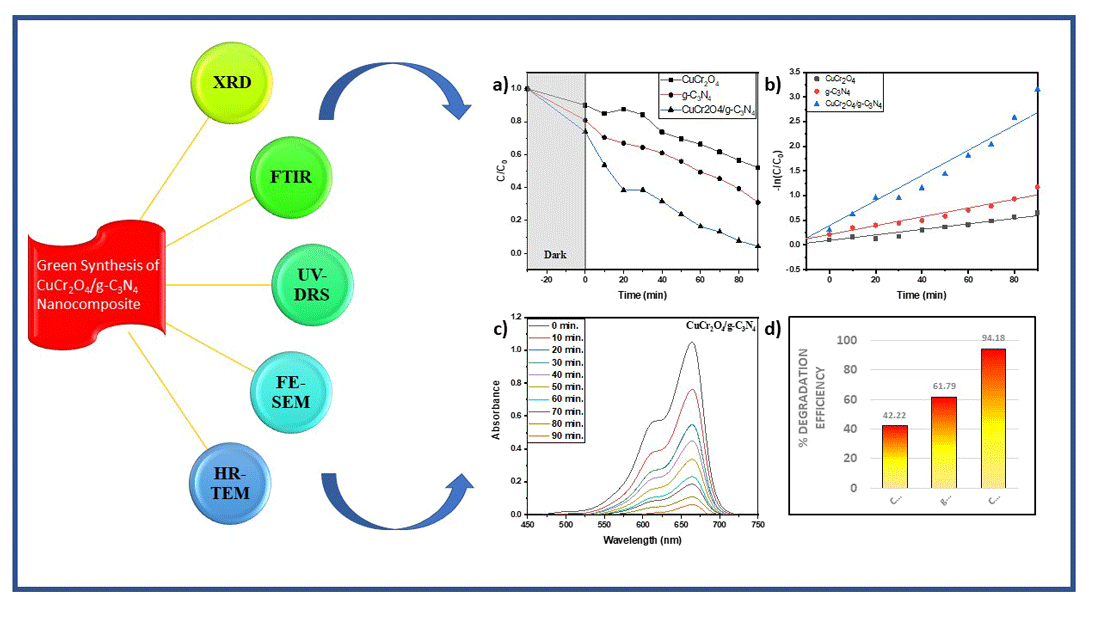
The effectiveness of photocatalytic degradation by CuCr₂O₄, g-C₃N₄, and the CuCr₂O₄/g-C₃N₄ nanocomposite was assessed by observing the breakdown of the organic pollutant methylene blue when exposed to visible light. Remarkably, the CuCr2O4/g-C3N4 nanocomposite shows superior photocatalytic degradation. Reaching 94.18 % degradation of MB within 90 min, whereas pure CuCr2O4 and g-C3N4 showed 42.22 % and 61.79 % degradation, respectively, under the same conditions. The photocatalytic performance of the nanocomposites saw significant enhancements due to the improved synergistic interaction between CuCr2O4 and g-C3N4. This combination not only facilitated more efficient charge separation but also increased the number of active sites available on the photocatalyst.[36].
Fig. 7 (a and b) shows the kinetics of photocatalytic degradation for methylene blue (MB), demonstrating adherence to a pseudo-first-order reaction model. Notably, the CuCr₂O₄/g-C₃N₄ nanocomposite displays the highest rate of degradation. (k = 0.392 min⁻¹), significantly surpassing those of pristine g-C₃N₄ (k = 0.212 min⁻¹) and CuCr₂O₄ (k = 0.09268 min¹). The improved kinetic performance showcases the superior catalytic efficiency of the CuCr₂O₄/g-C₃N₄ nanocomposite. This is largely due to synergistic effects that enhance charge separation and minimize electron-hole recombination[37].
Fig. 7(c) shows the UV-Vis absorption spectra for methylene blue(MB), where the characteristic peak at 664 nm was selected as the monitoring wavelength for degradation studies[38]. The degradation efficiency increased with prolonged irradiation time, as evidenced by the gradual decrease in peak intensity. This reduction in absorbance indicates the progressive breakdown of MB molecules over time[39].
3.6.1 Effect of Photocatalyst Dose
The study examined how different dosages of photocatalyst, ranging from 10 to 40 mg, influenced the degradation efficiency of MB, as illustrated in Fig. 8. Optimal performance was achieved at 30 mg, resulting in a 94.18% degradation of MB within 90 min. Further increase above 30 mg of photocatalyst dosage led to decreases in degradation efficiency. The decrease in degradation efficiency is due to light scattering effects and reduced photon absorption caused by excessive particle agglomeration and suspension opacity[40], [41]. These results reveal that 30 mg signifies the ideal catalyst loading, balancing sufficient active surface area with effective light penetration depth for maximizing photocatalytic activity. The pseudo-first-order kinetic model is employed to explore the photocatalytic degradation of the photocatalyst. In Fig. 8b, we can see that the heterojunction CuCr2O4/g-C3N4, when optimized to a dose of 30 mg, exhibits a higher rate constant (0.3331 min-1) compared to other concentrations.
3.6.2 Scavenging activity and
To explore the reactive species important in the photocatalytic degradation mechanism, a radical scavenging experiment was conducted. Different scavengers were used to quench the photogenerated species, including IPA (for hydroxyl radicals), EDTA (for h+), and BQ (for superoxide radicals)[42], [43]. To assess the role of each active species in the photodegradation of methylene blue, we compared the degradation efficiency with and without the use of scavengers. The findings are illustrated in Fig. 9. It was observed that the introduction of EDTA had little impact on the degradation efficiency, suggesting that holes (h⁺) were not a significant factor in this process. In contrast, a marked decrease in MB degradation was observed with the addition of IPA and BQ, reducing efficiencies to 54.23% and 39.31%, respectively. These findings strongly suggest that the main active species are superoxide radicals (•O₂⁻) and hydroxyl radicals (•OH), while holes (h⁺) contribute minimally[44]. Therefore, the photocatalytic mechanism predominantly involves a radical-mediated pathway.
Fig. 10. illustrates the possible photocatalytic degradation pathway of MB using the CuCr2O4/gC3N4 nanocomposite. When visible light hits a photocatalyst, it sparks the creation of electrons and holes. In the case of the heterojunction between CuCr2O4 and g-C3N4, the electrons from the conduction band of CuCr2O4 tend to recombine with holes found in the valence band of g-C3N4. The e in g-C3N4 combines with dissolved O2 to form a superoxide radical. It further reacts to form H2O2 and hydroxyl radicals. The hole in the CuCr2O4 Valence band oxidizes H2O, leading to the formation of hydroxyl radicals. The generated reactive oxygen species attack the methylene blue dye and break it into smaller, non-toxic molecules like water and carbon dioxide[36], [45]
The table presents a comparative analysis of dye degradation using graphitic-based nanocomposites. In this study, the CuCr2O4/gC3N4 photocatalyst, with its optimized dosage, demonstrates notable degradation performance in comparison to other reported graphitic carbon nitride-based photocatalysts.
3.6.3 Reusability study
The research focused on assessing the reusability of a catalyst through five consecutive cycles aimed at degrading methylene blue, a known pollutant. After each 90-minute reaction, the catalyst was recovered via centrifugation at 8000 rpm for 10 minutes. The solid residue underwent three washings with ethanol and deionized water, followed by a drying process at 60 °C for four hours. Once regenerated, the catalyst was reintroduced into a fresh solution of the pollutant under identical reaction conditions. The degradation efficiency for each cycle was calculated to assess the catalyst’s stability.
The stability and reusability of the CuCr₂O₄/g-C₃N₄ nanocomposite are essential for its practical applications. To investigate this, consecutive recycling experiments were carried out over five cycles under optimized conditions. The catalyst exhibited considerable stability, retaining a degradation efficiency of 63.12% by the fifth cycle, as shown in Fig. [11]. This finding confirms the durability of the nanocomposite and its resilience against photochemical degradation.
The slight decline in activity observed over the cycles can be explained by two main factors: the partial aggregation of catalyst nanoparticles during the recovery and washing process, which diminishes the overall active surface area, and the strong or competitive adsorption of resistant intermediate species on the active sites, which effectively inhibits their participation in subsequent photocatalytic reactions. These insights highlight the impressive reusability of the CuCr₂O₄/g-C₃N₄ nanocomposite while also elucidating the gradual deactivation noted during prolonged use.
Conclusion
This research presents the eco-friendly creation of a CuCr₂O₄/g-C₃N₄ nanocomposite, utilizing cow urine as a natural solvent and reducing agent to improve the photocatalytic breakdown of methylene blue (MB) when exposed to visible light. The nanocomposite was characterized using XRD, FTIR, FESEM, EDX, and HRTEM techniques. XRD analysis confirmed the formation of a cubic spinel CuCr₂O₄ phase and a graphitic carbon nitride framework, with an average crystallite size of 34 nm. FTIR spectra revealed interfacial interactions between CuCr₂O₄ and g-C₃N₄, while FESEM and HRTEM images showed a uniform dispersion of CuCr₂O₄ nanoparticles on the porous g-C₃N₄ sheets. The nanocomposite demonstrated remarkable photocatalytic efficiency by achieving a 94.18% degradation of MB within just 90 minutes. The ideal dosage of the catalyst was determined to be 30 mg. Through radical scavenging tests, it was found that the primary active species in the degradation of MB were hydroxyl radicals (•OH) and superoxide radicals (•O₂⁻). The key innovation of this study is the advanced application of cow urine as an eco-friendly medium for creating the CuCr₂O₄/g-C₃N₄ nanocomposite. This method offers a safer alternative to traditional chemical solvents, which can be harmful to the environment. Additionally, the well-established synergistic interaction between CuCr₂O₄ and g-C₃N₄ not only enhances photocatalytic activity but also aligns with the principles of green chemistry. This progress opens up new pathways for sustainable material synthesis, particularly in the field of environmental remediation.
Competing Interests Declaration
The authors confirm that there are no known financial conflicts or personal relationships that could have impacted the findings presented in this study.
Data availability
Data can be accessed upon request.
Author Contributions:
Rajeshwari Oza - study Conception or Design, manuscript Drafting, Critical Manuscript Revision.
Sonali Dichayal - Data Acquisition, Data analysis or interpretation, Manuscript Drafting
AI Statement
The authors confirm that no AI tools or services were used during the preparation of this work.