Document Type : Original Research Paper
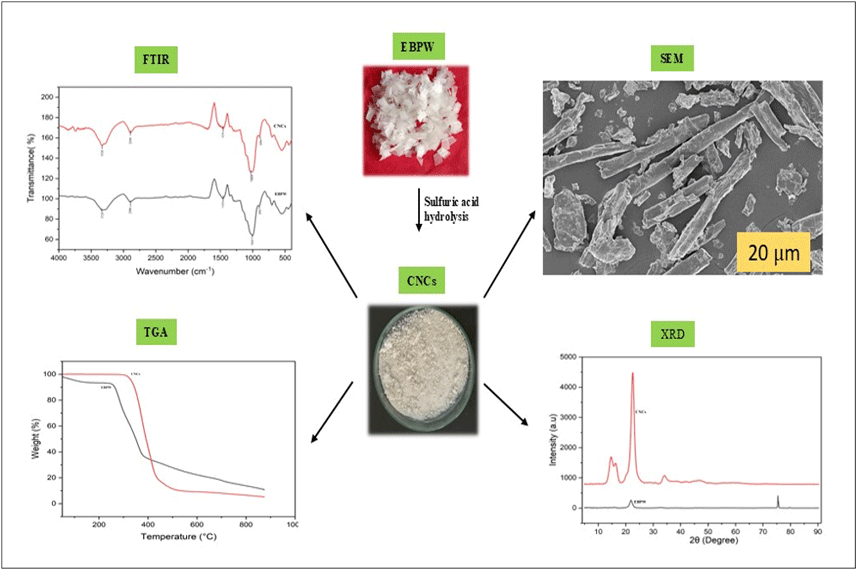
Graphical Abstract
Highlights
· Cellulose nanocrystals (CNCs) were successfully isolated from embroidery backing paper waste (EBPW).
· Isolated nanocellulose showed a high crystallinity index and good thermal stability.
· Sustainable utilization of biomass waste (EBPW) helps in reducing environmental pollution.
Please note: The following content displays the text-only preview. For the full article, complete with all illustrations, data tables, and equations, please download the free PDF from the sidebar at the top of this page.
Introduction
India is the 6th largest exporter of textiles and apparel in the world [1]. The Indian textile industry produces millions of tons of textile waste per year, contributing to carbon footprints [2]. Cost-effective methods like incineration and landfilling are the most commonly used methods to dispose of textile waste globally. These disposal methods pose a severe threat, emitting unpleasant odors, toxic chemicals, and greenhouse gases into the environment, which leads to pollution of the land, water, and air [3]. The textile waste management system in India aims to enhance sustainable utilization of textile waste materials by recycling them to produce new products and high-added-value products [2,4]. Embroidery backing paper is a sheet of paper that is hooped and embroidered along with the fabric. This paper acts as a stabilizer supporting the fabric and stitches during the embroidery process. Raw materials used for manufacturing this backing paper include cotton, starch powder, and water [5]. After the embroidery process, these papers will be removed from the fabric and end up in the trash. Tons of this embroidery backing paper waste reach landfills every year, polluting the environment. High cellulose content and abundant availability of EBPW could be a promising raw material for value-added products, enhancing sustainable utilization of waste resources.
Cellulose, the most abundant natural biopolymer, consists of highly ordered crystalline regions along with some amorphous (disordered) regions in varying proportions. When these cellulose regions are subjected to a proper combination of mechanical, chemical, and/or enzyme treatment, the amorphous region of the cellulose is preferentially disintegrated, whereas crystalline regions that have a higher resistance remain intact, producing nanocellulose. In general, nanocellulose can be distinguished as cellulose nanocrystals (CNCs) and cellulose nanofibers (CNFs) based on size, morphology, and mode of synthesis [6-8]. Various methods, such as high-intensity ultrasonication [9], steam explosion with high-shear homogenization [10], cryocrushing [11], the TEMPO oxidative method [12], microfluidization [13], the acid hydrolysis method [14-16], the enzymatic method [17], and combined processes [18], were reported in the literature for extraction of nanocellulose from different sources like plants, animals, woods, food wastes, industrial wastes, etc.
Amongst the various methodologies used in the preparation of nanocellulose, acid hydrolysis has been the most popular and convenient process to obtain CNCs because of cost-effectiveness, time-saving, and worldwide acceptance of the method that enables the production of various types of nanocellulose with tailored properties [14-16]. H2SO4 and HCl are commonly used inorganic acids in CNCs production. CNCs from H2SO4 hydrolysis were reported with good mechanical and thermal stability. CNCs extracted from untreated textile waste using sulfuric acid hydrolysis had 89.99% crystallinity index and showed improved mechanical properties when incorporated into soy protein isolate films [15]. Spherical CNCs consisting of crystallinity index 94.6% and high thermal stability (260-448 °C) were extracted from cotton cloth waste using sulfuric acid hydrolysis [19] (as indicated in Table.2). CNCs possess unique properties like biodegradability, biocompatibility, high surface area, high crystallinity and chemical functionality which makes them a potential reinforcing agent for biocomposite material production in different applications such as packaging, water purifying membranes, electrodes, etc [20].
Due to the lack of sustainable management practices, tons of EBPW end up in landfills or are incinerated, causing significant environmental issues. The processing and utilization of EBPW have the propensity to reduce environmental pollution associated with its discharge. Considering this, our research aims to determine the technical feasibility of utilizing embroidery backing paper waste (EBPW) for the production of CNCs using the H2SO4 hydrolysis process, thereby mitigating environmental impact caused by this waste while promoting the sustainable production of nanocomposite materials for a wide range of applications, such as food packaging, wastewater treatment, drug delivery, biosensing, etc. To our knowledge, this research is the first to extract CNCs from embroidery backing paper waste. This approach will likely increase the research interest in EBPW as a new source of nanocrystals because of their high availability and no/or low-cost cellulose resource. The morphology, crystallinity, and thermal stability of the obtained CNCs were investigated using analytical methods, such as field-emission scanning electron microscopy (FESEM), energy dispersive X-ray spectroscopy (EDAX), X-ray diffraction (XRD), Fourier transform infrared spectroscopy (FTIR), and thermogravimetric analysis (TGA). The results indicated that the extracted CNCs possess desirable properties of a reinforcing agent or filler for various applications, including composites and biomedical materials.
MATERIALS AND METHODS
Sample collection and preparation
One kg of embroidery backing paper waste was collected from Living Essential Clothing (Embroidery unit), Tirupur, Tamilnadu, India. The waste was cut into small pieces and then boiled for one hour to remove any dirt. The boiled waste was then filtered and rinsed with distilled water and dried in the oven at about 80◦ C for 2 hours and stored in zip-lock bags at room temperature for further treatment. Sulfuric acid (H2SO4, 98%, analytical grade) was purchased from Sri Precision Chemical Co. (Coimbatore, India).
Isolation of CNCs
CNCs from EBPW were prepared by sulfuric acid hydrolysis, as presented in Fig. 1. Acid hydrolysis of EBPW was performed by slowly adding 64% (w/v) H2SO4 to the sample, with a solid-to-liquid ratio of 1:10 (g/ml) under continuous stirring placed in an ice water bath. The obtained suspension was then heated at a temperature 45◦C for a hydrolysis reaction time of 1 h under constant agitation. The hydrolysis was terminated by adding a 10-fold amount of cool distilled water, and then the mixture was allowed to rest at room temperature for a few hours until two layers could be distinguished. Cellulose sediment was separated from the liquid phase and then centrifuged at 10000 rpm for 15 min to obtain the precipitate. Then the precipitate was washed with distilled water, and the centrifugation process was repeated 3 to 5 times until the pH of the suspension was reduced to pH 5 [21]. After the suspension was dialyzed until a neutral pH was obtained. Finally, the suspensions were sonicated for 15 min at an amplitude of 0.3% in an ice bath to avoid overheating. The suspension was then freeze–dried (lyophilized) at a temperature of - 50◦ C and a vacuum pressure of 0.5 torr. Dry CNC powder obtained was stored in a PVC bottle at 4◦ C for further characterization.
Yield Percentage
The percentage yield of the isolated nanocellulose was calculated through the gravimetric method [22], as shown in Equation (1):
The yield percentage of the extracted nanocellulose = (1)
where m1 represents the initial weight of the EBPW, and m2 is the final weight of the nanocellulose obtained.
Estimation of lignocellulosic content
Goering and Van Soest’s method (1970) [23] was used for the estimation of cellulose, hemicellulose, lignin, and ash content of EBPW.
Characterization of Nanocellulose
Fourier Transform Infrared Spectroscopy (FTIR)
The functional properties of the EBPW and isolated CNCs were carried out by the attenuated total reflection (ATR) method using the Shimadzu IR-Affinity-1S instrument, in the range of 500–4000 cm−1.
X-Ray Diffraction (XRD)
Samples of EBPW and isolated CNCs were X-rayed using an X-ray diffractometer with monochromatic CuKα energy basis, having a 2θ range between 10º-50º having phase of 0.04, and a scanning time of five min. The samples are placed on the sample holder in fine powdered form and uniformly levelled to obtain proper X-ray exposure. The crystallinity index and crystallite size were analyzed using the diffraction pattern. The crystallinity index was computed according to the Segal empirical method [24] as in Eq. (2):
(2)
where I200 is the intensity of the crystallite peak at approximately 2θ = 22.5, and Iam is the intensity of the amorphous cellulose at 2θ = 18–19. The crystallite size (t) was calculated by the Scherrer equation [25] as in Eq. (3) below:
(3)
where K (0.91) is the Scherrer constant, λ (1.54060 Å) is the radiation wavelength, β1/2 is the full width at the half maximum (FWHM) of the (200) diffraction peak in radians, and θ is the corresponding Bragg’s angle.
Thermogravimetric analysis
Thermogravimetric analysis (TGA) was conducted by TGA 4000 Perkin Elmer, taking 5 mg of the sample under N2 flow (30 mL min− 1) and controlling the heating rate at 20◦C min− 1. Thermal stability was obtained as the weight loss rate as a function of time.
Field Emission Scanning Electron Microscopy (FESEM)
The morphological structure of the EBPW and isolated CNCs was analysed by using field emission scanning electron microscopy (FE-SEM) images, captured by Carl Zeiss (Sigma with Gemini column).
Results and Discussion
Yield Percentage of CNCs
The yield percentage was calculated using Equation (1). In this work, the yield percentage of CNCs from EBPW was 51.6% with the reaction time of 60 min at 45◦C with 64% H2SO4. This result was comparable to other works, such as 39.6% CNCs yield from bleached cotton with the reaction time in 60 min at 45◦C with 64% H2SO4 [26] and 35.6% CNCs yield from Pennisetum hydridum fertilized by municipal sewage sludge through 65% sulfuric acid hydrolysis in 50 min at 40◦C [27]. Yield and quality of CNCs were controlled by processing conditions such as reaction time, temperature, concentration of the acid used, etc. If the hydrolysis time is long, it may lead to the depolymerization of crystalline cellulose, thereby reducing the aspect ratio of the resulting CNCs. Inadequate hydrolysis time leaves amorphous fractions unaffected, resulting in reduced crystallinity and a change in CNCs morphology. The size of CNCs is reduced by increasing the concentration of acid used. Similarly, higher reaction temperature leads to shorter CNCs [28].
Estimation of Lignocellulosic Content
The lignocellulosic contents of EBPW were analysed [23]. The observed amount of cellulose, hemicellulose, lignin, and ash content is shown in the table. 1. The results of various researchers are compared with the present study (as indicated in Table.1). All values in this study were conducted in triplicate and reported as the average of the triplicates.
Fourier Transform Infrared Spectroscopy (FTIR)
The FTIR spectra of EBPW and isolated CNCs are shown in Fig.2 (a) and Fig.2 (b), respectively. The stretching vibration of O–H and asymmetric stretching vibration of the C–H bond appeared at 3330 cm−1 and 2900 cm−1, respectively, and similar results have been observed by Mohamed et al [31] and Hernández et al [32] with stretching vibration at 3340 to 2900 cm−1and 3500 to 3100 cm-1, respectively. The peak at 898 cm−1 is characteristic of cellulose with β-glycoside bonds of the glucose ring. These results coincide with Listyanda et al [33] who observed a peak at 894 cm−1 related to C–H rock vibration of cellulose. The characteristic peaks of cellulose appeared at 3300 cm−1 and 3328 cm−1, and the peak at 1430 cm−1 is attributable to the crystalline absorption. The peaks at 1430 cm−1, 1375 cm−1, and 1310 cm−1 can be attributed to the bending of C-H, CH2, and OH, respectively, which are typical for polysaccharides, and similar results have been obtained by [29], [31]. There were no significant changes in the FTIR spectra of the isolated CNCs after sulfuric acid hydrolysis, which shows that hydrolysis temperature and time did not change the structure of cellulose. In addition, the intensity of CNC samples was higher compared to that of EBPW. The increased intensity might be linked to the increased crystallinity after sulfuric acid hydrolysis, and a similar result was reported by Listyanda et al [33] for CNCs obtained through H2SO4 hydrolysis from ramie fibers.
X-Ray Diffraction (XRD) Analysis
Crystalline characteristics determine the mechanical and thermal properties of cellulose. Further, deciding factors for the use in environmental remediation technologies are the reinforcing capability and mechanical strength of cellulose. XRD patterns of EBPW and isolated CNCs are shown in Fig. 3(a) and Fig. 3(b), respectively.
The cellulose XRD diffraction peaks were exhibited at 2θ = 15.9°, 16.4°, 22.7°, and 34.2°in accordance with the (11̅0), (110), (200), and (004) crystal planes, respectively, which represented the characteristic of cellulose crystals. Similar results were found with the CNCs from waste cotton cloths [31], ramie fiber [33], and jackfruit [34]. According to the Segal crystallinity index equation, the percentage of crystallinity index in EBPW is 43.54%, which increases to 88.19% in isolated CNCs.This alteration was a result of the breakdown of the amorphous area and the enhancement of the crystalline regions. Isolated CNCs from EBPW show an increase in crystallinity and similar results of CNCs with 83.46% crystallinity index from waste cotton cloth [31], 89.99% from textile waste [15], and 94.6% from cotton cloth waste [19] were reported in the literature and shown in Table 2. Increasing crystallinity also increases rigidity, toughness, and strength. Crystallite size is another crucial parameter relating to the crystal structure of cellulose. The average crystallite size of extracted CNCs was 31.12 nm. The crystallite sizes obtained were similar to those of CNC samples with an average crystallite size of 27.77 nm, extracted from cotton waste through sulfuric acid hydrolysis [35].
Thermogravimetric analysis
The thermal stability of EBPW and extracted CNCs was investigated using thermogravimetric analyses (TGA) and derivative thermogravimetric analyses (DTG), and shown in Fig. 4 (a) and Fig. 4 (b), respectively. The TGA curve showed an initial slight weight loss of only 5% for EBPW, found in the temperature range of 150 - 250 °C due to the evaporation of absorbed water or low-molecule compounds, whereas CNCs exhibited the lowest water weight loss, which indicates the highest crystalline content of the CNCs. This observation is consistent with the XRD analysis as discussed earlier. The thermal degradation of EBPW occurred from 250 to 380°C with a weight loss of 56%. Finally, rapid degradation of EBPW was noticed after 400 °C with a weight loss of 25%. The extracted CNCs showed obviously different thermal degradation, which occurred from 320 to 440°C with a weight loss of 80%. The main degradation temperature at 390 °C indicates that the extracted CNCs had higher thermal stability than EBPW. The DTG curve showed endothermic peaks at around 290 °C and 390 °C for EBPW and extracted CNCs, respectively. The results were found to be similar to CNCs isolated from pine cones using 64% H₂SO₄ hydrolysis at 45°C for 45 min [21] and cotton waste through sulfuric acid hydrolysis [35]. The thermal property analysis showed that the extracted CNCs had better thermal stability than EBPW. Therefore, EBPW could be utilized to isolate CNCs for future application in polymeric nanocomposites production.
Field Emission Scanning Electron Microscopy (FESEM)
The morphology of EBPW and isolated CNCs was observed by FESEM. Fig. 4 shows that the isolated CNCs extracted from the EBPW by acid hydrolysis had a spherical shape. The diameter of CNCs was calculated using ImageJ software. Fig. 5 (a) shows cellulose fibres of EBPW closely packed. Fig. 5(b) shows a soft, non-fibrous, structured, non-agglomerated spherical-shaped cellulose nanocrystals with an average diameter of 17.18 nm. Fig. 5(b) clearly shows that acid hydrolysis breaks the hydrogen bonds between the cellulose fibres in the EBPW and reduces it to cellulose nanocrystals (CNCs) by removing the amorphous structure of the cellulose. The morphology of spherical CNC obtained in this research is similar to that of spherical CNC isolated from cotton cloth waste with 14.4 nm [19] and 10-15 nm CNCs from sago seed shells [36].
Conclusion
In this study, cellulose nanocrystals were successfully isolated from embroidery backing paper waste by H2SO4 hydrolysis with 51.6% yield. The FTIR spectra indicated that the chemical treatment used in this research work resulted in isolating CNCs without impacting the chemical structure of cellulose. FESEM studies demonstrate supporting proof for nano-scale spherical CNCs with an average diameter of 17.18 nm. The spherical-shaped CNCs with crystallinity index 88.19% and good thermal stability, extracted from EBPW, have the potential to be utilized as reinforcing agents in nanocomposite materials. The findings of the present research work revealed that embroidery backing paper waste (EBPW) could be utilized as raw material for the production of CNCs, thereby enhancing sustainable utilization of waste, minimizing environmental pollution, and promoting the circular economy.
Conflict of Interest
The authors declare that they have no conflict of interest related to the publication of this article.
Funding
This study was not supported by any funding.
Author’s Contributions
Study Conception or Design: AD; KA
Data Acquisition: AD
Data Analysis or Interpretation: AD; KA
Manuscript Drafting: AD
Critical Manuscript Revision: AD; KA; MS
All authors have approved the final manuscript and are responsible for all aspects of the work
AI Statement
The authors confirm that no AI tools or services were used during the preparation of this work.