Document Type : Original Research Paper
Graphical Abstract
Highlights
Please note: The following content displays the text-only preview. For the full article, complete with all illustrations, data tables, and equations, please download the free PDF from the sidebar at the top of this page.
Introduction
Textile industries consume huge quantities of water and consequently produce highly contaminated wastewater. Wastewater from the textile industry consists of high organic and inorganic loads, unreacted dyestuff, pH, and temperature variations [1]. Synthetic compounds, especially dyes, are mainly responsible for the recalcitrance of textile effluents. Discharging untreated wastewater containing synthetic dyes to the fragile environment leads to serious complications like interference with the penetration of sunlight and also causes carcinogenic effects in human beings [2]. Changes of the dyestuff employed in the process cause considerable variation in the wastewater characteristics, showing intense color, high chemical oxygen demand (COD), dissolved solids, and highly fluctuating pH [3]. Natural degradation of synthetic dyes in the aquatic environment is a slow process, and because of their persistence, it is necessary to eliminate synthetic dyes from wastewater before disposing of it in water bodies or streams. At present, there is no single technology universally applicable for the treatment of textile wastewater [4]. Hence, the proper treatment of such wastewaters might be an economical and technical challenge.
The conventional treatment methods are ineffective for clean water reclamation, displaying high hydraulic retention times (HRT). Electrochemical treatment is known for its smaller and environmental foot prints. By employing a pre-treatment process, Akamatsu et al. [5] demonstrated the use of electrocoagulation (EC), combining it with membrane filtration processes using various reactor designs. Biological methods are environmentally friendly, produce less sludge than physicochemical systems, and are relatively inexpensive [6]. Membrane systems have also been reported in the open literature for dye-house wastewater treatment. Membrane systems can successfully remove large amounts of suspended solids (SS) in wastewater. Membrane filtration increases COD removal efficiency. MBR would provide longer sludge retention time and requires less reactor volume for the removal of organics. Though membrane bioreactors (MBRs) are quite effective, it has drawbacks of biofouling, restricting large-scale applications [7].
Electrochemical coagulation is considered to be an efficient and simple method for the treatment of many types of wastewater, such as pulp and paper mill wastewater [8-12], restaurant wastewater [13], and poultry slaughterhouse wastewater [14]. EC removes many pollutants and contaminants from wastewater that chemical coagulation cannot remove [15] and plays an important role in superior oxidation [16]. High oxidation power and removal rates consequently lead to improvement of the current efficiency [17]. Electrocoagulation is considered to be capable of having high removal efficiencies of color, chemical oxygen demand (COD), biochemical oxygen demand (BOD), and suspended solids. EC helps in achieving a more efficient treatment process quicker than traditional coagulation and is less expensive than other methods of treatment, such as ultraviolet (UV) and ozone [18].
Low solubility of the neutral M(OH)3, mainly at pH values 6.0-7.0, promotes the generation of sweep flocs inside the treated waste and the removal of the pollutants by their enmeshment into these flocs [19]. The charge of the metal hydroxide species promotes the neutralization of the charged pollutant particles, minimizing the electrical repulsion between them, and favoring their later flocculation [20,21]. Through in situ generation of coagulants, electrocoagulation processes do not require any addition of chemicals. Other advantages of electrocoagulation include the promotion in the flocculation process caused by the electric field generated in the electrochemical cell [22,23], the promotion in the separation process caused by the improvements in the flotation of the flocs with the hydrogen bubbles generated on the cathode, and the easy automation of the process, as the dosing of coagulant reagents depends directly on the cell potential (or current density) employed.
This work was carried out to treat raw wastewater combining electrochemical coagulation in batch mode, followed by membrane filtration. The effect of electrolysis time (ET), initial temperature, and pH of the bulk solution was investigated.
Materials and methods
All the chemicals and reagents used for analysis and experimentation were of analytical grade. All parameters were analyzed as per Standard methods (APHA, 2017). Raw textile wastewater for use in all the batch ECC experiments was collected from the textile dyeing unit in Mysore city using 20L polyethylene containers before the equalization tank of the existing effluent treatment plant, prior to use in the ECC experiments.
Characterization of raw silk textile wastewater (TWW)
Raw real silk TWW samples were characterized for their physico-chemical parameters following Standard methods (APHA, 2017). The physico-chemical characteristics of the raw wastewater before treatment are shown in Table 1.
Batch ECC treatment
Lab scale electrochemical reactor (ECR) of 1.8L capacity made up of perspex is used to carry out the experiments. A direct current (DC) power supply unit is used as a source of power across the electrodes using copper wires. The ECC reactor is placed on a magnetic stirrer. Fig. 1 shows the batch ECC schematic experimental setup used in laboratory-scale ECC studies.
Electrode material selection is important in the EC process. Iron is the material that is most commonly used in the EC process as it is economic, readily available, and proven to treat wastewater effectively [24-26]. Iron sheets were used as plate electrodes (anodes and cathodes) arranged in a bipolar configuration. The ECR was filled with 1.5L of raw sample and placed on a magnetic stirrer. Electrodes were connected to the positive and negative terminals of the DC power supply. Batch experiments were carried out at different cell voltages, 430 rpm for different time intervals, and with different electrode materials. Electrode spacing of 1cm was maintained using a separating stand. Aliquot samples were retrieved from the reactor, filtered using Whatman 42 filter paper, and analyzed for various quality parameters. Electrode material and sludge constituents were established through Scanning Electron Microscopy (SEM) and Energy Dispersive Spectroscopy (EDS). Energy consumption was determined by monitoring COD removal.
Electrode Composition Analysis Using Energy Dispersive Spectroscopy (EDS)
The composition of the iron electrodes used in the experiments is analyzed through EDS (ESEM Quanta 200, FEI) and shown in Fig.2. Iron, carbon, chromium, oxygen, and nickel by weight % are the major elements in the electrode: Fe: 43.03%, C: 17.64%, Cr: 16.41%, O: 8.70%, and Ni: 5.39%. Other minor elements include Na, Si, S, Cl, and Mn, ranging between 1 and 2%. Mg, P, and Ca were found to be <1%.
Membrane filtration
After separating the sludge/scum, the post ECC supernatant was further pumped through a membrane module to clarify water. The membrane holding unit made up of perspex material of size 12×5×17cms (L×W×D) was used for the experiment. Tubular PVDF membrane having pore size 0.1µm, membrane area: 0.5 sq.m, and size: 13cm×16cm (W×H) was used for all the experimental tests. Supernatant from batch ECC was passed through the membrane in a submerged condition. The main operating conditions are summarized in Table 2. As in most membrane filtration processes, the flux decline occurs mainly because of membrane fouling. Reducing membrane fouling is considered to be the main issue in the operation of membrane filtration. Hydrodynamic conditions mainly influence the membrane fouling. Membranes can be better operated by controlling hydrodynamic conditions.
Results and discussion
COD degradation as a function of electrolysis time (ET) at different applied voltages using two Fe electrodes configuration
Batch ECC experiments were carried out using 2 Fe electrodes for different operating conditions with 1V, 2V, 3V, 6V & 8V and 90min ET. The Surface Area /volume (SA/V) for 2 Fe electrodes was 18m2 m-3.
Fig. 3 shows COD removal rates as a function of electrolysis time at different applied voltages. At 1V, 2V, 3V, 6V & 8V and 90min ET COD removal was 35.54%, 71.6%, 76%, 80% and 83% respectively. For an applied voltage of 8V, COD degradation was stable after 70 min ET. The current densities at 1V, 2V, 3V, 6V & 8V were 0.14, 0.96, 1.25, 1.5, and 2.42 mA/ cm2, respectively.
Effect of initial temperature on COD removal
Raw TWW has a high temperature in the dyeing section of about 75 0C. By the time it reaches the equalization tank, it is ~ 30 0C. Batch ECC experiments were carried out at two different initial temperatures. Samples having initial temperatures of 6 0C and 26 0C were used in the experiments. Iron electrodes were used for the experiments at different operating parameters, viz., 2 electrode configurations, 9 volts, 430 rpm, and 60 minutes of electrolysis time. The samples were taken out at time intervals of 5, 10, 15, 20, 30, 45, and 60 minutes during each run, and the samples were filtered using Whatman 42 filter paper. The filtered samples were used for analysis of COD. Fig. 4 shows the COD degradation curves as a function of electrolysis time at initial wastewater temperatures of 6 °C and 26 0C respectively.
Before ECC, the COD values of the wastewater for the initial temperature of 6 °C and 26 0C were 1280mgL-1 and 1310 mgL-1, respectively. From Fig. 4, it can be observed that COD removal was favoured at a wastewater temperature of 26 0C compared to a lower initial wastewater temperature of 6 0C. Maximum COD removal was observed at 20min ET for the sample having an ambient operating temperature of 26 0C. The rest 40min was allowed for floc formation and aggregation.
Sludge analysis for ECC-treated wastewater
Separate batch ECC experiments were carried out at electrolysis times of 5, 10, 15, 20, 30, 45, and 60 minutes using iron electrodes with operating parameters of 4E, 9V, and 430 rpm. The ECC-treated slurry was kept under observation for sludge formation. Treated wastewater was analyzed for total solids both in slurry samples and supernatant. Electrodes were weighed before and after treatment. Initial and final pH of the wastewater before and after treatment were noted for each set of experimental run. Fig. 5 shows the effect of electrolysis time on sludge floc formation.
Fig. 5 shows no formation of sludge floc till 20min ET. The floc begins to form at 30min ET with a final dried weight of 0.5421g. Sludge formation and COD removal were higher at 45 min ET and 60min ET, with a final dried sludge weighing 1.7921g and 1.9201g, respectively.
Batch ECC studies on total solids removal at different ET
Fig. 6 shows the effect of electrolysis time on total solids removal. Total solids were seen to increase in the bulk solution during EC treatment from its initial value of 1425mgL-1 to 2457mgL-1 at the end of 60 min ET. Sludge formation begins at ~ 45min ET to reach stable levels at 60min. Total solids concentration in the supernatant after 60 min ECC was 706mgL-1 showing a removal of ~51%.
Settling characteristics
The mixture of sludge and supernatant from the EC process was mixed, and the resultant slurry was used for settling and filterability studies. Settling studies were carried out using a graduated cylinder. The slurry was homogenized before pouring into a cylinder and was allowed to settle under quiescent conditions. The position of the interface was measured as a function of time. Each settling experiment was carried out for a time interval of 45 min. Fig. 7 shows the settling characteristics for Fe electrodes.
Fig. 7 shows the volume of sludge settled interface vs time in minutes. Settling of sludge with Fe electrodes was quite faster due to the different morphology of iron hydroxide particles, which are better defined with higher density. No settling was observed up to 5 minutes. Discrete and compression settling are seen to dominate among all four settling regimes.
Filterability Characteristics
The filterability of the sludge was tested using a gravimetric filter paper, which is dry and previously weighed. Filter paper was placed on a funnel supported over a graduated cylinder column. A known volume of homogenized slurry was taken in a beaker and poured into the funnel. Filtrate was collected from the graduated vertical cylinder at regular intervals of time. Each filterability lasted for 10-15 min. The cake formed in the funnel was removed carefully and weighed. Fig. 8 shows the filterability characteristics of sludge. Sludge formed after ECC showed good filterability characteristics.
Batch ECC studies on electrode dissolution
Fig. 9 shows the electrode dissolution as a function of ET. The electrode dissolution curve shows two plateaus, namely, plateau 1 from 5 to 30 min ET, and plateau 2 from 45 to 60 min ET. A bulk solution pH shift from 7.73 to 8.84 was observed between 15 and 20 min ET. Maximum electrode dissolution was observed between 30 and 60 min ET. Electrode dissolution causes an increase in the solids concentration in the bulk solution during ECC.
Electrical energy consumption
The electrical energy consumption during the ECC process for different applied cell voltages was estimated using the following relation (Kariyajjanavar et al. 2011).
(1)
Where E is the electrical energy consumption (kWhm-3), V is the applied cell voltage (V), I is the applied current (A), tE is the electrolysis time (h), and VS is the volume of the wastewater (m3). Fig. 10 gives the details of the estimated electrical energy consumption for 2 electrode configurations during ECC for different cell voltages.
As can be seen from Fig. 10, with the increase in the applied cell voltage, the energy consumption was found to increase, which may be due to an increase in hydrogen and oxygen evolution (Kariyajjanavar et al. 2011). The value of E required to attain 80% removal of COD was 2115 kWhm-3. Hence, based on the present study, 2115 kWh m-3 electrical energy is required to achieve 95.3% COD removal from 1 m3 of textile wastewater.
Sludge composition analysis using EDS
Sludge composition analysis was carried out through EDS and is shown in Fig. 11. Iron, chromium, nickel, carbon, calcium, and oxygen by weight % are the main elements present in the sludge obtained after ECC treatment of silk wastewater. Major elements were Fe: 60.16%, Cr: 15.65%, Ni: 6.73%, Cl: 3.80, C: 3.77, O: 2.79%, and Ca: 2.12% by weight %. Other minor elements, ranging between 1 and 2%, include Na, Si, and S. Further, sludge can be either burnt in boilers as fuel or can be used as an adsorbent.
Membrane filtration of ECC-treated wastewater
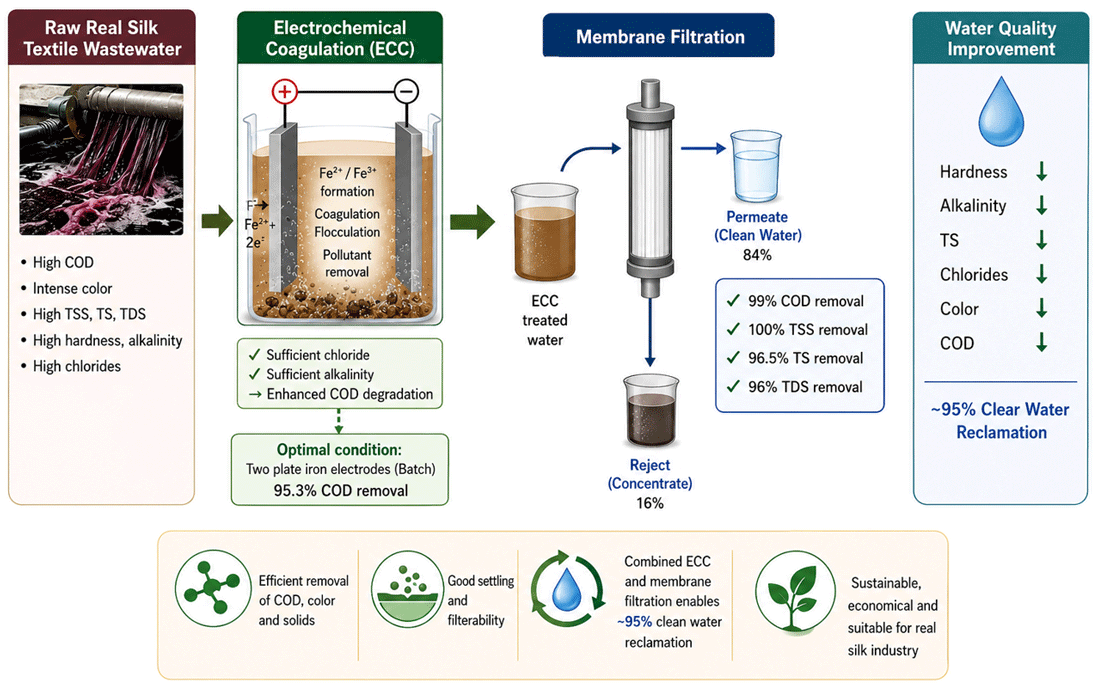
The filtration process was carried out for a flow rate of 2.5 lts/hr. The filtrate from the membrane filtration unit was then analyzed to assess the change in water quality parameters like COD, total solids (TS), and total dissolved solids (TDS). The reject obtained was 16% while the permeate obtained was 84%. With all water quality parameters much below the natural baseline values of aquatic systems. Removal of TS, total suspended solids (TSS), TDS, and COD was studied for membrane-treated effluent to attain the desired water quality parameters. Table 3 shows the percentage removal of organics from TWW in ECC and membrane filtration.
Initial COD of textile wastewater was 4800 mgL-1, which came to a very low level of 42 mgL-1 after membrane filtration. ECC showed 95.3% COD removal, 56% TS removal, 17.2% TSS removal, and 80.4% TDS removal, respectively. Membrane filtration showed 99% COD removal, 100% TSS removal, 96.5% TS removal, and 96% TDS removal. The iron electrode gives a light brown color to the treated water. To eliminate the residual color, membrane filtration was used.
Conclusions
During ECC treatment, COD removal was favoured at wastewater temperature of 26 0C compared to a lower initial wastewater temperature of 6 0C. Maximum electrode dissolution was observed between 30 and 60 min ET. Dry sludge was of the order of 0.36, 1.19, and 1.28kg/m3 of raw textile wastewater treated, which is less compared to other treatment methods. The Fe electrode showed good settling and filterability characteristics. This may be due to the different morphology of iron hydroxide particles, which are better defined and have a higher density. And also, the use of an iron electrode often results in the formation of very fine brown particles, which are more prone to settling.
Membrane filtration showed 99% removal of COD, 100% removal of TSS, 96.5% of removal of TS, and 96% of TDS removal, and treated wastewater can be used for reclamation purposes. The presence of chloride ions significantly reduced energy consumption because of oxidation mediated by active chloride ions. 2115 kWh m-3 electrical energy was required to achieve 95.3% COD removal from 1 m3 of textile wastewater.
Hence, the overall studies confirmed that combined treatment of electrochemical coagulation and membrane filtration is efficient in the degradation of organics from silk textile wastewater, avoiding a long treatment train of unit operations and unit processes in wastewater treatment facilities.
Acknowledgement
The authors thank JSS Academy of Technical Education, Bengaluru, Karnataka, for extending laboratory facilities to carry out this research work.
Author Contributions:
1) Experimental work was carried out by all the authors.
2) Dr. Hemalatha H N wrote the main manuscript
3) Vidyashree M G and Abhilash N R prepared figures.
4) All authors reviewed the manuscript.
b) Study Conception or Design: Dr. Hemalatha H N
c) Data Acquisition: Vidyashree M G and Abhilash N R
d) Data Analysis or Interpretation: Dr. Hemalatha H N, Vidyashree M G and Abhilash N R
e) Manuscript Drafting: Dr. Hemalatha H N
f) Critical Manuscript Revision: Dr. Hemalatha H N
Funding Declaration
No funding was received for conducting this study and manuscript preparation.
Conflict of Interest
The authors declare that they have no known competing financial interests or personal relationships that could have appeared to influence the work reported in this paper.
AI Statement
The authors confirm that no AI tools or services were used during the preparation of this work.