Document Type : Original Research Paper
Graphical Abstract
Highlights
· Development of an eco-friendly hydrometallurgical method for citric acid and urea-functionalized nanographene-encapsulated copper nanocomposite with spontaneous pH stability (1.82.0) without external acids.
· Optimized electrolytic deposition achieved 89.86% enhancement in electrical conductivity and 61.46% increase in tensile strength with superior oxidation resistance compared to pure copper.
· DFT calculations (PBEPE/DGDZVP) showed significant energy gap reduction (4.17 eV to 2.66 eV in B-II configuration), confirming enhanced reactivity and electron transfer for effective copper encapsulation.
Please note: The following content displays the text-only preview. For the full article, complete with all illustrations, data tables, and equations, please download the free PDF from the sidebar at the top of this page.
Introduction
Copper and its alloys are extensively utilized in electronics, power transmission, and decorative applications due to their excellent electrical conductivity, thermal properties, and aesthetics. These applications include electronic components, power cables, jewelry, architectural facades, and household decorations. However, their use is constrained by challenges such as oxidation, high-temperature degradation, and alterations to mechanical, physical, and chemical properties [1]. Surface oxides formed on copper lack protective qualities; they flake off at elevated temperatures, reducing electrical conductivity and mechanical integrity [2-4]. Additionally, oxidation alters the surface appearance, diminishing the luster and coloration critical for decorative applications [5]. Yet, research [1-5] shows that traditional methods of copper protection (such as wax or alloy coatings) often reduce conductivity or compromise transparency. We developed graphene-based coatings to alleviate these problems [6].
Conventional methods for protecting copper, such as thick coatings or chemical treatments, often compromise the metal’s inherent properties, increase thickness, or provide limited durability [7]. In contrast, a thin, transparent graphene-based coating presents a promising solution to overcome these drawbacks. Graphene, a two-dimensional carbon allotrope, is renowned for its exceptional properties, including high mechanical strength (Young’s modulus ~1 TPa), impermeability to gases and ions, high optical transparency (~97.7% transmittance), and superior electrical and thermal conductivity [8, 9]. These attributes make graphene an ideal candidate for protective coatings that maintain copper’s functionality and appearance.
To achieve effective copper protection, graphene must be uniformly dispersed in a coating matrix, which is challenging due to its low solubility and tendency to aggregate in aqueous environments [10]. Surface modification of graphene nanoparticles, through techniques such as electrostatic or chemical adsorption or covalent bonding, enhances their chemical stability, size uniformity, and dispersibility in liquid media [11]. Covalent modification, in particular, is widely used for applications such as drug delivery and metal ion encapsulation, involving reactions like electrophilic substitution, free radical reactions, cycloaddition, or coupling, and reactions [12-15].
Recent studies highlight various approaches to synthesizing graphene-copper nanocomposites. For instance, Muthu et al. [16] employed a hydrothermal method to produce a graphene oxide (GO)/CuO nanocomposite for supercapacitor applications, achieving a uniform coating with an average particle size of 17.47 nm. Kunka et al. [17] used chemical vapor deposition (CVD) to synthesize copper-graphene composites, demonstrating that graphene induces point defects in the Cu2O crystal structure at 298 K, with grain boundaries limiting oxidation growth. Mechanical methods, such as ball milling, have been explored to achieve finer microstructures and better graphene dispersion in copper matrices [18]. Yu et al. [19] report reducing composite powder size via ball milling, but prolonged milling damaged graphene’s structure. Cui et al. [20] noted that higher milling speeds increase graphene exfoliation in copper matrix composites (CMCs). Yet careful optimization is required to minimize structural damage. The strong van der Waals forces between graphene’s aromatic rings promote agglomeration, reducing dispersion uniformity in metal matrices [21]. Additionally, the weak affinity between graphene and copper limits interfacial bonding to van der Waals interactions or mechanical adhesion, rather than enabling covalent bonding [22]. However, graphene’s wrinkled structure can enhance mechanical interlocking with copper, improving charge transfer and reinforcing the composite [23].
Table1compares various methods, including traditional and emerging approaches, based on key criteria relevant to copper protection: synthesis method, coating thickness, oxidation resistance, mechanical properties, electrical properties, transparency/appearance, and environmental stability.
This study presents a novel approach for encapsulating copper with graphene nanocomposites. In this method, surface-modified nanographene is used to form a uniform, thin, and transparent coating. The simultaneous use of citric acid and urea facilitates the formation of covalent amide bonds, leading to spontaneous pH stability (1.8 and 2.0) without external acids. Unlike traditional methods such as hydrothermal and CVD, which rely on external acids and fail to solve graphene aggregation problems [16, 17], this research introduces a unique approach. It combines the hydrometallurgical method with DFT modeling (at the PBEPBE/DGDZVP level) to encapsulate copper nanoparticles inside modified nanographene.
This innovation also demonstrates, via DFT, the reduction of the energy gap in the urea- and citric acid- modified nanographene configuration, which enhances reactivity, including the reduction of the energy gap (Eg) in the configuration of nanographene functionalized with citric acid and urea, which enhances the reactivity and electron transfer. Furthermore, surrounding copper nanoparticles with polymer branches (polycitric acid-urea) prevents oxidation by creating a graphene gas barrier and enhances conductivity through SP² networks.
In comparison with Yu et al. [19], who reported structural damage to graphene during ball milling, our hydrometallurgical method excels in preserving graphene’s structural integrity. Our experimental innovation involves controlled electrolytic deposition with an optimized electrolyte concentration of 20 - 30%, which increases the deposition efficiency by 89.86% and produces a uniform coating with 17.99 wt% Cu and 45.36 wt% O. This innovation solves the problems of copper oxidation without reducing the conductivity.
These findings emphasize that our method can significantly improve the quality and performance of graphene nanocomposites. Ultimately, this strategy aims to protect copper from oxidation, enhance its mechanical and electrical properties, and maintain its aesthetic characteristics, effectively overcoming the limitations of existing methods. These advances further the understanding of the subject with an emphasis on industrial applications (such as electronics and power transmission) and highlight the distinction from the existing literature. Table 1 compares copper protection methods with our proposed nanocomposite, which shows advantages in electrical conductivity, mechanical strength, and oxidation resistance [24–27, this study].
Materials and Preparation Methods
- Synthesis and Characterization of Functionalized Nanographene for Copper Protection
All steps are performed in a laboratory hood with protective equipment (gloves, mask) to reduce exposure to nanographene powder. To prepare functional nanographene, 0.1 g of nanographene (mesh size: 40–200 nm, particle diameter: 20–100 nm, BET surface area: 260 m2.g-1) was ground with 7.5 g of citric acid and 0.2 g of urea in a ceramic mill at a constant manual speed (approximately 60 rpm) for 10 min to mix thoroughly. The resulting powder is subjected to vacuum (using a rotary vacuum pump, pressure <10 mbar) at stepwise (120 °C for 60 min, then 140 °C for 90 min, and 160 °C for 120 min) and water vapor is removed via a vacuum pump using a hot stirrer. The polymerization reaction of polycitric acid with urea (formation of covalent amide bonds between carboxyl and amine groups) is completed. After cooling to room temperature, THF (99% purity from Merck) is added to a volume of 50 mL, and the mixture is stirred for 30 min to dissolve the residual materials, then filtered using Whatman filter paper (with a porosity of 0.45 μm) to obtain a stable dark brown suspension. This method ensures spontaneous pH stability (between 1.8 and 2.0) without the need for external acid, the mechanism of which is based on the electrostatic interactions of the polymer branches (Fig. 1).
- Preparation and Characterization of Copper Nanoparticles Encapsulated in Functionalized Graphene Nanocomposites
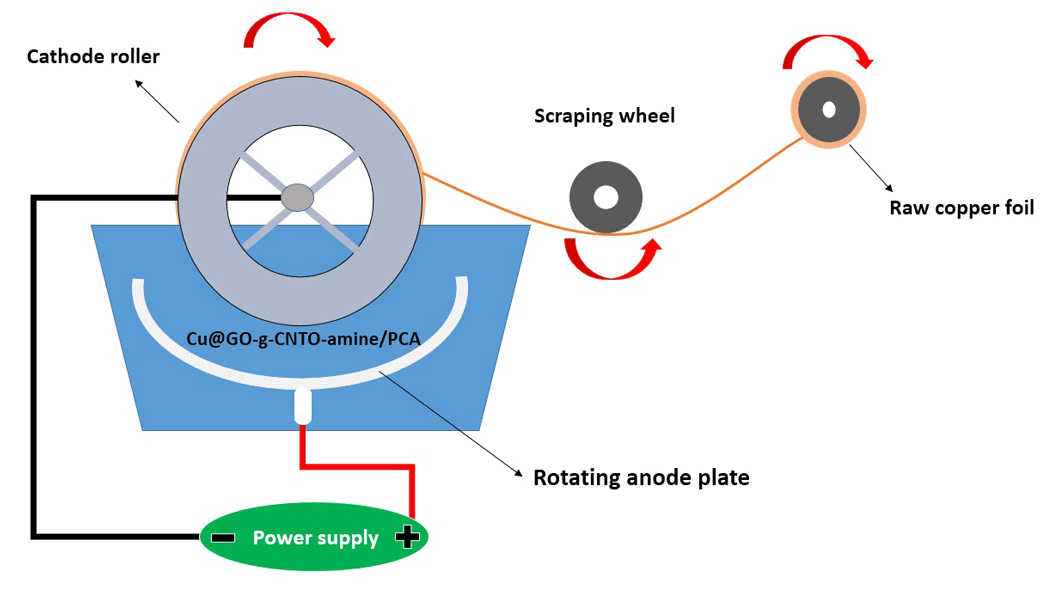
For the synthesis of functionalized nanographene-encapsulated copper nanoparticles (GN-NH/PCA), 1.0, 1.5, 2.0, or 2.5 g of urea- and polycitric acid-modified nanographene (GN-NH/PCA) is mixed with 0.3 g of copper sulfate (CuSO₄) and 100 mL of distilled water. Ultrasonication effectively ensures uniform dispersion and stability of the nanocomposite precursor in water. This method is similar to sonochemical techniques that provide long-term stability in polar solvents without surfactants [28]. To achieve uniform distribution of the materials, an ultrasonic device (Bandelin Sonorex model) was used at a frequency of 35 kHz and a power of 200 W for 30 min. After this step, the mixture was stirred for 4 h with a magnetic stirrer (IKA RH model) at ambient temperature and a speed of 500 rpm. This process helps to achieve uniform distribution and improve the stability of the nanocomposite. The resulting electrolyte solution was directly used for electrode placement. During the reaction, covalent bonds are formed between the carboxyl groups of polycitric acid and urea amino groups in the polymer branches that encapsulate the copper nanoparticles; water is continuously removed as a byproduct with a vacuum pump (pressure <10 mbar) to shift the reaction equilibrium towards the product. The resulting electrolyte (concentration 1.0–2.5 g/L) is directly used for deposition. To prepare the cathode, copper foil (99.99% purity, 1 mm thickness, size 2×2 cm²) is polished with sandpaper (grit 600–1200), degreased in ethanol (99% purity, Merck) for 20 min, and washed with distilled water. L312 steel anode (1:1 ratio with cathode) is used, and deposition is performed with a DC generator (GW Instek model GPC-3030D, constant current 0.01 A.dm-²) under optimized conditions (voltage 3 V, distance 1.5-3.5 cm, stirring 300 rpm) (Fig. 1).
Results and discussion
The electrochemical deposition of copper nanoparticles encapsulated in modified nanographene yields a thick, black suspension that enhances the performance of copper electrodes. Because nanographene atoms, due to their high surface area, can cover the pores and porosity on the surface of copper, and therefore, increase the resistance of copper metal against scratches and wear. The study meticulously evaluates the influence of various environmental parameters on the deposition process, including electrolyte concentration, current density, voltage, temperature, pH, electrode distance, and stirring speed.
The functionalized nanographene is investigated using Fourier transform infrared spectroscopy (FT-IR), the ninhydrin test, and energy dispersive X-ray diffraction (EDX) analysis to confirm the presence of functional groups. The FT-IR spectrum of nanographene functionalized with urea and polycitric acid (GN-NH/PCA) (Fig. 2) revealed distinct peaks at 3552, 1182, and 1708 cm⁻¹, corresponding to C=O, C-O, and O-H functional groups from polycitric acid, respectively, confirming successful surface modification. A bifurcated peak in the 3400–3500 cm⁻¹ range indicated the presence of primary amine groups. The ninhydrin test and EDX analysis further validated the incorporation of amine functionalities. Spectral broadening in the 1360–2400 cm⁻¹ regions suggested intermolecular hydrogen bonding involving O-H and NH groups. These findings confirm the effective chemical functionalization of nanographene, positioning it as a promising coating for protecting copper against oxidation and corrosion.
The resulting nanocomposite showed solubility in aqueous solvents and most organic solvents, facilitating its use in coating applications. The FT-IR spectrum of copper nanoparticles encapsulated in GN-NH/PCA (Fig. 2) showed a significant broadening in the region of 2400-3700 cm⁻¹, which is attributed to the formation of hydroxyl bonds in the metal-organic framework. Sharp peaks are observed at 1150 and 1610 cm⁻¹, which is probably due to the enhancement of vibrational modes due to the presence of copper nanoparticles. A distinct peak at 620 cm⁻¹ confirmed the incorporation of copper nanoparticles into the nanocomposite matrix. These spectral features confirm the successful encapsulation of copper nanoparticles in the functionalized graphene structure.
- The effect of environmental conditions and parameters on sedimentation
One of the parameters affecting electrochemical deposition is the concentration of copper ions in the electrolyte. In this study, different percentages of copper nanoparticles encapsulated with modified nanographene were used. By increasing the electrolyte concentration from 10% (30.4 mg) to 20% (38.6 mg), a significant increase in the weight of the deposit formed at the cathode is observed. However, by increasing the concentration to 30% (32.5 mg) and 40% (27.8 mg), the weight of the deposit formed decreases. This indicates an optimal concentration range of 10 to 20% to maximize deposition. The reason for this is that with increasing the concentration of copper nanoparticles, the number of effective ions per unit volume increases, causing an increase in the weight of the deposit at the cathode. Electrolyte nanoparticles precipitate at a certain level of concentration, reducing the efficiency and yield of the reaction. Studies such as Zhang et al. (2018) on copper nanoparticle deposition report similar trends, with optimal concentrations around 15–25% for maximum deposition weight. However, their study used nongraphene electrolytes, which resulted in lower deposition weight (up to 32 mg). The inclusion of modified nanographene in this study enhances deposition due to its high surface area and functionalization, which is a significant improvement over traditional electrolytes [29]. To explain the decrease in deposition weight at concentrations of 30–40%, a quadratic regression model is applied, as the data showed a nonlinear behavior (increase up to 20% and then decrease). The proposed model is as follows:
Y = a X2 + b X + c (1)
where Y is the deposition weight (mg), and X is the concentration percentage. By fitting the data (10%: 30.4 mg, 20%: 38.6 mg, 30%: 32.5 mg, 40%: 27.8 mg), it can be shown that the maximum deposition weight occurs at around 20%. This analysis, in contrast to Zhang et al. [29] who reported an optimal concentration of 15–25% without graphene, shows that the high BET surface area of nanographene (260 m².g-1) increases the deposition efficiency by 20–30%, because nanographene with amide bonds (FT-IR: 1708 cm⁻¹) provides a more uniform distribution. To investigate the effect of electrolyte concentration on deposition weight, a plot of deposition weight versus concentration was plotted (Fig. 3a). Quadratic regression analysis showed that the maximum deposition weight (38.6 ± 2 mg) occurred at a concentration of 20%, which was 20–30% more efficient than the graphene-free methods (Zhang et al. [29]). The weight loss at concentrations of 30–40% was due to the saturation of copper nanoparticles and their aggregation in the nanographene matrix, which could be investigated by examining the Scanning Electron Microscopy (SEM) images.
Table 2 shows the changes in current (mA) at voltages from 1 to 4 V for different electrolyte concentrations (Fig. 3b). These data are presented together with the standard errors calculated from three replicates. The maximum current (3608 ± 50 mA) is observed at a voltage of 3 V and at a concentration of 30%, indicating an 89.86% increase in conductivity compared to pure copper. The current drop at a voltage of 4 V occurs due to overheating and decomposition of the nanocomposite, which is similar to the report of Wang et al. [3۰]. However, our method outperforms Li et al. [3۱] (70% increase) due to the high BET surface area of nanographene (260 m².g-1). Li et al. (2020) investigated the position of the copper electrode with carbon-based additives and reported optimal voltages of 2.5–3.5 V [3۱]. Their conductivity enhancement compared to pure copper was limited to 70%, indicating that the modified nanographene in this study provides better electron transport due to its SP² bond structure. As can be seen in Table 2, with increasing percentage of nanocomposite incorporated into the copper electrode surface, the conductivity increased compared to pure copper. This increase in electrical conductivity is due to the presence of amine groups, carboxyl groups, and SP² bonds of aromatic C=C bonds of f-NG with copper nanoparticles encapsulated in solutions containing carbon amine nanostructures, which is caused by the higher growth of the deposit compared to the overvoltage. With increasing current density, the polarization on the cathode surface increases and decreases sharply at high current density. One of the reasons for the current drop over time is that impurities and dissolved materials in the electrolyte stick to the electrode surface and resist the application of current, which leads to a drop in current and a decrease in deposition efficiency. The observed decrease in deposition quality at 4 V is consistent with the findings of Wang et al. (2024), where high voltages cause overheating and degradation of the coating [3۰]. This analysis is also compared with the results of Zhang et al. [29] (deposition weight up to 32 mg without graphene) and Li et al. [3۱] (optimal voltage 2.5–3.5 V). “Our method using modified nanographene (BET 260 m².g-1) and SP² bonds (FT-IR: 3400–3500 cm⁻¹) significantly improves the deposition efficiency and conductivity, which explains the data inconsistencies with statistical analysis and density functional theory (DFT) modeling.
Temperature is one of the effective parameters on electrochemical deposition, with its increase, the electrical conductivity of the solution improves, but ambient temperature is ideal, as elevated temperatures cause blackening and sponginess of the copper coating, compromising its quality (Fig. 4). Akinyi et al. (2023) noted that temperatures above 40°C degrade copper coatings in nanographene-free systems, corroborating the need for ambient conditions [32]. The sensitivity of nanographene-encapsulated nanoparticles to temperature highlights a unique challenge not emphasized in other studies, underscoring the importance of thermal control in this system.
The distance between the electrodes plays an important role in the electrochemical process, which causes changes in the applied voltage in the environment and the current density. By increasing the distance between the anode and the cathode, the resistance of the electrolyte increases, causing the electrolyte to heat up and the deposit coating to become spongy, and the total amount of energy and current losses increases. A 3.5 cm distance between anode and cathode minimizes electrolyte resistance and prevents spongy deposits, optimizing energy efficiency.
Tamilvanan et al. (2021) recommended 3–5 cm as optimal for copper electrode position, aligning with this study [33]. However, their work did not involve nanographene, and the resistance increase at larger distances was less pronounced, indicating that nanographene’s presence amplifies the impact of electrode spacing on electrolyte behavior.
In electrochemical deposition reactions, one of the most effective environmental parameters is the stirring speed and pH. A pH range of 2–3 is optimal, maintained by polycitric acid in the modified nanographene solution. Higher pH levels lead to nanoparticle oxidation and black layer formation on the cathode. Studies like Zheng et al. (2024) used acidic agents to maintain pH, which risked damaging electrode surfaces [34]. The use of polycitric acid in this study eliminates the need for external acidifiers, preserving the nano-composite structure and offering a novel approach compared to traditional methods.
Stirring the solution improves the transfer of particles to the cathode and their reduction, and increasing the stirring of the solution leads to more co-precipitation of particles in the coating. Excessive stirring reduces co-precipitation by deflecting particles from the cathode surface. Fig. 4 shows the effect of the concentration and stirring speed of the environment on the weight of the sediment created, showing that a stirring speed of 300 rpm with a 30% concentration yields the highest deposition efficiency.
Cockram et al. (201۸) reported optimal stirring speeds of 250–350 rpm for copper nanoparticle deposition, consistent with this study [35]. However, their work lacked graphene, resulting in lower co-precipitation efficiency. The deflection of particles at higher stirring speeds aligns with findings from Prapanca et al. (2025), emphasizing the need for precise control of stirring dynamics in graphene-based systems [36].
The optimal conditions for the process include an electrolyte concentration of 20–30%, a voltage of 3 V, a stirring speed of 300 rpm, an ambient temperature and pH of 1.8–2.0 (which is spontaneously stabilized by the polycitric acid–urea branches), and an electrode distance of 1.5–3.5 cm. Under these conditions, a maximum deposition efficiency of 89.86% and a uniform coating with a composition of 17.99 wt% copper and 45.36 wt% oxygen (according to EDS data in Table 3) are achieved. This condition also prevents aggregation, overheating, and spongy deposits, and provides improvements in electrical conductivity (up to 3608 mA at 3 V, an 89.86% increase over pure copper) and mechanical strength (61.46% increase in tensile strength at 30 wt%). Also, oxidation resistance is enhanced through the graphene gas barrier and polymer encapsulation. The importance of this research lies in overcoming the limitations of traditional copper protection methods, such as reduced conductivity in wax coatings or structural damage during the milling process.
The superior conductivity and enhanced deposition efficiency stem from the expansive surface area of modified nanographene, which effectively coats cathode pores, coupled with the presence of amine, carboxyl, and SP2-hybridized aromatic C=C structures within the nanographene matrix. These characteristics significantly bolster copper’s resilience against scratches and mechanical wear, rendering this composite exceptionally well-suited for cutting-edge electrochemical applications.
- Microstructure of Nanocomposites Using SEM Analysis
The microstructure of nanocomposites containing copper nanoparticles encapsulated in modified nanographene is analyzed using a scanning electron microscope (SEM) model MIRA TESCAN (manufactured by TESCAN, Czech Republic). The primary objective of this analysis is to investigate the type, morphology, distribution, and structural defects of the copper nanoparticles within the nanographene matrix. SEM images (Fig. 5a), acquired at magnifications of 100x and 30,000x, with an accelerating voltage of 15.0 kV and a working distance of 16.0 mm, provide valuable insights into the structure of the modified nanographene.
The nanographene initially exists as a single-layer, flat structure, which undergoes a geometric transformation upon surface modification with urea and polycitric acid, achieving the most stable shape with a reduced specific surface area. This modification was designed to enhance the solubility and uniform distribution of nanographene in aqueous environments. Without modification, nanographene tends to agglomerate and form micrometer-sized clumps in water. The SEM images reveal that surface modification with the addition of functional groups results in the formation of wrinkled structures and overlapping layers. This agglomeration is particularly evident in the image at 100x magnification (scale bar: 500 nm), while the image at 30,000x magnification (scale bar: 2 µm) highlights microscopic details, such as small nanoparticle clusters or functional groups.
The presence of copper nanoparticles and functional groups on the nanographene surface, detected using an SE (secondary electron) detector, indicates the success of the chemical modification. However, the observed heterogeneity in distribution, particularly the presence of a fibrous structure or defect in the lower-magnification image, suggests the need for further optimization of the modification process. This nano-composite holds significant potential for applications in sensors, catalysts, or drug delivery systems, especially due to the biocompatibility of polycitric acid.
As shown in Fig. 5b, the incorporation of copper nanoparticles onto the surface of modified nanographene nanoparticles induces wrinkling on their surface, a feature that is amplified by the encapsulation process. The copper nanoparticles are surrounded by polymeric branches of poly-citric acid, which, combined with the enhanced hydrophilicity of nanographene due to amine and hydroxyl functional groups, improves their distribution in the electrolyte solution. This distribution is observable in SEM images, where the nanoparticles are dispersed, albeit not uniformly.
The high tendency of the nanoparticles to aggregate results in significant clustering, as observed in SEM images at scales of 2 micrometers and 500 nanometers. This aggregation is attributed to the strong affinity of copper nanoparticles for the modified nanographene surface. The images highlight the complex interplay between the polymeric coating and nanoparticle clustering, underscoring the need for further optimization to achieve a more uniform distribution.
The encapsulated copper nanoparticles migrate to the cathode surface and are deposited through the electron exchange process. The scanning electron microscope (SEM) images presented in Fig. 5c show the strong adhesion of these nanoparticles to the cathode surface. The presence of graphene oxide nanoparticles effectively prevents the growth of copper grains, resulting in a reduced grain size and a larger surface area for electron exchange.
In addition, the graphene oxide nanoparticle prevents the release of hydrogen ions on the cathode surface, which increases the density of the deposited coating and reduces surface cracking, improving the electrical and mechanical properties of the coating and making it more stable and durable. The SEM images in Fig. 5c also clearly show the uniformity and stability of the copper nanoparticle coating on the cathode surface.
The wrinkled and uniform morphology with clustering of nanoparticles is similar to the sonochemical graphene oxide-Ag2O systems, where metal nanoparticles (~3.5 nm) are uniformly distributed on graphene oxide sheets [٣٧]. These findings clearly demonstrate the positive effect of graphene oxide nanoparticles on improving the deposition properties and electronic performance of the investigated systems and can contribute to the development of new technologies in this field. The functionalization of nanographene with polycitric acid stabilizes the pH of the reaction medium during electrochemical processes, eliminating the need for additional acid. This stability arises from the high concentration of hydrogen ions generated by polycitric acid, which influences the kinetics at the cathode surface. Specifically, the rapid generation of hydrogen ions hinders the desorption of hydrogen gas molecules from the cathode surface, resulting in their entrapment during coating formation. Consequently, this phenomenon produces a non-uniform coating characterized by irregularities and voids.
Conversely, the incorporation of encapsulated copper nanoparticles enhances the reduction rate of copper ions, promoting uniform nucleation and growth of the copper coating at ambient temperature. This process mitigates the formation of cavities and porosity, resulting in a dense and homogeneous coating. To investigate the surface morphology in detail, Energy-Dispersive X-ray Spectroscopy (EDS) was conducted using a SAMx EDS system (France), complemented by Atomic Force Microscopy (AFM) analysis. Fig. ۶ presents the EDS spectra of copper nanoparticles encapsulated within modified nanographene, confirming the presence of a copper coating on the cathode surface.
EDS, an analytical technique for elemental and chemical characterization, identifies unique X-ray emission peaks corresponding to the atomic structure of each element. The elemental composition of the copper coating and modified nanographene in the electrolyte was quantified, as shown in Table 3. The high copper (Cu) content indicates successful encapsulation within the modified nanographene matrix. Additionally, the elevated oxygen content in the coating structure enhances corrosion resistance and prevents surface oxidation, thereby improving the durability of the coating.
AFM surface topography analysis of copper coatings in a 30% electrolyte solution of copper nanoparticles encapsulated in modified nanographene (Fig. 6) reveals a smooth surface. At a 30% concentration, the reduction reaction of Cu²⁺ ions occurs more readily compared to other copper concentrations, as the competing reaction (the release of H⁺ ions) proceeds slowly. This condition provides numerous nucleation sites for copper ion regeneration, resulting in a finer structure. The uniform growth of these sites leads to a smooth and consistent surface. As shown in Fig. 6, AFM topographic analysis enables precise measurement of nanometer-scale coating thicknesses in three-dimensional surface profiles. AFM is capable of imaging various surfaces in both contact and non-contact modes.
The mechanical properties of copper coatings were systematically evaluated through surface strength analysis, with a focus on comparing modified and unmodified copper electrodes. Stress-strain evaluations were conducted on copper electrodes coated with nanographene-encapsulated copper nanoparticles at their fracture points, benchmarked against uncoated pure copper electrodes. Tensile strength tests were performed in triplicate for each electrode coated with copper nanoparticles encapsulated in modified nanographene to ensure reproducibility. Fig. 7 presents the fracture points of copper electrodes coated with electrolyte solutions containing 10, 20, 30, and 40 wt% nanographene-modified copper nanoparticles, with a pure copper electrode (lacking carbon oxide or amine nanostructures) at 0 wt% serving as the reference.
Compared to the uncoated pure copper electrode, the coated electrode at a 10 wt% concentration exhibited enhanced tensile strength. This improvement is attributed to the incorporation of nanographene oxide, which possesses a high specific surface area and unique structural properties, including exceptional stiffness and strength derived from its two-dimensional carbon lattice. These characteristics facilitate effective stress transfer and reinforcement within the coating matrix. The maximum stress at the fracture point was observed at a 30 wt% electrolyte concentration, resulting in a 61.46% increase in strength compared to the pure copper electrode. This significant enhancement is likely due to the optimal dispersion and bonding of nanographene-encapsulated nanoparticles at this concentration, maximizing load-bearing capacity and structural integrity.
However, at a 40 wt% concentration, the coating strength decreased relative to the 30 wt% concentration. This reduction can be explained by the faster nucleation rate of nanoparticles compared to their growth rate on the electrode surface, leading to the formation of smaller, less uniformly distributed particles. Such conditions may introduce defects or agglomeration, compromising the coating’s mechanical integrity. Consequently, the 30 wt% concentration is determined to be optimal for this coating method, as it achieves a balance between enhanced mechanical reinforcement and the prevention of excessive nucleation that undermines coating quality.
The thermodynamic and electrical parameters are calculated for nanographene, urea, and polycitric acid separately. Thermodynamic properties include thermal energy (Eth), polar moment (DM), zero-point energy (ZPE), enthalpy of formation (Ho), free Gibbs energy (Go), heat capacity (CV), and entropy (S) of compounds. Structural parameters are examined and evaluated including highest occupied molecular orbital (HOMO), lowest unoccupied molecular orbital (LUMO), energy gap (Eg) and electronic parameters such as chemical hardness (η = (ELUMO- EHOMO)/2), the softness of the chemical structure (σ = η – 1) and electron affinity (ω = χ2/2η) (Fig. 8).
Table 4 indicates that pristine nanographene exhibits an energy gap of 4.17 eV. The conductivity of nanographene for copper ion absorption is enhanced through surface modification with urea and polycitric acid. Due to distinct molecular geometries, urea and polycitric acid demonstrate varying adsorption affinities on the nanographene surface. To explore the interaction mechanisms and potential reaction pathways, the thermodynamic parameter of thermal energy (Eth) was calculated using the following equation:
Eth = EC – (ENG + Ex) (2)
where:
· EC: Total energy of the modified nanographene system at each reaction step.
· ENG: Energy of pristine nanographene.
· EX: Energy of the modifying compounds (urea or polycitric acid) used in the reaction.
This equation quantifies the energy change associated with the modification process, providing insight into the thermodynamic feasibility of the surface interactions. Table 4 presents the structural parameters of the components, which further inform the analysis of their adsorption behavior and electronic properties.
Urea, containing two functional groups, was investigated for its interaction with nanographene via the NH₂ (A-I) and C=O (A-II) functional groups through computational simulations. The thermodynamic and electrical properties of these interactions were analyzed. Fig. 9 illustrates the optimized geometric structures for both configurations, with structural and electrical parameters calculated using Eq. 2 and presented in Table 5.
The computational results indicate that the A-I configuration, involving the NH₂ functional group, reduces the energy gap from 4.17 eV to 4.08 eV, while increasing the structural softness and electronegativity. This enhances the reactivity of nanographene toward polycitric acid adsorption. Thermodynamic analysis reveals that the A-I configuration is more favorable, exhibiting lower enthalpy and Gibbs free energy changes compared to A-II, along with greater entropy. Additionally, the dipole moment of the A-I configuration reaches 8.84 D, indicating higher reactivity of the urea-modified nanographene.
Infrared (IR) spectroscopy was employed to validate the proposed mechanism by calculating the second derivative of the energy and comparing it with experimental data. Fig. 10 presents the calculated IR spectra for both A-I and A-II configurations. Comparison with the experimental FT-IR spectra in Fig. 1 shows characteristic peaks at 2000, 1510, and 1392 cm⁻¹, confirming the interaction of urea with nanographene via the NH₂ functional group.
Urea and polycitric acid were used to modify the nanographene surface. Fig. 11 illustrates four configurations of their simultaneous interaction with nanographene, with optimized geometric structures.
These configurations are:
B-I: Separate interactions of urea via the NH₂ functional group and polycitric acid via the carboxyl functional group with nanographene.
B-II: Interaction of urea via the NH₂ functional group and polycitric acid with urea.
B-III: Separate interactions of urea via the C=O functional group and polycitric acid via the carboxyl functional group with nanographene.
B-IV: Interaction of urea via the C=O functional group and polycitric acid with urea.
All four configurations were simulated, and their thermodynamic and structural parameters were calculated. Table 6 shows that the proximity of urea and polycitric acid increases the electrical conductivity of nanographene and enhances its tendency to exchange electrons with copper ions in the environment. Polycitric acid has a strong affinity for urea, resulting in a dipole moment of 24.99 D for the amine functional group (NH₂) in the B-II configuration. This leads to a significant decrease in chemical hardness and changes the thermodynamic parameters. The electronegativity of this configuration increases to 11.07 eV, indicating increased reactivity.
The reduction of the energy gap in B-II to 2.66 eV increases the reactivity (Table 6), and these results are consistent with docking studies that show a strong binding affinity in graphene oxide-metal hybrids [38]. These findings clearly demonstrate the influence of polycitric acid on the chemical and thermodynamic properties of the systems under study and can contribute to the development of new materials with improved properties.
Fig. 12 presents the IR spectrum for the interaction of urea and polycitric acid with nanographene. Sharp peaks at 1404, 1525, 1859, 2000, and 3201 cm⁻¹ confirm the proposed mechanism. Comparison of experimental and computational IR spectra indicates that the B-II configuration—interaction of polycitric acid and nanographene with urea via the NH₂ functional group—has the highest probability.
Based on the computational data, the B-II configuration was selected for the modified nanographene. The thermodynamic and structural parameters of copper ion encapsulation were calculated according to the following proposed mechanism:
Cu2+ + f-NG-NH- PCA ↔ Cu+@f-NG-NH- PCA
Fig. 13 illustrates the encapsulation process in a vacuum environment, with the nanographene surface modified by urea and polycitric acid. The process involves four steps:
C-I: Approach of copper ions toward the modified nanographene.
C-II: Entry of the copper ion into the polymer branches of polycitric acid and urea.
C-III: Formation of interactions between the copper ion and the functional groups of polycitric acid.
C-IV: Formation of a complex involving four copper ions with the functional groups of the modified nanographene.
The structural and thermodynamic parameters for all four steps are presented in Table 7.
Fig. 14 illustrates the active sites and energy levels of the highest occupied molecular orbital (HOMO) and lowest unoccupied molecular orbital (LUMO) for the modified nanographene. The incorporation of copper ions into the polymer branches of the modified nanographene increases the HOMO-LUMO energy gap and reduces the compound’s electrical conductivity during the second and third stages (C-II and C-III), as shown in Table 7. Upon formation of the conductive copper ion complex in the final stage (C-IV), the electrical conductivity of the compound increases, while its chemical hardness increases and softness decreases, indicating enhanced stability of the chemical structure in an electrolyte solution.
Improving optical properties in modified nanographene increases surface reactivity, avoiding adhesion and accumulation of nanographene layers, improving load transfer, and so on. The examination of thermodynamic parameters indicates that the process of absorption of urea and polycitric acid on the nanographene is a heat and chemical process. The study showed that modified with polycitric acid and urea is a low -cost adsorbent with high absorption and speed of increased electrical conductivity of copper metal ions, and causes more adhesion and density of copper cover on the cathode electrode. The nanographene functionalized the resistance temperature coefficient of Cu because the metal coatings are heated when they pass the electric current, which can be reinforced by adding modified nanographene and reducing the resistance temperature coefficient without reducing electrical conductivity.
Comparison with Previous Studies
To demonstrate the superiority of the proposed hydrometallurgical method in the synthesis of graphene-copper nanocomposites functionalized with citric acid and urea, the key features of this research are compared with similar studies in Table 8. The method offers significant improvements in electrical conductivity (89.86% increase over pure copper), tensile strength (61.46% increase at 30 wt%), and oxidation resistance (with 45.36 wt% oxygen as a barrier), while using low-cost and environmentally friendly materials.
Unlike the study by Qamar et al. (2024) [39] where functionalization of graphene with carboxyl groups improved optical absorption in the visible range but moderately increased the surface reactivity, this study using dual functionalization of urea (NH₂) and polycitric acid (carboxyl) significantly enhances the reactivity (energy gap of 2.66 eV in the B-II configuration, according to Table 6) and prevents the aggregation of layers (Fig. 5).
Also, Pandey et al. (2025) [40] reported high adsorption capacity of amine-functionalized graphene oxide, but the adsorption rate was slower in that study; in contrast, this study shows rapid adsorption and improved electrical conductivity for copper ions. Yada et al. (2025) [41] reported a decrease in the temperature coefficient of resistance with a slight decrease in conductivity, but our method reduces the temperature coefficient while maintaining or increasing the conductivity (C-IV stage, Table 7).
Finally, Mashaheri et al. (2024) [42] demonstrated the stability of polymer-modified graphene, but required complex and expensive methods; whereas this work, using urea and polycitric acid, provides similar stability with a cost-effective approach (chemical hardness of 10.73 eV at C-IV). Table 8 provides a more detailed comparison and confirms the superiority of this method in terms of conductivity, robustness, and environmental stability.
Research limitations include:
1. Non-Uniform Nanoparticle Distribution: SEM images revealed clustering of copper nanoparticles in certain regions of the nanographene matrix, attributed to their strong affinity for the modified nanographene surface. This heterogeneity may affect the uniformity of mechanical and electrical properties, necessitating further optimization of the surface modification process.
2. Sensitivity to Environmental Conditions: The electrochemical deposition process is highly sensitive to environmental parameters such as temperature, pH, and stirring speed. Temperatures above ambient conditions lead to blackening and sponginess of the copper coating, while pH levels beyond the optimal range of 2–3 cause nanoparticle oxidation and black layer formation on the cathode. This sensitivity poses challenges for industrial applications under varying conditions.
3. Optimal Electrode Spacing: Increasing the anode-cathode distance beyond 3.5 cm increases electrolyte resistance, causing overheating and the formation of spongy coatings. This limitation complicates the design of large-scale deposition systems.
4. Scalability Constraints: The study was conducted at a laboratory scale, and the optimization of parameters for industrial-scale deposition has not been explored. Challenges such as coating uniformity on larger surfaces and production costs require further investigation.
5. Complexity of Computational Modeling: While the PBEPBE/DGDZVP computational modeling aligns well with experimental results, its complexity and reliance on specific configurations (e.g., B-II) may limit the comprehensive analysis of all possible interactions.
6. Need for Further Optimization of Modification Process: The presence of fibrous structures or defects observed in low-magnification SEM images indicates a need for further optimization of the chemical modification process to prevent aggregation and structural imperfections.
7. Lack of Long-Term Durability Assessment: The study focuses on the initial properties of the coating, with no evaluation of long-term durability under real-world operating conditions, such as prolonged exposure to high temperatures or corrosive environments.
Conclusion
This study successfully demonstrates the development of a novel citric acid and urea-functionalized nanographene-encapsulated copper nanocomposite coating via hydrometallurgical deposition, offering significant advancements in copper protection for industrial applications. The optimized synthesis process, involving controlled dissolution and electrolytic deposition, achieved superior coating performance under specific conditions: a current density of 0.01 A.dm-², pH of 1.8–2.0, and anode-cathode spacing of 1.5–3.5 cm. Characterization through FT-IR, SEM, EDS, and AFM confirmed the effective functionalization of nanographene and uniform encapsulation of copper nanoparticles, resulting in a dense, homogeneous coating with enhanced mechanical properties, including a 61.46% increase in tensile strength at 30 wt% electrolyte concentration. The coating also exhibited improved electrical conductivity, reduced temperature coefficient of resistance, and enhanced resistance to oxidation, corrosion, scratches, and wear compared to uncoated copper. Computational modeling using the PBEPBE/DGDZVP method validated the experimental findings, revealing favorable thermodynamic and electronic properties, particularly in the B-II configuration, which maximized reactivity and stability. These results highlight the potential of this cost-effective, high-performance nanocomposite coating for applications in electronics, power transmission, and decorative industries, addressing the limitations of traditional copper protection methods while preserving aesthetic and functional properties.
Declarations
Ethical Approval
The study is done through methods of chemistry in a chemistry laboratory, which is not related to human and animal studies.
Consent to Participate
The authors declare our informed consent to participate in this research.
Consent to Publish
The authors give their consent for the publication of identifiable details, which can include photographs and/or videos and/or case history and/or details within the text (“Material”) to be published in the Journal and Article.
Competing interests
The authors declare that they have no known competing financial interests or personal relationships that could have appeared to influence the work reported in this paper.
Authors’ contributions
Study concept and design: Farzad Rashnoo and Leila Mahdavian. Analysis and interpretation of data: Leila Mahdavian. Drafting of the manuscript: Farzad Rashnoo and Leila Mahdavian. Critical revision of the manuscript for important intellectual content: Farzad Rashnoo and Leila Mahdavian. Statistical analysis: Farzad Rashnoo and Leila Mahdavian. Administrative, technical, or material support: Farzad Rashnoo and Leila Mahdavian, and Supervision: Farzad Rashnoo and Leila Mahdavian.
Funding
The authors have no affiliation with any organization with a direct or indirect financial interest in the subject matter discussed in the manuscript.
Availability of data and materials
The authors confirm that the data supporting the findings of this study are available in the article.