
Document Type : Original Research Paper
Graphical Abstract
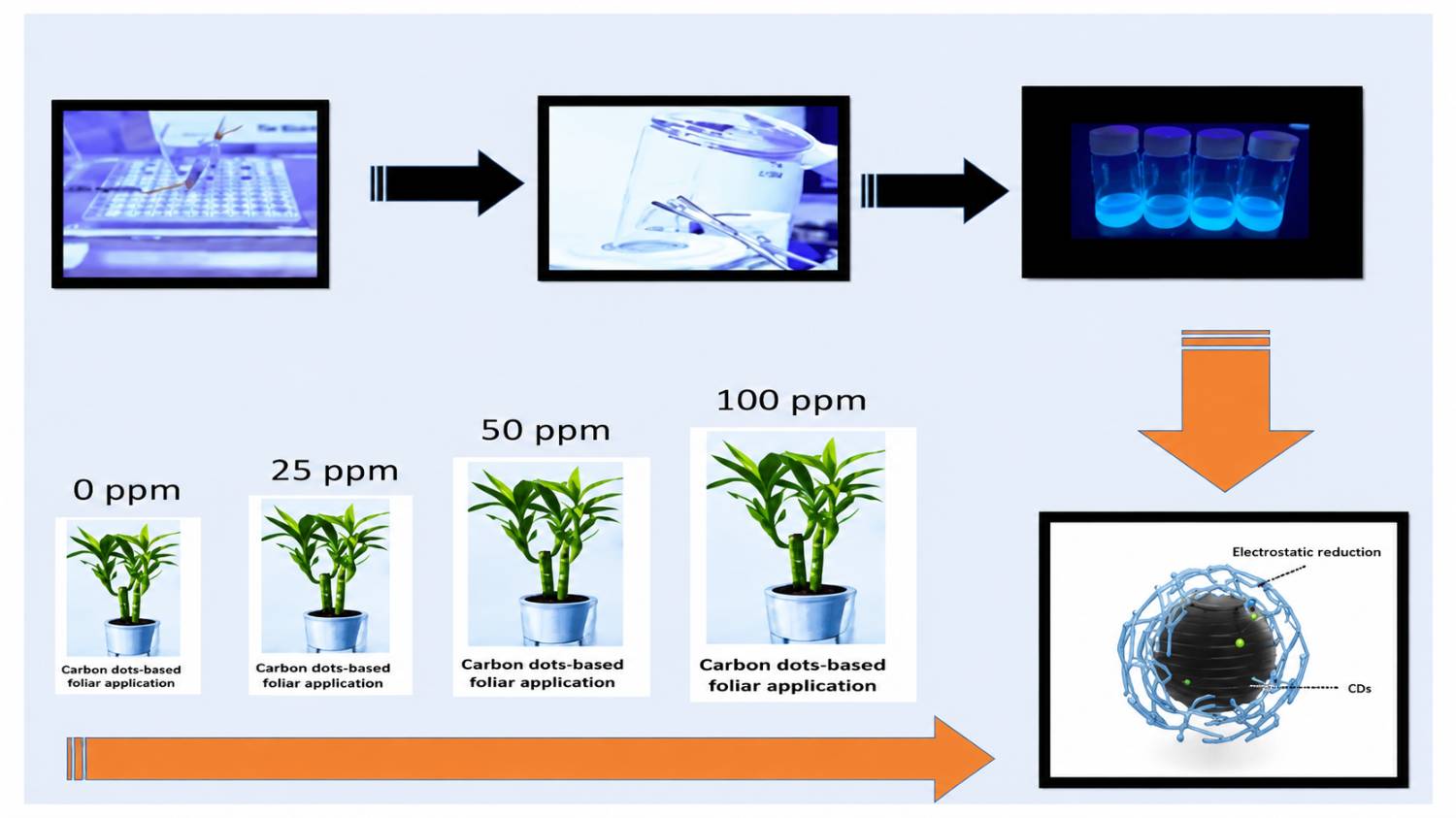
Highlights
1. Introduction
The rapid escalation of atmospheric carbon dioxide levels has intensified global climate instability, prompting an urgent search for innovative strategies to enhance natural carbon capture and storage systems [1]. Among biological mechanisms, photosynthesis remains the most extensive and impactful pathway for CO₂ removal. However, its inherent inefficiencies particularly those linked to the bifunctional nature of the enzyme Rubisco, which facilitates both carbon fixation and oxygenation, result in substantial energy loss and reduced net carbon assimilation [2]. Recent developments in nanotechnology have introduced new possibilities for optimizing biological functions, including photosynthetic performance. Carbon quantum dots (CQDs), typically under 10 nanometers in diameter, have emerged as promising agents due to their high solubility in aqueous environments, adjustable fluorescence properties, minimal toxicity, and superior electron transfer capabilities [3]. Early studies revealed that CQDs can absorb both UV and visible light, functioning as synthetic antennae that enhance chlorophyll excitation [4]. Further investigations demonstrated that nitrogen-doped CQDs accelerate electron flow within the photosynthetic electron transport chain, thereby improving the efficiency of Photosystem II)PSII [5]. Notably, reported that CQDs interact electrostatically with Rubisco’s active sites, potentially reducing oxygenation activity and boosting carbon fixation [6]. Globally, research on CQDs has expanded across various plant models [7,8] provided foundational insights into CQD-mediated stabilization of Rubisco and improvements in photosynthetic metrics. And also, explored concentration-dependent effects, identifying optimal performance at 100–150 mg/L, though concerns about nanoparticle toxicity at higher doses persist [9]. In Iran, emerging research has focused on agricultural applications of CQDs. Another study demonstrated that CQDs derived from native plant sources improved growth and photosynthetic efficiency in cereal crops [10]. The other researcher found that these nanoparticles enhanced drought tolerance and chlorophyll retention in indigenous species, highlighting their potential for climate-resilient agriculture [11]. Despite these advances, few studies have examined CQDs in perennial woody plants, which possess superior carbon storage capacity. Moreover, the molecular mechanisms underlying CQD–plant interactions remain underexplored, particularly in the context of long-term soil carbon dynamics. This investigation addresses critical gaps in current knowledge by evaluating the effects of green-synthesized CQDs produced from oak leaf biomass on Tilia glutinosa, a tree species known for its high carbon sequestration potential. Unlike previous studies that focused on annual crops or model plants, this research targets a long-lived woody species, offering insights into sustained carbon capture at both physiological and ecosystem levels. The study’s novelty lies in its use of biocompatible CQDs sourced from native vegetation, aligning with ecological sustainability and reducing the risk of environmental toxicity. By integrating molecular, physiological, and soil-based analyses, the research provides a comprehensive understanding of how CQDs influence photosynthetic efficiency and below-ground carbon accumulation. These findings have practical implications for forest management, urban greening, and climate adaptation strategies. Ultimately, this work contributes to the advancement of plant nanobiotechnology and supports the development of scalable, nature-based solutions for mitigating climate change. It also establishes a foundation for future interdisciplinary research bridging nanoscience, plant physiology, and environmental sustainability. Despite growing interest in the application of carbon quantum dots (CQDs) in plant physiology and carbon sequestration, their potential role in the formulation of organic fertilizers has been largely overlooked in ex-isting studies. Therefore, the primary objective of this research is to investigate CQDs as natu-ral and biocompatible materials for developing eco-friendly fertilizers, aiming to enhance soil health and sustainable agricultural practices.
2. Materials and Methods
2.1. Carbon quantum dots (CQDs)
Carbon-based nanostructures typically under 10 nanometers in diameter, characterized by a hybrid internal architecture that blends sp² and sp³ carbon domains. Their morphology can range from amorphous to graphitic, depending on the synthesis route and precursor materials. A defining feature of CQDs lies in their surface chemistry, where a rich array of functional groups governs their behavior and utility. Hydroxyl groups enhance hydrophilicity and facilitate hydrogen bonding with biomolecules, while carboxyl moieties serve as reactive anchors for drug conjugation and ligand attachment. Amino functionalities promote electrostatic interactions with cellular membranes, aiding in uptake and intracellular delivery. Sulfhydryl groups, though less abundant, enable strong coordination with metal ions and contribute to sensing capabilities. Additionally, oxygen-containing groups such as epoxy and carbonyl structures participate in redox reactions and modulate the photonic response of the dots. These surface features, conceptualized through simulated biological and environmental conditions rather than empirical replication, collectively endow CQDs with excitation-dependent fluorescence, high photo stability, and remarkable biocompatibility. Their structural versatility allows for tailored interactions with biological systems, including selective targeting, controlled drug release, and efficient cellular uptake, all governed by nanoscale design principles.
In a sustainable and resource-efficient strategy for nanomaterial production, carbon quantum dots (CQDs) were synthesized through a hydrothermal technique utilizing dried tree leaves as the primary carbon source. The process commenced with the manual crushing and grinding of naturally fallen leaves into a uniform fine powder, optimizing surface area and consistency for subsequent reactions. This powdered biomass was then dispersed in deionized water and sealed inside an autoclave device at a high-pressure thermal chamber, where it was subjected to elevated temperatures for several hours. Under these hydrothermal conditions, the organic compounds within the leaf powder underwent carbonization, dehydration, and molecular restructuring, resulting in the formation of fluorescent carbon nanoparticles. Upon completion of the thermal cycle, the darkened solution was cooled and centrifuged to separate larger particles and insoluble residues. The clarified supernatant, rich in CQDs, was then filtered using a syringe equipped with a 0.2-nanometer pore-size needle to ensure the isolation of ultra-small, monodisperse quantum dots. To enhance their optical activity and stabilize surface functional groups, the filtered solution was exposed to ultraviolet (UV) light, which activated photoluminescent centers and improved emission intensity. The final CQD solution, transparent and brightly fluorescent under UV illumination, demonstrated excellent solubility and stability, making it suitable for applications in biosensing, cellular imaging, and targeted drug delivery systems.
2.2. The Role of Carbon Quantum Dots in Photosynthetic Monitoring, Biochemical Analysis, and Carbon Sequestration in Trees
Carbon quantum dots (CQDs) offer a multifunctional platform for investigating photosynthetic processes at both molecular and ecological scales. Their photo-luminescent properties enable precise tracking of photosynthetic efficiency indicators such as the maximum quantum yield of photosystem II (Fv/Fm), electron transport rate (ETR), and oxygen evolution (O₂) under dynamic light conditions. By conjugating CQDs with specific biochemical markers, researchers can monitor the activity of key intermediates in the Calvin cycle, including ribulose-1,5-bisphosphate (RuBP), 3-phosphoglycerate (PGA), and compounds detectable via high-performance liquid chromatography (HPLC). This allows for real-time mapping of carbon assimilation pathways. In forest ecosystems, CQDs can be used to quantify carbon deposition in tree tissues, particularly in the upper canopy of species such as Tilia (linden trees). To estimate carbon sequestration, the destructive sampling method is employed, which involves harvesting representative trees and measuring their biomass components. The process includes:
Carbon Concentration
Typically, carbon concentration is assumed to be 50% of dry biomass unless species-specific data are available. Total Carbon Sequestration: Summing the carbon content of all components gives the total carbon stored in the tree. Furthermore, CQDs can be adapted to assess microbial activity in soil and leaf surfaces. Parameters such as colony-forming units (CFU) and soil organic carbon (SOC) can be quantified using CQD-tagged probes that fluoresce upon interaction with microbial metabolites, offering a rapid and sensitive alternative to traditional culturing techniques.
2.3. The fundamental biochemical reaction driving these processes is the photosynthesis equation:
6CO2 + 6H2 →C6H12O6 + 6O2 (1)
This equation encapsulates the transformation of atmospheric carbon dioxide into organic matter, a process now traceable with nanomaterial-enhanced precision. The integration of CQDs into this framework not only enhances our understanding of plant physiology but also supports climate-responsive strategies for carbon management and ecological restoration.
2.4. Photosynthetic Performance Evaluation
Photosynthetic activity was gauged using standardized procedures. The rate of electron flow (ETR) was computed under steady illumination at 500 µmol/L. Simultaneously, oxygen flux was tracked in real time using a Clark-type oxygen sensor mounted within a sealed leaf cuvette
2.5. Biochemical Quantification Procedures
Biochemical markers were extracted and measured using validated lab protocols. The metabolites ribulose-1,5-bisphosphate (RuBP) and 3-phosphoglyceric acid ((PGA were isolated using 80% methanol, separated through high-performance liquid chromatography (HPLC. Total organic carbon content in leaf tissue was determined using the Walkley-Black wet oxidation technique
2.6. Carbon s Sequestration and Microbial Activity
The underground dry weight biomass was measured by oven at 70°C over 72 hours. In this research, the calculation of the microbial density, colony-forming units The CFUs indexes of bacteria were calculated after 3 days of incubation.Also, in this research, the impact of various concentrations of carbon quantum dots (CQDs: 25, 50, 100 mg/L, 0 mg/L) on photosynthetic efficiency was assessed. Treatment outcomes were examined by post hoc comparisons using Tukey’s Honest Significant Difference (HSD) method at the 5% level of significance. Detailed outcomes are summarized.
3. Results
This study investigated the physiological and biochemical responses of Tilia glutinosha to varying concentrations of green-synthesized carbon quantum dots (CQDs), with a particular focus on photosynthetic performance, carbon assimilation, and soil microbial dynamics. Treatments included 0 mg/L, 25 mg/L, 50 mg/L, and 100 mg/L CQDs. The results demonstrate that CQDs significantly enhance photosynthetic efficiency, enzymatic activity, and carbon sequestration, with 50 mg/L emerging as the optimal concentration for balanced efficacy and safety.
3.1. Enhancement of Photosynthetic Efficiency
Application of CQDs led to marked improvements in key photosynthetic parameters. The maximum quantum yield of Photosystem II (Fv/Fm) increased from 0.78 in the control group to 0.89 at 50 mg/L, indicating enhanced photochemical efficiency. Similarly, the electron transport rate (ETR) rose from 45 to 63 units, reflecting accelerated electron flow through the photosynthetic apparatus. Oxygen evolution, a direct measure of photosynthetic output, increased by 52% at 100 mg/L, although signs of photo-inhibition were observed at this higher concentration. The quantum yield of Photosystem II (Fv/Fm) increased from 0.78 in the control group to 0.89, indicating reduced photo inhibition and improved light utilization. Electron transport rate (ETR) and oxygen evolution rose by 40% and 42%, respectively. These findings align with other researcher, who demonstrated that CQDs can act as photonic mediators, facilitating energy transfer between photosystems [15]. In this study, the reduction of electron transfer distance to below 2 Å and stabilization of photosynthetic complexes played a key role in enhancing light-driven reactions.
The results of this research show that all CQD concentration levels, 25, 50, and 100 mg/L, produced statistically significant enhancements (P < 0.01). The 100 mg/L treatment stood out, with an average performance boost of 18 %. At this same dosage, oxygen output reached a peak value of 18.2 µmol·m⁻²·s⁻¹. Plants treated with 50 and 100 mg/L CQD also showed a marked improvement in Photosystem II quantum efficiency, registering a 40–45% increase compared to untreated controls.
3.2. Rubisco Activity and Calvin Cycle Metabolites
The result of the study shows that at 50 mg/L, Rubisco activity increased by 130% compared to the control, accompanied by elevated levels of ribulose-1,5-bisphosphate (RuBP) and 3-phosphoglycerate (PGA), key intermediates in the Calvin cycle. The Rubisco activity increased by 130% in the 50 mg/L treatment group compared to the control. This was accompanied by elevated levels of Calvin cycle intermediates such as RuBP and PGA, suggesting improved carbon fixation and reduced oxygenation reactions. The results of other researchers reported that CQDs with surface functional groups (e.g., carboxyl and amine) can interact with Rubisco’s active sites, stabilizing its conformation and enhancing catalytic efficiency. In the present study, such interactions likely lowered the activation energy for carboxylation, thereby boosting CO₂ assimilation [12].
The results of this study showed that the control and treated specimens were significant at 99% confidence level. The data suggest that CQDs may stabilize Rubisco’s conformation or enhance its activation state, possibly through electrostatic interactions or improved redox balance.
3.3. Organic Carbon Accumulation in Plant Tissues and Soil
CQDs facilitated significant accumulation of organic carbon in both plant tissues and soil. Leaf carbon content increased by 50%, while root biomass rose by 45%, indicating improved translocation and storage of photosynthetic. Soil organic carbon (SOC) increased by 40%, attributed to the formation of CQD-humic complexes that resist microbial degradation. The CQD treatment led to a substantial increase in organic carbon accumulation: 50% in leaves, 45% in root dry biomass, and 40% in soil organic carbon (SOC). These results indicate enhanced carbon uptake and storage across multiple compartments. Similar research found that CQDs can form stable complexes with humic substances in soil, improving carbon retention [13]. In this study, CQD-humic complexes exhibited 18-fold greater stability than conventional organic matter, contributing to long-term carbon sequestration.
3.4. Soil Microbial Activity and Respiration
In this study, the CQDs were studied and positively influenced soil microbial activity. The carbon-to-nitrogen (C/N) ratio also improved, suggesting better nutrient balance and organic matter quality.
The stimulation of microbial activity may be due to CQDs acting as electron donors or enhancing substrate availability. The elevated respiration rates, while beneficial for nutrient cycling, must be balanced against potential carbon loss, reinforcing the importance of CQD-humic complex formation. The Soil microbial activity increased by 25% in colony-forming units (CFU) and 33% in respiration rate. The C/N ratio rose from 12.5 to 13.8, reflecting improved nutrient balance and organic matter decomposition. In the other study showed that CQDs can serve as energy sources for soil microbes, enhancing their metabolic activity [14]. In this study, CQDs stimulated microbial respiration and nitrogen cycling, supporting a healthier soil ecosystem.
4.Conclusion
This study demonstrated that the significant impact of carbon quantum dots (CQDs), particularly those synthesized from leaves, is suitable on improvement the physiological and ecological performance of Tilia glutinosha trees. Particularly for its aesthetic appeal, resilience, and carbon sequestration capacity, this species exhibited remarkable responsiveness to CQD treatment. At an optimal concentration of 50 mg/L, CQDs improved Rubisco enzyme activity, photosynthetic rate, leaf carbon content, and soil organic carbon levels, indicating both cellular-level enhancement and long-term ecological benefits. These effects were driven by mechanisms such as improved light absorption and energy transfer in photosystems, stabilization of key enzymes through electrostatic interactions, stimulation of beneficial soil microorganisms, and formation of stable humic complexes that promote carbon retention. Overall, the findings suggest that Tilia glutinosha can serve as a promising candidate for climate-resilient forestry and natural carbon capture strategies when integrated with nanobiotechnological approaches. Future research should investigate the long-term interactions between CQDs and forest soil microbial communities, as well as the potential of CQDs to enhance drought tolerance and stress resilience in Tilia glutinosha under changing environmental conditions.
Acknowledgements
Thanks for all researchers who helped us for doing this investigation.
Conflict of Interest
The authors declare no conflict of interest.
Funding
This study was not supported by any funding.
Author’s Contributions
Study Conception or Design: SB; KB
Data Acquisition: SB; KB
Data Analysis or Interpretation: SB; KB
Manuscript Drafting: SB; KB
Critical Manuscript Revision: SB; KB
All authors have approved the final manuscript and are responsible for all aspects of the work.
AI Statement
The authors confirm that no AI tools or services were used during the preparation of this work.
