
Document Type : Original Research Paper
Graphical Abstract
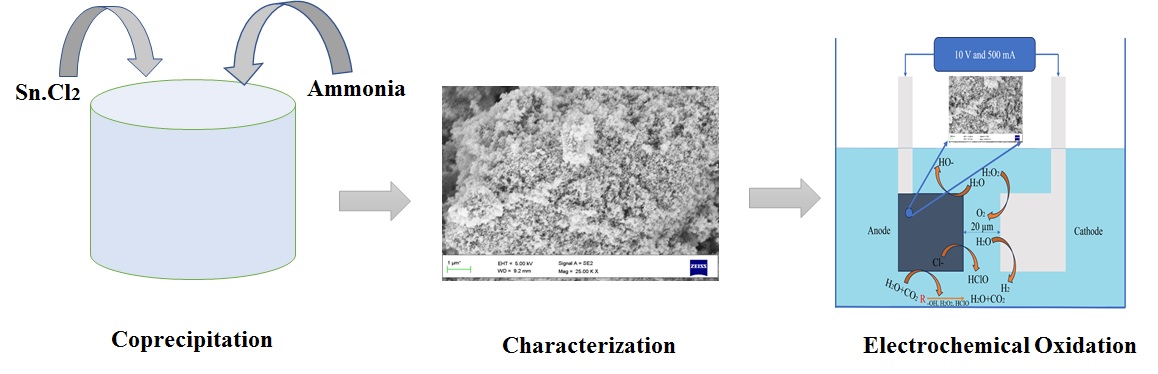
Highlights
1. INTRODUCTION
The issue of water pollution is becoming increasingly critical owing to the rapid expansion of the global population, urban sprawl, and industrial growth. Key sources of water contamination include residential areas, industrial facilities, roadways, and agricultural activities [1–3]. The direct discharge of untreated wastewater into freshwater systems poses serious threats to human health [1,4–7]. The textile industry contributes significantly to this problem, as its core processes involve wet operations such as scouring, bleaching, and dyeing [8–11]. Conventional treatment methods such as flocculation, adsorption, biological oxidation, and ion exchange are insufficient for managing this type of wastewater because of its complex composition and the difficulties associated with large-scale treatment [12–14].
In the ever-evolving realm of environmental management, there is an increasing emphasis on electrochemical methods for detoxifying hazardous waste[15,16]. Among these methods, electrochemical oxidation (EO) is a promising approach that combines ease of use, effectiveness, and environmental friendliness to address pollution [17,18]. EO functions by utilizing both direct and indirect electrical currents to break down pollutants[19]. In the direct method, oxidation is facilitated by hydroxyl radicals, which are produced at the electrode surface by dimensionally stable anodes with high oxygen overvoltage, aiding mineralization. The indirect method involves the electrochemical creation of a mediator in solution, which catalyzes the transformation of harmful organic compounds into less harmful compounds [20-26]
To evaluate water quality, the chemical oxygen demand (COD) test measures the amount of organic pollutants in surface water and wastewater, whereas the biological oxygen demand (BOD) test assesses oxygen consumption by microorganisms as they break down organic material [27–29]. A crucial element of this electrochemical process is the anode material, the performance of which can vary widely against different toxic substances [30,31].
Recently, nanostructured transitional metal oxides have attracted interest owing to their catalytic properties [30,32,33]. Numerous studies have reported the use of metal oxides such as TiO₂, MnO₂, and PbO₂ for electrode modification in electrochemical applications due to their high oxidation potential and conductivity. However, concerns over toxicity (PbO₂), high cost (BDD), and limited stability have prompted the search for safer, economical alternatives. SnO₂ offers an ideal balance of electrochemical performance, cost-efficiency, and environmental safety, making it an attractive choice for sustainable wastewater treatment [34–37]. The electrochemical water oxidation process on metal oxide anodes starts with the formation of surface-bound hydroxyl radicals (MOx·OH), which are converted into chemisorbed active oxygen (MOx+1), promoting oxygen evolution activity [38]. In a study conducted by Daghrir et al.[39] In domestic wastewater, the electrochemical treatment performed with diamond doped with boron and amorphous nanostructured carbon electrodes achieved a notable 78.9±2% COD removal and an 85.5±2% reduction in color, along with a 70% decrease in total organic carbon.
P Iovino et al. [40] examined titanium electrodes coated with platinum and assessed the efficiency of the electro-oxidation method in removing atrazine from simulated wastewater, with a focus on the impact of current density and ionic strength. Liu et al. [41] investigated micropollutant degradation, aiming to find optimal conditions for an ozone-based advanced oxidation process. Cordova et al.[42] In a different approach, multicore particles (40 nm) with magnetic properties and colloidal stability were developed, creating a self-heating catalyst with a precisely controlled structure of small core (10 nm) aggregates for the degradation of methyl orange dye.
Wang Yun-Hai et al. [43] thoroughly investigated nonactive anode materials, focusing on electrodes made from niobium oxide, tantalum oxide, diamond, tin dioxide, and lead dioxide. Their study delved into the basic principles, preparation methods, and applications of these materials in wastewater treatment. When used on inert substrates, lead dioxide anodes offer excellent conductivity and a high overpotential for oxygen evolution at a lower cost. However, owing to its toxicity, lead dioxide is not advisable. Furthermore, Nordin et al. [44] optimized the electrochemical oxidation process for textile wastewater treatment and analyzed how operational parameters, such as pH, sodium chloride (supporting electrolyte) concentration, initial pH, current density, duration of electrolysis, chemical oxidation demand (COD), biochemical oxidation demand (BOD), color removal efficiency, surfactant removal, and total organic carbon (TOC), change. Under optimal conditions, the color and COD removal efficiency reached 96%, whereas the BOD, TOC, and surfactant removal percentages were slightly lower. The main challenges associated with these materials are their stability and toxicity, making it crucial to find alternative materials that can serve as effective anodes in terms of energy consumption, purification efficiency, and cost-effectiveness [45,46].
Tin dioxide (SnO2) is a promising catalyst for electrochemical reactions because of its ability to oxidize pollutants both directly and indirectly in the presence of chloride ions [46]. This study details the synthesis of nanostructured SnO₂ nanoparticles and their use as anodes for the electrochemical oxidation of contaminated water and Indigo carmine dye. Indigo carmine, a widely used synthetic dye in the textile industry, is chosen due to its high chemical stability, complex aromatic structure, and potential toxicity. These characteristics make it a representative model contaminant for evaluating the efficacy of advanced oxidation processes in wastewater treatment.
This study systematically investigated the effects of parameters such as the reaction time, electrolyte concentration, pH, and applied voltage on the performance of the electrochemical process. The primary goal was to optimize the synthesis and assess the performance of SnO₂ anodes in wastewater treatment. Insights from this study will contribute to the development of sustainable and efficient electrochemical oxidation methods, offering potential solutions for environmentally friendly water purification and pollution management.
2. EXPERIMENTAL
2.1. Instrument
Wastewater is treated through an electrochemical process conducted within a chamber or an electrochemical cell, as illustrated in Fig. 1. This arrangement comprises several key components: electrodes (anode and cathode) that are aligned parallel to each other, with a specific distance separating them. The power supply connects the anode to its positive terminal and the cathode to its negative terminal. A magnetic stirrer was employed to maintain a uniform reaction throughout the electrochemical cell, and a supporting electrolyte was used to boost the electrochemical reaction. The core process during electrolysis involves electrolytic reactions at the surface of the electrodes, which facilitate the breakdown of pollutants. The efficiency of the treatment is influenced by various factors, including the material of the anode, the concentration of the supporting electrolyte, the applied voltage, the current density, the pH, and the spacing between the electrodes.
2.2. Synthesis of SnO2 nanoparticles:
Tin dioxide nanoparticles were synthesized via a chemical precipitation method, as outlined in previous studies[47]. The process was initiated by dissolving stannous chloride dihydrate (SnCl2.2H2O, 0.1 M) in distilled water. After complete dissolution, ammonia was introduced incrementally into the solution with continuous stirring. To remove the water molecules, the resulting gels were filtered and subsequently dried at 80 °C for 24 h. The dried material was crushed, finely milled, and calcined at 550 °C for 2 h.
2.3. Electrode Preparation
First, 100 mg of SnO2 nanoparticles was mixed with 10 mg of carbon black, and then 5 mg of polytetrafluoroethylene binder was added. The role of carbon black is to increase the conductivity of the active material. These ingredients were subsequently ground and mixed via a mortar and pestle, and a slurry was formed via N-methyl-2-pyrrolidone (NMP). This slurry was then applied to a polished stainless-steel substrate shaped like an L, with dimensions of 10 cm in length and 2 cm in width, and left to dry in a vacuum oven set at approximately 80 °C for 24 h.
2.4. Electrochemical treatment with Indigo carmine dye
The electrochemical oxidation of the indigo carmine dye was carried out using a 10 ppm dye solution under the experimental conditions listed in Table 1.
The same experiment was repeated by adding 0.1 M electrolyte (NaCl). Further studies were carried out to understand the effects of the electrolyte, voltage, and pH on the treatment.
2.5. Study of the effect of electrolyte concentration:
NaCl functions as a supporting electrolyte because it can accelerate degradation and decrease the reaction time. Experiments were carried out using four different NaCl concentrations (0.025, 0.05, 0.075, and 0.1 M), and the time required for color removal was documented. The conditions for these experiments to assess the effect of the electrolyte concentration included a voltage of 10 V, a pH of 3, and a solution volume of 125 ml.
2.6. Study on the effect of applied voltage:
The experiment was performed by varying the input voltage applied to the electrodes. The time required for color removal was recorded at voltages of 3, 5, 7, and 10 V.
2.7. Study of the effect of pH
The effect of pH in the range of 2.5-7 was investigated using HNO3 and NaOH as acids and bases, respectively.
2.8. Electrochemical treatment of domestic wastewater:
The electrochemical treatment of domestic wastewater was conducted via a stainless-steel electrode with a dual SnO2 coating as the anode, whereas a plain stainless-steel electrode functioned as the cathode. The coating on the anode was approximately 20 µm thick, and the electrodes were positioned 2 cm apart. The Technomax power supply delivered 10 V and 500 mA, and the pH was maintained at 3 throughout the 1-hour treatment duration. Both the treated and untreated water samples were evaluated for COD and BOD reduction. This analysis was conducted in the general analytical laboratory of the Karnataka State Pollution Control Board, which is located in Karnataka, India.
2.9. Characterization of SnO2 nanoparticles
The phase purity and crystal structures were verified via powder X-ray diffraction (XRD) on a Rigaku Ultima-IV X-ray diffractometer. This analysis spanned a 2-theta range from 20--700, with measurements taken at intervals of 0.020 steps per second, utilizing Cu-Kα radiation (λ = 0.15406 nm) at ambient temperature. The morphology and dimensions of the samples were assessed by scanning electron microscopy (SEM, Hitachi Sem, SU1510). Transmission electron microscopy (TEM) was performed using a Hitachi TEM instrument at 100 kV. Isotherms were recorded at 77 K after the samples were degassed to a pressure below 10–2 kPa. The Brunauer–Emmett–Teller (BET) specific surface area and pore size distribution were derived from nitrogen sorption measurements via a Belsorp Mini(II).
3. RESULTS AND DISCUSSION
3.1. XRD Results
The XRD patterns of the SnO2 nanoparticles are shown in Fig. 2. The XRD pattern of SnO2 shows peaks at 2θ values of 26.5°, 33.85°, 37.98°, 51.75°, 54.69° and 65.82°, which can be assigned to the (1 1 0), (1 0 1), (2 0 0), (2 1 1), (2 0 0), and (3 0 1) planes, respectively [48,49]. The crystal structure was found to be tetragonal, matching JCPDS card numbers 41-1445. The peaks were sharp with slight broadening, indicating the presence of nanosized crystallites. The average crystallite size calculated via the Scherrer equation was found to be 17.4 nm [50].
3.2. Morphological and Size Study
To evaluate the morphology and size of the synthesized SnO2 nanoparticles, SEM and TEM analyses were performed, as illustrated in Fig. 3. (a), (b), (c), and (d). The samples exhibit a uniform distribution of spherical particles. Determining the morphology of the synthesized SnO2 nanoparticles from the SEM images in Fig. 3(a, b) is challenging. However, TEM analysis confirmed the spherical nature of the particles, as shown in Fig. 3(c) and (d). The images indicate that there may be some agglomeration of particles. The average diameter of a single particle in the TEM image is approximately 40–50 nm.
3.3. BET surface area studies
The Brunauer‒Emmett–Teller (BET) surface area and porosity characteristics of the SnO₂ nanostructures were investigated to determine their effects on electrochemical oxidation. As depicted in Fig. 4(a), the material demonstrated a type-IV isotherm, which is typical of mesoporous (2–50 nm) and macroporous (>50 nm) structures, with a surface area of 3.1 m² g-1. Fig. 4(b) shows the BJH pore size distribution, indicating a significant concentration of pores within the 0–50 nm range, with some extending up to 100 nm. This hierarchical pore configuration, which includes both meso- and macropores, enhances the adsorption of Indigo carmine dye onto the electrode surface. The interconnected porous network facilitates efficient charge transport during the electrochemical reactions, thereby increasing the oxidation efficiency of the dye. The interplay between the surface area and pore structure highlights the potential of the material for applications that require quick ion diffusion and easy access to reactive sites.
3.4. Electrochemical treatment with Indigo carmine dye
The electrochemical oxidation process was applied to a 10 ppm solution of indigo carmine dye via a stainless-steel electrode coated with SnO2. Within 1.10 h, the dye solution became colorless and was entirely broken down by direct oxidation, as illustrated in Fig. 5(a). This direct oxidation likely occurs in three phases, as detailed in equations (1)–(3), in which an electron is directly transferred to the electrode surface. Subsequently, reactive oxygen species, such as OH, are generated, followed by the formation of weak oxidants through the oxidation of other ions present in wastewater, as shown in equations (1)–(3) [51]. An alternative method, known as indirect oxidation, employs electrolytes to enhance anodic oxidation by producing oxidants such as chlorines, sulfates, and polycarbonates, as shown in Fig. 5 (b) (36).
The plot of the percentage of degradation versus time degradation of Indigo Carmine dye with SnO2 nanoparticles coated on a stainless-steel substrate is shown in Fig. 6 (a). The indigo carmine dye was completely degraded within 70 min. To conduct the kinetic analysis of the photocatalytic degradation, the plot of ln C0/Ct vs. time (min) is shown in Fig. 6 (b). where C0 is the initial concentration of the IC dye (mg L−1) and Ct is the dye concentration at time t (mg L−1). The slope of the linear plot between irradiation time (t) and ln C0/Ct yields the rate constant K (min−1). The K value indicates that the dye concentration and reaction rate are inversely related; as a result, the kinetics of IC dye degradation were verified to follow pseudo-first-order rate kinetics.
For the electrochemical oxidation of Indigo carmine dye, NaCl was introduced as an electrolyte with a SnO2-coated stainless-steel electrode. An increase in the electrolyte concentration decreased the time required to remove the color of the indigo carmine dye, as shown in Fig. 7 (a). The concentration of the electrolyte increased the number of chloride ions. As a result, a greater amount of hypochlorite ions was generated, which increased the oxidation of organic molecules in the wastewater. When 0.1 M was used as the electrolyte under all the other conditions, the color disappeared within 30 s
M + H2O → H2 + M(.OH) + H+ + e- (1)
2M (.OH)→ 2MO + H2O2(2)
3H2O → O3 + 6H+ + 6e- (3)
C16H8N2Na2O8S2+ e- → intermediates → CO2 + H2O + NO3- (4)
A possible degradation mechanism is described by the following equation:
In solution, bulk Cl hydrolysis takes place as follows:
2Cl + H2O → HOCl + H+ + Cl-(5)
HOCl → H+ + OCl- (6)
The generated hypochlorite ions act as the main oxidizing species in the degradation of the dye present in the effluent. The overall desired reaction for the degradation of the dye solution is as follows:
C16H8N2Na2O8S2+ OCl- → intermediates → CO2 + Cl-+ H2O +NO3-(7)
An increase in voltage decreased the time required for color removal, as shown in Fig. 7 (b). This was mainly due to an increase in the mobility of ions when the applied voltage was increased. An increase in the mobility of ions increases the electro-oxidation process, thereby removing the color.
In addition, as shown in Fig. 7(c), an increase in the pH of the solution results in a reduction in color removal. This was attributed to the decreased generation of chlorine and hypochlorite ions in the alkaline medium, which promoted the formation of chlorate or perchlorate. Conversely, in an acidic medium, the percentage of COD removal is elevated owing to the presence of chlorine/chloride as hypochlorous acid, which has a higher oxidation potential than hypochlorite does [52]. The table above presents the COD and BOD values of the water before and after treatment. The test results revealed that the BOD and COD removal rates were 87% and 88.25%, respectively, following a 1-hour treatment of the wastewater, as shown in Table 2. These findings indicate that the proposed method is effective for the purification of domestic wastewater[53].
Table 3 summarizes recent investigations on the synthesis of SnO2 materials via diverse methods and their application as photocatalysts for the degradation of organic dyes. A 10% reduction in COD for ammonium nitrogen was observed with titanium coated with PbO2 or SnO2. Titanium-coated Ta2O5-SnO2 achieved an 85.4% reduction in the COD for methylene blue dye degradation. Moreover, the titanium-coated Sb-SnO2 electrode demonstrated a 96.8% reduction in the COD for aniline degradation. Compared with other electrode materials, such as boron-doped diamond, PbO2-based, and titanium-based electrodes, SnO2-coated stainless steel electrodes are notably more cost-effective and readily available. As a result, SnO2-coated stainless steel electrodes are crucial for the large-scale treatment of wastewater. The rapid and efficient degradation of contaminants using SnO2-coated stainless-steel electrodes demonstrates not only high performance but also the practical viability of using readily available substrates. Compared with conventional and costlier materials like BDD or PbO2, this approach offers a sustainable alternative with reduced environmental and economic costs.
4.CONCLUSION
Nanostructured tin dioxide was synthesized via a simple precipitation method. The resulting materials were characterized via X-ray diffraction (XRD) and scanning electron microscopy (SEM). Stainless steel electrodes coated with SnO2 nanoparticles were employed as anodes for the degradation of indigo carmine dye and the treatment of domestic wastewater. This study investigated the effects of varying the electrolyte concentration, pH, and voltage on the oxidation of organic molecules. The treatment efficiency increased with increasing electrolyte concentration, pH, and voltage. Using the SnO2 electrode, 10 ppm Indigo carmine dye in 125 ml of water was completely degraded within 30 s when 0.1 M NaCl was used as the electrolyte, the pH was set to 3, and a voltage of 10 V was applied. Furthermore, an electrochemical treatment of domestic wastewater was conducted for one hour, and the COD and BOD reductions in the treated water were evaluated. The results indicated an 88.25% reduction in COD and an 87% reduction in BOD. The experimental findings confirmed that SnO2-coated stainless steel is an effective anode material for the electrochemical treatment of wastewater.
Conflict of Interest
The authors declare no conflict of interest.
Funding
This study was not supported by any funding.
Author’s Contributions
Study Conception or Design: MM
Data Acquisition: MM
Data Analysis or Interpretation: NRM
Manuscript Drafting: MS
Critical Manuscript Revision: DR
All authors have approved the final manuscript and are responsible for all aspects of the work.
AI Statement
The authors confirm that no AI tools or services were used during the preparation of this work.
