Document Type : Review Paper
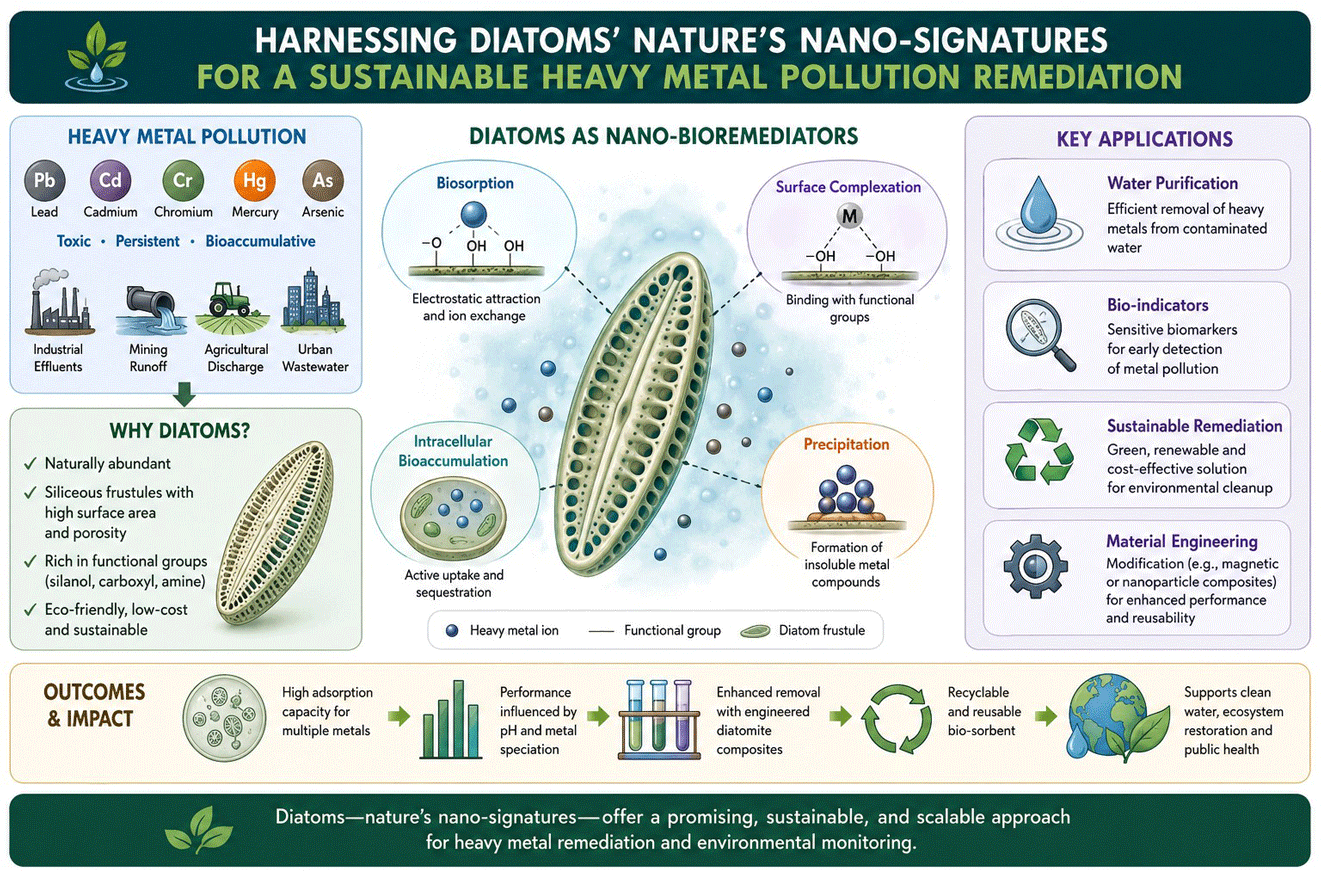
Graphical Abstract
Highlights
· Diatomite’s unique porous silica framework enhances adsorption capacity for toxic heavy metals.
· Adsorption efficiency is strongly influenced by pH and varies across different metal ion species.
· Novel diatom–nanostructure composites (magnetic and noble metal nanoparticles) show superior removal performance and recyclability.
· Mechanistic pathways clarified: adsorption involves electrostatic attraction, ion exchange, surface complexation, and precipitation
Please note: The following content displays the text-only preview. For the full article, complete with all illustrations, data tables, and equations, please download the free PDF from the sidebar at the top of this page.
Introduction
Diatoms are a class of microalgae that have long piqued the curiosity of scientists from a variety of scientific disciplines. They are prized for their distinctive decorative characteristics and intriguing architectural configurations. With their contribution to almost 20% of the photosynthetic activity on Earth, these eukaryotic organisms play a crucial role in aquatic environments. Diatoms are significant ecologically, but they have also drawn attention for their complex porous silica shells, or frustules, which are a demonstration of nature’s nano-engineering and have practical uses in biofiltration, biosorption, and biomonitoring of environmental pollutants [1, 2].
With the increasing discharge of heavy metals into water environments due to industrialization, effective and sustainable remediation approaches must be sought immediately. Heavy metals such as chromium, lead, mercury, etc., are very harmful to the environment and health due to their high toxicity and ability to persist in the environment. On the other hand, traditional heavy metal extraction methods typically depend on chemical treatments that can be costly and even produce secondary pollutants or fail at low concentrations. In this regard, the bioremediation potential of diatoms is an environmentally friendly and appealing alternative, as it makes removing and detoxifying heavy metals in polluted waters easy. The 3D architecture of diatom frustules with functional groups can be complex and adsorb to different metal ions. A broad range of their metabolic pathways facilitates these contaminants’ accumulation and potential transformation in the ecosystem. Being highly receptive to any environmental change, diatoms act as a bio-indicator for evaluating water quality and monitoring heavy metal pollution. Diatoms, with their distinct and intricate silica frustules, are among the most essential creatures in a diverse collection of aquatic environments [3]. As the leading primary producers responsible for over 20% of global photosynthesis, they are the principal food source for higher-ranking organisms and heterotrophic bacteria. The trophic role of these organisms helps to understand how metals are available and are affected within food webs [4].
The diatom frustule’s porous structure allows the dead cells to settle and sink, leading to the marine environment’s benthic sequestration of organic carbon. Diatom residues and lipid composition also generate fatty acid variation in bay sediments; thus, they are significant for biofuel production [5]. Interestingly, the diatomaceous earth also has a ceramic paste application. Research proves diatoms exist in the same environment as other plankton and microbes [4]. Diatoms have metal-accruing features affected by nutrient concentration and metal affinity. The phytoplankton communities sequester heavy metals like vanadium, chromium, and nickel [6]. The anthropogenic impacts on diatom consortia can be complex since trace elements can be either encouraging or not, especially in symbiotic relationships [7].
They are the best proxies for water quality assessment because of their ability to respond to environmental changes, thus making diatoms the most reliable bioindicators for heavy metal bioaccumulation, eutrophication, biosorption, metal pollution, bioavailability, in-situ dredging monitoring, and sediment toxicity assays. Diatoms are sensitive to changes in environmental conditions and thus can act as biotic signifiers to several ecological pollutants and as water quality predictors [8]. These xenobiotics and other human-made compounds often have long-term adverse effects on ecosystems. These pollutants thwart microbial communities, which may cause reduced growth rates and cell abnormalities. The 18S rRNA analysis effectively and accurately identifies diatoms and other microalgae in biofilms, which has aided in water quality assessments [9]. After the genotoxic and teratogenic pollutants, such as heavy metals, negatively impact the benthic diatoms’ cell walls, the cells get deformed.
This review probes the complicated mechanisms diatoms engage for heavy metal interaction, exploring biosorption and bioaccumulation competencies. It examines the environmental implications of heavy metal exposure on diatom populations and their broader role within aquatic ecosystems. By understanding the intricate relationship between diatoms and heavy metals, we can harness their natural potential for developing sustainable water quality management strategies. This work highlights diatoms’ vital role in protecting aquatic ecosystems and promoting the responsible use of natural resources in the face of anthropogenic pressures. Unlike previous reviews that have primarily focused either on ecological roles of diatoms as bioindicators or on engineered applications of diatomaceous earth, the present work uniquely integrates bibliometric analysis with mechanistic insights into biosorption, surface complexation, and intracellular accumulation, which also showcase the recent trends in this domain. By combining ecological perspectives with applied remediation strategies, this review addresses the gap in the literature. It highlights diatoms as both sustainable bio-remediators and sensitive real-time monitors of heavy metal contamination.
Bibliometric analysis
The bibliographic record provides information about various articles based on document type, author participation, and country-specific collaborative works. The keyword query “Diatom AND Heavy metal” from Clarivate’s Web of Science is documented in this review. Fig. 1 displays annual scientific data from 1991 to 2025. The red line graph shows the mean citation score of all published articles in that year, while the blue column shows the number of papers produced in that year. Fig. 2, which follows, shows the country-wise publication based on diatom studies on the remediation of heavy metals.
The VOSviewer is a software tool used to construct visualizations of key term networks: author correlation, journal, and source cross-linkage based on BibTeX outputs from various search databases. Fig. 2 depicts the network visualization of all the keywords by author and word plus from data retrieved from the WOS database between the years 1981 and 2025. The frequency-based links are shown as 9 clusters, in which Key terms such as “diatom”, “heavy metals”, “algae”, “microalgae”, “biomonitoring”, “wastewater treatment”, and “biomass” are prominently displayed, suggesting these are central themes in the research literature being analyzed. The focus of scientific studies and the emergence of researched concepts over time are better understood by researchers and policymakers thanks to this kind of visualization, which may assist in directing future investigations and interventions in diatom research on heavy metal remediation.
The network visualization focused on the interrelationships between various terms related to diatoms in heavy metal remediation. Key terms such as “heavy metals”, “algae”, “microalgae”, “wastewater treatment”, and “biomass” are prominently displayed, suggesting these are central themes in the research literature being analyzed. These central terms are connected to a variety of other related terms like “diatoms”, “copper”, “zinc”, “adsorption”, and “biofuels”, indicating the diverse aspects of research in this area. The different colors and thickness of the lines likely represent the strength and nature of the relationships between terms, such as co-occurrence frequency in the literature over time (from 2016 to 2021, as indicated by the timeline at the bottom). Thicker lines might suggest stronger or more frequent associations, while thinner lines indicate fewer connections. This type of visualization helps researchers and policymakers understand the focus of scientific studies and the evolution of research topics over time, potentially guiding future studies and interventions in diatom research on heavy metal remediation (Fig. 3) [10].
Diatomite and Diatomaceous Earth: Definitions and Characteristics
Diatomite, also known as diatomaceous earth (DE), is a naturally occurring, soft, siliceous sedimentary rock formed from the fossilized remains of diatoms. These microalgae leave behind intricate silica frustules after cell death, which, over geological time, accumulate in large deposits. When mined and processed, these deposits are referred to as diatomaceous earth. Although the terms “diatomite” and “diatomaceous earth” are often used interchangeably, diatomite usually refers to the raw geological material. In contrast, diatomaceous earth commonly refers to its processed, powdered form used industrially [11, 12].
Structurally, diatomite is characterized by a high porosity (up to 80–90%), low density, and large surface area due to the nanostructured architecture of the diatom frustules. Its composition is primarily amorphous silica (SiO₂·nH₂O), often containing trace amounts of alumina, iron oxides, and organic matter. These features confer diatomite with exceptional filtration capacity, adsorption potential, and chemical inertness [13, 14].
The unique combination of high surface area, reactive silanol groups, and tunable porosity makes diatomaceous earth an ideal substrate for environmental remediation. In particular, its ability to immobilize, adsorb, and exchange heavy metal ions has led to its increasing use in water purification, industrial wastewater treatment, and as a support matrix for functional modifications (e.g., chitosan coating, nanoparticle impregnation). The eco-friendly nature, abundance, and cost-effectiveness of diatomite further underscore its potential as a sustainable resource for large-scale remediation technologies [15, 16].
Heavy Metal Uptake by Diatoms
Extensive research has been conducted on the biogeochemistry of trace metal acquisition and regulation in aquatic systems. The findings have consistently shown that the concentrations of these metals are far lower than anticipated; this suggests a mechanism that controls the concentration and arrangement of metals. Diatoms, the prevailing kind of phytoplankton in seas, are recognized for their ability to absorb substantial amounts of nutrients, including heavy metals. Diatoms are abundant in benthic ecosystems, particularly in freshwater bodies, where high levels of heavy metals are due to human activities. Through biotransformation, biomineralization, accumulation, and biosorption, the diatoms have developed many ways to cope with the harmful effects of heavy metals on their environment [17].
Classification and Chemical Behavior of Heavy Metals
Heavy metals encompass a broad group of elements with densities greater than 5 g cm⁻³ that persist in the environment and can bioaccumulate. They are generally divided into two categories: (i) essential trace elements, such as copper (Cu), zinc (Zn), iron (Fe), manganese (Mn), and cobalt (Co), which are required in small amounts for enzymatic and metabolic functions, but become toxic at elevated concentrations; and (ii) non-essential or toxic metals, such as lead (Pb), cadmium (Cd), mercury (Hg), and arsenic (As), which have no known biological function and are toxic even at low concentrations [10, 18].
The chemical behavior of heavy metals in aquatic environments is strongly influenced by their speciation, i.e., the distribution of an element among different chemical forms. Metals can exist as free hydrated ions (e.g., Pb²⁺, Cd²⁺, Cu²⁺), complexed with inorganic ligands (e.g., Cl⁻, OH⁻, CO₃²⁻, SO₄²⁻), or bound to organic molecules such as humic and fulvic acids. The stability and toxicity of these forms depend largely on pH and redox potential [19-21].
At low pH (acidic conditions), most heavy metals exist in their free ionic state (e.g., Cu²⁺, Zn²⁺, Cd²⁺), which enhances solubility and bioavailability but also increases toxicity. At higher pH (alkaline conditions), metals tend to form hydroxides, carbonates, or precipitate as insoluble salts, thereby reducing their bioavailability. For example, Cr exists as the more toxic and mobile hexavalent form Cr(VI) under oxidizing, alkaline conditions. At the same time, it is reduced to the less mobile trivalent form Cr(III) under neutral to acidic conditions. Similarly, arsenic occurs primarily as arsenite [As(III)] under reducing conditions and arsenate [As(V)] under oxidizing conditions, with significant differences in toxicity and adsorption behavior [22, 23]. Thus, pH not only governs solubility and precipitation, but also modulates adsorption–desorption dynamics at biological and mineral surfaces. These variations in speciation and bioavailability are central to understanding the mechanisms of heavy metal uptake and detoxification by diatoms and other microalgae. Fig. 4 depicts various heavy metal sources, causes, and remediation techniques.
Microalgae can assimilate and accumulate high amounts of heavy metal ions [9]. Algae, including diatoms, can accumulate and absorb metals; therefore, the metals may attach to their cell surface or internal ligands. Differences in their silica-based cell wall structure allow diatoms to store up to 10% of their biomass in trace metals because it has a high affinity and metal-binding functional groups. The diatoms are the producers of antioxidant chemicals, which include PUFA, terpenes, and pigments like fucoxanthin, for the regulation of the processes of detoxification, absorption, transport, and accumulation of heavy metals [24]. Acute heavy metal toxicity can impair the synthesis of photosynthetic pigments such as chlorophyll a, b, and c. Nevertheless, diatoms also show an increase in their pigment synthesis. There are two types of diatoms, one resistant and the other susceptible to heavy metal pollution, and they have different responses to this type of pollution. Heavy metal poisoning can cause the synthesis of lipids that contain a significant amount of polyunsaturated fatty acids, which is the physiological response to that. This lipid accumulation in diatom biomass is helpful in the generation of biofuels and biomolecules [25, 26]. Figs. 5a and b illustrate the mechanisms of heavy metal uptake and transformation by diatoms.
The surfaces of diatom frustules, which have negatively charged groups like silanol (Si-OH), carboxyl (-COOH), and amino (-NH2), are good electrostatic attractors for positively charged heavy metal ions [27]. This adsorption onto the frustule’s surface is the next quick step in metal accumulation. There are several physicochemical processes simultaneously involved in biosorption. The removal of heavy metals from water sources can be achieved by various methods, such as ion exchange, surface complexation, precipitation, and electrostatic interactions [28]. Biosorption is the key mechanism of diatom-based heavy metal sorption. Diatom cells can actively translocate metal ions across their membranes and accumulate them internally. This metabolic process, which can manifest by forming complexes with intracellular ligands or compartmentalization within vacuoles, is more likely to happen [29]. The diatom’s topography and pattern of the surface vary from one species to another. This trait’s uniqueness is usually remarkable for all algae. Aqueous solutions and diatoms’ surface amphoteric properties are the reasons for this complexation of metal-diatom frustules. Carboxyl, silanol, and amine are the most common functional groups on the diatom surface responsible for the metal complexation process [30].
Various factors influence the adsorption of heavy metals by diatoms, including metal concentration, biomass quantity, temperature, pH, and others. The initial metal concentration substantially impacts the removal of heavy metals. As the concentration of metal in wastewater increases, the process of adsorption also increases until it reaches a point of saturation. Due to numerous functional groups on their cell surface, diatoms exhibit a phenomenon where low-affinity functional groups bind to metals at high concentrations. In contrast, high-affinity functional groups bind to metals at low concentrations. Hence, the heavy metal concentration inversely affects its removal [31]. Similarly, wastewater’s pH is influenced by heavy metals’ adsorption. However, the specific pH level that maximizes the removal of metals by diatoms has not been thoroughly investigated. Research has demonstrated that the diatoms exhibit a greater capacity for adsorbing metals as the pH level rises. The organism is identified as Melosira sp. The presence of thiol and amino groups enables the effective removal of arsenic from the aqueous environment [32]. This removal process exhibits its highest adsorption capacity at an acidic pH of 4. Previous studies have shown that the most effective pH for removing Cd, Ni, and Zn is slightly acidic, while for Cu and Pb, it is more acidic [33].
Biomass concentration is another crucial factor in removing heavy metals—active surface ligands in living biomass offer superior removal capabilities to dead biomass. The adsorption of Cu and Ni reached its maximum level even at low biomass concentration. Multiple studies have demonstrated that higher biomass concentration leads to a reduction in Pb sorption. Cr, Co, Ni, Cu, and Cd sorption at high biomass concentrations decreases due to limited metal availability, increased electrostatic interactions, interference between binding sites, and reduced mixing [34, 35]. Temperature is a significant factor that affects the removal of heavy metals. The rise in temperature increases removal efficiency, indicating that the metal adsorption process is endothermic. For instance, Chlorella vulgaris exhibits enhanced adsorption of Ni at elevated temperatures. However, other studies have been conducted on the macroalgae Sargassum sp. Previous studies have yielded conflicting findings, suggesting that the adsorption of Cd2+ ions onto metals is exothermic and occurs at normal temperatures. Therefore, it can be deduced that a temperature rise enhances the process of heavy metal biosorption by causing the breaking of chemical bonds, which in turn increases the number of available sites for metal adsorption or enhances the affinity towards metal adsorption [36].
The presence of anions and cations in the medium can also impact the adsorption of metals by competing for active adsorption sites and reducing the adsorption of heavy metals. The ions can create inner-sphere complexes with heavy metals, decreasing interactions between two ions. The density and types of functional groups on the frustule surface significantly influence heavy metal adsorption capabilities [2, 37]. Metal Speciation: The chemical form of the heavy metal in solution (e.g., oxidation state, complexation with organic matter) affects its bioavailability and propensity for uptake. Environmental Factors: Parameters such as pH, temperature, salinity, and competing ions in the water can all impact adsorption and biosorption processes. The diversity of diatom species results in variations in surface chemistry, morphology, and metabolic strategies, leading to differences in heavy metal uptake abilities [38].
Diatoms’ heavy metal uptake capabilities hold promise for bioremediation applications. Immobilized live or dead diatom biomass can be employed in biofilters to remove heavy metals from contaminated water systems. The sensitivity of diatoms to heavy metal pollution makes them valuable bioindicators. Changes in diatom community composition, cellular morphology, and growth rates can signal the presence and type of heavy metal contamination. Bioaccumulated heavy metals within diatoms can potentially transfer up the food chain, posing a risk to aquatic ecosystems [39, 40]. Future research efforts should focus on identifying diatom strains with optimal metal uptake properties, exploring genetic engineering approaches to enhance diatom bioremediation capacity, and understanding the long-term ecological impacts of diatom-heavy metal interactions in complex aquatic environments.
Research emphasized the predominance of negatively charged hexavalent chromium speciation in highly acidic conditions. Cr(VI) oxyanion species are readily soluble with extreme mobility in nature, which may invoke enhanced complexation with diatom surfaces. Surface complexation of chromium (VI) with four different diatoms under highly acidic conditions is mainly by oxyanion-based adsorption onto the diatom frustules due to the electrostatic interactions with protonated amine functional groups [41, 42]. Research demonstrated the potential of two different diatoms in removing various heavy metals from a synthetic aqueous solution. Toxic cations of arsenic, silver, nickel, hexavalent chromium, and lead are eliminated using diatom as a filter aid. This study revealed that approximately 10% of chromium metal is possibly due to the reduction attributes and maximum concentration of Cr(VI). The research team recommends calcination-based activation to improve this anion exchange capacity [15, 32]. The heavy metal bioaccumulation potential of selected plants and algae has been reported. Among these, diatom (Bacillariophyceae) displayed the maximum accumulation of arsenic (760 mg/kg dry weight), whereas chromium (around 100 mg/kg dry weight) is comparatively too low [43].
Diatoms play a crucial role in evaluating various trace heavy metals and their possible mobilization into the food web. This study also highlighted the significance of this diatom’s bio-accumulating efficacy for continuously tracing heavy metal pollution in polar environments. Recently, Studies have shown the impacts of various trace heavy metals and photochemical responses of Phaeodactylum tricornutum diatom as early metal detecting biomarkers. Heavy metal chromium is found to be producing undesirable effects on photosystem I, but it doesn’t harm the Evolving Complexes level. Chromium exposure will decrease end electron acceptors, which directly influences Photosystem II and Photosystem I by fluctuating the equilibrium constant for the redox reactions. Higher chromium concentration results in physiological damage incorporated into oxidative responses. This diatom can reduce the photochemical efficiency when subjected to dithiothreitol stress. Hence, P. tricornutum diatoms have their in-built defense mechanism to manage the damaging effect of all trace heavy metal consortia. Thus, it is a prominent sentinel biomonitoring species for heavy metal pollution [44, 45].
Diatom assemblages in terms of cell densities and bio-volumes are more promising as an early warning system, which helps to assess the water streams and their related environmental threats, owing to the introduction of anthropogenic toxicants and hazardous xenobiotic artifacts. Live periphytic diatoms and diatomites are some of them, and they are more effective in detecting dangerous potential pollutants in fresh and brackish water than marine diatoms. Contrarily, observations made in this study point to the marine diatoms as extremely sensitive to such pollutants in intense saline conditions (maximum of ~35 ppt) due to the osmotic imbalance during the accumulation of contaminants. Conversely, among several heavy metals, chromium is positively correlated with lipid body induction and teratological frustules [46, 47]. Such combinatorial effects of trace heavy metals will create physiological changes in sentinel diatom species. In general, ecosystems can be assessed using hydrobiological and hydrochemical parameters. In such studies, diatoms and algae play a significant role in determining the ecological status of the particular environment as bio-indicators. This study also authenticates that diatom-based nutrient reconstructions are not responsible for the eutrophication of the lakes. Similarly, the diatom Thalassiosira sp. is deployed to analyze the presence of heavy metal pollutants in the sewage sludge sample, and the results indicate a potential bioindicator [48].
Benthic diatoms are highly affected due to the effluents released from acid mining industries. To monitor the direct and indirect changes, a team designed a validation tool to identify the taxonomy of diatoms in highly metal-polluted rivers. It also provides information about dissolved metal concentrations and their bioavailability. Based on this information, it is easy to interpret the diatom assemblages and their communal populations and to detect teratological abnormalities. Heavy metal pollution of aquatic ecosystems significantly threatens environmental and human health. Diatoms, with their sensitivity to environmental stressors and well-studied ecological responses, serve as valuable bioindicators for assessing and monitoring heavy metal contamination in water systems [49].
Diatom–Nanostructure Composites for Heavy Metal Adsorption
The natural porosity and biogenic silica framework of diatoms provide an ideal scaffold for integrating nanostructures to enhance heavy metal adsorption. Diatom–nanoparticle composites combine the advantages of high surface area, abundant functional groups, and tunable surface chemistry of diatoms with the catalytic, magnetic, or plasmonic properties of engineered nanoparticles [50].
Magnetic Nanoparticle Composites (Fe₃O₄, γ-Fe₂O₃):
Incorporating magnetic nanoparticles into diatom frustules enables facile separation of adsorbents after treatment using external magnetic fields, addressing a key limitation of powdered adsorbents. Magnetic diatom composites have demonstrated high removal efficiency for Pb(II), Cr(VI), and Cu(II), often outperforming pristine diatomite due to synergistic effects of electrostatic attraction, surface complexation, and ion exchange. Additionally, magnetic modification enhances recyclability, allowing multiple adsorption–desorption cycles without significant performance loss [51-53].
Noble Metal Nanoparticle Composites (Au, Ag, Cu):
Noble metals impart antimicrobial, catalytic, and enhanced binding characteristics to diatom composites. Ag-decorated diatoms, for example, not only adsorb heavy metals such as Hg(II) and Pb(II) but also reduce microbial contamination, making them multifunctional adsorbents for water treatment. Au- and Cu-modified diatoms have been explored for selective adsorption and catalytic reduction of Cr(VI) to the less toxic Cr(III), as well as improved uptake of arsenic species due to metal–ligand interactions. These composites harness localized surface plasmon resonance (LSPR) properties of noble metals, improving binding efficiency and enabling potential sensing applications [54, 55]. Table 1 lists a few prominent examples of heavy metal remediation by diatoms.
Application of Diatom Earth (DE) tailored for metal remediation
Water contamination occurs due to the unprocessed discharge of industrial effluents and chemicals into water resources. Many heavy metals are found in the environment at trace levels, although most are essential for maintaining a healthy life. Still, in extremely tiny quantities, and if these ions’ concentration exceeds the acceptable threshold, they become toxic and pose a health risk. Hence, it is imperative to eliminate these noxious metal ions from water [73]. Diatoms, ubiquitous microalgae with intricate silica frustules, can interact with heavy metals in aquatic environments. This interaction is crucial in bioaccumulation and potential remediation of these toxic pollutants. Understanding the mechanisms of heavy metal uptake onto diatom frustules is essential for developing effective remediation strategies and using diatoms as sensitive bioindicators of pollution [74, 75].
Mechanism of Heavy Metal Adsorption on Diatomite: Role of pH and Ion Behavior
The adsorption of heavy metals onto diatomite is governed primarily by surface complexation, ion exchange, electrostatic attraction, and physical entrapment within the porous silica structure. The frustules of diatoms contain abundant silanol (≡Si–OH) groups, which can undergo protonation or deprotonation depending on the pH of the surrounding medium [15, 75]. At low pH (acidic conditions), silanol groups are protonated (≡Si–OH₂⁺), imparting a positive surface charge that reduces electrostatic attraction toward cationic metal species (e.g., Pb²⁺, Cd²⁺, Cu²⁺). Consequently, adsorption capacity decreases because both the surface and the metals are positively charged, leading to electrostatic repulsion [51, 52].
As the pH increases to near-neutral values, deprotonation of silanol groups generates negatively charged sites (≡Si–O⁻), which strongly bind cationic species through electrostatic attraction and complexation. This results in a significant increase in adsorption capacity. For example, Pb²⁺ and Cu²⁺ ions show maximum uptake between pH 5–7, reflecting optimal surface charge conditions and minimal competition from protons [76].
At higher pH values (>7), adsorption mechanisms are often complicated by metal hydrolysis and precipitation. Metals such as Zn²⁺, Cr³⁺, and Fe³⁺ tend to form insoluble hydroxides, leading to an apparent increase in removal efficiency, though this may result from precipitation rather than true adsorption [77]. On the other hand, oxyanionic metals such as arsenate (As(V)), chromate (Cr(VI)), and selenate (Se(VI)) exhibit distinct behavior: they adsorb more effectively under acidic conditions due to electrostatic attraction between negatively charged oxyanions and positively charged diatomite surfaces [78]. Thus, the adsorption behavior of heavy metals on diatomite is strongly metal-specific and pH-dependent. Optimal removal conditions depend on the ionic form: cationic metals are better adsorbed at near-neutral to slightly alkaline conditions, while anionic species require acidic conditions for maximum uptake. These findings underscore the importance of pH control in practical applications of diatomite for wastewater treatment.
The functional groups (-OH and -NH2) present in chitosan have a more remarkable ability to adsorb heavy metals than the unmodified DE (-OH). Their superior metric value and cost-effective production approach produce encouraging outcomes that may be efficiently utilized in real-time applications. Despite undergoing ten cycles, the recycling process of these modified DEs has a remarkable removal effectiveness of 61% [79]. Fu et al. [80] determined that it takes 120 minutes for Hg2+ ions to be adsorbed entirely at equilibrium. In their investigation, Fu et al. [81] effectively enhanced the adsorption capability of a DE composite by modifying it with chitosan. This modification was aimed at removing Hg2+ at a pH level of 3. The research revealed that the chitosan-modified DE exhibited a larger surface area and qm values compared to DE, measuring ‘15 m2/g and `196 mg/g, respectively. After undergoing five cycles, the research on recycling demonstrates a commendable level of performance, around 61%, and the state of equilibrium was achieved in under 60 minutes.
The integration of the composite material’s surface area (SA)and the solution’s pH level resulted in a significant qm value [81]. In a study conducted by Beheshti and Irani [82], an attempt was made to produce nano-DE using ball milling and spray drying techniques. The purpose was to adsorb Pb2+ ions at an acidic pH. The altered DE demonstrates a greater adsorption efficiency of `130 mg/g compared to the original DE. Copper hydroxide significantly enhances the adsorption of Pb2+ ions from a liquid solution in this scenario. In order to efficiently capture Pb2+ ions, the altered adsorbent should possess a cationic charge. This remodeling technique is highly efficient and cost-effective. Salih et al. [51] assessed the effectiveness of modifying chitosan impregnated on DE to improve the elimination of Pb2+ ions at an acidic pH. The SA of DE increased after chitosan alteration, resulting in a higher qm value of 175 mg/g; this indicates the presence of influential functional groups on the chitosan surface. The adsorption process in these trials is characterized by a sluggish rate, requiring 180 minutes to reach equilibrium.
Consequently, the functional groups of chitosan may significantly adsorb Pb2+ ions. In a separate study, Dobor et al. investigated the impact of different cellulose+DE in mixed ratios on carbonization. Subsequently, the carbonized amalgams were employed to remove Pb2+ at a pH of 5, as Dobor et al. [83] reported. Cellulose: DE exhibited a ratio of 15:5 for the carbon layers and functional groups necessary for Pb2+ adsorption. The SA was determined to be ‘15 m2/g. Due to its relatively low surface area of 10.2 m2/g, the procedure did not enhance the SA of DE after being treated with cellulose. Nevertheless, the carbonization strategies based on cellulose exhibited an extraordinary ability for adsorption on DE. The optimized composites (15:5) had a qm rate of `388 mg/g.
Abu-Zurayk et al. [84] used Hexadecyltrimethylammonium bromide (HDTMABR), a positively charged surfactant, to create a modified form of DE; this modified DE was then used to extract Pb2+ ions from an acidic water solution. The surfactant-customized DE exhibits superior removal efficacy to the unmodified diatomaceous earth (DE). Sun et al. [85] did a hydrothermal investigation to create a nanostructured silicate Zn2SiO4 customized DE. This modified DE was subsequently employed to eliminate Pb2+ ions at a pH level of 5.5. The silicate-modified diatomaceous earth (DE) outperforms other modified DEs’ ability to remove Pb2+ ions. The improvement is due to its greater SA (`265 m2/g) and elevated qm (`440 mg/g) rates. Subsequently, mesoporous Zn2SiO4 material has the potential to effectively function as a surfactant for altering DE and eliminating Pb2+ ions. Yu et al. [86] developed a novel method utilizing an amine-modified concentration on MCM-41 to remove Cd2+ ions at pH 6 effectively. Tetraethyl orthosilicate, sometimes known as TEOS, is an expensive and hazardous source of silica. The researchers utilized diethylamine (DE) as a source of silica to synthesize MCM-41. The study used MCM-41, which had been modified with an amine. An ideal concentration of 0.3 yielded a better qm value of `103 mg/g. However, these investigations need a total of six hundred minutes. Chang et al. [73] employed differential evolution (DE) to enhance the removal of Cd2+ ions at an acid pH. The DE adsorbent, with a SA of 27 m2/g, can adsorb Cd2+ ions. After five minutes, the system achieved a state of equilibrium, at which point the qm was determined to be `3.5 mg/g. Researchers utilized micellar+micro-emulsion-cutomized DE to adsorb metal ions (Fe3+, Pb2+, and Cr6+). The metal ions exhibited the maximal removal in an acidic solution. The researchers discovered that DE treated with micro-emulsion is more effective than DE customized with micellar treatment and untreated DE in eliminating metal ions [87]. In their study, Sun et al. [88] employed a hydrothermal technique to enhance the efficiency of DE by incorporating carbon. This modification effectively eliminated Cr6+ ions in acidic conditions with a pH of 2. Cr6+ was adsorbed for 30 minutes, resulting in a qm rate of ‘20 mg/g.
Sha et al. [89] employed a hydrothermal technique to extract DE from manufacturing waste and altered it with EDTA to modify its properties. The altered differential equation (DE) was subsequently used to extract chromium (Cr6+) at a pH of 3. The qm rate was ‘22 mg/g, although the measured surface area was 10 m2/g. Hydrothermal chemical treatment of DE does not effectively enhance its surface area. Studies demonstrated that the hydrothermal technique effectively eliminated Cr6+ from wastewater by utilizing Nb2O5 nanorods-modified DE at a pH of 7. This material has a significant qm value of 115 mg/g for wastewater treatment [90, 91]. Selim et al. [92] prepared MCM 41, modified with DE to eliminate Cr6+ ions at a pH of 2, employing the hydrothermal technique. After 30 minutes, the state of equilibrium was achieved, and the quantitative measurement (qm) value in this investigation was determined to be 70.8 mg/g. The utilization of MCM-41 in this research requires a costly alteration procedure. Abukhadra et al. [3] devised a method to create nickel-infused DE. The increased effectiveness of this modified DE in eliminating Cr6+ was proven by its high qm rate of `338 mg/g.
Sun et al. [88] conducted a DE study to modify sucrose-based carbon particles. These particles were further treated with acrylic acid to introduce carboxyl groups, which enabled them to adsorb Cr6+. The carboxyl-rich carbon-modified DE exhibited a greater surface area of 20.3 m2/g compared to the naked DE with a surface area of 16.9 m2/g and the carbon-modified DE with a surface area of ‘13 m2/g. The carboxyl-rich carbon-modified DE exhibited superior Cr6+ adsorption compared to the unmodified DE due to its greater SA. This study showcased a cost-effective and straightforward method for removing heavy metal ions. Zhang et al. [42] created and applied nano zero-valent iron (NZVI) onto DE treated with chitosan. This substance is used to adsorb Cr6+ at a pH of 3. The altered DE exhibited an 89% efficacy in eliminating Cr6+. The approach utilized a systematic and cost-effective procedure. Response surface methodology was used to optimize the process parameters. The enhanced protonation of the DE’s surface at a pH of 3 accelerated the adsorption process by allowing it to bond with the negatively charged CrO42- ionic species of Cr6+.
The extraction of Cu2+ from aqueous solutions at a pH of 4 can be achieved by using polyethyleneimine (PEI) modified DE, as shown by Nosrati et al. [93]. The altered differential equation achieves a state of equilibrium over three minutes and exhibits a strong affinity for Cu2+ ions. The presence of tertiary and secondary amines in the chemical composition of PEI enables efficient metal ion binding. The study found that the SA of DE, which was altered with PEI, measured ‘61 m2/g, surpassing the raw DE’s SA of ‘39 m2/g. The modification consists of multiple iterations of washing with highly purified water and follows a multi-step procedure. Larsson et al. developed an approach to eliminate Cu2+ from contaminated water with a pH of 4. The group employed a glutaraldehyde (GA) networked with PEI tailored on DE as an additional measure. The experiment yielded a qm rate of 5 mg/g, which was lower than expected. Yet, there was no detectable adsorption of Cu2+ on the uncoated DE [94]. The study involved ceramsite production using tungsten waste, which was then mixed with DE. The mixture included additives such as sodium bicarbonate and kaolin—the resulting ceramsite exhibits exceptional corrosion resistance, high porosity, and excellent temperature resistance. The sintering procedure removed Cu2+ from the ceramsite. This research discovered a direct correlation between the adsorption capability and the pH level of the metal ion solution. The adsorption of Cu2+ ions reached equilibrium after 300 minutes, which is a longer duration compared to previous modified DE samples. The DE (diatomaceous earth) altered with ceramsite has a qm value of 14 mg/g [95].
In the work reported by Nefzi et al. [96], the precipitation method was employed to synthesize palygorskite mineral clay from DE, consisting of Mg2+, Fe3+, and Al3+ ions. This synthesis aimed to remove Cu2+ ions at a pH of 4. The modification technique successfully removed Cu2+ ions with a qm rate of `333 mg/g. The inquiry reached equilibrium in under 90 minutes, indicating that this study presents a viable and cost-effective method for enhancing the removal capacity of Cu2+. The specific SA of DE was determined to be ‘26 m2/g. The adsorption procedure was accomplished within a short duration of fifteen minutes. In contrast, the adsorption of Pb2+ and Ni2+ ions exhibited a sluggish pace, necessitating sixty minutes. Shabani et al. [77] found that their material DE had an extensive SA of `120 m2/g and can effectively adsorb Fe2+, Cu2+, Mn2+, and Cr3+ ions. The adsorption capacities for these ions are 111.1, 100, 142.8, and 33.2 mg/g, respectively. These initiatives also demonstrate an enhanced ability to assimilate cations with green resources. The study involved the removal of a multitude of metal ions onto natural DE at acidic pH. After 120 minutes, the findings indicated that almost all metal ions had been removed from the aqueous solution [97].
Sha et al. [89] utilized the hydrothermal method to process industrial waste DE with EDTA to eliminate Ni2+ ions at a pH of 8. The authors of the experiment discovered a low qm rate of 9 mg/g for DE treated with EDTA. The phenomena can be explained by the tiny surface area of diatomaceous earth (DE) and the absence of active functional groups on its surfaces. In their study, Nefzi et al. (2018) investigated the process of producing palygorskite clay from diatomaceous earth (DE) utilizing the precipitation technique. This experiment aimed to assess clay’s efficacy in removing Ni2+ ions at a pH of 7 [96]. The DE clay showed superior performance in removing Ni2+ ions than other modified DE materials, with a qm rate of `167 mg/g.
Palygorskite clay exhibits superior efficacy in extracting Ni2+ ions, as reported by Salih et al. [52], due to the incorporation of functional groups onto the surface of DE treated with chitosan. These functional groups enhance the process of metal ion adsorption. The modification of DE with Chitosan using a drop-wise technique resulted in an elevated qm rate of `150 mg/g for the adsorption of Ni2+ ions at pH 6. Sosa et al. [98] described the application of basic chemical techniques to modify DE using EDTA and 2-N-(hydroxyethyl)iminodiacetic acid (HEIDA). At a pH of 5.5, this modification effectively eliminates Zn2+ ions by augmenting the charge on DE. The adsorption capability of the modification on DE decreases as the molar concentration rises, with a qm rate of ‘32 mg/g.
In a study published by Yang et al. [37], chitosan-tailored DE was utilized to adsorb As5+ at a pH of 5. The surface of DE was enhanced by adding chitosan, resulting in an SA of `143 m2/g; this is a significant improvement compared to the original surface area of naked DE, which was ‘19 m2/g. At an acidic pH, the As5+ ions easily bind to the ‘+’ charged surface of the DE modified by chitosan. After 40 minutes, the system reached a state of equilibrium, and the chitosan-modified DE’s qm rate was ‘12 mg/g. According to the reusability trials, the adsorbent showed a better removal efficacy of 91% after six reuse cycles. Table 2 highlights notable research studies that utilize tailored DE to eliminate heavy metals.
The hydrothermal technique was employed to produce magnesium silicate-modified DE. This modified DE was then utilized to extract U6+ ions at a pH of 5. The SA of DE rose to 12 m2/g after being modified with magnesium silicate. When using U6+ ions, the modification process demonstrated negligible adsorption, achieving equilibrium after 180 minutes; this indicates a sluggish adsorption rate and a decreased adsorption capacity. The qm value was determined to be 31.5 mg/g, signifying that 31.5 milligrams of the chemical may be absorbed for every gram of the adsorbent material. In a recent study, Şenol et al. utilized polyacrylamide-customized DE as an adsorbent to effectively eliminate uranyl (UO2) at ambient pH levels [99]. The altered diatomaceous earth (DE) exhibited a surface area of 21.5 m2/g, whereas the unaltered DE had an SA of ‘52 m2/g. This approach necessitated many elements and a series of consecutive alteration procedures. Table 2 displays the DE customized for the remediation of heavy metals.
Prospects
Strain Optimization: The scientists can assess varied diatom species from different places to determine which groups have evolved unique capacities to adsorb heavy metals. Factors such as high growth rates, strong resistance to metal toxicity, and specific surface chemistry should be prioritized for practical bioremediation.
Genetic Engineering: Using advanced genetic tools, scientists can modify diatom genes responsible for metal transport and detoxification processes, thereby creating compounds that facilitate metal binding. The purpose is to build robust strains of diatoms that can prosper in polluted environments and perform effectively in the removal of specific pollutants.
Large-scale diatom farming in economically viable, high-yield systems is the key to successfully applying the organisms in the real world. The two systems must consider factors like light exposure, nutrient supply, pH, and temperature to ensure the maximum production of diatom biomass, which is the basis of large-scale bioremediation.
Responsive Diatoms are great bioindicators since they are susceptible to ambient pollutants. The study would likely focus on developing metabolic profiles and growth indices for various diatom species under optimal conditions. Next, biomarkers (such as the physical structure of diatoms, genetic activity, or biochemical reactions) can be compared for diatoms exposed to various contaminants, thus creating a comprehensive collection of biomarkers.
Responses specific to a particular species: Each diatom species has unique sensitivities and limits. Exploring the responses seen in various species can help determine the source of pollution (as each industrial sector uses multiple types of heavy metals) and adapt the remediation measures by choosing diatom strains that are most effective in addressing the specific contaminants present.
Biosensors: The intricate structure and chemical makeup of diatom frustules might be the platform for attachment to compounds that link to metals or enzymes. The setup can detect and measure the level of heavy metals in the water, which is on a smaller scale. It is a continuous and real-time system that may inform us of the likely occurrence of contamination at an early stage.
Bio-nanotechnology: The nano-engineering of diatom frustules by nature has been implemented at the nano-scale. Scientists can study diatoms as a guide to develop new nanomaterials with a specific surface structure. Moreover, designed nanoparticles could be highly effective metal-trapping agents, making the water filtration systems more efficient.
Diatoms may be the first step of a multi-factor remediation system called a Coupled Bioremediation System. The main task would be to remove heavy metals from the atmosphere. Along with these agents, other biological elements like specially designed microorganisms or genetically engineered lifeforms can be used to further decontaminate or decompose these compounds.
It is crucial to conduct a cost analysis comparing the cost of diatom-based bioremediation with that of the traditional method, considering the high expenses of large-scale production, implementation requirements, and long-term maintenance. Subsequently, these costs can be evaluated using chemicals or mechanical filtration systems.
Life Cycle Assessment (LCA): LCA systematically addresses the environmental and economic consequences of diatom-based bioremediation. It analyzes energy consumption, waste generation, and potential gains, including reduced chemical usage; this makes it possible to conduct a more comprehensive examination of its financial viability.
Achieving economic incentives, such as tax exemptions or financial assistance, for factories employing diatom bioremediation could catalyze widespread adoption and accelerate its integration into current water treatment methods.
Safety standards: It is necessary to develop specific safety standards, including assessing the risks related to using diatom in large-scale remediation projects, such as unknowingly introducing invasive species or unexpected ecological disruptions.
Environmental impact assessments (EIAs) should be conducted to ensure that the bioremediation process has no undesirable consequences on the ecosystem being restored. The evaluations are performed systematically and strictly to make sure that no unforeseen repercussions will happen.
Standardization Protocols: The development of standardized protocols for diatom-based bioremediation is vital to ensure that the technique is consistent and effective in different environmental settings. The protocols are designed to be the basis for selecting diatom strains; they give the methods for their application and establish the monitoring processes.
Educational Outreach: Public education programs can increase knowledge about environmental pollution issues and encourage diatoms to be a natural and eco-friendly choice. These programs can be designed as educational programs, community workshops, and public media campaigns focusing on the advantages of using diatoms for bioremediation.
Stakeholder Engagement: Involving the relevant industries, environmental agencies, and the local community is crucial to ensure the proposed plan’s wide-scale implementation becomes successful. Collaboration may lead to creating a platform for communication, problem-solving, and the sharing of ideas, all of which can aid in creating a collective vision for a sustainable future. For instance, providing examples of bioremediation campaigns where diatoms were successfully used may help raise public confidence and increase the popularity of this technique. Examples of real projects showing the advantages of such a conservation model may be more effective in visualizing the practical outcomes of this approach.
To fully exploit the potential of diatoms for the remediation of heavy metals, not only are scientific achievements needed, but also the economic, regulatory, and social aspects of the issue need to be taken into consideration.
Conclusion
This review has shown that diatoms have a considerable but scantily explored potential for remediation of heavy metals in the environment. Diatoms, due to their diagnostic siliceous structures with specific features for accumulating and absorbing heavy metal ions, enable them to remediate metals effectively. Such systems help in removing toxic metals from water bodies; moreover, they convert some heavy metals into non-toxic substances, thus reducing the environmental and health threats from heavy metal hazards.
The importance of applying diatoms, the nano-signatures of nature, in solving environmental problems, such as heavy metal contamination, is proven in this review. The ability of diatoms to interact with heavy metal ions and significantly reduce their levels in water bodies emphasizes the utilization of a sustainable approach in water treatment and environmental management. Besides, the current work extends the conversation of microalgae application in bioremediation by providing necessary information for the improvement of these biological systems for environmental clean-up.
To conclude, diatoms are a powerful tool to combat heavy metal pollution, and they are crucial for the sustainability of aquatic environments. It is an ecologically safe and permanent method of environmental pollution control. Following that, the later study should focus on extending these bioremediation methods for industrial settings, understanding the lasting effect of diatoms on the metal cycle, and exploring the capability of diatoms for most heavy metals and pollutants. Through the application of these microalgae, tremendous progress could be made to protect aquatic ecosystems from being disrupted.
Author Contribution:
Conceptualization: JSK; Writing original draft: JSK and JA; Writing, editing and review: All authors; Supervision: PSB; Collection of literature: SDP; Critical Manuscript Revision: JA and PSB.
Data Availability: No data was generated in this study
Conflict of Interest: The authors declare no conflict of interest.
Funding: This study was not supported by any funding.
AI Statement: The authors confirm that no AI tools or services were used during the preparation of this work.