
Document Type : Original Research Paper
Graphical Abstract
Highlights
1. Introduction
Azo dyes, including Carmoisine A, are prominent synthetic compounds extensively utilized in various industries such as textiles, food, and cosmetics. Their popularity is largely attributed to their vibrant and diverse colors, remarkable stability, and cost-effectiveness. However, these properties that make azo dyes so useful also contribute to significant environmental and health challenges [1]. The complex molecular structure of azo dyes renders them highly resistant to degradation, resulting in their persistence in the environment. This resistance leads to bioaccumulation in water bodies, soil, and living organisms, posing long-term ecological risks [2]. Also, the presence of azo dyes in the environment can disrupt aquatic ecosystems, interfere with photosynthesis in aquatic plants, affect reproductive systems in aquatic animals, and alter microbial community structures [3,4]. Carmoisine A (also known as E122) is a prominent azo dye associated with adverse environmental impacts and health risks, including allergic reactions and carcinogenicity [5,6].
The resistance of azo dyes to conventional treatment methods, such as biological treatment, adsorption, and coagulation, underscores the need for advanced remediation techniques. Traditional approaches often fail to completely degrade these complex molecules, leading to inadequate treatment and persistent pollution. This inadequacy drives the need for innovative strategies that can break down azo dyes into harmless end-products, ensuring environmental safety and public health protection [7]. Significant research has been conducted to address these challenges. Advanced oxidation processes (AOPs), such as Fenton’s reagent, ozonation, and photocatalysis, have shown promise in effectively degrading azo dyes. These techniques utilize reactive oxygen species to break down the complex dye molecules into simpler, non-toxic compounds [8]. Additionally, biological treatments employing certain microorganisms, including bacteria and fungi, have demonstrated the capability to degrade azo dyes. These microorganisms possess specific enzymes that can metabolize the dyes, reducing their concentration in wastewater [9].
Electrochemical methods offer another promising avenue for azo-dye degradation. Techniques such as electrochemical oxidation and reduction apply an electric current to target specific dye molecules, achieving complete mineralization [10]. Nanotechnology also presents exciting possibilities, with nanomaterials such as titanium dioxide (TiO2) nanoparticles and zero-valent iron (ZVI) enhancing the efficiency of degradation processes through their high surface areas and catalytic properties. Moreover, advanced membrane filtration techniques can effectively separate azo dyes from wastewater, often in combination with other treatment methods to ensure comprehensive removal and degradation [11].
Recent advances in catalytic degradation have shown significant promise in addressing the persistent issue of azo dye contamination, particularly through the combination of various catalytic agents to enhance removal efficiency. Among these agents, hexacyanoferrate(III), abbreviated as HCF(III), and iridium nanoparticles (Ir-nano) have emerged as potent candidates due to their unique and complementary properties [12]. Hexacyanoferrate(III) is renowned for its strong oxidative capabilities, making it an effective agent in breaking down complex organic compounds such as azo dyes [13]. The use of hexacyanoferrate(III) in dye degradation processes not only facilitates the breakdown of dyes but also helps in preventing the formation of harmful intermediate products, ensuring a more thorough and environmentally safe treatment [14].
In parallel, iridium nanoparticles have garnered attention for their exceptional catalytic activity and stability. These nanoparticles are highly effective in promoting oxidative reactions, which are crucial for the degradation of stubborn contaminants like azo dyes. The high surface area-to-volume ratio of iridium nanoparticles enhances their interaction with dye molecules, thereby accelerating the degradation process. Moreover, their stability under various reaction conditions, including high temperatures and acidic or basic environments, ensures consistent and reliable performance in catalytic applications [15].
Combining hexacyanoferrate(III) with iridium nanoparticles leverages the strengths of both, creating a synergistic effect that significantly boosts the efficiency of azo dye removal. Meanwhile, iridium nanoparticles, recognized for their high catalytic activity and stability, offer significant advantages in promoting oxidative reactions [14,15]. In this study, we focus on the degradation of Carmoisine A, an azo dye, using hexacyanoferrate(III) in the presence of iridium nanoparticles. Our research aims to optimize the conditions for this catalytic process and provide detailed kinetic and mechanistic insights. We investigated the impact of various parameters, such as catalyst, oxidant, and substrate concentration, pH, and temperature, on the degradation efficiency. Additionally, we explore the reaction mechanisms involved to better understand how hexacyanoferrate(III) and iridium nanoparticles interact during degradation. This innovative approach ensures the thorough degradation of azo dyes and aligns with environmental and health safety standards, offering a promising solution for sustainable wastewater treatment. By elucidating these aspects, our study contributes to the development of more efficient catalytic systems for azo dye removal. It also offers insights into the broader application of combined catalysts in environmental remediation. Moreover, in the present method, the concentration of HCF(III) used to degrade Carmoisine A is 10 times less than the dye concentration, while in other methods, the concentration of oxidant is the same or more than the dye concentration. Thus, the present method seems to be better than other conventional methods [16].
2. Experimental
All the chemicals and reagents employed in this study were of analytical reagent (AR) grade, ensuring high purity suitable for laboratory research. Specifically, Carmoisine A, which was 99% pure (the chemical structure is shown in Fig. 1), and Iridium trichloride (IrCl3·3H2O) were sourced from Loba Chemie Pvt. Ltd. and Sisco Research Laboratories Pvt. Ltd (SRL), both based in Mumbai, India.) HCF(III) was procured from Merck. To regulate the pH of the reaction mixture, potassium dihydrogen phosphate (KH2PO4, 99.0% purity) and extra pure sodium hydroxide (NaOH) were utilized. These substances were chosen to ensure the precision and reliability of the experimental conditions.
The pH measurements of the solution were conducted using a digital pH meter (Systronics µ pH system 361). Iridium nanoclusters, with a particle size of 4.05 ± 0.25 nm, were synthesized through the wet reduction method. In this process, polyvinylpyrrolidone (PVP) was used as a stabilizing agent, and the precursor salt, Iridium trichloride (IrCl3·3H2O), was reduced by methanol, following the procedure previously described by Goel et al [17].
The kinetic experiments were performed at a pH of 7.5 and a constant temperature of 40 ± 0.1 °C. All reactants, except for the substrate, were mixed in appropriate quantities in a 100 mL iodine flask and maintained at 40 ± 1 °C. The reaction was initiated by adding a solution of Carmoisine A to the preheated reaction mixture, which was also kept in a thermostat at 40 ± 1 °C.
The reaction progress was monitored spectrophotometrically using a Systronics-117 spectrophotometer equipped with a 1 cm path-length quartz cell, at a 515 nm wavelength corresponding to the maximum absorbance (λmax) of the reaction mixture. It was confirmed that there was minimal interference from other species in the reaction mixture at this wavelength. As the reaction progresses, the absorbance of the reaction mixture decreases over time. This decline in absorbance indicates a linear relationship between the dye concentration and absorbance. To determine the kinetic behavior of these reactions, the initial rate method was employed. The initial reaction rate (da/dt)i for each set was calculated from the slope of individual graphs plotted between the absorbance values and the corresponding times, using the plane mirror method. To evaluate the first-order rate constant (k1), a plot of log (a−x) versus time was used. The slope of this plot is equal to –k1/2.303. In this context, ‘a’ represents the initial concentration of the reactants, and ‘x’ denotes the concentration of the reactants that have been converted to products at a given time t.
For product analysis, the reaction mixture was allowed to stand at atmospheric conditions for 24 hours. The products were then extracted using ethyl acetate. The degradation products were characterized by UV-visible spectroscopy, High-performance liquid chromatography (HPLC), and liquid chromatography-mass spectrometry (LC-MS) using a BRUKER ELITE system a using C18 column. The mobile phase for the LC-MS analysis consisted of a mixture of methanol, water, and acetonitrile at 1:2:1, with a flow rate of 300 µL/min.
3. Result and Discussion
3.1 Kinetic Study
The oxidation of Carmoisine A, both in the presence and absence of a catalyst, has been systematically investigated under controlled conditions. The experiments were conducted at a fixed pH of 7.5 and a consistent temperature of 40 ± 0.1°C. To assess the reaction kinetics, the concentration of one reactant was varied while maintaining constant concentrations of the other reactants. This study was performed using spectrophotometric methods to accurately monitor and measure the changes in concentration during the oxidation process.
3.1.1 Effect of pH
In kinetic studies, determining the pH of the solution is a critical operational parameter, especially in ionic reactions, where pH influences the ionization of reactants. Achieving optimal ionization is crucial, as it directly impacts the reaction rate. In this study, the impact of pH on the degradation rate of Carmoisine A, both with and without the presence of an Ir-nano catalyst, was examined by varying the pH between 6.0 and 7.5. pH values above 7.5 were excluded from the study because Carmoisine A undergoes a color change at higher pH levels, potentially interfering with accurate measurements. The experimental data reveal that while the reaction rate peaks at pH 6.0 for both catalyzed and uncatalyzed reactions (as shown in Fig. 2), a pH of 7.5 was selected as the optimal condition for further experiments. The specific requirements of the experimental setup led to this decision. Conducting the reaction in a pH range below 7 proved challenging due to electrostatic interactions between hydrogen ions and the dye molecules, which hindered the study of the reaction in more acidic conditions.
3.1.2 Effect of HCF(III) concentration
The experimental results, as depicted in Fig. 3, illustrate the impact of varying concentrations of HCF(III) ions on both the catalyzed and uncatalyzed reactions. These findings reveal that the reaction adheres to first-order kinetics at lower concentrations of HCF(III), but as the concentration increases, the reaction rate approaches zero, indicating a diminishing effect at higher concentrations. Specifically, the study investigated the influence of HCF(III) concentration on the degradation rate by systematically varying the concentration within the range of 1 x 10⁻⁶ to 9 x 10⁻⁶ mol dm⁻³. This range allowed for a detailed examination of how the reaction dynamics shift as the HCF(III) concentration increases, providing insights into the concentration-dependent behavior of the reaction.
3.1.3 Effect of Carmoisine A concentration
The effect of Carmoisine A concentration on the oxidation rate was examined across a concentration range of 1 x 10⁻³ to 8 x 10⁻³ mol dm⁻³, both in the presence and absence of an Ir-nanocatalyst. The analysis of the data reveals a clear trend; as the concentration of Carmoisine A increases, there is a corresponding increase in the reaction rate. This suggests a positive correlation between Carmoisine A concentration and the oxidation rate. Moreover, the curve plotted between the concentration of Carmoisine A and the reaction rate indicates that the reaction adheres to first-order kinetics, as demonstrated in Fig. 4. This kinetic behaviour highlights that the rate of reaction is directly proportional to the concentration of Carmoisine A, confirming the first-order nature of the reaction. The study provides valuable insights into how Carmoisine A concentration influences the oxidation process, especially when comparing the catalytic and non-catalytic conditions.
3.1.4 Effect of Iridium Nanoparticles
The study also investigated the impact of Iridium nanoparticle concentration on the degradation rate (Fig. 5), revealing a consistent increase in the reaction rate as the concentration of Iridium nanoparticles rose. This behaviour aligns with first-order kinetics concerning the concentration of Iridium nanoparticles. The concentration range of these nanoparticles varied extensively, from 0.2 x 10⁻⁷ to 1.204 x 10⁻⁷ mol dm⁻³, providing a broad spectrum for analysis. The observed variation in reaction rate with the amount of catalyst indicates that the mass of the catalyst significantly influences the reaction rate.
Furthermore, the study compared the effect of Iridium nanoparticles with that of a precursor Iridium on the rate of Carmoisine A degradation by HCF(III) in an aqueous alkaline medium. The findings demonstrate (Fig. 6) that PVP-stabilized Iridium nanoparticles exhibit superior catalytic activity compared to the Iridium precursor. This enhanced activity is attributed to the larger surface area-to-volume ratio of the nanoparticles, which increases their effectiveness as a catalyst. The results confirm that the reaction follows first-order kinetics for both the Iridium nanoparticles and the precursor, but the nanoparticles prove to be a more efficient catalyst, highlighting their potential in catalytic applications.
3.1.5. Effect of Temperature and calculation of thermodynamic parameters
The influence of temperature on the degradation rate of Carmoisine A was systematically examined at four distinct temperatures: 40°C, 45°C, 50°C, and 55°C. The results indicate a positive correlation between temperature elevation and degradation rate. This enhancement can be attributed to the accelerated generation of hydroxide (OH⁻) ions at higher temperatures, which, in turn, facilitates the degradation process of Carmoisine A. To quantify the effect of temperature, the activation energy (Ea) was calculated using the Arrhenius Equation:
k = A.e-Ea/RT(1)
where ‘k’ is the specific rate constant, ‘A’ is the frequency factor, ‘Ea’ is the activation energy, ‘R’ is the gas constant, and ‘T’ is the absolute temperature. The Arrhenius plot is presented in Fig. 7. exhibits a strong linear relationship, affirming the applicability of the Arrhenius model to this degradation process.
Further thermodynamic parameters were deduced using the transition state theory, employing the following equations:
kr = (kT/h) eΔS#/R. e-∆Ea/RT(2)
where ‘kr’ is the rate constant; ‘k’ is the Boltzmann constant; ‘h’ is Planck’s constant; ‘e’ is a constant having a value of 2.718, and ΔS# is the entropy of activation.
The free energy of activation (ΔF#) was determined using the relationship:
ΔF# = ΔH# - TΔS#(3)
The computed thermodynamic parameters are summarized in Table 1. A comparative analysis reveals that the activation energy for the catalyzed reaction is notably lower than that of the uncatalyzed reaction, underscoring the efficacy of the Iridium nanoparticles as catalysts. The substantially negative entropy of activation for the catalyzed reaction suggests increased disorder among the reactants and indicates the formation of polar intermediates during the reaction. Moreover, the elevated value of the frequency factor implies that the reacting species possesses considerable size. Interestingly, the free energy of activation remains nearly identical for both catalyzed and uncatalyzed reactions. This observation suggests that the fundamental mechanism governing the degradation of Carmoisine A remains consistent across both reaction pathways.
3.1.6 Mechanism of catalysed reaction
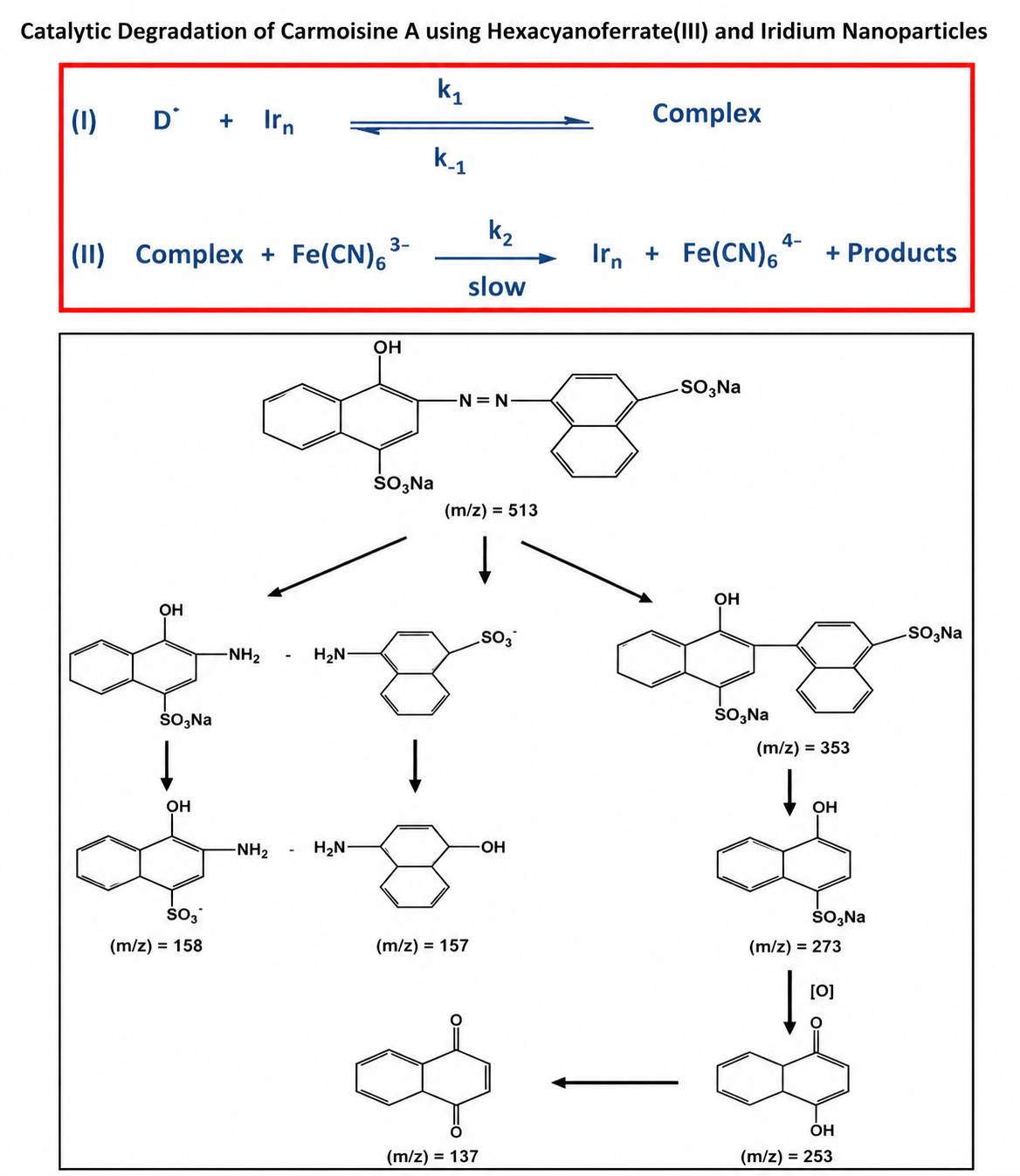
While it is challenging to propose a mechanism for such a complex reaction, experimental results and prior evidence allow us to suggest a mechanism for the aforementioned electron transfer reaction. This mechanism involves the binding of the substrate to the surface of Ir-nanoparticles (Irn), followed by its reaction with HCF(III) ions in the solution.
In scheme 1, it is assumed that in an alkaline medium, azo dyes exist as an anion, D, which forms a loosely bonded complex with iridium nanoparticles (Irn). This complex slowly reacts with HCF(III) ion, resulting in products along with Irn and Fe(CN)64-. It is reported that the metal ion complexing with the organic substrate makes the electron transfer easier[12]. The formation of the complex was also proved kinetically by the Michaelis-Menten plot, i.e., a non-zero intercept on the plot of 1/rate versus 1/[Substrate] (Fig. 8, Fig. 9)
Scheme 1 leads to the following rate law in terms of the rate of disappearance of substrate concentration. According to the step (II), the rate of disappearance of substrate concentration would be:
r = - d[D-] /dt = k2 [Complex] [HCF(III)](4)
From steps (I) and (II), the rate of formation of the complex will be:
d[Complex] /dt = k1 [D-] [Irn] – k-1[Complex] - k2[Complex][HCF(III)](5)
The complex formed in step (I) of scheme 1 is short-lived. In step (I), it is formed, while in step (II), it it may decompose into the final product. It is also possible that the complex may dissociate into Ir nano and dye anion. Thus, the overall concentration of the complex in the reaction mixture remains constant. Hence, steady state treatment can be applied to its concentration. Thus, applying the steady state treatment to the concentration of the complex:
d[Complex] /dt = 0
From equation (5) :
[Complex] = (6)
During the reaction, the [Irn]T (total iridium concentration) will be-
[Irn]T = [Irn] + [Complex](7)
Now substituting the value of [Complex] from equation (6) into equation (7):
[Irn]T = [Irn] + (8)
Now multiplying equation (8) on both sides by k-1 + k2 [HCF(III)]:
[Irn]T {k-1 + k2 [HCF(III)]}= {k-1 + k2 [HCF(III)]} [Irn]+k1[D-][Irn]
[Irn] = (9)
Now substituting the value of Irn from equation (9) into equation (6)
[Complex] = (10)
Substituting the value of [Complex] from equation (10) into equation (4):
-d[D-]/dt = (11)
Thus, equation (11) is the derived rate law based on the above-said mechanism. The rate law shows pseudo-first order kinetics with respect to Irn as well as retarding trend with respect to HCF(III) and [D-].
3.1.7. Verification of rate law
It would be expedient at this stage to explain the experimental finding in the case of oxidation of the aforementioned organic substrate based on the proposed mechanism in the following lines by making some probable assumptions.
At very low concentrations of HCF(III) ions and organic substrate, the values of k2[HCF(III)] and k1[D-] will be quite small. Hence, neglecting these factors in the denominator, equation (11) reduces to :
-d[D-]/dt = (12)
Equation (12) clearly accounts for the first-order kinetics with respect to [HCF(III)], [D-] and the catalyst at their lower concentration. Equation (11) at constant [Irn]T becomes :
-d[D-]/dt = (13)
For the verification of the rate law at higher concentration, equation (13) can be written as :
1/rate = (14)
According to equation (14), plots of 1/rate versus 1/[substrate], 1/rate versus 1/[HCF(III)] were found linear. Such plots are presented in Fig. 8 and Fig. 9. A close examination of these figures indicates that these are straight lines with a positive intercept at 1/rate axis, showing the validity of the derived rate law equation based on the proposed mechanism.
3.2. Product Analysis
Carmoisine A displays maximum absorption at 515 nm due to the chromophore containing an azo linkage within the dye molecule in solution[18]. Its UV-vis spectrum reveals a broad absorption band at this wavelength. As shown in Fig. 10, the intensity of the 515 nm band, which serves as the primary site for oxidative attack[19] significantly diminished over time. Additionally, the emergence of new bands at 250 and 268 nm indicates the degradation of Carmoisine A by HCF(III) ions.
The HPLC chromatograms of Carmoisine A and its degradation products provide further confirmation of the dye’s degradation. Fig. 11(a) displays a single prominent peak corresponding to Carmoisine A with a retention time of 1.492 minutes. However, this peak is absent in the HPLC elution profile of the degradation products. Instead, two new peaks with retention times of 1.939 and 3.603 minutes appear in Fig. 11(b), indicating the formation of two major degradation products. The mobile phase used for the analysis consisted of methanol, water, and acetonitrile in a 25:50:25 ratio.
LC-MS analysis identified four degradation products of Carmoisine A which are smaller, less hazardous molecules with low molecular weights. These compounds exhibit mass-to-charge (m/z) values of 353, 223, 159, and 157. The possible structures of these degradation products are provided in Table 2,
aligning with the LC-MS spectra shown in Fig. 12.
3.3. Proposed degradation pathway of Carmoisine A
Scheme 2 illustrates the proposed mechanism for the degradation of Carmoisine A, following two distinct pathways. In the first pathway, the formation of an aromatic amine is observed [20]. Meanwhile, the second pathway suggests that a nucleophilic attack by water leads to the breakdown of the dye molecule, resulting in the formation of naphthoquinone [21]. Additionally, it is proposed that the initial step involves the release of molecular nitrogen, leading to the formation of 3-Naphthyl-4-hydroxy naphthalene sulfonic acid.
4. Conclusion
This study successfully demonstrates the optimized degradation of the azo dye Carmoisine A using hexacyanoferrate(III) as an oxidizing agent, both in the absence and presence of iridium nanoparticles. The kinetic analysis confirms that key factors such as solution pH, concentrations of Ir-nanoparticles, HCF(III), and dye significantly influence the degradation rate. The order of reaction with respect to HCF (III) is one at its lower concentration, tending towards zero at higher concentration. The reaction follows first-order kinetics with respect to the concentration of Carmoisine A and iridium nanoparticles The presence of Ir-nanoparticles an enhanced the reaction efficiency as they demonstrated enhanced degradation rate as compared to the iridium precursor, thus accelerating the oxidation process. Analytical techniques, including UV-vis, HPLC, and LC-MS, confirmed the formation of simpler, less hazardous degradation products, viz. 4-Hydroxy naphthalene sulphonic acid, 3- Naphthyl- 4-hydroxy naphthalene sulphonic acid, 1-Hydroxy-2-amino naphthalene, and 1,4-Naphthoquinone. Based on experimental findings, a plausible electron transfer mechanism was proposed and validated through the derived rate law.
In the present method, the concentration of HCF(III) used to degrade Carmoisine A is 10 times less than that of the dye concentration, while in the reported Fenton oxidation method, the concentration of oxidant is the same or more than that of the dye concentration. Thus, the present method seems to be better than other conventional methods due to its low cost, easy availability, and effectiveness. After degradation of the dye HCF(III) converts into HCF (II), which is non-toxic and is used in food industries for metal precipitation.
This approach demonstrates strong potential for breaking down complex organic molecules into simpler forms. Azo dyes, which constitute a major pollutant in textile effluents, can be transformed into less harmful, smaller molecules. The study highlights the potential industrial applicability of this approach for wastewater treatment, particularly in textile industries where azo dyes are major pollutants. Given its efficiency, cost-effectiveness, and scalability, this technique provides an environmentally friendly solution for the degradation of organic pollutants. Furthermore, the catalytic oxidation process can be extended to other hazardous substances, making it a promising alternative for broader environmental remediation applications.
List of Abbreviations
HCF(III)—hexacyanoferrate(III);
PVP—polyvinylpyrrolidone;
Ir-nano— Iridium nanoparticles;
(da/dt)i—initial degradation rate of Carmoisine A;
Ea– activation energy;
ΔH# —enthalpy of activation;
ΔS# entropy of activation;
ΔF #—free energy of formation;
HPLC — High performance Liquid Chromatography;
LC–MS—liquid chromatography and mass spectroscopy
Acknowledgements
The authors express their gratitude to Gurukul Kangari (Deemed to be University), Haridwar for providing the essential facilities that supported this research.
Conflict of Interest
The authors declare no conflict of interest.
Funding
This study was not supported by any funding.
Author’s Contributions
Study Conception or Design: RL; AG
Data Acquisition: RL
Data Analysis or Interpretation: RL; AG
Manuscript Drafting: RL
Critical Manuscript Revision: RL; AG
All authors have approved the final manuscript and are responsible for all aspects of the work.
AI Statement
The authors confirm that no AI tools or services were used during the preparation of this work.
