
Document Type : Original Research Paper
Graphical Abstract
Highlights
1. Introduction
The development of many significant technologies in the areas of optical science, electronic devices [1], wastewater treatment [2,3], medical science, mechanical engineering [4], chemically produced industry, nonlinear optical equipment, catalytic processes, space industries, energy sources science, and photoelectrochemical uses depends on nanotechnology, which uses nanoscale structures. Their smaller sizes, large surfaces with dangling free bonds, and more reactivity than their bulk counterparts provide them with special and fascinating features. Due to the emergence of efficient green synthesis methods that utilize natural reducing, capping, and stabilizing agents rather than expensive, energy-intensive [5], and hazardous chemicals, researchers are now increasingly interested in biological techniques. Eco-friendly synthesis techniques [6] for metal-based nanoparticles have garnered significant attention over the last decade. Green synthesis methods, in contrast to traditional physicochemical methods, employ non-toxic chemicals, produce less hazardous waste, and produce biocompatible nanomaterials with minimal ecotoxicity [7]. In many plant species, zinc deficiency lowers development and prevents photosynthesis, manifesting as chlorosis and white necrotic patches on leaves. Many environmental issues, like pollution, chemical leaching, fertilizer loss, and so forth, can be successfully resolved with zinc oxide nanofertilizer [8,9]. Nanoparticles (NPs) are being produced at an exponentially higher rate worldwide. Optics, electronics, energy production, materials science, medicine, and the biological sciences are just a few of the fields that employ them. Engineered nanoparticles’ effects on plants depend on a number of variables, including the nanoparticles’ size, concentration, content, and other chemical and physical characteristics, as well as the type of plant. Due to rapid population expansion, there has been an increased focus on improving food sources and crops. As a result, there is a growing need for natural products for energy, food, medicine, and other biotechnological applications [10]. One of the micronutrients that plants require in large amounts is zinc. When it comes to enzymes, zinc is either their primary component or a cofactor. Pollen function, germination, fertilization, and the synthesis of chlorophyll all depend on zinc oxide nanoparticles, or ZnO NPs [11]. Several chemical and physical techniques are employed in the synthesis of nanoparticles (NPs), which have higher production rates and precisely regulated size and form. The usage of hazardous compounds as precursors and production processes is the approach’s limitation, with significant waste production, energy loss, and high costs [12]. On the contrary, the green route of NPs’ synthesis provides an eco-friendly, low-cost, sustainable, and safe way. Different natural resources were used in NPs’ green synthesis, including microorganisms and plant extracts [13]. Green synthesis is mainly based on biological precursors but is also controlled by other reaction parameters such as pH, time, solvent, temperature, and pressure. Biological extracts have various effective phytochemicals such as ketones, aldehydes, phenols, flavones, terpenoids, amides, carboxylic acids, and ascorbic acids that help in metal/metal oxide NPs’ synthesis [14]. While several studies have reported the synthesis of zinc oxide nanoparticles via chemical and physical methods, these often involve hazardous reagents, high energy consumption, and environmental concerns. Green synthesis methods employing plant extracts have gained attention for their eco-friendliness and sustainability; however, the use of date seed extract — an abundant agricultural biowaste in the Middle East — remains largely unexplored. Furthermore, few studies have applied green-synthesized ZnO nanoparticles for the targeted removal of chemical oxygen demand (COD) from real oil-field wastewater. This research addresses these gaps by developing a sustainable synthesis method for ZnO NPs using date seed extract and demonstrating their application in efficient COD removal from contaminated water collected from the Siba oil field in Basra, Iraq. The approach not only valorizes agro-waste but also offers a cost-effective, environmentally friendly solution with promising potential for industrial wastewater treatment.
The applications of green-produced nanoparticles in molecular sensing, optical imaging, biomedical diagnostics, catalysis, antibacterial, and biological system labeling were explored. Food waste, tires, building debris, electronics, plastics, industrial sludges, and other wasted materials are all considered solid waste. In developing nations, where over 90% of waste is burned or dumped in the open, solid waste has detrimental effects on people’s health [15]. Utilizing this biodegradable trash as a raw material for green synthesis is one of the most crucial ways to dispose of it after recycling. It is a cheap, readily available, sustainable, and renewable resource with typical wealth [16]. Earlier studies on the synthesis of different NPs using waste products like eggshells, groundnut shells, tamarind shells, human hair, tea waste, marine waste, algal extract, and slaughterhouse waste were published. In addition to Functional polymer resins and activated carbon from agricultural wastes, mixed with magnetite nanoparticles, are used for the adsorption of p-toluenesulfonic acid [17,18] and removal of p-nitrophenol [19]. The waste products included mango peel [20], orange [21], onion[22], pomegranate[23], sapota [24], rice husks [25], watermelon rind [26], and coconut coir [27,28]. Reactive oxygen species (ROS) such as superoxide anion (O2-), hydrogen peroxide (H2O2), and hydroxyl radicals (.OH) are produced in excess by zinc oxide nanoparticles (ZnO NPs) in the cell. As a result, it is established that ZnO NPs can inhibit a wide variety of microorganisms, making them an antibacterial agent. With applications in biology, biomedicine, the environment, industry, agriculture, and food, zinc oxide nanoparticles (ZnO NPs) were created using extracts of pineapple, Musa acuminata, longan (Dimocarpus longan Lour) seeds, and peels from dragon fruit (Hylocereus polyrhizus) [28-31]. Date seeds (DS), the most plentiful biomass, can be used to synthesize nanoparticles (NPs) at a low cost and with minimal environmental impact. This approach has the potential to address the issue of pollution. Furthermore, a variety of NPs could be produced on a massive scale using biomass. This process is a good substitute for physicochemical methods, which are more costly, need additional equipment, and may have harmful and disastrous impacts on the environment when it comes to the synthesis of nanoparticles. This research aims to use biodegradable wastes (date seeds) to synthesize ZnO NPs in an environmentally friendly manner. ZnO NPs were confirmed to have formed, and their size, shape, and surface charge were ascertained through characterization using a variety of methods, including ultraviolet–visible spectrophotometer (UV–VIS), X-ray diffraction (XRD), and Fourier-transform infrared (FTIR) spectroscopy. The antibacterial properties and exceptional UV absorption effectiveness of zinc oxide nanoparticles (ZnO NPs) make them one of the most widely used nanomaterials in consumer goods (food packaging and sunscreens). Consequently, it is necessary to evaluate the risk of ZnO NPs to human health and synthesize them in a sustainable, easy, and environmentally friendly manner [32]. In addition, green-synthesized ZnO NPs from the waste extract of date seed.
2. Materials and methods
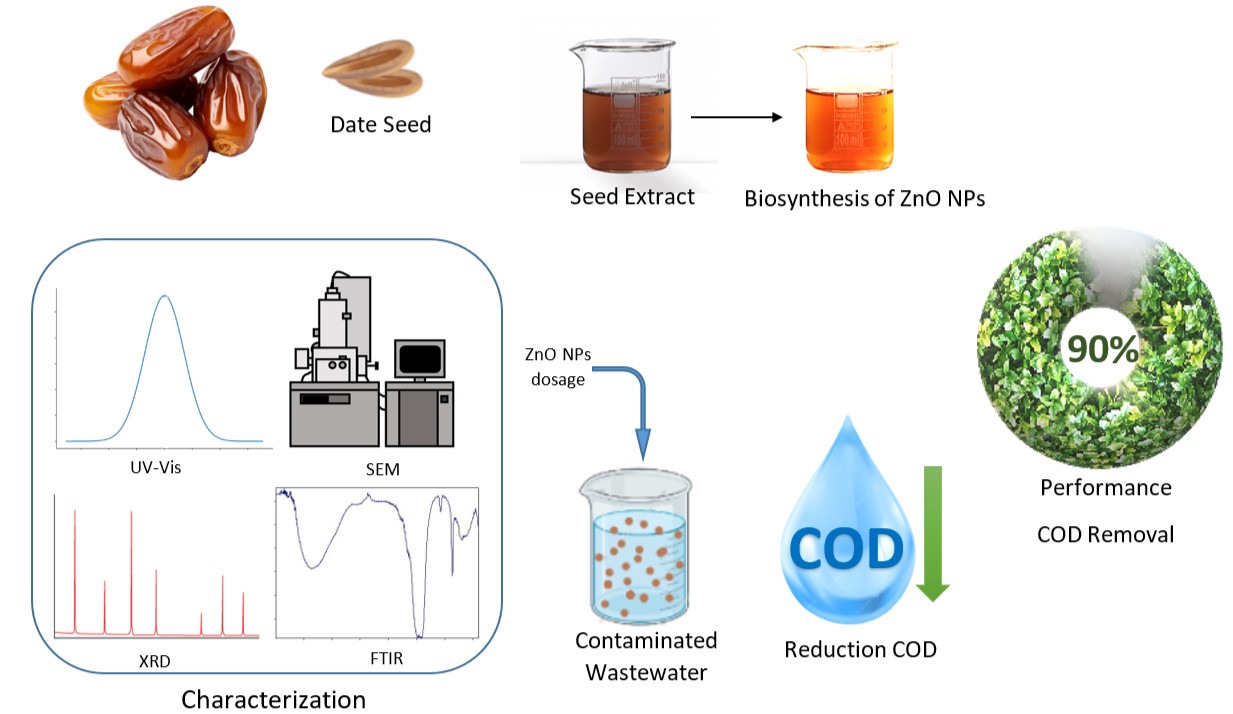
Fresh dates were purchased from a local shop; date seeds were collected and ground using a grinder. As shown in Fig. 1, in a flask, put 5 gm of date seed powder in 50 ml of distilled water. boiled for 10 min, filtered, and then cooled down at room temperature . Finally,, we obtained date seed extracts. Next, put 5 gm of Zn(NO₃)₂into the extract. The mixture was heated at 70°C for 1 hr. on a magnetic stirrer until the appearance of precipitates. Then put the mixture in the nanofiltration to filter the mixture, then put the filter paper in the vacuum oven at 60°C for 2 hr. When the paper has dried, take the mixture from it and grind it.
2.1. Experimental studies
Statistical design of experiments and data analysis (Design Expert Software), statistician, Ease Inc., Minneapolis, Minnesota, USA, and centralized instrument design (CCD) using response surface methodology (RSM) were used to study three different factors: (A) sorbent concentration, (B) pH dosage, and (C) sorption time [33]. Responses and factors are two groups of variables employed in the optimization process, and the program was used to create graphs and compute effects using an analysis of variance [34]. A straightforward way to choose the best practical experiments is to build a set of tests using the response surface approach in many chemical and physical processes. Three process variables—solution pH, adsorbent dosage, and adsorption time—were connected to the procedure and optimized for the reduction of COD in this work. The pH ranged from 6 to 10, the adsorbent concentration ranged from 10 to 50 mg/L, the reaction time went from 60 to 120 minutes, and the initial generated water concentration was set at 100 ppm. As indicated in Table 1, the study employed three levels and three variable components: minimum (-1), average (0), and maximum (+1). The data specifics for each of the 20 runs are shown in Table 2 [35].
2.2. Characterization
2.2.1. Fourier-Transform Infrared (FTIR) Spectroscopy
The infrared spectrum of the synthesized zinc oxide nanoparticles (Fig. 2) shows the presence of several functional groups derived from zinc precursors, as well as phytochemicals present in the date seed extract. These groups act as stabilizing and reducing agents throughout the manufacturing process. The broad absorption band at approximately 3400 cm¹, which exhibits O–H bond stretching vibrations, indicates the presence of hydroxyl groups. The presence of peaks at 2920.6 cm¹ and 2851.9 cm¹ indicates the presence of organic residues from the plant extract, attributed to asymmetric and symmetric stretching vibrations of C–H bonds, which are typically found in aliphatic hydrocarbons. The absorption band at 1651.07 cm⁻¹ indicates the presence of molecular stretching of water or the C=O bond in the amide groups and is associated with H–O–H bond bending vibrations. The two strong bands at 1383.62 cm⁻¹ and 1555.89 cm⁻¹ indicate the presence of amine or amide groups, which may be produced by proteins present in the date seed extract and are often attributed to C–N bond stretching and N–H bond bending. Notably, the formation of ZnO nanoparticles is confirmed by the clear signal at 459.47 cm⁻¹, which is attributed to Zn–O bond stretching vibrations. Additional peaks, including 782.65 cm⁻¹, 629.01 cm⁻¹, and 1090.25 cm⁻¹, may exhibit lattice modes of the Zn–oxygen bond and tensile vibrations of the C–O–C bond, confirming the successful production of ZnO. As evidenced by the presence of organic functional groups, these results demonstrate that the biomolecules in the date seed extract stabilize the generated nanoparticles by coating their surfaces, in addition to reducing zinc ions.
2.2.2. XRD
The XRD pattern of the as-prepared sample showed sharp, distinct peaks at 2θ ≈ 31.7° (100), 34.4° (002), and 36.2° (101), which are almost identical to the standard values for the hexagonal wurtzite ZnO phase (JCPDS card no. 36-1451). The characteristic large peaks of hydrozincite, such as the two peaks at approximately 14.5° and 28.9°, were not observed, indicating that any potential carbonate-hydroxide phase is present, if present, in small amounts. The absence of these peaks, along with the dominance of ZnO reflections, confirms that the product is mainly composed of crystalline ZnO. The use of date seed extract as a reducing and stabilizing agent likely contributed to the reduction of secondary phases.
2.2.3. FESEM & EDX
Fig. 4(A) shows the FESEM image captured at a magnification of about 100,000× of the surface morphology of the synthesized zinc oxide (ZnO) nanoparticles using zinc nitrate and date seed extract through a green synthetic procedure. The image displays a cluster of nanostructures that are made up of irregular-shaped crystallites that have rough surfaces and distinct hexagonal facets belonging to the wurtzite ZnO phase. The nanoparticles have a porous three-dimensional structure that consists of small crystallites. Their size is estimated to be about 20 to 80 nm. The development of this hierarchical configuration results in a large specific surface area, which is highly useful for environmental applications like wastewater treatment. The image indicates high porosity and surface roughness. These qualities arise from the organic compounds in the date seed extract. The organic compounds are polyphenols and sugars. They play a role as a reducing and capping agent. The agents are beneficial in the synthesis process. It is the reason for heterogeneous nucleation plus growth. The processes are taking place in ZnO nanostructures. The structure indicates the possibility of increasing its adsorption and photocatalytic abilities due to the availability of active surface sites and a porous structure.An Energy Dispersive X-ray Spectroscopy (EDX) was performed on the synthesized ZnO nanomaterial using a Scanning Electron Microscope (SEM), which is coupled with an X-ray.The sample was prepared using zinc nitrate and date seed extract as a natural, green synthesis agent. When measuring at 15.0 kV and a beam current of 800 pA and a live time of 11 seconds, an analysis type of ‘standardless’ was chosen with a correction method of PAP (Phi-Rho-Z). The spectra were sampled with several channels of 1024 with an energy range of 0–10 keV and an energy per channel of 10 eV. The study of the sample-specific compositions that comprise zinc and oxygen shows the formation of high-purity zinc oxide. The Zn to O stoichiometric ratio is almost equal to 1, which suggests the ZnO structure is designed. EDX Spectrum Image: The recorded EDX spectrum shows sharp peaks corresponding to Zn and O. The spectrum displays strong and well-defined peaks at the characteristic energies of Zn and O. This signal indicates the purity and successful formation of ZnO.Based on the results, the synthesized nanomaterial clearly contains predominantly ZnO material; uniquely, it shows high purity, which means no contaminants were detected. It shows that zinc nitrate and date seed extract are effective for green synthesis.This material may have potential use in the field of nanotechnology.
2.3. Produced water characterization
The Siba field in Basra, southern Iraq, provided a sample of tainted generated water with a density of 1.2 g/cm³ and a pH of 5.5. Before the effluent was released into the environment, a significant number of organic contaminants had to be eliminated because it had high levels of chemical oxygen demand (COD), as shown in Table 4 .TSS levels in the wastewater sample were higher (485 mg/L), suggesting a high amount of total suspended solids. Therefore, a high COD indicates that there are many total dissolved solids in the wastewater that are chemically oxidizable. We added a TDS of 172891 mg/L. The COD level was 1658 mg/L, and the pollutants were measured at the Environmental Research Center at the University of Technology.
3. Results and Discussion
3.1. Regression model equation
The inverse regression method was used to model the experimental data for COD elimination in order to include only significant features in the models. Design-Expert 7.0.0 automated this procedure. The COD elimination (response) model was built using the following parameters, which were encoded as a second-order quadratic polynomial equation: B is the sorbent dose (mg/L), C is the contact period (min), and A is the pH.
In the proposed model, positive signals indicate a rise in the COD Reduction ratio brought on by these factors, while negative signals indicate a decrease in the response. Examine equations 1 and 2.
Coded equation
Reduction%=+78.53-13.21*A-12.11*B+3.90*C -2.78*AB+2.92*AC+0.0433*BC-19.19*A2+5.50*B2 -12.74*C2 +3.90*C-2.78*AB+ 2.92*AC+0.0433*BC -19.19 *A2 + 5.50 *B2 -12.74 * C2(1)
Actual equation
Reduction % = -252.92463+ 67.84701 *ph -0.879290*dose +2.28687 *time – 0.069596 *ph * dose + 0.048723 *ph* time + 0.000072 * dose * time – 4.79677 *ph2 + 0.013738 * dose2 – 0.014160 * time 2(2)
Because these constraints accelerate the rate of Reduction, a negative value associated with the sorbent dosage (C) and solution pH (B) has a negative effect. The adsorption capacity of %COD, on the other hand, is positively impacted by them if the value associated with the time content (c) is positive.
3.2. ANOVA analysis
ANOVA findings obtained from CCD are used to evaluate the model’s appropriateness and significance, as indicated in Table 5.
In this instance, A2, B2, C2, AB, AC, and BC are the important model terms. The models’ validity was assessed using the regression coefficients (R2), adjusted R2, and R2, which were 0.9893, 0.9796, and 0.9440, respectively. These findings suggest that there is a lot of experimental data to take into account.
To ascertain whether a chosen model offers a reliable approximation of an actual experimental system, diagnostic plots are utilized. A plot of the actual and anticipated COD data is presented in Fig. 5 demonstrating the relationship between the obtained values and the predicted model response values. The points have a linear behavior, are reasonably close to one another, and show a decent fit between the obtained and actual data. The second-order quadratic polynomial model is significant and appropriate for predicting and optimizing the independent variables within its designated range, as shown by all charts.
3.3. One factor and interaction plots:
The most significant element influencing and regulating the adsorption process is the adsorption factor. The COD Reduction effectiveness in relation to the pH of the solution is displayed in Fig. 7 (A). The highest COD reduction of 90% was attained at pH 8.0. As the pH rose from 6 to 8, the COD Reduction effectiveness rose from 62.8% to 90%.
This is probably because the positively charged zinc oxide and the anionic species in the waste have a significant electrostatic attraction that leads to strong adsorption and, ultimately, more favorable effluent breakdown. The highest COD Reduction effectiveness, however, was 90.0% at pH 8. Additionally, because of the high antagonism between the waste species and zinc oxide, the clearance percentage (%) decreased when the pH rose above 9 [36].
ZnO performs better at removing COD in basic environments than in acidic ones because it has a highly reactive hydroxyl radical or hole with OH [37,38].
The net surface charge on the ZnO particle surface is represented by the zeta potential values depicted in Fig. 6. The point of zero charge (pzc) was determined via the salt method. Eleven conical flasks were prepared, each containing 30 milliliters of sodium chloride solution (0.02 milliliters) with pH values ranging from 2 to 12. [39] Subsequently, it was titrated with 0.1 N NaOH and HCl, followed by the introduction of 0.3 g of the nano-absorbent material. It was thereafter stirred for 24 continuous hours at 25°C. The initial pH was determined using a pH measuring device. [40] After a day of equilibration, the solutions were filtered using filter paper, and the final pH was determined. The iron particles had a pHpzc of 7 ± 0.1. The surfaces of the produced nanoparticles exhibited a negative charge above the isoelectric point, and chemical and electrostatic interactions partially facilitated the removal of COD. [41] The positively charged surfaces of the clusters resulted in reduced COD adsorption below the pHpzc. Nonetheless, an inner-sphere complex formation process through surface deprotonation enabled the core-supported zinc nanoparticles to selectively adsorb cations from COD-contaminated water, even at pH levels well below the zero charge point. The clusters generated in an aqueous saline solution have a porous architecture, as illustrated in Fig. 6, characterized by high sphericity, minimal or only smooth edges, and a polished surface texture. This aligns with the characterization of amorphous particles, typically composed of spherical, submicroscopic entities that aggregate to create an irregular mosaic[42].
Since dosage affects the whole cost of water treatment, it is a crucial factor. To eliminate the chemical oxygen demand (COD), a ZnO NPs dose ranging from 10 to 50 g/L was used, as illustrated in Fig. 7 (B). The existence of functional groups on the date waste’s surface enhanced its ability to adsorb organic contaminants. Zinc oxide was used to illustrate the adsorption of COD in wastewater. 90% of the COD was removed at a dosage of 10 g/L. The elimination of COD was shown to decrease from 73.2% to 55.6% as the dosage of the ZnO NPs rose from 10 to 50 g/L. This demonstrates that when the sorbent dosage surpasses 10 g/L, the effectiveness of COD Reduction significantly declines.
The lack of new adsorption sites as a result of the ZnO NPs' surfaces being saturated with organic matter, the medium’s turbidity, which prevents radiation from reaching the ZnO NPs, the agglomeration of higher doses of ZnO NPs, and the electrostatic repulsion of the ions of the absorbed ZnO NPs are the reasons why the COD Reduction efficiency decreased as the sorbent dosage increased. However, it seems that maximum adsorption can be achieved with a modest amount of the adsorbent [43].
The COD elimination efficiencies (60–120 min) at various contact times are displayed in Fig. 7 (C). The maximum COD elimination rate of 90% was attained after 120 minutes. As contact duration increased from 90 to 120 minutes, COD elimination rates dropped from 78% to 68.3%. ZnO NPs with more accessible surface locations could be the cause of this. The adsorption rate dropped and stayed the same after 60 minutes of contact time. The possibility of organic pollutants physically adhering to the surface or saturating the chemisorption active sites is increased by the decreased adsorption rate and ensuing equilibrium, demonstrating that time had a negligible impact [44].
The study found that the optimal COD reduction rate (90%) was achieved at pH = 8, which is close to the actual conditions for industrial water treatment, reducing the need for acidity adjustment. This is due to the compatibility between ZnO nanoparticles and organic pollutants, where electrostatic repulsion or attraction enhances adsorption efficiency.
Found that COD reduction efficiency decreased as the dosage of nanomaterials increased above 10 g/L. This suggests that increasing the amount of nanomaterial doesn’t necessarily increase efficiency. The study emphasizes the importance of optimal utilization of nanomaterials to reduce operating costs and prevent material loss, demonstrating that environmentally friendly ZnO can achieve high performance even at low dosages.
The 120-minute contact time of adsorption technology indicates adsorption equilibrium, enabling the design of continuous or batch treatment processes. This reasonable treatment time allows for integration into industrial treatment systems without affecting flow rate or plant capacity.
3.4. The combined effect of variables on COD Reduction
Using a CCD device to assess the COD Reduction effectiveness on the ZnO NPs, three-dimensional contour plots of the solution surface were created in order to ascertain the interactive influence of factors. According to the graphs, the primary variables influencing the COD Reduction efficiency were the sorbent dosage, contact time, and pH. After a set contact period of 90 minutes, the relationship between pH and ZnO/nanopodium dosage is depicted in Fig. 8 (A), where notable peaks were seen. Adding date seed/ZnO and raising the aqueous solution’s pH from 6 to 8 increased the COD Reduction effectiveness. The elimination of COD is significantly impacted by pH.
At pH 6, the elimination of COD was 62.8%; this percentage increased to 8. The greatest COD elimination of 90% was attained at pH 8, suggesting that freshwater micro pollutant interaction was best at near-neutral pH [45].
The effect of simultaneous pH and contact time modifications is depicted in Fig. 8 (B), which uses fixed variables such as the sorbent dosage of 90 mg/L to highlight the link between pH and contact time. The findings demonstrate that when the pH value dropped, yet somewhat increased, high COD Reduction efficiency was attained with longer precipitation times. As the pH level drops to the optimal range (6–10) needed for the adsorption process [46] , positive charges often predominate on the surface of the active particles, resulting in the formation of colloids and the elimination of pollutants [47]. These findings align with those of Poladjol and colleagues [48]. The association between date seed/zinc oxide dosage and contact time is depicted in Fig. 8 (C). At a dosage of 10 g/L of adsorbent and a contact time of 120 minutes, 90% of the COD was removed. The modest number of active adsorption sites was confirmed by the decrease in COD Reduction as the adsorbent dosage rose from 10 to 50 g/L.
The nanomaterial, prepared from date seeds, is highly efficient in treating oilfield water, despite low material consumption and moderate operating conditions. This environmentally sustainable method, based on locally available agricultural raw materials, offers a viable alternative to conventional COD treatment methods. The antimicrobial potential of ZnO also opens up potential applications in medical and industrial fields. Table 6. Shows a comparison of the previous study with this research, comparing the operation condition and COD reduction efficiencies.
It can be noted from the study that ZnO NPs made from date seeds offer the best performance in reducing COD under suitable conditions compared to other research.
3.5. Removal Process
COD removal was conducted randomly using an adsorbent (ZnO) and batch experiments in aqueous solution. Adsorption experiments were conducted at 100 rpm using a magnetic stirrer. We introduced fifty milliliters of petroleum-derived water, which had a known initial concentration of 100 mg/L, into a 100-milliliter beaker. At a controlled pH level (6–10), a specified mass of ZnO (10–50 mg/L) was introduced, with a contact duration of 60–120 minutes. Upon achieving equilibrium, the supernatant was subjected to centrifugation. A HANNA pH 9124 meter, manufactured in Woonsocket, Rhode Island, USA, was utilized to assess the solution’s pH level. The contaminant was subsequently treated with either 0.1 M sodium hydroxide or 0.1 M hydrochloric acid to modify the pH. Consistent sampling facilitated the equilibrium of the experiment. The fluid was centrifuged for fifteen minutes at 10,000 rpm. The COD content and percentage clearance were assessed utilizing an atomic weight device and equation (1) [49].
where Ci and Co are the initial and final concentrations of COD, respectively.
3.6. The mechanism for the reduction of COD
Utilizing the superior adsorptive properties of pretreated date pits with the catalytic and adsorptive characteristics of zinc ions or particles, a composite of zinc (Zn) and date pits might serve as an improved natural adsorbent for the elimination of chemical oxygen demand (COD) from polluted water. Date pits are initially processed through drying, grinding, and cleaning to produce a powder with a high surface area[50]. Researchers often subject date pits to physical or chemical treatments (e.g., thermal or chemical activation) to enhance the porosity and density of active functional groups on their surfaces—particularly hydroxyl (-OH) and carboxyl (-COOH) groups [51]. The surface is subsequently loaded with zinc ions or particles through physical immobilization, ion exchange, or impregnation. This enhances the surface’s chemical reactivity and its ability to engage with organic pollutants. Organic contaminants transfer from the aqueous medium to the surfaces and walls of the micropores during contact between contaminated water and the adsorbent (Zn-Date Seed). Adsorption occurs via two mechanisms: Physical adsorption occurs when organic pollutant molecules interact with polar groups on the date seed’s surface through hydrogen bonds and van der Waals forces [52]. Chemical adsorption occurs when zinc ions interact with functional groups in pollutants, such as amine or carbonyl, leading to the deposition of pollutants on the surface or the formation of coordination bonds [53]. In the presence of dissolved oxygen or other oxidants, zinc can facilitate the oxidation of contaminants. Such reactions may lead to the generation of reactive oxygen species (ROS), which assist in the degradation of certain organic compounds into smaller molecules, thereby reducing COD levels and enhancing their removal through adsorption. This method is efficient and economical for treating water contaminated with organic matter, as it lowers COD levels through a combination of chemical and physical adsorption on zinc-loaded date kernels, alongside the potential for partial oxidation of the pollutants [54].
3.7. Practical application and Reusability
This study examined the cyclic adsorption efficacy of ZnONPs. Upon concluding the COD removal procedure, the ZnO/DeEd particles were removed from the reaction mixture, subjected to four washings with distilled water and ethanol, dried at 60°C, and subsequently reused. Fig. 9 indicates that the nanoparticles attained a removal efficiency of 90% following four cycles of cyclic adsorption, with COD removal rates of 90%, 82.5%, 76.9%, 65.3%, and 50.89% under optimal conditions of pH = 8, adsorbent dosage = 10 mg/L, initial concentration = 100 mg/L, and duration = 120 min. The findings indicate that ZnO/DEED particles exhibit stability and reusability in the extraction of COF from oil effluent, and the incorporation of plant residues enhances their catalytic efficacy and provides beneficial adsorbent sites [55].
4. Conclusion
The current study investigates a cost-effective, environmentally friendly, and sustainable method for using date seed extracts to produce green ZnONPs. Several analytical techniques have demonstrated that this approach can also aid in waste management and recycling agricultural waste. FTIR analysis revealed the presence of important functional groups, such as hydroxyl groups, carboxylates, and phenolic compounds, responsible for the reduction and stabilization of ZnO nanoparticles. The crystalline nature of the resulting nanoparticles was verified through XRD patterns, which showed characteristic peaks consistent with the hexagonal wurtzite structure. Using the Debye-Scherrer equation, the average crystal size was determined to be in the nanoscale range. While EDX analysis confirmed the elemental composition and demonstrated the high purity of zinc and oxygen in the sample, FESEM images revealed the morphology of the ZnO nanoparticles, which appeared clustered but fairly homogeneous.A COD elimination model was developed to remove tainted water from the Siba field in Basra, Iraq. The model showed positive signals indicating a rise in the COD reduction ratio, while negative signals indicated a decrease. The adsorption factor was the most significant factor influencing the process. The highest COD reduction was achieved at pH 8.0, and the effectiveness increased with a pH rise. Zinc oxide (ZnO) performed better in basic environments than acidic ones. ZnO NPs in doses ranging from 10 to 50 g/L were used to eliminate COD. At a dosage of 10 g/L of adsorbent and a contact time of 120 minutes, 90% of the COD was removed. The best choice with the desired efficiency of 1 is depicted in Fig. 8. The best values of the independent variables acquired for the adsorption process were found using a numerical optimization technique. The suggested models are suitable and accurate since they agree with the experimental findings.All of these results support the efficiency of the green synthesis technique and demonstrate that it is possible to successfully synthesize zinc oxide nanoparticles with suitable structural properties and compositions. Future research will study the antibacterial activity of ZnO NPs. This green synthesis process opens up studies for scaling up ZnO NPs for different applications, such as environmental or medical research.
Recommended in future studies to obtain a more detailed characterization of the nanostructure and surface properties. Antibacterial activity tests using various pathogenic and antibiotic-resistant bacteria are also proposed, leveraging the known antimicrobial properties of zinc oxide, which could open the door to broad applications in the medical field as well as environmental applications.
Conflict of Interest
The authors declare no conflict of interest.
Funding
This study was not supported by any funding.
Author’s Contributions
Study Conception or Design: RMAM; SBK
Data Acquisition: RMAM
Data Analysis or Interpretation: RMAM; SBK; AA
Manuscript Drafting: RMAM
Critical Manuscript Revision: RMAM; SBK; AA
All authors have approved the final manuscript and are responsible for all aspects of the work.
AI Statement
The authors confirm that no AI tools or services were used during the preparation of this work.
