
Document Type : Original Research Paper
Graphical Abstract
Highlights
1. Introduction
The rapid growth of industrial activities and population growth has intensified global environmental contamination, with inadequate waste management posing significant risks to ecosystems and human health through air, water, and soil [1, 2]. Among the most disturbing pollutants are heavy metals, such as copper(II) ions, which accumulate in wastewater from mining, electroplating, textile production, and battery manufacturing [3–5]. Despite the essential biological role of copper, excessive exposure can lead to severe organ damage [6, 7]. For this reason, the United States Environmental Protection Agency (US-EPA) has set a tight limit of 1.3 ppm for Cu²⁺ in drinking water [8]. Heavy metals can be removed using standard techniques such as ion exchange, membrane filtration, and chemical precipitation [9–11]. But they suffer from restrictions involving high operating costs, sludge formation, and ineffectiveness at low metal concentrations. On the other hand, adsorption is remarkable for being easy to employ, inexpensive, and versatile, especially when using novel adsorbents, such as metal-organic frameworks (MOFs) [12–16].
MOFs are structures that combine organic ligands with metal ions, and their primary characteristics encompass significant porosity, a large internal surface area, customizable pore sizes, and the capacity for easy functionalization for enhancing interactions with guest molecules. They are currently gaining attention as outstanding adsorbents for the treatment of water owing to their flexible porosity, adaptability, and enormous surface area [17–20]. In particular, the chromium-based MIL-101 (Cr-MOF) received consideration due to its outstanding chemical stability in water, wide pore capacity, and exceptional stability [21]. Furthermore, MIL-101(Cr) remains stable when exposed to different solvent treatments and humid air [22]. In several different industries, MIL-101 has been one of the most investigated and used MOFs, such as in drug administration, adsorption, detection, catalysis, sensors, and others, because of its special qualities [23]. Recent studies have demonstrated that functionalized MIL-101 using either post-synthetic modification or pre-synthetic modification produces new physical and chemical properties that enhance its adsorption capacity for diverse targets, including dyes, pharmaceuticals, and heavy metals [21, 24–28]. For example, tetraethylenepentamine (TEPA)-modified MIL-101 achieved a notable rise in the adsorption capacity for uranium(VI) (350 mg g-1) compared to pristine MIL-101 at pH 4.5 [29]. In another report, Rastkari and his colleagues constructed TEPA-MIL-101 via TEPA grafting to adsorb several heavy metals from aqueous solution. The adsorption capabilities of the synthesized TEPA-MIL-101 for Pb(II), Cd(II), Cu(II), and Co(II) from aqueous samples were 227.5, 221.4, 217.7, and 215.6 mg g-1, respectively. These values were more than eight times MIL-101’s adsorption capacity on average [27]. Furthermore, Han et al. synthesized a polyethylene glycol-functionalized Fe3O4@MIL-101(Cr) with maximal adsorption capacities for As(V), Zn(II), Ni(II), Cd(II), and Pb(II) of 60.27, 45.06, 38.48, 62.29, and 72.18 mg g-1, respectively [30].
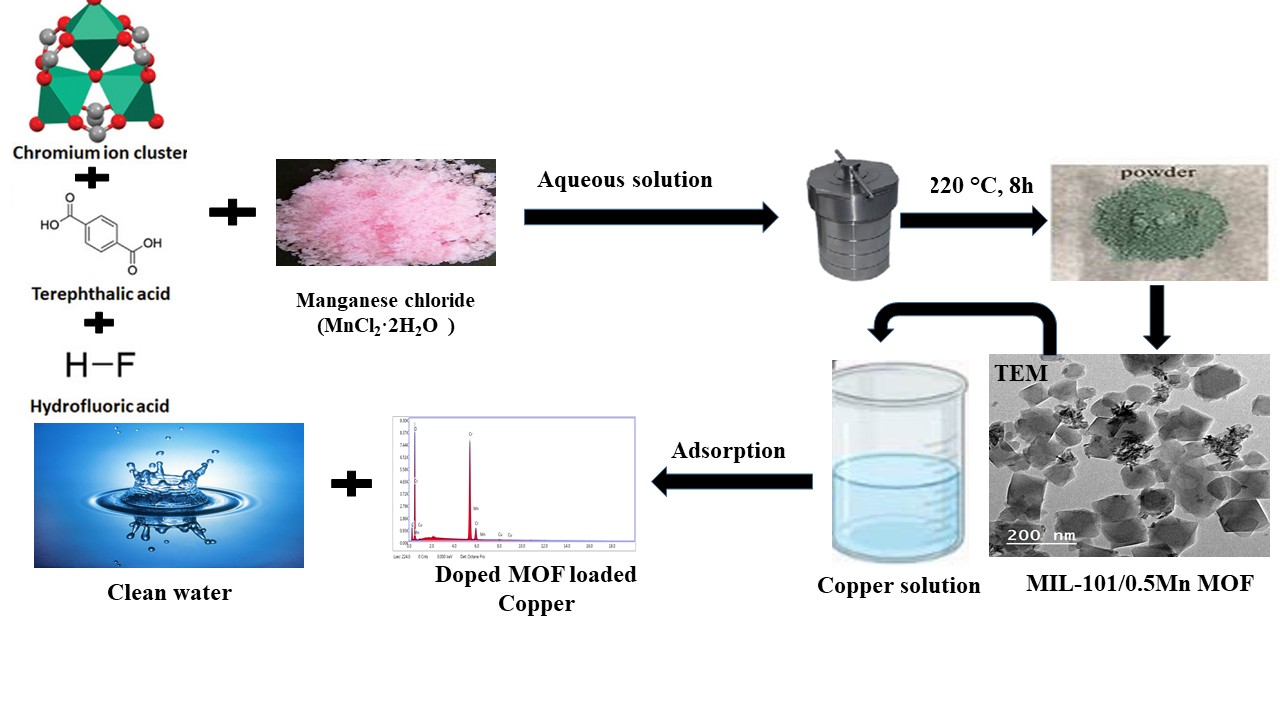
In this study, a novel manganese-doped MIL-101 MOF was developed to enhance its efficiency and applicability for the removal of heavy metals from wastewater. For the first time, manganese ions were incorporated into the MIL-101 framework via a pre-synthetic (in situ) doping approach using two different molar ratios, resulting in MIL-101/0.25Mn and MIL-101/0.5Mn MOFs. The incorporation of Mn ions improved the MOF’s chemical and physical characteristics by increasing the number of active sites, surface area, and pore volume, thereby significantly enhancing its adsorption performance. The adsorption behavior of MIL-101/0.5Mn toward copper ions was systematically studied through isothermal, kinetic, and thermodynamic analyses. Additionally, the influence of coexisting ions was evaluated to assess selectivity, and the reusability and efficiency of the material were tested using real water samples. To the best of our knowledge, this is the first report on the synthesis and application of manganese-doped MIL-101(Cr) for copper removal from aqueous solutions.
2. Materials and Methods
2.1. Chemicals
All materials utilized were analytical grade, acquired commercially, and utilized without additional purification. Terephthalic acid (TPA) and sodium diethyl dithiocarbamate (DDTC) were obtained from LOBA Chemie Co. (India). Cr(NO3)3·9H2O was obtained from Panreac Quimica S.A. Co. (Spain). MnCl2·2H2O and CuSO4·5H2O were purchased from Chemische-Fabrik Co. (Germany). N, N-dimethylformamide (DMF), hydrofluoric acid (HF), hydrochloric acid, sodium chloride, citric acid (CA), and sodium hydroxide were acquired from El Nasr Pharmaceutical Chemicals Co. (Egypt).
2.2. Instruments
The details of the instrumentation are in the supplementary information file.
2.3. Synthesis of MIL-101 and MIL-101/Mn MOFs
The MOF of MIL-101 was synthesized via a one-pot hydrothermal method, using chromium salt and TPA. First, TPA (2.5 mmol) and Cr(NO3)3·9H2O (2.5 mmol) solutions were prepared individually in a distillation.. H2O at ambient temperature using magnetic stirring [31]. The two solutions were mixed and heated for 2 h, then HF (0.2 mL, 1 mmol) and 0.4 mmol of CA were added to help the reactants combine. A mixture was placed in a Teflon-lined steel autoclave (100 mL), then heated to 220°C for eight hours. After centrifugation and DMF washing for 8 hours, the final powder was vacuum-dried at 80°C. The resulting MIL-101 MOF powder was placed in a hydrochloric acid solution with a pH = 3 to remove unreacted TPA. Then, it was centrifuged and purified after being agitated for 20 to 40 minutes. Lastly, the product was dried under vacuum at 80°C for 10 hours. The Mn-doped MIL-101 MOF was synthesized as reported [32]. Similar to the MIL-101 MOF synthesis method, manganese-doped MIL-101 MOF was synthesized by mixing solutions of metal salts (2.5 mmol) (wherein the total amount of Cr3+ and Mn2+ was 2.5 mmol) before adding them to the TPA (2.5 mmol) solution. The obtained Mn-doped MIL-101 MOFs were described as MIL-101/xMn, in which x represents the molar amount of Mn incorporated. MIL-101/0.25Mn and MIL-101/0.5Mn MOFs correspond to the Mn contents of 0.25 and 0.50 mmol, respectively.
3. Results and Discussion
3.1. Characterization
3.1.1. XRD
Figs. 1a and 1b present the synthetic MOFs’ phase structure as described by X-ray diffraction (XRD). For MIL-101 MOF (Fig. 1a), the primary characteristic peaks appeared at 2θ of 8.29°, 8.89°, 9.54°, 10.14°, and 16.29°. The sample’s XRD pattern resembles the patterns of MIL-101 MOF earlier reported [33, 34], confirming the crystal structure of the prepared MOF. After doping MIL-101 MOF with Mn, the primary XRD peak characteristics of the MIL-101 MOF were retained, indicating that the Mn-doped MOFs’ crystalline structures were effectively maintained after doping with Mn ions. In the case of the MIL-101/0.25Mn XRD pattern (Fig. 1a), some peaks became less intense than those of pure MIL-101 MOF and slightly changed to a higher 2θ angle, which can be attributed to the doped Mn ions within the nodes of MIL-101, such as those at 17.32° and 27.82°. It is noted that the strength of the peaks in the MIL-101/0.25Mn MOF pattern diminished, while the main peak in the MIL-101/0.5Mn MOF became stronger and the other peaks’ intensities noticeably diminished (Fig. 1b). The primary distinctive peaks in the Mn-doped MIL-101 MOF patterns changed to a lower angle in contrast to the pattern of the undoped MOF. These results demonstrated that in situ Mn-doping influences the MOF’s crystalline form [35].
The MIL-101/0.5Mn MOF’s XRD analysis after Cu2+ adsorption was examined to ensure its stability. In the MIL-101/0.5Mn MOF after copper adsorption, the XRD pattern, as represented in (Fig. 1b), revealed a drop in the MOF’s specific peaks’ strength. Furthermore, the peaks at 8.4°, 10.3°, and 27.9° shifted, and their corresponding intensities drastically reduced. These results demonstrate that the adsorption of Cu2+ significantly decreased MIL-101 MOF crystallinity.
3.1.2. FT-IR
Figs. 1c and 1d displays the MIL-101, MIL-101/0.25Mn, and MIL-101/0.5Mn FT-IR spectra (both before and after copper adsorption). The spectrum is established in the wavenumber range of 4000–450 cm-1. In the case of the IR spectrum of MIL-101 MOF, a stretching vibration peak of OH was seen in the 3000–3500 cm−1 range in Fig. 1c, which may have been a result of water molecules that were adsorbed on the MOF’s surface [32]. In MIL-101 MOF, there was a shoulder at about 1672 cm−1 that was covered by a water vibration peak that was related to the frequency of stretching of the -C=O group [36]. Also, the peak representing adsorbed water is located at 1623 cm−1 [37]. Between 1600 and 600 cm−1, the peaks were formed by the benzene ring; this included stretching (C=C) vibrations at 1510 cm−1 and bending (C=C) vibrations at 1254 cm−1 [38]. In addition, the narrow, weak peaks at 1018 and 747 cm−1 were indicative of the aromatic rings’ C-H vibrations [38]. The carboxylic symmetric and antisymmetric vibrational peaks of TPA in MIL-101, which were discovered at 1535 and 1401 cm−1, respectively, clearly demonstrated the existence of the organic ligand TPA within the material being investigated [39, 40]. Also, the stretching (C–O) vibration at 1282 cm−1 was observed [41]. Oxygen stretching vibrations with metals typically demonstrate the peaks in the 800–400 cm-1 range. A Cr–O vibration was connected to a peak at 663 cm-1 [37]. MIL-101 MOF’s successful synthesis is further supported by an additional vibration peak at 585 cm-1 [40]. According to [42], the modest peaks at 700–400 cm−1 could be caused by the in-plane and out-of-plane bending forms of COO-groups. The main peaks of MIL-101, MIL-101/0.25Mn, and MIL-101/0.5Mn MOFs’ IR spectra (Fig. 1c and 1d) are almost identical, and there are minor variations with varying Mn2+ions doping ratios, indicating that doping with Mn ions will not modify the MIL-101 MOF’s distinctive structure. Nonetheless, upon Mn doping, other peaks appeared at 715 and 508 cm-1 related to the Mn-O bond, confirming successful Mn integration into the MOF [43].
3.1.3. SEM-EDX
FE-SEM with EDX analysis was employed to investigate and assess the morphological characteristics and composition of the MIL-101/0.5Mn MOF before and after copper adsorption, as presented in Fig. 2. The successful MIL-101/0.5Mn MOF synthesis demonstrated the presence of agglomerated particles (Figs. 2a and 2b). The structural morphology of MIL-101/0.5Mn MOF was slightly altered after the Cu2+ ion adsorption, as shown in Figs. 2d and 2e. The particles of MIL-101/0.5Mn MOF after copper adsorption showed noticeable agglomeration, indicating strong interactions between Cu2+ ions and the MOF surface, which may lead to surface restructuring or partial accumulation of copper species.
The elemental composition of the MIL-101/0.5Mn MOF, as determined by EDX analysis, is displayed in (Figs. 2c and 2f) before and after copper adsorption. Mn ions were effectively doped into MIL-101 MOF because the EDX data of MIL-101/0.5Mn MOF showed that the main chemical elements C, O, Cr, and Mn are all present. The Mn ions’ efficient doping into the MIL-101 MOF was confirmed by the color mapping analysis (Fig. S1). Simultaneously, as shown in (Fig. S2), the investigation of elemental color mapping and the EDX spectrum of the MIL-101/0.5Mn MOF after copper adsorption revealed that the surface of the MOF contains copper.
3.1.4. TEM
The prepared MIL-101/0.5Mn MOF’s morphology was characterized using TEM with the SAED pattern (Fig. 3a). MIL-101/0.5Mn MOF has various morphologies, combining the octahedral-like structure of the original MIL-101 MOF with rod-like structures that derive from Mn ions. Mn doping impacts the normal arrangement of atoms in MIL-101 MOF, leading to a structural deformation and defects. The synthetic MOF’s octahedral crystals, as presented in the pictures, have an average diameter of 38 to 95 nm, while the width of the rods has a mean diameter ranging from 3 to 7 nm. The histograms of the particle size distribution of MIL-101/0.5Mn MOF, estimated by the TEM data displayed in (Fig. 3b), demonstrate that the average diameter of the crystallite is around 70 nm.
3.1.5. XPS
The chemical state and surface atomic composition of MIL-101/0.5Mn MOF are studied by XPS analysis (Fig. 4a). The MIL-101/0.5Mn sample’s XPS examination verifies the existence of carbon, oxygen, and chromium in addition to doped Mn, as shown in the survey spectrum. The binding energies of C=O, C-C, and C=C bonds are characterized by peaks at 288.36, 285.0, and 284.45 eV in the spectra of C 1s (Fig. 4b),
respectively [44-46]. Three oxygen bonding characteristics are visible in the O 1s spectrum (Fig. 4c). The peaks at 533.16 and 531.60 eV can be attributed to O=C and O-C bonds, respectively [47], while the peak at 530.25 eV is typical of the metal (Cr)–oxygen bond [48]. Furthermore, (Fig. 4d) displays four significant peaks designated to Cr3+ 2p1/2, Cr2+ 2p1/2, Cr3+ 2p3/2, and Cr2+ 2p3/2 located at 567.50, 586.55, 580.42, and 577.17 eV that are typical of species of Cr3+ [49]. Mn2+ 2p3/2 and Mn2+ 2p3/2 sat were identified as the sources of the peaks at 641.98 and 647.05 eV, respectively, in (Fig. 4e), indicating that the original Mn–O in MIL-101/0.5Mn MOF [50, 51].
3.1.6. TGA
To assess MIL-101 and MIL-101/0.5Mn MOFs’ thermal stability, TGA analysis was performed in the temperature range of 20-790°C. The TGA curves for the MIL-101 and MIL-101/0.5Mn samples are shown in (Fig. S3). At about 90°C, the initial weight loss was 27% for MIL-101 and 12% weight loss at 213°C for MIL-101/0.5Mn MOF, due to the water molecules that were adsorbed [52]. The second weight loss occurred at 400°C for MIL-101 (about 13% mass loss) and at 428°C for MIL-101/0.5Mn (about 22% mass loss), which can be attributed to the desorption of –OH groups and the breakdown of Cr–OH bonds [53]. The third stage of weight loss for MIL-101 MOF and MIL-101/0.5Mn MOF occurred at 675 and 700°C, respectively, corresponding to the decomposition of the MOF framework. During this stage, the coordination bonds with chromium were disrupted, and the terephthalic acid (TPA) ligand was degraded [46, 54], resulting in weight losses of approximately 35 and 40%, respectively. From thermogravimetric measurements, the undoped MIL-101 MOF has less thermal stability than MIL-101/0.5Mn MOF. Enhancement of thermal resistance is closely associated with additional interactions between the MIL-101 MOF and the doped Mn ions [49].
3.1.7. BET
MIL-101 and MIL-101/0.5Mn MOFs were the parent materials, and their porosity was determined by analyzing the isotherm data using the BET model. Figs. S4 and S5 show the pore size distributions of the produced MOFs as well as the adsorption/desorption isotherms for nitrogen at 77 K. As is typical of mesoporous materials, the samples of MIL-101 and MIL-101/0.5Mn displayed a type IV pattern with the H4 hysteresis loops [55]. Using the BET approach, the MIL-101 MOF’s pore volume and specific surface area were found to be 0.19 cm3 g−1 and 1009.53 m2 g−1, respectively. However, an improved BET surface area of 1676.59 m² g−1 and a pore volume of 0.27 cm3 g-1 were created by the MIL-101/0.5Mn MOF. In contrast, the pore radius slightly decreased from 1.77 nm in MIL-101 to 1.64 nm in MIL-101/0.5Mn after Mn-doping. This reduction in pore size is attributed to the encapsulation of Mn ions within the MIL-101 framework pores, which reduces the amount of free volume available for N2 adsorption, as evidenced by the BET analysis [26].
3.2. Adsorption Studies
3.2.1. Comparison between the prepared adsorbents
The removal of the ions of Cu2+ by MIL-101, MIL-101/0.25Mn, and MIL-101/0.5Mn MOFs under similar conditions is contrasted in (Fig. 5a): 10 mg L-1 as the starting metal concentration, 0.02 g of sample, pH 6, 2 hours of contact duration, and 25°C. The adsorption efficiencies achieved for Cu2+ using MIL-101, MIL-101/0.25Mn, and MIL-101/0.5Mn MOFs were 68.14%, 82.07%, and 97.07%, respectively. Notably, the MIL-101/0.5Mn MOF achieved the maximum removal efficiency. These results may be due to the BET measurements, which showed that MIL-101/0.5Mn MOF has a higher surface area and more active sites as a result of Mn-doping [56]. Therefore, MIL-101/0.5Mn MOF was selected as the optimal adsorbent for subsequent experiments.
3.2.2. Initial pH
The adsorption of Cu2+ ions is strongly influenced by the solution pH. As presented in (Fig. 5b), the adsorption efficiency of Cu2+ was investigated over a pH range from 2 to 6 to prevent precipitation of Cu2+ as Cu(OH)2, which typically occurs at pH values above 6.5 [57, 58]. The point of zero charge (pHpzc) of MIL-101/0.5Mn was also evaluated and found to be 5.3 (Fig. S6), indicating that the surface becomes negatively charged at pH > 5.3, enhancing the electrostatic attraction-induced adsorption of positively charged Cu2+ ions. On the contrary, while the pH drops, the surface acquires a higher positive charge, which reduces Cu2+ adsorption efficiency due to increased electrostatic repulsion. Additionally, within the studied pH range (2-6), Cu(II) speciation changes due to hydrolysis. While the free Cu2+ is the predominant species at lower pH, hydrolysis species, such as CuOH⁺ and Cu2(OH)22+ become increasingly significant as pH approaches 6 [59]. The observed increase in removal efficiency with rising pH (Fig. 5b) suggests that, in addition to electrostatic interactions, other mechanisms, such as surface complexation or coordination with functional groups, may also contribute to the adsorption of Cu2+ ions on the MIL-101/0.5Mn MOF.
3.2.3. Effect of contact time
Using MIL-101/0.5Mn MOF (Fig. 5c) illustrates how contact time impacts the quantity of Cu2+ ions removed. Using 10 mg L-1 Cu2+, the MOF’s ability to remove Cu2+ was investigated at various time intervals (10, 15, 30, 45, 60, 90, 120, 180, and 300 min). Cu2+ ion removal from the solution occurred quickly at first, but then gradually decreased until it reached equilibrium time (around 120 min). Consequently, 120 min was shown to be the ideal contact period. In the early stage, the high rate of Cu2+ removal on the MIL-101/0.5Mn MOF surface is caused by an abundance of active patches. On the other hand, the slower absorption in the later stages is probably explained by saturation of the MIL-101/0.5Mn MOF surface and a reduction in available active sites for adsorption [60]. The subsequent studies were carried out for 120 minutes to ensure that Cu2+ ions were completely adsorbed.
3.2.4. Effect of initial concentration
Fig. 5d demonstrates the impact of starting Cu2+ ion concentrations that range from 5 to 200 mg L-1 on copper removal using MIL-101/0.5Mn MOF. Fig. 5d shows that when the starting concentration of Cu2+ ions increased, the efficiency of removal of Cu2+ ions decreased. There is a certain quantity of active sites in every adsorbent, which are typically occupied by adsorbate ions. As the Cu2+ concentration increased, the active sites of MIL-101/0.5Mn MOF became saturated, leading to a decline in Cu2+ removal efficiency, and the composite active sites are susceptible to saturation at higher adsorbate concentrations. However, the capacity of adsorption increased with the rise in initial Cu2+ concentration (Fig. 5d). This was attributed to the increased Cu2+ concentration, which enhanced the driving force for mass transfer. The increase in concentration gradient that occurred when the concentration of Cu2+ ions was increased served as a stimulus to overcome the resistance to the transport of Cu2+ ions between the adsorbate and MIL-101/0.5Mn MOF [61]. As shown, the adsorption capacity for Cu2+ during the equilibrium state is as high as 124.97 mg g-1, indicating the higher efficiency of the prepared MIL-101/0.5Mn MOF.
3.2.5. Effect of solid/liquid ratio
One important factor that has a substantial impact on removal efficiency is the ratio of solid/liquid. In (Fig. 5e), the influence of the solid/liquid ratio of MIL-101/0.5Mn MOF (0.4, 0.8, 1.2, 2, and 4 g L-1) on the removal of Cu2+ is presented. The findings demonstrated that raising the solid/liquid ratio from 0.4 to 4.0 g L-1 improved the Cu2+ ions removal. The enhancement in the adsorption of Cu2+ on the surface of MIL-101/0.5Mn MOF could be the cause of the improved removal efficiency of Cu2+. When the solid/liquid ratio exceeded 0.8 g L-1, there was no discernible change in the Cu2+ removal efficiency, suggesting that the adsorption had reached its full capability. For all other measurements, 0.8 g L-1 of MIL-101/0.5Mn MOF was chosen as the optimum solid/liquid ratio.
3.2.6. Effect of ionic strength
Fig. 5f demonstrates how ionic strength affects Cu2+ removal using MIL-101/0.5Mn MOF. The removal percentage dramatically decreased with the increase in ionic strength, ranging from 0.01 to 0.5 mol L-1. At higher NaCl concentrations, Cu2+ ions are unable to interact with the adsorbent surface, which explains the decline. The presence of excess Na⁺ ions may hinder Cu²⁺ access to active sites by creating a shielding effect. Additionally, the quantity of Cu2+ ions adsorbed at the MIL-101/0.5Mn MOF surface active sites decreased because the coexisting cations compete with the Cu2+ ions for adsorption [62]. It can be concluded that raising the ionic strength has a negative impact on Cu2+ removal employing MIL-101/0.5Mn MOF.
3.2.7. Interference studies
Using MIL-101/0.5Mn MOF, this study investigated the effects of various coexisting anions and cations when Cu2+ is removed (5 mg L-1), as stated in Table 1. At pH 6.0, the experiments were carried out with 0.02 g of MIL-101/0.5Mn MOF. The concentration of foreign ions that caused a difference in the Cu2+ removal percentage of less than 95% was known as the tolerance limit. The results showed that cations interfere more than anions during Cu2+ removal using MIL-101/0.5Mn MOF. The competition for the active sites on the adsorbent surface, based on the cations’ charge being identical to that of the copper species, can account for this drop in removal %. This competition reduces the number of available sites for Cu²⁺ adsorption.
3.3. Sorption Isotherms
The adsorption isotherms are useful in explaining the interaction between the adsorbate and the adsorbent and in defining optimal adsorbent application [63]. The Cu2+ adsorption process using MIL-101/0.5Mn was investigated using various models of the Freundlich, Langmuir, Temkin, and Sips isotherms. To examine the applied isotherm models, the experimental findings were graphed using linear fitting equations as given in the supplementary information file. Table 2 presents the correlation coefficient (R2) data and the calculated parameters of the employed isotherm models for Cu2+ adsorption. Additionally, the plots of the models under study are displayed in (Fig. S7). The greater R2 values suggest that the Freundlich isotherm model outperformed the other models being studied in terms of fitting the results. This proposes the presence of copper ions’ multilayer adsorption and the heterogeneous nature of the MIL-101/0.5Mn MOF surface. The maximum capacity for adsorption of MIL-101/0.5Mn MOF for Cu2+ at 25°C was approximately 124.97 mg g-1. Based on the Langmuir isotherm adsorption model, the largest adsorption capacities of Cu2+ onto MIL-101/0.5Mn MOF at 298‒318 K were calculated to be 124.97‒134.92 mg g–1, respectively. As the temperature increases, the maximum adsorption capacity increases. Moreover, the findings of comparing the qmax of MIL-101/0.5Mn MOF for Cu2+ removal to those of earlier studies are shown in Table 2. In comparison to other MOF-based adsorbents, the MIL-101/0.5Mn MOF represents a promising option for adsorption applications. According to Table 2, the values of RL varied from 0 to 1, suggesting that the Cu2+ adsorption method using MIL-101/0.5Mn MOF was beneficial [64]. Moreover, the MIL-101/0.5Mn MOF exhibited a preferential adsorption of Cu2+ since the n values were greater than one. It was discovered that the adsorption process is endothermic since the Freundlich constant, KF, rose with temperature [65]. Furthermore, Table 2
summarizes the values of the Temkin isotherm constants, KT and bT. A lower electrostatic connection between Cu2+ ions and the MIL-101/0.5Mn MOF surface during the adsorption process is proved by the low bT values [66]. Table 2 provides a summary of the Sips kinetic model’s parameter constants, which are calculated as a function of temperature. The parameters (KS and n) depend on the adsorbent and the adsorbate. According to Tzabar and Brake [67], the Sips isotherm model is well-suited for characterizing heterogeneous adsorption systems; therefore, this model demonstrates a similarly strong fit to experimental data as the Freundlich model [68].
3.4. Sorption Kinetics
The experimental data at various contact times for Cu2+ removal using MIL-101/0.5Mn were analyzed using the Lagergren pseudo-first-order and pseudo-second-order kinetic models. Also, Elovich and Weber-Morris intraparticle diffusion models were employed (applying linear regression using the equations offered in the supplementary information file). The findings of the adsorption investigations can be approximated and fitted using kinetics models (pseudo-first-order, pseudo-second-order, intraparticle diffusion, and Elovich) to identify the mechanism that governs the adsorption process. The results are displayed in Fig. 6a and Fig. S8. Table 3 summarizes the kinetic variables for Cu2+ adsorption using MIL-101/0.5Mn MOF. Among the tested models, the pseudo-second-order model provided the best fit for Cu2+ adsorption onto MIL-101/0.5Mn MOF, as indicated by the highest R² values. Furthermore, there was a remarkable similarity between the calculated value (qe, cal) of Cu2+ equilibrium capacity using the pseudo-second-order kinetic model and the experimental value (qe, exp). The diffusion mechanism was elucidated using the intraparticle diffusion model. When the intraparticle diffusion curve passes the origin, intraparticle diffusion alone defines the adsorption rate [76]. The two linear zones in Fig. 6a, however, show that a multi-step mechanism controls the Cu2+ adsorption [77]. Cu2+ ions rapidly diffused on the MIL-101/0.5Mn MOF’s external surface first, followed by intraparticle diffusion. The migration of Cu2+ ions from the MIL-101/0.5Mn MOF outer surface into the pores, where the actual adsorption process takes place, is the second activity. Furthermore, the Elovich constants’ values for α and β are compiled in Table 4. The values of α and β showed that the saturation of the MIL-101/0.5Mn MOF surface with Cu2+ ions caused the adsorption rate to decrease over time [78].
3.5. Thermodynamic Studies
Table 5 summarizes the thermodynamic variables of the adsorption of Cu2+ ions over MIL-101/0.5Mn MOF. The ln KS vs. 1/T graph’s slope and intercept were used to estimate the ∆H° and ΔS° values (Fig. 6b). It can be said that from (Fig. 6b), the process of adsorption is dependent on temperature, as evidenced by the fact that the removal of Cu2+ using MIL-101/0.5Mn MOF improved with temperature. This behavior can be attributed to enhanced ion diffusion at elevated temperatures, which promotes contact between the MIL-101/0.5Mn MOF surface and Cu2+ ions [29]. The positive ∆H° values demonstrated that the adsorption of Cu2+ was endothermic [79]. The MIL-101/0.5Mn MOF/solution surface’s growing degree of disorder during the adsorption process of Cu2+ was shown by the positive ΔS° value. The Cu2+ adsorption process was also shown to be feasible and spontaneous by the negative values of ∆G° [80].
3.6. Recovery and Reusability
Reusability and recovery of the synthesized MIL-101/0.5Mn MOF are necessary for its application in industrial processes. To evaluate the desorption process, 0.02 g of Cu2+-loaded MIL-101/0.5Mn MOF was shaken with 10 mL of several desorption solutions for two hours. Among these were solutions containing NaOH, Na2CO3, HCl, HNO3, and NaCl of 0.01 mol L-1. The desorption efficiencies were calculated using Eq. 1 after the desorbed quantities of Cu2+ were determined. Results revealed that hydrochloric acid was the most efficient solution for quantitatively removing Cu2+ from the MIL-101/0.5Mn MOF. The created MIL-101/0.5Mn MOF potential has been evaluated for reusability using adsorption/desorption cycles. It is clear from Fig. 6c that the recycling process caused a minor decline in adsorption efficiency. The findings demonstrate that the five-cycle reuse capability of MIL-101/0.5Mn MOF indicates its potential for frequent use in practical applications.
(1)
3.7. Application to Real Samples
To determine its analytical applicability, the produced adsorbent, MIL-101/0.5Mn MOF, has been used for removing Cu2+ from real water samples, including industrial water (Abu-Zaable Fertilizers and Chemicals Co.), groundwater, and tap water. Known concentrations of Cu2+ (5 and 10 mg L-1) were spiked into a 25 mL aliquot of each water at the ideal pH of 6 to investigate the recovery of Cu2+ from the tested samples. Fig. 6d displays the Cu2+ recovery results. As shown, slight variations were observed in Cu2+ removal efficiency among the different real water samples that can be attributed to differences in their physicochemical compositions (Table S1). Industrial and groundwater have more competing ions than tap water that compete with Cu2+ for adsorption sites on the MOF surface. This competition can reduce the overall adsorption capacity, leading to slightly lower removal efficiencies. The greater presence of competing cations (e.g., Ca2+, Mg2+ in industrial water, in particular, led to slightly lower removal efficiency compared to groundwater and tap water samples. In addition, a slight increase in removal efficiencies was observed (~3%) between 5 ppm and 10 ppm in real water samples. The removal percentages observed are likely influenced by the complex composition of real water samples. The MOF surface may interact with competing ions and organic materials in these samples, limiting Cu(II) adsorption sites even at lower concentrations. However, the findings indicate that MIL-101/0.5Mn MOF is a highly effective and successful adsorbent for practical environmental and industrial applications.
3.8. Adsorption mechanism
The FTIR spectrum of the MIL-101/0.5Mn MOF after Cu(II) adsorption was further investigated to elucidate the sorption mechanism of Cu(II) on the MIL-101/0.5Mn MOF. Fig. 1d shows the MIL-101/0.5Mn MOF IR spectrum after copper adsorption. It is evident that the spectrum has changed, and some MOF peaks have a minor decrease in intensity, and some other peaks are shifted to lower wavenumbers, confirming the removal of copper [66]. Additionally, upon the adsorption of Cu2+, the peaks at 1672 and 1282 cm−1 significantly decreased. Based on these results, the C=O and C-O groups are also involved in copper ion adsorption, where surface complexation and electrostatic attraction may be the mechanisms by which copper ions were adsorbed.
Also, the adsorption of Cu2+ onto MIL-101/0.5Mn is strongly pH-dependent, mainly due to surface charge and Cu(II) speciation. At pH values above the MIL-101/0.5Mn MOF’s pHpzc (5.3), the MOF surface becomes negatively charged, favoring electrostatic attraction with Cu²⁺ ions. In contrast, lower pH values result in a positively charged surface and electrostatic repulsion. Additionally, Cu(II) hydrolysis leads to species, such as CuOH⁺ and Cu2(OH)22+ at higher pH, suggesting that, along with electrostatic interactions, surface complexation or coordination with the MOF MIL-101/0.5Mn functional groups may also play a role in the adsorption mechanism.
4. Conclusion
This work produced the MIL-101/0.5Mn MOF adsorbent to remove copper ions from wastewater. Investigative techniques such as XRD, FTIR, XPS, TEM, SEM, BET, and TGA are used to explore the produced materials. The results confirmed that MIL-101/0.5Mn MOF possesses an octahedral morphology. The specific surface area improved considerably, according to the BET study, upon Mn incorporation from 1009.53 to 1676.59 m2 g–1. In addition, the results showed that MIL-101/0.5Mn MOF has greater thermal stability than undoped MIL-101 MOF. The optimal pH for Cu2+ removal using MIL-101/0.5Mn MOF was determined to be 6, with a maximum adsorption capacity of 124.97 mg g-1. Additionally, a multilayer process for adsorption on a heterogeneous surface was suggested by the close agreement between the pseudo-second-order kinetic model and the Freundlich isotherm with experimental results. The removal process of Cu2+ was spontaneous and exothermic. The results indicated that surface complexation and electrostatic attraction may be the mechanisms by which copper was adsorbed. The five-cycle reuse capability of MIL-101/0.5Mn MOF, as well as the high recovery rates of Cu2+ from actual water samples prove the MIL-101/0.5Mn MOF’s efficiency in the removal of copper ions from environmental water sources.
Acknowledgements
This work was supported by the financial support of the Science and Technology Development Funds (STDF) Foundation of the Project No. (37068).
Conflict of Interest
The authors declare no conflict of interest.
Funding
This study was not supported by any funding.
Author’s Contributions
Study Conception or Design: SMS; EAE; OIA; ATK; SME
Data Acquisition: SMS; EAE; OIA; ATK; SME
Data Analysis or Interpretation: SMS; EAE; OIA; ATK; SME
Manuscript Drafting: SMS; EAE; OIA; ATK; SME
Critical Manuscript Revision: SMS; EAE; OIA; ATK; SME
All authors have approved the final manuscript and are responsible for all aspects of the work.
AI Statement
The authors confirm that no AI tools or services were used during the preparation of this work.
