
Document Type : Review Paper
Graphical Abstract
Highlights
1. INTRODUCTION
Graphene oxide (GO) and reduced graphene oxide (rGO) are carbonaceous materials with unique properties and a wide range of applications. Due to this, recently, there has been a lot of interest in graphene oxide (GO) and reduced graphene oxide (rGO). Graphene oxide is a two-dimensional material produced from graphite. It is made up of carbon sheets that have been highly functionalized with oxygen. It consists of oxygen-containing functional groups like carboxylic acid, hydroxyl, etc. Its exceptional surface area, exceptional mechanical robustness, and adaptable chemical characteristics make it an exceptional material [1]. Conversely, rGO is a chemically modified form of graphene oxide that has less oxygen, which increases its electrical conductivity and makes it more hydrophobic. Many scientific disciplines, including materials science, nanotechnology, electronics, environmental engineering, energy storage, and biomedicine, have shown a great deal of interest in these materials [2]. Ecosystems and human health are seriously threatened by the dissemination of organic contaminants in the environment and natural water bodies. These pollutants, which come from industrial and agricultural sources, comprise a variety of organic pollutants like hydrocarbons, dyes, pesticides, herbicides, and antibiotics [3-7]. Traditional treatment techniques frequently fail to substantially reduce the detrimental impacts of these contaminants, resulting in continuous environmental contamination and related health hazards [8-11]. Utilizing the unique properties of GO and rGO in the photodegradation of organic contaminants has gained popularity in light of the difficulties previously mentioned. Because of its effectiveness and ecologically beneficial qualities, photodegradation - the breakdown of pollutants upon exposure to light-offers a promising method for pollution cleanup [12]. Because of their high surface area, superior light-absorption capabilities, and catalytic activity, GO and rGO act as potential candidates for enhancing the photodegradation efficacy [13]. Immobilization of n-type, p-type semiconductor material and other nanocomposites on GO and rGO material efficiently increases the catalytic breakdown of hazardous organic pollutants. In order to fully exploit these materials’ potential for environmental remediation, however, a thorough examination of the complex mechanisms underlying their photocatalytic activity and interactions with organic contaminants is necessary [14].
Even though GO and rGO material applications have been extensively studied, researchers are still searching for new GO and rGO-based photocatalysts with improved compositions, structures, and photocatalytic capabilities for environmental remediation. This suggests that there is still room for improvement and problems to be addressed in the field of photocatalysis. Furthermore, the synthesis of novel GO and rGO-based photocatalysts with distinctive morphological characteristics and their possible application in the photocatalytic destruction of hazardous organic pollutants constitute the novelty of this study. This article highlights the possible use of GO and rGO-based nanocomposites in the degradation of hazardous contaminants and illustrates the importance of morphology when evaluating their application. As a result, the researchers looking into photocatalytic applications of nanomaterials will find that employing GO and rGO materials is a viable approach.
The main objective of this review article is to present an in-depth overview of the most recent cutting-edge studies on the application of GO and rGO for the photodegradation of organic contaminants [15]. The paper aims to clarify the potential of these materials as efficient catalysts for pollution cleanup by thoroughly examining the fundamental ideas, current developments, and difficulties in this area. The review will also emphasize important elements that affect GO and rGO’s photocatalytic activity, such as ambient influences, synthesis techniques, and structural alterations. This article is intended to help in the creation of sustainable strategies for eliminating organic pollution and preserving environmental quality by integrating the body of knowledge now in existence and suggesting directions for further study.
2. DIFFERENT FEATURES OF GRAPHENE OXIDE AND REDUCED GRAPHENE OXIDE
2.1. Definition and synthesis of GO and rGO
Graphene oxide is basically made up of one sheet or several layers of carbon atoms arranged in a flat hexagonal arrangement. The basal plane and margins of the GO are adorned with oxygen-containing functional groups [16]. It is generally made from 2D graphitic material by oxidation processes like the Staudenmaier or Hummers processes. These processes introduce oxygen-containing groups like carboxyl, epoxy, and hydroxyl to the graphene structure, which makes the graphene hydrophilic and able to disperse in water-based solutions [17]. On the other hand, reduced graphene oxide is obtained from GO by undergoing reduction reactions that attempt to partially rebuild the sp2 carbon network while simultaneously deleting certain oxygen functional groups [18]. Typical techniques for reducing GO include thermal annealing, chemical reduction utilizing agents such as hydrazine or sodium borohydride, and electrochemical reduction. These reduction reactions cause the elimination of oxygen-containing functional groups and the reestablishment of conjugated π-bonds, resulting in enhanced electrical conductivity and other desirable characteristics in comparison to GO [19].
2.2. Surface and structural characteristics of GO and rGO
Graphene oxide exhibits a two-dimensional layered structure; wherein individual sheets are stacked together via van der Waals interactions and electrostatic attractions as well [20]. The existence of oxygen atoms induces hydrophilicity to GO, facilitating its dispersion in polar solvents and aqueous solutions [21]. Furthermore, because GO contains oxygen-containing groups, the spacing between layers is frequently larger than in pure graphene. This renders it simple for molecules or ions to move between the layers of GO.
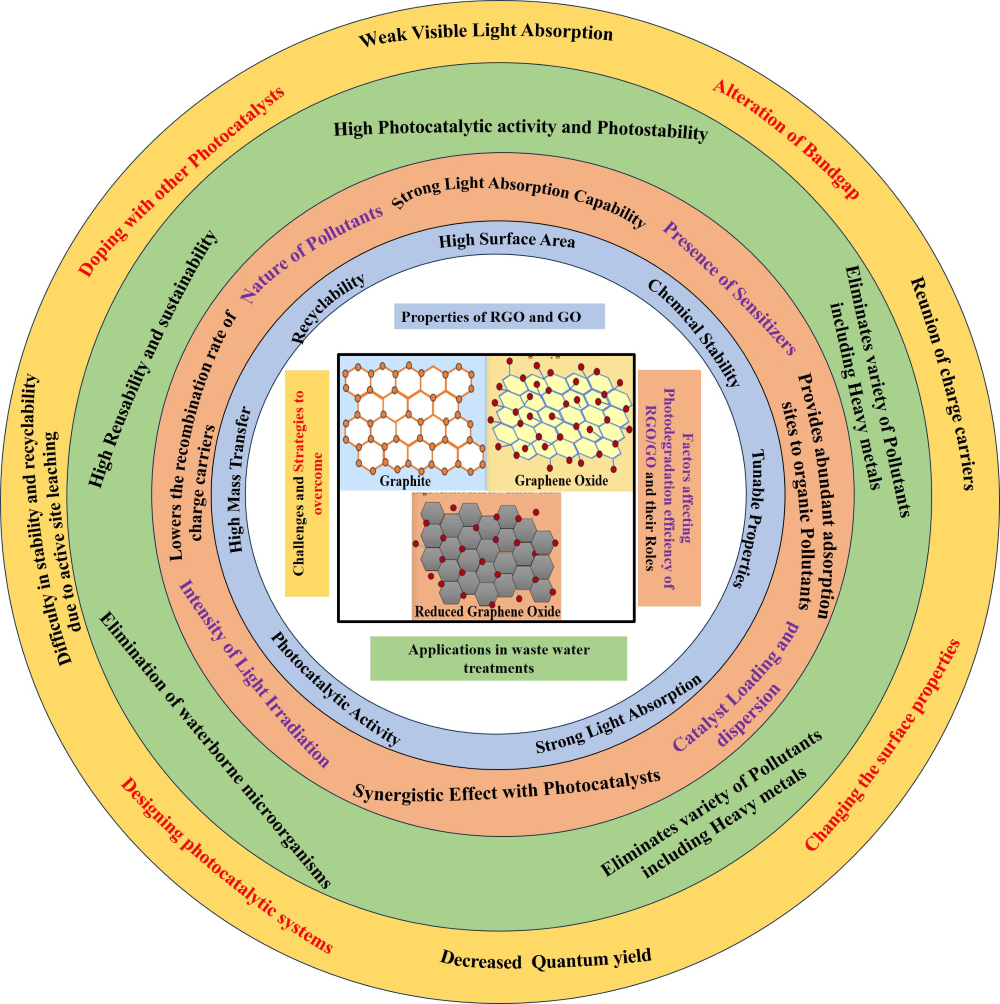
The structural difference between GO and rGO is illustrated in Figure 1. Reduced graphene oxide retains the layered structure of graphene oxide but with fewer oxygen functional groups and a higher degree of π-conjugation [22]. This results in improved properties such as high electrical and thermal conductivity, mechanical strength, strong light absorption ability, and high surface area compared to GO [23].
2.3. Unique properties related to photocatalytic applications
Both graphene oxide and reduced graphene oxide have several unique characteristics (Figure 2) that make them ideal for photodegradation applications:
a. High Surface Area: graphene and reduced graphene oxide show a large surface area due to their layered 2D structure, providing ample catalytic breakdown of organic pollutants [24].
b. Strong Light Absorption: These materials possess strong and broad light absorption ability spanning from ultraviolet to near-infrared regions, enabling greater utilization of the solar spectrum for photocatalytic degradation [25].
c. Photocatalytic Activity: When GO is exposed to light, the oxygen chemical moieties in it allow for the production of active oxygen species, which effectively degrade organic contaminants adhered to their surfaces [26].
d. Chemical Stability: Under a variety of environmental factors, GO and rGO display strong chemical stability, guaranteeing a long catalyst lifetime and reliable photodegradation process performance [27].
e. Tunable Properties: Through different synthesis and modification techniques, the characteristics of GO and rGO, such as their electrical conductivity, dispersibility, and surface chemistry, can be adjusted to maximize their performance in particular photodegradation applications [28].
3. MECHANISTIC ROUTES OF PHOTOCATALYTIC DEGRADATION OF ORGANIC POLLUTANTS
3.1. Overview of photodegradation processes and pathways
The term “photodegradation” describes how organic pollutants break down or decompose into harmless products, when exposed to light, usually ultraviolet (UV) or visible radiation [29]. This degradation pathway involves a series of photochemical reactions that result in the breakdown of chemical bonds within the pollutant molecules, leading to the formation of smaller, less harmful byproducts such as water and carbon dioxide molecules [30]. The chemical structure of the pollutant and the particular environmental circumstances can affect the mechanisms of photodegradation. Common pathways include:
a. Direct Photolysis: In this pathway, the pollutant molecule absorbs photons of light and immediately undergoes cleavage of chemical bonds, leading to the formation of reactive intermediates or radicals. Pollutant molecules are broken down by these reactive species [31].
b. Indirect Photolysis: Indirect photolysis relies on the activation of water or oxygen molecules present on the surface by light. These molecules that have been activated produce active species such as superoxide radicals (O2•-) and hydroxyl radicals (•OH), which further assist in the breakdown of pollutant molecules. [32].
c. Photocatalysis: When a catalyst absorbs light energy and promotes the production of reactive species that can break down contaminants, photocatalytic degradation takes place. Semiconducting materials like titanium dioxide (TiO2) and zinc oxide (ZnO), pertinent to this review, graphene-based materials like GO and rGO are examples of common photocatalysts [33].
Table 1 provides a more comprehensive overview, including examples, environmental impacts, and potential applications of each photodegradation process.
3.2. Role of GO and rGO in photocatalysis and photodegradation reactions
The GO and rGO play a crucial role in photocatalytic degradation reactions due to their unique physical and chemical properties, as well as due to an excellent surface chemistry [34]. These oxides can act as efficient photocatalysts or co-catalysts by:
a. Strong Light Absorption: GO and rGO possess strong light absorption capacity in both the ultraviolet and visible regions of the solar spectrum. This enables efficient utilization of solar irradiation for effective breakdown of organic pollutants [35].
b. Charge Carrier Generation and their Separation: When GO and rGO materials absorb light, electron-hole (e-/h+) pairs are produced. These photogenerated pairs migrate to the surface of GO and rGO and promote oxidation-reduction reactions. The sheet-like structure and efficient electrical conduction in rGO allow the fast movement and separation of these charges, improving photocatalytic degradation performance [36].
c. Surface Functional Groups: The surface of graphene oxide has functional groups that contain oxygen, which serve as binding sites for organic contaminants. These groups produce reactive species such as superoxide radicals (O2•−) and hydroxyl radicals (•OH) following exposure to solar light. The breakdown of the contaminants into innocuous chemicals is started by these reactive molecules [37].
d. Synergistic Effects: To enhance photocatalytic activity and selectivity for pollutant destruction, GO and rGO can be mixed with other photocatalysts or co-catalysts to generate hybrid nanocomposites [38].
3.3. Factors affecting the photodegradation efficiency using GO and rGO
The effectiveness of photodegradation techniques employing GO and rGO as photocatalysts or co-catalysts is influenced by several factors:
a. Light Intensity and Wavelength: It has a major impact on the rate and extent of photodegradation reactions. The distinct absorption spectra of GO and rGO determine the responsiveness they have to particular light wavelengths [39].
b. Catalyst Loading and Dispersion: The availability of active sites and the effectiveness of pollutant adsorption and degradation can be impacted by the loading concentration and dispersion of GO or rGO inside the photocatalytic system [40].
c. Environmental Conditions like acidity (pH), temperature, and the presence of other ions or dissolved oxygen can impact the performance and durability of GO and rGO-based photocatalyst [41].
d. Pollutant Characteristics: The organic pollutant’s adsorption affinity and vulnerability to photodegradation on the surface of GO or rGO can be influenced by its chemical structure, concentration, and reactivity [42].
e. Synthesis and Modification Strategies: For effective pollutant degradation, the synthesis process, degree of reduction, surface functionalization, and structural morphology of GO and rGO can be tuned to enhance their photocatalytic performance [43].
4. PHOTODEGRADATION OF ORGANIC POLLUTANTS
4.1. Review of studies on the photodegradation of various organic pollutants using GO and rGO material
The effectiveness of graphene oxide (GO) and reduced graphene oxide (rGO) as photocatalysts for the degradation of different organic pollutants has been investigated by numerous researchers [44, 45]. Photocatalytic degradation by GO and rGO includes a wide range of pollutants:
a. Dyes: Many studies have been conducted on the use of GO and rGO-based photocatalysts to break down various synthetic dyes, such as methyl orange (MO), malachite green (MG), rhodamine B (RhB), and methylene blue (MB) [46, 47]
b. Pharmaceuticals and Personal Care Products (PPCPs): These are becoming a bigger environmental hazard and include UV filters, hormones, and antibiotics. With the use of both visible and ultraviolet (UV) light, GO and rGO exhibit an ability in to break down these pollutants [48, 49].
c. Pesticides and Herbicides: The ecology is seriously threatened by these agricultural toxins, which include glyphosate and atrazine. Research indicates that these substances can be broken down by GO and rGO-based photocatalysts, facilitating the removal of pesticide contamination [50, 51].
d. Polycyclic Aromatic Hydrocarbons (PAHs): These are common pollutants found in the environment that are created during combustion. GO and rGO are being explored for their potential to break down PAHs with light, suggesting a sustainable solution to clean up contaminated areas [52, 53].
e. Endocrine Disruptors: These substances, which include phthalates and bisphenol A (BPA), can be detrimental to both ecosystems and human health. It has been demonstrated that GO and rGO-based photocatalysts efficiently break down EDCs, lessening their detrimental impact on environmental health. [54, 55].
4.2. Comparison of the effectiveness of GO and rGO-centered photocatalysts
The effectiveness of GO and rGO-based photocatalysts for organic pollutant degradation depends on various factors, including their structural properties, surface chemistry, and light absorption characteristics [56]. Although rGO and GO both have photocatalytic activity, rGO often performs better because of its lower density of oxygen functional groups and higher electrical conductivity [57]. These features improve photocatalytic efficiency by enabling rapid generation, transport, and utilization of charge carriers. Additionally, the degree of reduction of graphene oxide during the synthesis process influences its photocatalytic activity, with higher degrees of reduction typically correlating with increased efficiency in pollutant degradation [58]. However, it’s essential to balance reduction levels to maintain the desired surface chemistry and active sites for pollutant adsorption and degradation [59].
4.3. Identification of key factors affecting the photodegradation performance of GO and rGO
Several key factors influence the photodegradation performance of GO and rGO-based photocatalysts:
a. Light Irradiation: The rate and scope of photodegradation reactions are strongly influenced by the light irradiation’s intensity, wavelength, and duration. To maximize photocatalytic efficiency, these factors must be optimized [60].
b. Catalyst Loading and Dispersion: The accessibility of active sites and the effectiveness of pollutant adsorption and degradation are impacted by the loading concentration and dispersion of GO or rGO inside the photocatalytic system [61, 62].
c. Pollutant Characteristics: The chemical structure, concentration, and reactivity of the organic pollutant can influence its adsorption affinity and susceptibility to photodegradation on the surface of GO or rGO [63, 64].
d. Synthesis and Modification Strategies: The synthesis method, degree of reduction, surface functionalization, and structural morphology of GO and rGO can be tailored to optimize their photocatalytic performance towards various pollutants [64].
These factors mentioned in Table 2 collectively determine the effectiveness and efficiency of photocatalytic degradation.
5. APPLICATIONS OF GO AND RGO IN WASTEWATER TREATMENT
5.1. Overview of wastewater treatment processes
In order to comply with safety standards for consuming or providing water to the environment, water and wastewater treatment procedures seek to purify water sources by eliminating pollutants and impurities [65]. Usually, these procedures combine physical, chemical, and biological techniques, such as:
a. Particle Destabilization and Removal: To destabilize suspended particles and small groups of matter (colloids), chemicals are introduced to water. This causes the particles to group and settle out or be more easily filtered [66, 67].
b. Filtration: To eliminate the suspended particles, microbes, and other undesirable items, water is run through a variety of filter materials, such as sand, activated carbon, or specific membrane filters [68, 69].
c. Disinfection: Water is treated with chemical disinfectants, including chlorine or ultraviolet (UV) radiation, to destroy or inactivate harmful microbes and stop waterborne illnesses [70].
d. Adsorption: Adsorbent materials, such as activated carbon or graphene-based materials, are used to adsorb organic pollutants, heavy metals, and other contaminants from water [71].
e. Photocatalysis: Photocatalytic processes involve the use of photocatalysts, such as titanium dioxide (TiO2), zinc oxide (ZnO), or graphene-based semiconductors, to degrade organic pollutants and disinfect water under light irradiation [72].
5.2. Role of GO and rGO-based photocatalysts in water purification and pollutant removal
The graphene and reduced graphene oxide have gained attention for their potent applications in environmental remediation due to their unique properties and excellent photocatalytic efficacy [73]. GO and rGO-based photocatalysts offer several advantages, including:
a. High Photocatalytic Activity: When exposed to UV and visible light, GO and rGO effectively deprive organic pollutants and disinfect water due to their exceptional light absorption characteristics and catalytic activity [74].
b. Wide Spectrum of Pollutant Removal: Pure GO and rGO and their heterostructures with different semiconductors can successfully remove a wide range of contaminants from water, such as pesticides, dyes, antibiotics, heavy metals, and pathogens [75].
3. Reusable and Sustainable: Compared to conventional treatment techniques, GO and rGO-based photocatalysts are easily recovered and used in wastewater treatment processes, lowering operating costs and environmental impact [76].
4. Enhanced Photostability: The chemical stability and robustness of GO and rGO enhance their photostability and resistance to degradation, ensuring prolonged catalyst lifespan and consistent performance in the degradation process. [77, 78]
5.3. Case studies illustrating the application of GO and rGO in real-world water treatment scenarios
The efficiency of GO and rGO-based photocatalysts in actual water treatment situations has been shown in numerous case studies, including:
a. Breakdown of Organic Contaminants: Studies have demonstrated that graphene oxide (GO) and reduced graphene oxide (rGO) based photocatalysts may effectively remove organic contaminants, such as colorants, drugs, and pesticides, from contaminated water sources [79, 80].
b. Sterilization of Waterborne Microorganisms: Reduced graphene oxide (rGO) and graphene oxide (GO) have been used to eradicate waterborne microorganisms, including bacteria, viruses, and protozoa, providing an environmentally responsible way to clean water and protect public health [81, 82].
c. Elimination of Heavy Metals: A promising solution for the removal of heavy metals from industrial wastewater streams is the use of adsorbents made from graphene oxide (GO) and reduced graphene oxide (rGO), which have demonstrated significant adsorption capabilities for heavy metals such as lead, cadmium, and mercury [83].
4. Solar Water Purification: In rural and resource-constrained areas, water purification systems that use photocatalysis and integrate graphene oxide (GO) and reduced graphene oxide (rGO) have been established. These systems employ solar energy to provide a sustainable and decentralized water treatment alternative [84].
6. CHALLENGES AND LIMITATIONS
6.1. Discussion of challenges and limitations connected to the usage of GO and rGO for the photodegradation of organic pollutants
The use of these graphites for photodegradation confronts several difficulties and restrictions despite their encouraging characteristics and possible uses: [66]
a. Limited Visible Light Absorption: GO and rGO have broad light absorption spectra, but they have weak absorption in the visible spectrum, which limits how much solar energy they can use for photocatalytic activities. This restriction reduces the effectiveness of photodegradation processes, especially when exposed to visible light [85].
b. Reunion of Charge Carriers: On the surface of graphene oxide (GO) and reduced graphene oxide (rGO), the rapid reassociation of electron-hole pairs produced by light can weaken their photocatalytic activity and limit the efficiency of pollutant breakdown. Improving photocatalytic efficacy requires strategies to reduce charge carrier reunion [86].
c. Reduced Quantum Efficiency: Graphene oxide (GO) and reduced graphene oxide (rGO)-based photocatalysts’ quantum efficiency, which measures the ratio of absorbed photons to the number of pollutant molecules broken down, is usually limited by issues like insufficient light absorption, charge separation, and reactive component use [87].
d. Absence of Discrimination: Photocatalysts generated from graphene oxide (GO) and reduced graphene oxide (rGO) may exhibit insufficient discrimination towards certain contaminants, leading to partial degradation or the production of undesirable secondary products during photodegradation processes. This issue can be lessened by adding selective functionalization or surface modifications to GO and rGO [87].
e. Stability and Recyclability: For real-world uses in water treatment, GO and rGO-based photocatalysts’ stability and recyclability are essential factors. Over time, structural deterioration, active site leaching, and nanoparticle aggregation can reduce catalyst effectiveness and demand for regular regeneration or replacement [88].
6.2. Strategies for overcoming challenges and improving the efficiency of GO and rGO-based photocatalysts
The difficulties and restrictions involved in using GO and rGO for photodegradation can be addressed in several ways: [69].
a. Bandgap Engineering: Heteroatom doping (such as nitrogen or sulfur) or hybridization with other semiconductor materials (such as metal oxides or quantum dots) can alter the bandgap of GO and rGO to boost photocatalytic activity by increasing visible light absorption and extending the spectrum response range [71].
b. Surface Alteration: Certain functional groups or nanoparticles can be added to the surface of graphene oxide (GO) and reduced graphene oxide (rGO) to increase their adsorption capacity, charge separation efficiency, and preference for target contaminants. Techniques for engineering surface properties also strengthen stability and reusability by thwarting aggregation and bolstering catalyst resilience [89].
c. Co-Catalyst Incorporation: Incorporating co-catalysts to the surface of GO and rGO, such as metal oxides (like TiO2, ZnO) or precious metals (like platinum, palladium), can speed up charge transfer and increase the generation of reactive species, improving photocatalytic performance and the efficiency of pollutant degradation [90, 91].
d. Dimensional Control: Tailoring the dimensional morphology of GO and rGO-based photocatalysts, such as nanosheets, nanotubes, or hierarchical structures, can optimize light absorption, surface area, and mass transport properties, leading to improved photocatalytic performance and stability [92, 93].
e. In-situ Photocatalytic Systems: For water treatment applications, designing in-situ photocatalytic systems-such as membrane reactors or immobilized catalysts-allows for improved mass transfer and effective photocatalyst usage, reducing active site loss and increasing overall degradation efficiency [94].
7. FUTURE DIRECTIONS AND OPPORTUNITIES
7.1. Recommendations for future research in the field of photodegradation using GO and rGO
a. Exploration of Novel Synthesis Methods: Examine novel synthesis methodologies (such as bottom-up methods, green synthesis methods, and template-assisted fabrication techniques), for GO and rGO with superior properties tailored particularly for photocatalytic applications [95].
b. Mechanistic Understanding: Using sophisticated characterization methods and computer modeling, get a deeper knowledge of the fundamental mechanisms controlling photocatalytic degradation processes on GO and rGO surfaces, such as charge transfer kinetics, surface reactions, and interactions with organic contaminants [96].
c. Enhanced Visible Light Absorption: Employ techniques like bandgap engineering, heteroatom doping, and plasmonic nanoparticle integration that enhance the visible light absorption of GO and rGO-based photocatalysts to boost their efficiency and practicality for solar-driven photodegradation processes [97].
d. Selective Photocatalysis: Investigate selective photocatalytic degradation of specific pollutants using GO and rGO-based photocatalysts, targeting emerging contaminants, persistent organic pollutants (POPs), and recalcitrant compounds, to address evolving environmental challenges and regulatory requirements [98].
e. Scale-Up and Technological Integration: Translate laboratory-scale research into scalable and cost-effective photodegradation technologies using GO and rGO, including the development of continuous-flow reactors, immobilized photocatalyst systems, and integrated water treatment processes for real-world applications [99].
7.2. Identification of emerging trends and opportunities for innovation in the development of GO and rGO-based photocatalysts
a. Nanocomposite Materials: Investigate how GO and rGO can be integrated with other nanomaterials, such as metal nanoparticles, metal oxides, and carbon nanotubes, to generate hybrid nanocomposite materials that will enhance photocatalytic activity, stability, and selectivity [100].
b. Smart Photocatalytic Systems: For on-demand and adaptive water treatment applications, create intelligent and responsive photocatalytic systems based on stimuli-responsive GO and rGO nanoparticles that respond to external stimuli, including light intensity, pH, temperature, and target pollutant concentrations [101].
c. Energy-Efficient Processes: To reduce energy consumption and environmental impact while optimizing process efficiency, investigate energy-efficient photocatalytic processes using renewable energy sources like solar energy, visible light-emitting diodes (LEDs), and photocatalytic membrane reactors [102].
d. Integrated Water-Energy Nexus: Investigate the relationship between water and energy systems by developing integrated water-energy solutions based on GO and rGO-based photocatalysts. This will allow for the simultaneous production of energy and water treatment through processes including pollutant degradation and photocatalytic water splitting [105].
e. Advanced Functionalization: To facilitate selective pollutant targeting, quick adsorption, and selective degradation in intricate water matrices, enhance the functionalization of GO and rGO surfaces with tailored functionalities, such as molecular recognition elements, catalytic sites, and responsive coatings [104].
8. ENVIRONMENTAL IMPLICATIONS AND SUSTAINABILITY
8.1. Assessment of the environmental impact of using GO and rGO for photodegradation
a. Material Production: Numerous chemical processes are involved in the manufacturing of graphene oxide (GO) and reduced graphene oxide (rGO), which may have an impact on the environment due to energy consumption, greenhouse gas emissions, and the creation of chemical waste. To comprehend these processes’ overall sustainability, it is crucial to evaluate their environmental impact [105].
b. Pollutant Degradation: The photodegradation process itself may result in intermediates or byproducts that could be hazardous to the environment, even though GO and rGO-based photocatalysts provide a sustainable method for pollutant degradation. To assess the overall environmental impact of photodegradation employing GO and rGO, it is essential to comprehend the fate and toxicity of these degradation products [106].
c. Disposal and End-of-Life: After use, GO and rGO-based photocatalysts must be disposed of properly to avoid contaminating the environment and reducing waste production. Given the possible environmental persistence and mobility of graphene-based materials, relevant end-of-life management techniques must be employed to ensure minimal adverse environmental effects. [107].
8.2. discussion of the sustainability and scalability of GO and rGO-based photocatalytic processes
a. Resource Efficiency: Because solar energy is a plentiful and sustainable source of energy for photocatalytic reactions, GO and rGO-based photocatalysts have an advantage in terms of resource efficiency. Furthermore, these materials’ ability to be recycled and reused can support the sustainability of photocatalytic processes [108].
b. Water and Energy Consumption: When compared to traditional water treatment techniques, photocatalytic systems employing GO and rGO usually demand lower energy and water inputs. These methods can reduce energy use and dependency on fossil fuels by using solar energy to degrade pollutants, improving sustainability [109].
c. Scalability and Technological Integration: For GO and rGO-based photocatalytic processes to be sustainable, scalability and technical integration are essential. The development of effective reactor designs, integrated water treatment systems, and scalable synthesis techniques can help these technologies become widely used for extensive environmental remediation applications [110].
d. Life Cycle Assessment (LCA): To analyze the environmental sustainability of GO and rGO-based photocatalytic processes and find areas for improvement, life cycle assessments (LCAs) must be carried out. LCA considers the environmental impacts associated with the entire life cycle of the photocatalytic system, from raw material extraction and production to end-of-life disposal [111].
e. Regulatory Compliance and Social Acceptance: For GO and rGO-based photocatalytic processes to be used sustainably, social acceptance and regulatory compliance must be guaranteed. Achieving broad acceptance and support for new technologies requires addressing possible health and safety issues, outlining their advantages, and including stakeholders at every stage of the process [112, 113].
9. FUTURE PERSPECTIVES AND CHALLENGES
In recent decades, graphene oxide and reduced graphene oxides have attracted a lot of attention because of their special qualities, which include a large number of surface-active sites, economic efficacy, cost-effectiveness, environmental friendliness, and exceptional reusability and recyclability. However, there are still some challenges and potential research directions to be investigated.
9.1. Investigation of innovative applications
The unique properties of GO and rGO open up new possibilities for their potential uses in the energy, water purification, and catalysis industries. Enhancing catalytic potential through immobilization with n-type, p-type, and nanocomposite semiconductor materials is clearly the direction of the upcoming trend in GO and rGO applications. This approach will make it easier to precisely modify the particle size, shape, and crystallinity, all of which improve the nanomaterial’s usefulness.
9.2. Environmental Impact
To ensure their safe and sustainable use, a detailed analysis of the possible environmental effects of graphene oxide and reduced graphene oxide-based nanomaterials is required.
10. CONCLUSION
In conclusion, graphene oxide (GO) and reduced graphene oxide (rGO) have emerged as promising materials for addressing the challenges of organic pollutant remediation in water and wastewater treatment. This review article has provided a comprehensive overview of the potential applications, mechanisms, challenges, and opportunities associated with the utilization of GO and rGO-based photocatalysts for photodegradation.
Throughout the review, we explored the unique properties of GO and rGO, including their high surface area, strong light absorption ability, and excellent catalytic activity, which make them well-suited for photocatalytic degradation processes. We discussed the mechanisms underlying photodegradation reactions on GO and rGO surfaces, as well as the factors influencing their efficiency in pollutant removal.
Furthermore, the review highlighted the diverse range of organic pollutants that can be effectively degraded using GO and rGO-based photocatalysts, including dyes, pharmaceuticals, pesticides, and endocrine disruptors. Case studies illustrated the successful application of these materials in real-world water treatment scenarios, showcasing their potential for environmental remediation.
Despite the considerable progress in this field, challenges and limitations remain, including limited visible light absorption, charge carrier recombination, and selectivity issues. However, innovative strategies such as bandgap engineering, surface modification, and co-catalyst integration offer promising avenues for overcoming these obstacles and improving the efficiency of GO and rGO-based photocatalysts.
Looking ahead, future research directions should focus on exploring novel synthesis methods, advancing mechanistic understanding, and developing sustainable and scalable photocatalytic processes using GO and rGO. Moreover, addressing environmental implications and ensuring regulatory compliance and social acceptance are essential for the successful implementation of these technologies.
In summary, the utilization of graphene oxide and reduced graphene oxide holds tremendous potential for advancing water and wastewater treatment practices, offering sustainable solutions to mitigate organic pollution and safeguard environmental health. By continuing to innovate and collaborate across interdisciplinary fields, we can harness the full potential of these materials to address emerging environmental challenges and build a more sustainable future.
Conflict of Interest
The authors declare no conflict of interest.
Funding
This study was not supported by any funding.
Author’s Contributions
Study Conception or Design: VM; SD; DH
Data Acquisition: VM; SD; DH
Data Analysis or Interpretation: VM; SD; DH
Manuscript Drafting: VM; SD; DH
Critical Manuscript Revision: VM; SD; DH
All authors have approved the final manuscript and are responsible for all aspects of the work.
AI Statement
The authors confirm that no AI tools or services were used during the preparation of this work.
