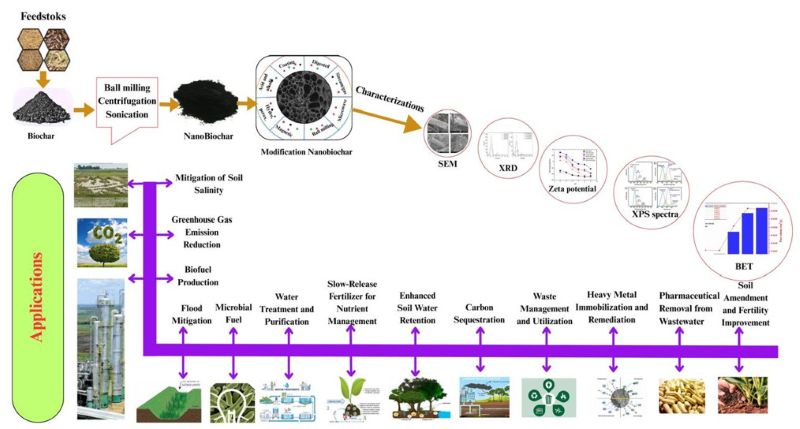
Bhandari G, Gangola S, Dhasmana A, Rajput V, Gupta S, Malik S, et al. Nano-biochar: recent progress, challenges, and opportunities for sustainable environmental remediation. Front Microbiol. 2023;14:1214870. https://doi.org/10.3389/fmicb.2023.1214870
Sani MNH, Amin M, Siddique AB, Nasif SO, Ghaley BB, Ge L, et al. Waste-derived nano biochar: a new avenue towards sustainable agriculture, environment, and circular bioeconomy. Sci Total Environ. 2023;166881. https://doi.org/10.1016/j.scitotenv.2023.166881
Irewale AT, Dimkpa CO, Elemike EE, Oguzie EE. Water hyacinth: Prospects for biochar-based, nano-enabled biofertilizer development. Heliyon. 2024. https://doi.org/10.2139/ssrn.4680844
Luo L, Xu C, Chen Z, Zhang S. Properties of biomass-derived biochars: Combined effects of operating conditions and biomass types. Bioresour Technol. 2015;192:83-9. https://doi.org/10.1016/j.biortech.2015.05.054
Seow YX, Tan YH, Mubarak N, Kansedo J, Khalid M, Ibrahim ML, et al. A review on biochar production from different biomass wastes by recent carbonization technologies and its sustainable applications. J Environ Chem Eng. 2022;10(1):107017. https://doi.org/10.1016/j.jece.2021.107017
Oh T-K, Choi B, Shinogi Y, Chikushi J. Characterization of biochar derived from three types of biomass. 2012. https://doi.org/10.5109/22049
Manyà JJ, Azuara M, Manso JA. Biochar production through slow pyrolysis of different biomass materials: Seeking the best operating conditions. Biomass Bioenergy. 2018;117:115-23. https://doi.org/10.1016/j.biombioe.2018.07.019
Oleszczuk P, Ćwikła-Bundyra W, Bogusz A, Skwarek E, Ok YS. Characterization of nanoparticles of biochars from different biomass. J Anal Appl Pyrolysis. 2016;121:165-72. https://doi.org/10.1016/j.jaap.2016.07.017
Janu R, Mrlik V, Ribitsch D, Hofman J, Sedláček P, Bielská L, et al. Biochar surface functional groups as affected by biomass feedstock, biochar composition, and pyrolysis temperature. Carbon Resour Convers. 2021;4:36-46. https://doi.org/10.1016/j.crcon.2021.01.003
Cabeza I, Waterhouse T, Sohi S, Rooke J. Effect of biochar produced from different biomass sources and at different process temperatures on methane production and ammonia concentrations in vitro. Anim Feed Sci Technol. 2018;237:1-7. https://doi.org/10.1016/j.anifeedsci.2018.01.003
Jayakumar M, Hamda AS, Abo LD, Daba BJ, Prabhu SV, Rangaraju M, et al. Comprehensive review on lignocellulosic biomass derived biochar production, characterization, utilization, and applications. Chemosphere. 2023;140515. https://doi.org/10.1016/j.chemosphere.2023.140515
Wang L, Olsen MN, Moni C, Dieguez-Alonso A, de la Rosa JM, Stenrød M, et al. Comparison of properties of biochar produced from different types of lignocellulosic biomass by slow pyrolysis at 600 °C. Appl Energy Combust Sci. 2022;12:100090. https://doi.org/10.1016/j.jaecs.2022.100090
Li C, Kerner P, Williams CL, Hoover A, Ray AE. Characterization and localization of dynamic cell wall structure and inorganic species variability in harvested and stored corn stover fractions as functions of biological degradation. ACS Sustain Chem Eng. 2020;8(18):6924-34. https://doi.org/10.1021/acssuschemeng.9b06977
He X, Liu Z, Niu W, Yang L, Zhou T, Qin D, et al. Effects of pyrolysis temperature on the physicochemical properties of gas and biochar obtained from pyrolysis of crop residues. Energy. 2018;143:746-56. https://doi.org/10.1016/j.energy.2017.11.062
Yuan X, Dissanayake PD, Gao B, Liu W-J, Lee KB, Ok YS. Review on upgrading organic waste to value-added carbon materials for energy and environmental applications. J Environ Manage. 2021;296:113128. https://doi.org/10.1016/j.jenvman.2021.113128
Intani K, Latif S, Cao Z, Müller J. Characterisation of biochar from maize residues produced in a self-purging pyrolysis reactor. Bioresour Technol. 2018;265:224-35. https://doi.org/10.1016/j.biortech.2018.05.103
Lee Y, Park J, Ryu C, Gang KS, Yang W, Park Y-K, et al. Comparison of biochar properties from biomass residues produced by slow pyrolysis at 500 °C. Bioresour Technol. 2013;148:196-201. https://doi.org/10.1016/j.biortech.2013.08.135
Panwar N, Pawar A, Salvi B. Comprehensive review on production and utilization of biochar. SN Appl Sci. 2019;1:1-19. https://doi.org/10.1007/s42452-019-0172-6
Ippolito JA, Cui L, Kammann C, Wrage-Mönnig N, Estavillo JM, Fuertes-Mendizabal T, et al. Feedstock choice, pyrolysis temperature and type influence biochar characteristics: A comprehensive meta-data analysis review. Biochar. 2020;2:421-38. https://doi.org/10.1007/s42773-020-00067-x
Zhang M, Gao B, Wang Y. Advances in nano-biochar for environmental applications. Environ Sci Technol. 2021;55(12):7487-95. https://doi.org/10.1021/acs.est.1c01976
Liu Y, Zhang Z, Chen G. Nano-biochar for sustainable environmental applications: A review. Sci Total Environ. 2020;715:136904.
Alloway BJ. Heavy metals in soils: Trace metals and metalloids in soils and their bioavailability. Vol. 22. Dordrecht: Springer Sci Bus Media; 2012. https://doi.org/10.1007/978-94-007-4470-7
Singh R, Gautam N, Mishra A, Gupta R. Heavy metals and living systems: An overview. Indian J Pharmacol. 2011;43(3):246-53. https://doi.org/10.4103/0253-7613.81505
Wuana RA, Okieimen FE. Heavy metals in contaminated soils: A review of sources, chemistry, risks and best available strategies for remediation. ISRN Ecol. 2011;2011:402647. https://doi.org/10.5402/2011/402647
Rai PK, Lee SS, Zhang M, Tsang YF, Kim K-H. Heavy metals in food crops: Health risks, fate, mechanisms, and management. Environ Int. 2019;125:365-85. https://doi.org/10.1016/j.envint.2019.01.067
Muthusaravanan S, Sivarajasekar N, Vivek J, Paramasivan T, Naushad M, Prakashmaran J, et al. Phytoremediation of heavy metals: Mechanisms, methods and enhancements. Environ Chem Lett. 2018;16:1339-59. https://doi.org/10.1007/s10311-018-0762-3
Soni S, Jha AB, Dubey RS, Sharma P. Mitigating cadmium accumulation and toxicity in plants: The promising role of nanoparticles. Sci Total Environ. 2023;168826. https://doi.org/10.1016/j.scitotenv.2023.168826
Salt DE, Smith R, Raskin I. Phytoremediation. Annu Rev Plant Biol. 1998;49(1):643-68. https://doi.org/10.1146/annurev.arplant.49.1.643
Ali H, Khan E, Sajad MA. Phytoremediation of heavy metals: Concepts and applications. Chemosphere. 2013;91(7):869-81. https://doi.org/10.1016/j.chemosphere.2013.01.075
Pilon-Smith E. Phytoremediation. Annu Rev Plant Biol. 2005. https://doi.org/10.1146/annurev.arplant.56.032604.144214
Lehmann J, Joseph S. Biochar for environmental management: Science, technology, and implementation. 2nd ed. Boca Raton: Taylor & Francis; 2024. https://doi.org/10.4324/9781003297673
Tan X, Liu Y, Zeng G, Wang X, Hu X, Gu Y, et al. Application of biochar for the removal of pollutants from aqueous solutions. Chemosphere. 2015;125:70-85. https://doi.org/10.1016/j.chemosphere.2014.12.058
Hong Y, Li D, Xie C, Zheng X, Yin J, Li Z, et al. Combined application of apatite, biochar, and organic fertilizer for remediation of soils co-contaminated with heavy metals. 2022.
Kuppusamy S, Thavamani P, Venkateswarlu K, Lee YB, Naidu R, Megharaj M. Remediation approaches for polycyclic aromatic hydrocarbons (PAHs) contaminated soils: Technological constraints, emerging trends, and future directions. Chemosphere. 2017;168:944-68. https://doi.org/10.1016/j.chemosphere.2016.10.115
Ma H, Wei M, Wang Z, Hou S, Li X, Xu H. Bioremediation of cadmium polluted soil using a novel cadmium immobilizing plant growth promotion strain Bacillus sp. TZ5 loaded on biochar. J Hazard Mater. 2020;388:122065. https://doi.org/10.1016/j.jhazmat.2020.122065
Rodriguez-Narvaez OM, Peralta-Hernandez JM, Goonetilleke A, Bandala ER. Biochar-supported nanomaterials for environmental applications. J Ind Eng Chem. 2019;78:21-33. https://doi.org/10.1016/j.jiec.2019.06.008
Chen W, Meng J, Han X, Lan Y, Zhang W. Past, present, and future of biochar. Biochar. 2019;1:75-87. https://doi.org/10.1007/s42773-019-00008-3
Yu J, Deem LM, Crow SE, Deenik JL, Penton CR. Biochar application influences microbial assemblage complexity and composition due to soil and bioenergy crop type interactions. Soil Biol Biochem. 2018;117:97-107. https://doi.org/10.1016/j.soilbio.2017.11.017
Qin G, Niu Z, Yu J, Li Z, Ma J, Xiang P. Soil heavy metal pollution and food safety in China: Effects, sources and removing technology. Chemosphere. 2021;267:129205. https://doi.org/10.1016/j.chemosphere.2020.129205
Liu Y, Zhang Y, Chen G. Environmental impacts of pyrolysis and biochar applications. Environ Sci Technol. 2020;54(6):3883-91.
Lehmann J, Joseph S. Biochar for environmental management: an introduction. In: Lehmann J, Joseph S, editors. Biochar for environmental management. 2nd ed. London: Routledge; 2015. p. 1-13. https://doi.org/10.4324/9780203762264
Mohan D, Pittman CU Jr, Steele PH. Pyrolysis of wood/biomass for bio-oil: a critical review. Energy Fuels. 2006;20(3):848-89. https://doi.org/10.1021/ef0502397
Sriram A, Swaminathan G. Pyrolysis of Musa balbisiana flower petal using thermogravimetric studies. Bioresour Technol. 2018;265:236-46. https://doi.org/10.1016/j.biortech.2018.05.043
Lu Q, Dong CQ, Zhang XM, Tian HY, Yang YP, Zhu XF. Selective fast pyrolysis of biomass impregnated with ZnCl₂ to produce furfural: Analytical Py-GC/MS study. J Anal Appl Pyrolysis. 2011;90(2):204-12. https://doi.org/10.1016/j.jaap.2010.12.007
Taghizadeh-Alisaraei A, Tatari A, Khanali M, Keshavarzi M. Potential of biofuels production from wheat straw biomass, current achievements, and perspectives: a review. Biofuels. 2023;14(1):79-92. https://doi.org/10.1080/17597269.2022.2118779
Kuhlbusch TAJ, Wijnhoven SWP, Haase A. Nanomaterial exposures for worker, consumer, and the general public. NanoImpact. 2018;10:11-25. https://doi.org/10.1016/j.impact.2017.11.003
Ravindra K, Kaur K, Mor S. System analysis of municipal solid waste management in Chandigarh and minimization practices for cleaner emissions. J Clean Prod. 2015;89:251-6. https://doi.org/10.1016/j.jclepro.2014.10.036
Yang RJ, Liu CC, Wang YN, Hou HH, Fu LM. A comprehensive review of micro-distillation methods. Chem Eng J. 2017;313:1509-20. https://doi.org/10.1016/j.cej.2016.11.041
Bridgwater AV. Review of fast pyrolysis of biomass and product upgrading. Biomass Bioenergy. 2012;38:68-94. https://doi.org/10.1016/j.biombioe.2011.01.048
Wang Z, Liu K, Xie L, Zhu H, Ji S, Shu X. Effects of residence time on characteristics of biochars prepared via co-pyrolysis of sewage sludge and cotton stalks. J Anal Appl Pyrolysis. 2019;142:104659. https://doi.org/10.1016/j.jaap.2019.104659
Zhang Z, Zhu Z, Shen B, Liu L. Insights into biochar and hydrochar production and applications: a review. Energy. 2019;171:581-98. https://doi.org/10.1016/j.energy.2019.01.035
Yu W, Hu J, Yu Y, Ma D, Gong W, Qiu H, et al. Facile preparation of sulfonated biochar for highly efficient removal of toxic Pb(II) and Cd(II) from wastewater. Sci Total Environ. 2021;750:141545. https://doi.org/10.1016/j.scitotenv.2020.141545
Ippolito JA, Cui L, Kammann C, Wrage-Mönnig N, Estavillo JM, Fuertes-Mendizabal T, et al. Feedstock choice, pyrolysis temperature and type influence biochar characteristics: a comprehensive meta-data analysis review. Biochar. 2020;2:421-38. https://doi.org/10.1007/s42773-020-00067-x
Hamdi W, Jellali S, Lafi R, Issaoui M, Jeguirim M. Banana wastes turning into values: valorization for wastewater treatment. In: Jeguirim M, editor. Banana Peels Valorization. Amsterdam: Elsevier; 2024. p. 159-89. https://doi.org/10.1016/B978-0-323-95937-7.00008-1
Chintala R, Schumacher TE, McDonald LM, Clay DE, Malo DD, Papiernik SK, et al. Phosphorus sorption and availability from biochars and soil/biochar mixtures. Clean Soil Air Water. 2014;42(5):626-34. https://doi.org/10.1002/clen.201300089
Liu X, Wang Y, Zhang J, Chen H. The high lignocellulosic composition of wood residues like sawdust and wood chips makes them a common feedstock for hydrothermal carbonization. J Biomass Sci. 2021;15(3):123-35.
Kumar A, Singhania RR, Saini R. Hydrothermal carbonization of agricultural residues for biochar production and its potential environmental applications. Environ Sci Pollut Res Int. 2020;27:31524-34.
Zhao C, Zhang Y, Liu F. Hydrothermal carbonization of animal manure: a sustainable approach for biochar production and its potential environmental applications. Bioresour Technol. 2018;258:147-55.
Zhao L, Wei X, Hu Z. Hydrothermal carbonization of food waste for biochar production and its application in environmental remediation. Sci Total Environ. 2019;651:3074-82.
Sharma P, Prakash O, Yadav A. Hydrothermal carbonization of algae for biochar production: a comprehensive review. Renew Sustain Energy Rev. 2020;133:110356.
Demirbas A, Pehlivan E, Altun T. Potential evolution of Turkish agricultural residues as biogas, biochar and bio-oil sources. Int J Hydrogen Energy. 2006;31(5):613-20. https://doi.org/10.1016/j.ijhydene.2005.06.003
Oliveira I, Blöhse D, Ramke HG. Hydrothermal carbonization of agricultural residues. Bioresour Technol. 2013;142:138-46. https://doi.org/10.1016/j.biortech.2013.04.125
Hoekman SK, Broch A, Robbins C. Hydrothermal carbonization (HTC) of lignocellulosic biomass. Energy Fuels. 2011;25(4):1802-11. https://doi.org/10.1021/ef101745n
Liu Z, Balasubramanian R. Upgrading of waste biomass by hydrothermal carbonization (HTC) and low-temperature pyrolysis (LTP): a comparative evaluation. Appl Energy. 2014;114:857-64. https://doi.org/10.1016/j.apenergy.2013.06.027
Hoekman SK, Broch A, Robbins C, Zielinska B, Felix L. Hydrothermal carbonization (HTC) of selected woody and herbaceous biomass feedstocks. Biomass Convers Biorefinery. 2013;3:113-26. https://doi.org/10.1007/s13399-012-0066-y
Jang ES, Ryu DY, Kim D. Hydrothermal carbonization improves the quality of biochar derived from livestock manure by removing inorganic matter. Chemosphere. 2022;305:135391. https://doi.org/10.1016/j.chemosphere.2022.135391
Cheng C, Zhao L, Li X. Effects of pyrolysis temperature on the properties of biochar and its applications. Bioresour Technol. 2014;156:259-65.
Zhang M, Gao B, Wang Y. Phosphoric acid activated biochar for environmental applications. Environ Sci Technol. 2017;51(7):3873-81.
Sun K, Huang Q, Chi Y, Yan J. Effect of ZnCl₂-activated biochar on catalytic pyrolysis of mixed waste plastics for producing aromatic-enriched oil. Waste Manag. 2018;81:128-37. https://doi.org/10.1016/j.wasman.2018.09.054
Azargohar R, Dalai A. Steam and KOH activation of biochar: Experimental and modeling studies. Microporous Mesoporous Mater. 2008;110(2-3):413-21. https://doi.org/10.1016/j.micromeso.2007.06.047
Oginni O, Singh K, Oporto G, Dawson-Andoh B, McDonald L, Sabolsky E. Effect of one-step and two-step H₃PO₄ activation on activated carbon characteristics. Bioresour Technol Rep. 2019;8:100307. https://doi.org/10.1016/j.biteb.2019.100307
Sakhiya AK, Baghel P, Anand A, Vijay VK, Kaushal P. A comparative study of physical and chemical activation of rice straw derived biochar to enhance Zn²⁺ adsorption. Bioresour Technol Rep. 2021;15:100774. https://doi.org/10.1016/j.biteb.2021.100774
Sajjadi B, Zubatiuk T, Leszczynska D, Leszczynski J, Chen WY. Chemical activation of biochar for energy and environmental applications: a comprehensive review. Rev Chem Eng. 2019;35(7):777-815. https://doi.org/10.1515/revce-2018-0003
Angın D, Altintig E, Köse TE. Influence of process parameters on the surface and chemical properties of activated carbon obtained from biochar by chemical activation. Bioresour Technol. 2013;148:542-9. https://doi.org/10.1016/j.biortech.2013.08.164
Cui K, Yan B, Xie Y, Qian H, Wang X, Huang Q, et al. Regenerable urchin-like Fe₃O₄@PDA-Ag hollow microspheres as catalyst and adsorbent for enhanced removal of organic dyes. J Hazard Mater. 2018;350:66-75. https://doi.org/10.1016/j.jhazmat.2018.02.011
O’Connor D, Peng T, Zhang J, Tsang DCW, Alessi DS, Shen Z, et al. Biochar application for the remediation of heavy metal polluted land: a review of in situ field trials. Sci Total Environ. 2018;619:815-26. https://doi.org/10.1016/j.scitotenv.2017.11.132
Zhang M, Gao B, Yao Y, Xue Y, Inyang M. Synthesis of porous nano-biochar nanocomposites for removal of phosphate and nitrate from aqueous solutions. Chem Eng J. 2012;210:26-32. https://doi.org/10.1016/j.cej.2012.08.052
Inyang M, Gao B, Yao Y, Xue Y, Zimmerman AR, Pullammanappallil P, et al. Removal of heavy metals from aqueous solution by biochars derived from anaerobically digested biomass. Bioresour Technol. 2012;110:50-6. https://doi.org/10.1016/j.biortech.2012.01.072
Sánchez MD, García R, Martínez J. Advances in the sol-gel process for the preparation of functional materials. J Water Environ Technol. 2021;19(2):145-59.
Zarkov A. Sol-gel technology applied to materials science: synthesis, characterization, and applications. 2024. https://doi.org/10.3390/books978-3-7258-0159-6
Song X, Segura-Egea JJ, Díaz-Cuenca A. Sol-gel technologies to obtain advanced bioceramics for dental therapeutics. Molecules. 2023;28(19):6967. https://doi.org/10.3390/molecules28196967
Li D, Xia Y. Electrospinning of nanofibers: reinventing the wheel? Adv Mater. 2004;16(14):1151-70. https://doi.org/10.1002/adma.200400719
Greiner A, Wendorff JH. Electrospinning: a fascinating method for the preparation of ultrathin fibers. Angew Chem Int Ed Engl. 2007;46(30):5670-83. https://doi.org/10.1002/anie.200604646
Huang ZM, Zhang YZ, Kotaki M, Ramakrishna S. A review on polymer nanofibers by electrospinning and their applications in nanocomposites. Compos Sci Technol. 2003;63(15):2223-54. https://doi.org/10.1016/S0266-3538(03)00178-7
Bhardwaj N, Kundu SC. Electrospinning: A fascinating fiber fabrication technique. Biotechnol Adv. 2010;28(3):325-47. https://doi.org/10.1016/j.biotechadv.2010.01.004
Li S, Cui Z, Li D, Yue G, Liu J, Ding H, et al. Hierarchically structured electrospinning nanofibers for catalysis and energy storage. Compos Commun. 2019;13:1-11. https://doi.org/10.1016/j.coco.2019.01.008
Liao J, Ding L, Zhang Y, Zhu W. Efficient removal of uranium from wastewater using pig manure biochar: understanding adsorption and binding mechanisms. J Hazard Mater. 2022;423:127190. https://doi.org/10.1016/j.jhazmat.2021.127190
Mansouri S, Sadeghi S, Mohammadi M. High-energy ball milling for the synthesis of nanobiochar: A review. J Nanosci Nanotechnol. 2022;22(1):25-34.
Suryanarayana C. Mechanical alloying and milling. Prog Mater Sci. 2001;46(1-2):1-184. https://doi.org/10.1016/S0079-6425(99)00010-9
Cuenya BR. Synthesis and catalytic properties of metal nanoparticles: Size, shape, support, composition, and oxidation state effects. Thin Solid Films. 2010;518(12):3127-50. https://doi.org/10.1016/j.tsf.2010.01.018
Chen C, Qian S, Liu R, Wang S, Liao B, Zhong Z, et al. The microstructure and tensile properties of W/Ti multilayer composites prepared by spark plasma sintering. J Alloys Compd. 2019;780:116-30. https://doi.org/10.1016/j.jallcom.2018.11.346
Sopicka-Lizer M. High-energy ball milling: mechanochemical processing of nanopowders. Amsterdam: Elsevier; 2010. https://doi.org/10.1533/9781845699444
Liu Z, Xu Z, Xu L, Buyong F, Chay TC, Li Z, et al. Modified biochar: synthesis and mechanism for removal of environmental heavy metals. Carbon Res. 2022;1(1):8. https://doi.org/10.1007/s44246-022-00007-3
Khare P, et al. A comprehensive evaluation of inherent properties and applications of nano-biochar prepared from different methods and feedstocks. J Clean Prod. 2021;320:128759. https://doi.org/10.1016/j.jclepro.2021.128759
Sohi SP, Krull E, Lopez-Capel E, Bol R. A review of biochar and its use in soil. Soil Use Manag. 2010;26(3):343-57. https://doi.org/10.1016/S0065-2113(10)05002-9
Cheng CH, Zhao L, Li X. Effects of pyrolysis temperature on the properties of biochar and its applications. Bioresour Technol. 2014;156:259-65.
Liu Y, Zhang Z, Xie F. Influence of pyrolysis temperature on the structure and properties of biochar derived from biomass residues. Fuel. 2018;225:222-29. https://doi.org/10.1016/j.fuel.2018.03.014
Zheng T, Ouyang S, Zhou Q. Synthesis, characterization, safety design, and application of NPs@BC for contaminated soil remediation and sustainable agriculture. Biochar. 2023;5(1):5. https://doi.org/10.1007/s42773-022-00198-3
Wei Y, Chu R, Zhang Q, Usman M, Haider F, Liqun C. Nano zero-valent iron loaded corn-straw biochar for efficient removal of hexavalent chromium: remediation performance and interfacial chemical behavior. RSC Adv. 2022;12(10). doi:10.1039/D2RA04650D. https://doi.org/10.1039/D2RA04650D
Duwiejuah A, Abubakari A, Quainoo A, Amadu Y. Review of biochar properties and remediation of metal pollution of water and soil. J Health Pollut. 2020;10(27):200902. doi:10.5696/2156-9614-10.27.200902. https://doi.org/10.5696/2156-9614-10.27.200902
Huang D, Deng R, Wan J, Zeng G, Xue W, Wen X, et al. Remediation of lead-contaminated sediment by biochar-supported nano-chlorapatite: Accompanied with the change of available phosphorus and organic matters. J Hazard Mater. 2018;348:109-16. https://doi.org/10.1016/j.jhazmat.2018.01.024
Ahmad M, Rajapaksha AU, Lim JE, Zhang M, Bolan N, Mohan D, et al. Biochar as a sorbent for contaminant management in soil and water: a review. Chemosphere. 2014;99:19-33. https://doi.org/10.1016/j.chemosphere.2013.10.071
Song J, He Q, Hu X, Zhang W, Wang C, Chen R, et al. Highly efficient removal of Cr(VI) and Cu(II) by biochar derived from Artemisia argyi stem. Environ Sci Pollut Res Int. 2019;26:13221-34. https://doi.org/10.1007/s11356-019-04863-2
Saxena M, Maity S, Sarkar S. Carbon nanoparticles in ‘biochar’ boost wheat (Triticum aestivum) plant growth. RSC Adv. 2014;4. doi:10.1039/C4RA06535B. https://doi.org/10.1039/C4RA06535B
Chatterjee R, Sajjadi B, Chen WY, Mattern DL, Hammer N, Raman V, et al. Effect of pyrolysis temperature on physicochemical properties and acoustic-based amination of biochar for efficient CO₂ adsorption. Front Energy Res. 2020;8:85. https://doi.org/10.3389/fenrg.2020.00085
Soudani A, Youcef L, Chebbi M, Bulgariu L, Patel N. Agricultural waste-based biochars for sustainable removal of heavy metals from stabilized landfill leachate. Environ Sci Pollut Res Int. 2024;1-21. https://doi.org/10.1007/s11356-024-34946-8
Gwenzi W, Chaukura N, Mukome FN, Machado S, Nyamasoka B. Biochar production and applications in sub-Saharan Africa: Opportunities, constraints, risks and uncertainties. J Environ Manage. 2015;150:250-61. https://doi.org/10.1016/j.jenvman.2014.11.027
Lyu H, Gao B, He F, Zimmerman AR, Ding C, Huang H, et al. Effects of ball milling on the physicochemical and sorptive properties of biochar: experimental observations and governing mechanisms. Environ Pollut. 2018;233:54-63. https://doi.org/10.1016/j.envpol.2017.10.037
Visser ED, Seroka NS, Khotseng L. Recent advances in biochar: Synthesis techniques, properties, applications, and hydrogen production. Processes. 2024;12(6):1111. https://doi.org/10.3390/pr12061111
Inyang MI, Gao B, Yao Y, Xue Y, Zimmerman A, Mosa A, et al. A review of biochar as a low-cost adsorbent for aqueous heavy metal removal. Crit Rev Environ Sci Technol. 2016;46(4):406-33. https://doi.org/10.1080/10643389.2015.1096880
Subramanian P, Pandian K, Pakkiyam S, Dhanuskodi K, Annamalai S, Chidambaram PP, et al. Biochar for heavy metal cleanup in soil and water: a review. Biomass Convers Biorefin. 2024. doi:10.1007/s13399-024-05989-1. https://doi.org/10.1007/s13399-024-05989-1
Huang D, Deng R, Wan J, Zeng G, Xue W, Wen X, et al. Remediation of lead-contaminated sediment by biochar-supported nano-chlorapatite: Accompanied with the change of available phosphorus and organic matters. J Hazard Mater. 2018;348:109-16 https://doi.org/10.1016/j.jhazmat.2018.01.024
Wang Z, Bai J, Wang W. High crystallinity nano-biochar synthesized from lotus leaf wastes for uptake of dye molecules from synthetic and real wastewater. Desalin Water Treat. 2024:100542. https://doi.org/10.1016/j.dwt.2024.100542
Elnour A, Alghyamah A, Shaikh H, Poulose A, Al Zahrani S, Anis A, et al. Effect of pyrolysis temperature on biochar microstructural evolution, physicochemical characteristics, and its influence on biochar/polypropylene composites. Appl Sci. 2019;9:1149. https://doi.org/10.3390/app9061149
Elnour A, Alghyamah A, Shaikh H, Poulose A, Al Zahrani S, Anis A, et al. Effect of pyrolysis temperature on biochar microstructural evolution, physicochemical characteristics, and its influence on biochar/polypropylene composites. Appl Sci. 2019;9:1149. https://doi.org/10.3390/app9061149
Huang P, Zhang P, Wang C, Tang J, Sun H. Enhancement of persulfate activation by Fe-biochar composites: Synergism of Fe and N-doped biochar. Appl Catal B. 2022;303:120926. https://doi.org/10.1016/j.apcatb.2021.120926
Gwenzi W, Chaukura N, Mukome FN, Machado S, Nyamasoka B. Biochar production and applications in sub-Saharan Africa: Opportunities, constraints, risks and uncertainties. J Environ Manage. 2015;150:250-61. https://doi.org/10.1016/j.jenvman.2014.11.027
Li F, Lin M, Li X, Wang W, Kokyo O. Preparation of biochar-based composites and its application in remediation of organic polluted environment. Pollut Study. 2022;3(1).
Lyu H, Gao B, He F, Zimmerman AR, Ding C, Huang H, et al. Effects of ball milling on the physicochemical and sorptive properties of biochar: experimental observations and governing mechanisms. Environ Pollut. 2018;233:54-63. https://doi.org/10.1016/j.envpol.2017.10.037
Rahman MM, Toha M, Sikder S. Micro/nano plastics pollution from landfill sites: A comprehensive review on the formation, distribution, effects and potential mitigation. In: Tech Landfills Waste Manag. 2024;1:247-65. https://doi.org/10.1007/978-3-031-52633-6_10
Wang H, Gao B, Fang J, Ok YS, Xue Y, Yang K, Cao X. Engineered biochar derived from eggshell-treated biomass for removal of aqueous lead. Ecol Eng. 2018;121:124-9. https://doi.org/10.1016/j.ecoleng.2017.06.029
Zhao X, Liu Y, Chen Y, Su X, Feng Y, Lu C, et al. Research progress of novel magnetic two-dimensional carbon composites in photocatalytic degradation of pollutants: a review. Environ Sci Pollut Res Int. 2023;30(27):69774-95. https://doi.org/10.1007/s11356-023-27234-4
González-Hourcade M, Simões dos Reis G, Grimm A, Dinh V, Lima E, Larsson S, et al. Microalgae biomass as a sustainable precursor to produce nitrogen-doped biochar for efficient removal of emerging pollutants from aqueous media. J Clean Prod. 2022;348:131280. https://doi.org/10.1016/j.jclepro.2022.131280
Chausali N, Saxena J, Prasad R. Nanobiochar and biochar based nanocomposites: Advances and applications. J Agric Food Res. 2021;5:100191. https://doi.org/10.1016/j.jafr.2021.100191
Lodhi N, Narayan Chadar SN, Singh Thakur DS, Raikwar A. A comprehensive study on biochar-based nanocomposites in removal of organic pollutants from wastewater. J Water Environ Nanotechnol. 2024;9(3):302-17.
Thakur DS, Chadar S, Lodhi N, Raikwar A. Overview of biochar-based nanocomposite materials: A comparative analysis. Res Dev Mater Sci. 2024;21(1):2485-92. https://doi.org/10.31031/RDMS.2024.21.001003
Yang Y, Zheng Z, Yang M, Chen J, Li C, Zhang C, et al. In situ fabrication of a spherical-shaped Zn-Al hydrotalcite with biochar and study on its enhanced photocatalytic mechanism for perfluorooctanoic acid removal performed with a response surface methodology. J Hazard Mater. 2020;399:123070. https://doi.org/10.1016/j.jhazmat.2020.123070
Gwenzi W, Chaukura N, Mukome FN, Machado S, Nyamasoka B. Biochar production and applications in sub-Saharan Africa: Opportunities, constraints, risks and uncertainties. J Environ Manage. 2015;150:250-61. https://doi.org/10.1016/j.jenvman.2014.11.027
Zwart K. Effects of biochar produced from waste on soil quality. In: Biorefinery of Inorganics: recovering mineral nutrients from biomass and organic waste. 2020. p. 283-99. https://doi.org/10.1002/9781118921487.ch5-7
Wang T, Li Y, Zhang J, Zhao J, Liu Y, Sun L, et al. Evaluation of the potential of pelletized biomass from different municipal solid wastes for use as solid fuel. Waste Manag. 2018;74:260-6. https://doi.org/10.1016/j.wasman.2017.11.043
Hua L, Cheng T, Liang Z, Wei T. Investigation of the mechanism of phytate-modified biochar-catalyzed persulfate degradation of ponceau 2R. Biochar. 2022;4(1):6. https://doi.org/10.1007/s42773-022-00136-3
Karamchedu S, Hryha E, Nyborg L. Changes in the surface chemistry of chromium-alloyed powder metallurgical steel during delubrication and their impact on sintering. J Mater Process Technol. 2015;223:171-85. https://doi.org/10.1016/j.jmatprotec.2015.03.054
Binnemans K, Jones PT. Solvometallurgy: an emerging branch of extractive metallurgy. J Sustain Metall. 2017;3(3):570-600. https://doi.org/10.1007/s40831-017-0128-2
Galindo R, Gregory C, Fas N, Llusar M, Monroe G. New chromium doped powellite (Cr-CaMoO4) yellow ceramic pigment. Ceram Int. 2015;41(5):6364-72. https://doi.org/10.1016/j.ceramint.2015.01.071
Verger L, Dargaud O, Chasse M, Trcera N, Rousse G, Cormier L. Synthesis, properties and uses of chromium-based pigments from the manufacture de Sèvres. J Cult Herit. 2018;30:26-33. https://doi.org/10.1016/j.culher.2017.09.012
Ayturan ZC, Kunt F, Dursun S. Metal bioaccumulation/toxicity test for metal industry wastewaters. Int J Environ Pollut Environ Model. 2018;1(1):1-5.
Oginni O, Singh K. Influence of high carbonization temperatures on microstructural and physicochemical characteristics of herbaceous biomass derived biochars. J Environ Chem Eng. 2020;8(5):104169. https://doi.org/10.1016/j.jece.2020.104169
Fancello D, Scalco J, Medas D, Rodeghero E, Martucci A, Meneghini C, et al. XRD-thermal combined analyses: An approach to evaluate the potential of phytoremediation, phytomining, and biochar production. Int J Environ Res Public Health. 2019;16(11):1976. https://doi.org/10.3390/ijerph16111976
Shaikh Hamid M. Effect of carbon fiber as secondary filler on the electrical, thermal and rheological properties of carbon fiber/polypropylene composites. J Polym Eng. 2018;38:545-53. https://doi.org/10.1515/polyeng-2017-0121
Chen Y, Yang H, Wang X, Zhang S, Chen H. Biomass-based pyrolytic poly generation system on cotton stalk pyrolysis: Influence of temperature. Bioresour Technol. 2012;107:411-8. https://doi.org/10.1016/j.biortech.2011.10.074
Chun Y, Sheng G, Chiou CT, Xing B. Compositions and sorptive properties of crop residue-derived chars. Environ Sci Technol. 2004;38:4649-55. https://doi.org/10.1021/es035034w
Rafiq MK, Bachmann RT, Rafiq MT, Shang Z, Joseph S, Long R. Influence of pyrolysis temperature on physicochemical properties of corn stover (Zea mays L.) biochar and feasibility for the carbon capture and energy balance. PLoS One. 2016;11:e0156894. https://doi.org/10.1371/journal.pone.0156894
Zhao B, O’Connor D, Zhang J, Peng T, Shen Z, Tsang DCW, et al. Effect of pyrolysis temperature, heating rate, and residence time on rapeseed stem derived biochar. J Clean Prod. 2018;174:977-87. https://doi.org/10.1016/j.jclepro.2017.11.013
Li S, Chen G. Thermogravimetric, thermochemical, and infrared spectral characterization of feedstocks and biochar derived at different pyrolysis temperatures. Waste Manag. 2018;78:198-207. https://doi.org/10.1016/j.wasman.2018.05.048
Shenoy AV. Rheology of Filled Polymer Systems. Berlin: Springer; 2013.
Hakeem KR, Jawaid M, Alothman OY. Agricultural Biomass Based Potential Materials. Berlin: Springer; 2015. https://doi.org/10.1007/978-3-319-13847-3
Fu S, Song P, Liu X. 19-Thermal and flame retardancy properties of thermoplastics/natural fiber biocomposites. In: Fan M, Fu F, editors. Adv High Strength Nat Fibre Compos Constr. Sawston: Woodhead Publ; 2017. p. 479-508. https://doi.org/10.1016/B978-0-08-100411-1.00019-4
Srinivasan P, Sarmah AK, Smernik R, Das O, Farid M, Gao W. A feasibility study of agricultural and sewage biomass as biochar, bioenergy, and biocomposite feedstock: Production, characterization and potential applications. Sci Total Environ. 2015;512-513:495-505. https://doi.org/10.1016/j.scitotenv.2015.01.068
Uchimiya M, Wartelle LH, Klasson KT, Fortier CA, Lima IM. Influence of pyrolysis temperature on biochar property and function as a heavy metal sorbent in soil. J Agric Food Chem. 2011;59:2501-10. https://doi.org/10.1021/jf104206c
Bikiaris D. Microstructure and properties of polypropylene/carbon nanotube nanocomposites. Materials (Basel). 2010;3:2884-946. https://doi.org/10.3390/ma3042884
Chen J, Li X, Wu C. Crystallization behavior of polypropylene filled with modified carbon black. Polym J. 2007;39:722-30. https://doi.org/10.1295/polymj.PJ2006084
Nagarajan V, Mohanty AK, Misra M. Biocomposites with size-fractionated biocarbon: Influence of the microstructure on macroscopic properties. ACS Omega. 2016;1:636-47. https://doi.org/10.1021/acsomega.6b00175
Das O, Sarmah AK, Bhattacharyya D. A novel approach in organic waste utilization through biochar addition in wood/polypropylene composites. Waste Manag. 2015;38:132-40. https://doi.org/10.1016/j.wasman.2015.01.015
Das O, Sarmah AK, Bhattacharyya D. Structure-mechanics property relationship of waste derived biochars. Sci Total Environ. 2015;538:611-20. https://doi.org/10.1016/j.scitotenv.2015.08.073
El-Sayed SA, Khass TM, Mostafa ME. Thermal degradation behavior and chemical kinetic characteristics of biomass pyrolysis using TG/DTG/DTA techniques. Biomass Convers Biorefin. 2024;14(15):17779-803. https://doi.org/10.1007/s13399-023-03926-2
Subramani A, Jacangelo JG. Emerging desalination technologies for water treatment: a critical review. Water Res. 2015;75:164-87. https://doi.org/10.1016/j.watres.2015.02.032
Tsybulskaya ON, Ksenik TV, Yudakov AA, Slesarenko VV. Reagent decontamination of liquid chrome containing industrial wastes. Environ Technol Innov. 2019;13:1-10. https://doi.org/10.1016/j.eti.2018.10.003
Sahu O, Mazumdar B, Chaudhari PK. Treatment of wastewater by electrocoagulation: a review. Environ Sci Pollut Res Int. 2014;21(4):2397-413. https://doi.org/10.1007/s11356-013-2208-6
Tahir SS, Naseem R. Removal of Cr(III) from tannery wastewater by adsorption onto bentonite clay. Sep Purif Technol. 2007;53(3):312-21. https://doi.org/10.1016/j.seppur.2006.08.008
Frolova L, Pivovarov A. Obtaining of brown pigments from concentrated wastewater containing nickel. Chem Chem Technol. 2016;10(2):209-12. https://doi.org/10.23939/chcht10.02.209
Frolova LA, Pivovarov AA, Butyrina TE, Tsepich EG. Purification of waste waters containing chromium by a sorbent based on blast furnace slag. J Water Chem Technol. 2015;37(4):185-90. https://doi.org/10.3103/S1063455X15040062
Uluozlu OD, Sari A, Tuzen M, Soylak M. Biosorption of Pb(II) and Cr(III) from aqueous solution by lichen (Parmelina tiliaceae) biomass. Bioresour Technol. 2008;99(8):2972-80. https://doi.org/10.1016/j.biortech.2007.06.052
Reddy DHK, Yun YS. Spinel ferrite magnetic adsorbents: alternative future materials for water purification. Coord Chem Rev. 2016;315:90-111. https://doi.org/10.1016/j.ccr.2016.01.012
Inyang MI, Gao B, Yao Y, Zhang AX, Pullammanappallil P, Cao X. A review of biochar as a low-cost adsorbent for aqueous heavy metal removal. Crit Rev Environ Sci Technol. 2016;46(4):406-33. https://doi.org/10.1080/10643389.2015.1096880
He X, Jiang J, Hong Z, Pan X, Dong Y, Xu R-K. Effect of aluminum modification of rice straw-based biochar on arsenate adsorption. J Soils Sediments. 2020;20(8). doi:10.1007/s11368-020-02595-2. https://doi.org/10.1007/s11368-020-02595-2
Ashworth AJ, Sadaka SS, Allen FL, Sharara MA, Keyser PD. Influence of pyrolysis temperature and production conditions on switchgrass biochar for use as a soil amendment. BioResources. 2014;9:7622-35. https://doi.org/10.15376/biores.9.4.7622-7635
Sadaka S, Sharara M, Ashworth A, Keyser P, Allen F, Wright A. Characterization of biochar from switchgrass carbonization. Energies. 2014;7:548-67. https://doi.org/10.3390/en7020548
Pilon G, Lavoie J-M. Pyrolysis of switchgrass (Panicum virgatum L.) at low temperatures within N2 and CO2 environments: product yield study. ACS Sustain Chem Eng. 2013;1:198-204. https://doi.org/10.1021/sc300098e
Wang X, Zhou W, Liang G, Song D, Zhang X. Characteristics of maize biochar with different pyrolysis temperatures and its effects on organic carbon, nitrogen, and enzymatic activities after addition to flavor-aquic soil. Sci Total Environ. 2015;538:137-44. https://doi.org/10.1016/j.scitotenv.2015.08.026
Park J-H, Ok YS, Kim S-H, Cho JY, Heo YS, Lee JD, et al. Competitive adsorption of heavy metals onto sesame straw biochar in aqueous solutions. Chemosphere. 2016;142:77-83. https://doi.org/10.1016/j.chemosphere.2015.05.093
Komkiene J, Baltrenaite E. Biochar as adsorbent for removal of heavy metal ions [cadmium(II), copper(II), lead(II), zinc(II)] from the aqueous phase. Int J Environ Sci Technol. 2016;13(2):471-82. https://doi.org/10.1007/s13762-015-0873-3
Bobde PV, Sharma AK, Kumar R, Pandey JK, Wadhwa S. Recent advances on sustainable removal of emerging contaminants from water by bio-based adsorbents. New J Chem. 2023;47(38):17626-44. https://doi.org/10.1039/D3NJ03731B
Deng S, Lu X, Chen X, Lei K, Zhu T, Zhang Y, et al. Research on biochar remediation of heavy metal contaminated soil based on CiteSpace visual analysis. Clean Technol Environ Policy. 2024;1-17. https://doi.org/10.1007/s10098-024-02767-5
Kermannezhad J, TorabiPoodeh H, Ghanbari-Adivi E, ShahiNezhad B. Removal of pollutants from aqueous solution with magnetic biochar: a mini-review. Part Sci Technol. 2024;42(3):361-76. https://doi.org/10.1080/02726351.2023.2255834
Sonowal S, Koch N, Sarma H, Prasad K, Prasad R. A review on magnetic nanobiochar with their use in environmental remediation and high-value applications. J Nanomater. 2023;2023(1):4881952. https://doi.org/10.1155/2023/4881952
Sisman M, Teomete E, Yanik J, Malayoglu U, Tac G. The effects of apricot kernel shell nanobiochar on mechanical properties of cement composites. Cem Wapno Beton. 2023;28(1). https://doi.org/10.32047/CWB.2023.28.1.1
Chaudhary T, Priya P, Maurya A, Sharma V, Balyan G, Sharma A, et al. Carbon nitride nano-biochar exhibit dose-dependent effect on rice growth. BIO Web Conf. 2024;110:01007. https://doi.org/10.1051/bioconf/202411001007
Jiang J, et al. Nanobiochar as a slow-release fertilizer: Implications for sustainable agriculture. J Water Environ Nanotechnol. 2020;5(1):15-25.
Liu H, et al. Controlled release of nutrients using nanobiochar: A strategy for reducing environmental pollution. J Water Environ Nanotechnol. 2019;4(2):45-55.
Nagaraju K, Prasad T, Chari MS, Ramu YR, Murthy BR, Naidu M, et al. Effects of soil application of nano biochar-based nitrogen and potassium fertilizers on the growth and yield of groundnut (Arachis hypogaea L.). J Soil Sci Plant Nutr. 2024;1-13. https://doi.org/10.1007/s42729-024-01938-z
Gad MA, Ahmed FK, Haggag WM, Elbakery AM, El-Yazied MNA, Elbudony KA, et al. Micro- and nano-biochar fertilizers for sustainable agroecosystems. In: Nanofertilizer Synthesis. Elsevier; 2024. p. 325-43. https://doi.org/10.1016/B978-0-443-13535-4.00003-1
Shukla P, Giri BS, Mishra RK, Pandey A, Chaturvedi P. Lignocellulosic biomass-based engineered biochar composites: A facile strategy for abatement of emerging pollutants and utilization in industrial applications. Renew Sustain Energy Rev. 2021;152:111643. https://doi.org/10.1016/j.rser.2021.111643
Al Masud MA, Shin WS, Sarker A, Septian A, Das K, Deepo DM, et al. A critical review of sustainable application of biochar for green remediation: Research uncertainty and future directions. Sci Total Environ. 2023;166813. https://doi.org/10.1016/j.scitotenv.2023.166813
Palencia M, García-Quintero A. Green synthesis of nanomaterials and their use in bio- and nanoremediation. In: Bio and Nanoremediation of Hazardous Environmental Pollutants. CRC Press; 2023. p. 195-229. https://doi.org/10.1201/9781003052982-11
Liu Z, Zhang L, Sun J. Sustainable production and applications of nano-biochar: A review. Sci Total Environ. 2024;826:154104.
Smith A, Kumar B, Kumar S. The potential of nanobiochar in energy storage applications. J Water Environ Technol. 2023;21(3):45-58.
Nishshankage K, Fernandez AB, Pallewatta S, Buddhinie P, Vithanage M. Current trends in antimicrobial activities of carbon nanostructures: Potentiality and status of nanobiochar in comparison to carbon dots. Biochar. 2024;6(1):2. https://doi.org/10.1007/s42773-023-00282-2
Stephen R, Thomas S. Nanocomposites: state of the art, new challenges and opportunities. In: Rubber Nanocomposites: Preparation, Properties, and Applications. 2010. p. 1-19. https://doi.org/10.1002/9780470823477.ch1
Garg S, Bhavya Surendran V, Avanthi A. Recent trends, and applications of biochar and nanoparticles from plant biomass. In: Medicinal and Aromatic Plants: Current Research Status, Value-Addition to Their Waste, and Agro-Industrial Potential. Vol. II. Springer; 2024. p. 203-16. https://doi.org/10.1007/978-3-031-64601-0_14
Secondes MFN, Naddeo V, Belgiorno V, Ballesteros Jr F. Removal of emerging contaminants by simultaneous application of membrane ultrafiltration, activated carbon adsorption, and ultrasound irradiation. J Hazard Mater. 2014;264:342-9. https://doi.org/10.1016/j.jhazmat.2013.11.039
Liu Z, Dugan B, Helal A. Hydrothermal carbonization of biomass: Principles, applications, and recent advances. J Water Environ Technol. 2020;18(4):315-30.
Zhang H, Gao B, Liu S. Application of biochar in concrete: A sustainable approach for environmental improvement. Environ Sci Technol. 2021;55(11):7591-9. https://doi.org/10.1021/acs.est.0c07206
Manan TSBA, Kamal NLM, Beddu S, Khan T, Mohamad D, Syamsir A, et al. Strength enhancement of concrete using incinerated agricultural waste as supplementary cement materials. Sci Rep. 2021;11(1):12722. https://doi.org/10.1038/s41598-021-92017-1
Tedeschi A, Schillaci M, Balestrini R. Mitigating the impact of soil salinity: Recent developments and future strategies. Ital J Agron. 2023;18(2). https://doi.org/10.4081/ija.2023.2173
Zhang H, Gao B, Liu S. Enhancing microbial fuel cell performance using biochar-based materials: A review. Environ Sci Technol. 2020;54(11):6994-7007.
Liu Y, Sun X, Chen G. The effect of nano-biochar on microbial fuel cell performance and microbial community structure. Bioresour Technol. 2021;324:124674.
Ashfaq M, Chauhan D, Talreja N. Nanobiochar: An emerging material for the environment, energy, and biomedical applications. In: Biochar-Based Catalysts: Preparation, Characterization and Applications. Springer; 2024. p. 1-16. https://doi.org/10.1007/978-981-97-6544-7_1
Akash S, Rameshwar SS, Rajamohan N, Rajasimman M, Vo DVN. Metal oxide nano biochar materials to remediate heavy metal and dye pollution: A review. Environ Chem Lett. 2024;1-22. https://doi.org/10.1007/s10311-024-01724-4
Sun Y, Wang X, Wu Q, Zong T, Xin X, Xie J, et al. Use of rice straw nano-biochar to slow down water infiltration and reduce nitrogen leaching in a clayey soil. Sci Total Environ. 2024;948:174956. https://doi.org/10.1016/j.scitotenv.2024.174956
Yousaf W, Shah AA, Afzal MB, Nisa Z-u, Ali N, Ashraf MY, et al. Supplementation of nano-biochar improved growth and physiological attributes in wheat seedlings exposed to salt stress through enhanced activity of hydrolyzing and nitrogen metabolic enzymes and regulation of crucial metabolites. S Afr J Bot. 2024;167:500-8. https://doi.org/10.1016/j.sajb.2024.02.039
Vijaya Geetha B, Shreenidhi K, Vihaa Sriee M, Rashminiza A. Removal of the pharmaceutical compounds from wastewater by biochar. In: BioChar: Applications for Bioremediation of Contaminated Systems. 2022. p. 329. https://doi.org/10.1515/9783110734003-017
Rajapaksha AU, Chen SS, Tsang DC, Zhang M, Vithanage M, Mandal S, et al. Engineered/designer biochar for contaminant removal/immobilization from soil and water: potential and implication of biochar modification. Chemosphere. 2016;148:276-91. https://doi.org/10.1016/j.chemosphere.2016.01.043
Giwa AS, Sheng M, Maurice NJ, Liu X, Wang Z, Chang F, et al. Biofuel recovery from plantain and banana plant wastes: Integration of biochemical and thermochemical approach. J Renew Mater. 2023;11(6). https://doi.org/10.32604/jrm.2023.026314
Borah P, Baruah N, Gogoi L, Borkotoki B, Gogoi N, Kataki R. Biochar: A new environmental paradigm in the management of agricultural soils and mitigation of GHG emission. In: Biochar Applications in Agriculture and Environment Management. 2020. p. 223-58. https://doi.org/10.1007/978-3-030-40997-5_11
Shafiq F, Anwar S, Zhang L, Ashraf M. Nano-biochar: Properties and prospects for sustainable agriculture. Land Degrad Dev. 2023;34(9):2445-63. https://doi.org/10.1002/ldr.4620
Kabir E, Kim K-H, Kwon EE. Biochar as a tool for the improvement of soil and environment. Front Environ Sci. 2023;11:1324533. https://doi.org/10.3389/fenvs.2023.1324533
Liu Q, Liu B, Zhang Y, Lin Z, Zhu T, Sun R, et al. Can biochar alleviate soil compaction stress on wheat growth and mitigate soil N₂O emissions? Soil Biol Biochem. 2017;104:8-17. https://doi.org/10.1016/j.soilbio.2016.10.006
Ali S, Shafique O, Mahmood S, Mahmood T, Khan BA, Ahmad I. Biofuels production from weed biomass using nanocatalyst technology. Biomass Bioenergy. 2020;139:105595. https://doi.org/10.1016/j.biombioe.2020.105595
Rajput VD, Minkina T, Ahmed B, Singh VK, Mandzhieva S, Sushkova S, et al. Nano-biochar: A novel solution for sustainable agriculture and environmental remediation. Environ Res. 2022;210:112891. https://doi.org/10.1016/j.envres.2022.112891
Rashid MI, Shah GA, Sadiq M, Amin NU, Ali AM, Ondrasek G, et al. Nanobiochar and copper oxide nanoparticles mixture synergistically increases soil nutrient availability and improves wheat production. Plants. 2023;12(6):1312. https://doi.org/10.3390/plants12061312
Datta D, Ghosh S, Das K, Singh SV, Mazumdar SP, Mandal S, et al. Biochar imparting abiotic stress resilience. In: Biochar Production for Green Economy. Elsevier; 2024. p. 227-48. https://doi.org/10.1016/B978-0-443-15506-2.00012-2
Graves C, Kolar P, Shah S, Grimes J, Sharara M. Can biochar improve the sustainability of animal production? Appl Sci (Basel). 2022;12(10):5042. https://doi.org/10.3390/app12105042
Chandel M, Kaur K, Sahu BK, Sharma S, Panneerselvam R, Shanmugam V. Promise of nano-carbon to the next generation sustainable agriculture. Carbon. 2022;188:461-81. https://doi.org/10.1016/j.carbon.2021.11.060
Thakur A, Kumar A. Recent advances on rapid detection and remediation of environmental pollutants utilizing nanomaterials-based (bio)sensors. Sci Total Environ. 2022;834:155219. https://doi.org/10.1016/j.scitotenv.2022.155219