
Document Type : Original Research Paper
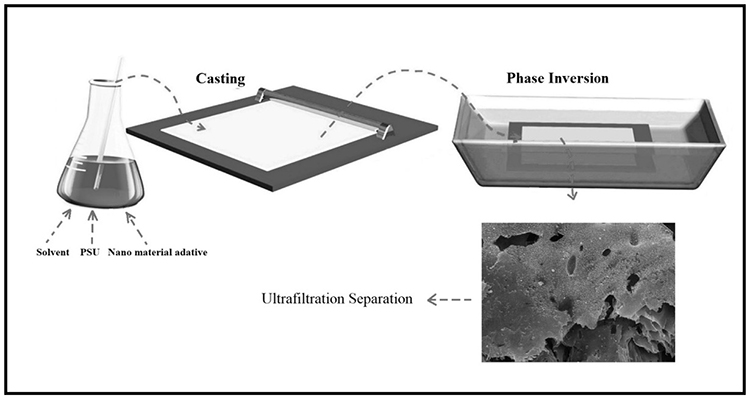
Graphical Abstract
Introduction
Water is life, but increasing consumption and growing scarcity are becoming major global concerns. With the rapid expansion of various industries, water pollution has become an increasingly serious problem. Industries such as textiles, leather, paper, food processing, plastics, and cosmetics are major contributors, as they generate significant amounts of inorganic and organic pollutants—including acids, bases, sludge, phenols, toluene, and dyes [1–3]. Due to their high structural stability, dyes are considered among the most hazardous pollutants [4, 5].
Membrane technologies such as reverse osmosis (RO), nanofiltration (NF), microfiltration (MF), and ultrafiltration (UF) are among the most important methods for water treatment. These filtration methods have been continuously developed to enhance water availability through more efficient processes [6,7]. Compared to other water treatment approaches - including sedimentation, distillation, sand filtration, activated carbon, flocculation, chlorination, and ultraviolet light treatment - membrane filtration offers several advantages: (1) continuous operation, (2) no chemical requirements, (3) low energy consumption, (4) scalability, (5) compatibility with other processes, and (6) automation feasibility [8].
Most of the membranes mentioned are usually made of polymers and their related composites. In the case of ultrafiltration membranes, the following constituent polymers can be listed: polysulfone (PSU), polyamide (PA), polyether sulfone (PES), and polyvinylidene fluoride (PVDF), etc. [9, 10, 11]. A polymer that can create such an asymmetric membrane is polysulfone (PSU) [12]. The PSU has been widely employed for ultrafiltration membranes because of its inexpensive cost, good mechanical properties, excellent membrane-forming ability, anti-compaction qualities, and its strong chemical (acidic and alkaline resistance) and thermal stabilities. However, due to its hydrophobicity, frequent membrane fouling and permeability loss may occur [13]. As a result, the PSU membrane needs to be modified to increase its hydrophobicity using new additive materials [14].
Polymer membrane technology has diverse industrial applications, including gas separation, water treatment, pharmaceuticals, food and beverages, hemodialysis, and textiles. It plays a key role in desalination, wastewater reuse, and ensuring safe drinking water. A major environmental goal is achieving a zero-waste economy, where waste is repurposed into new products. A key challenge is recovering high-value components from industrial and agricultural waste, such as olive mill wastewater, grape marc, and winery effluents. Integrated membrane systems help extract valuable compounds like phenolics and flavonoids. While conventional membrane technologies are used for water purification and desalination, future sustainability will require combining them with other methods for greater efficiency and resource recovery [15,16].
Nanoparticles as additives are among the most well-known modifiers for PSU membranes. In recent years, they have been shown to increase hydrophobicity and reduce fouling in these membranes. Numerous studies have attempted to enhance membrane performance by incorporating nanomaterials, such as carbon-based nanomaterials, carbon nanotube (CNT) [17, 18], metal oxides (Al2O3, TiO2, SiO2, ZnO, MgO, Fe2O3, and zeolite) [19 - 24], and metals [25] into the membrane matrix.
In the current study, modified polysulfone (PSU) membranes were successfully employed to fabricate composite ultrafiltration (UF) membranes via the phase inversion method. The casting solution incorporated multi-walled carbon nanotube (MWCNT) nanoparticles. The effects of these composite UF membranes were investigated with respect to cross-sectional morphology, hydrophilicity, porosity, pure water flux, and Congo Red dye removal efficiency. The membrane structure was characterized using Fourier transform infrared spectroscopy (FTIR), scanning electron microscopy (SEM), and porosity measurements. The results clearly demonstrate that MWCNT incorporation significantly affects membrane structure and that the manufacturing method substantially influences the membrane’s purification performance.
Polysulfone (PSU), with a molecular weight of 35,000, supplied by Xian Lyphar Biotech Co., Ltd., China, was used as a polymer to prepare the membrane casting solutions. Multi-walled carbon nanotube (outside diameter (OD): 10-20 nm (from HRTEM, Raman), inside diameter (ID): 5-10 nm, purity: > 95 wt% (from TGA & TEM)), were provided by US NANO. N, N-Dimethylformamide (DMF) with assay 99 % was used as a solvent from Ambernath, India. Used Congo Red dye (CR) in the separation process with chemical structure C32H22N6Na2O6S2, provided by BDH Chemicals Ltd, Poole, England, UK. The chemical formula of Congo red dye and its Uv-vis spectrum are shown in Fig. 1. Deionized (DI) water was used in the experiments.
Composite ultrafiltration membranes were fabricated using the phase inversion technique, containing 17 wt.% polysulfone (PSU) and 0.05 wt.%.% MWCNT nanoparticles. Table 1 presents the chemical compositions of each casting solution for the UF membrane. For each membrane, the casting solution was prepared as follows: First, the appropriate quantity of CNTs was added to DMF. The solution was then magnetically stirred for 6 hours at 60°C, after which PSU was added. The casting solution was degassed for 1 hour in an ultrasonic bath. A 200-micrometer film of the casting solution was applied onto a clean glass plate using a four-sided film applicator. The glass plate with the cast film was then briefly immersed in DI water. The formed membrane floated off the glass surface to remove any residual solvent. Before testing, the membranes were stored in DI water for at least 24 hours. All processes were conducted at room temperature.
Instrumentation, Characterization, and Performance Methods
The composition of ultrafiltration membranes was determined by the Spectrum Two FTIR spectrometer (Perkin Elmer, Germany), combined with the UATR unit, a was performed using Spectrum 10™ software. Scanning electron microscopy (TESCAN VEGA3 SB instrument, EO Elektronen-Optik-Service GmbH, Germany) was employed to examine the surface and cross-section morphology of membranes. Before the SEM observation, membranes were cracked, sputtered with platinum, and frozen in liquid nitrogen as samples. Following that, SEM inspections with a potential of 5.00 kV at various magnifications were performed on the dried sample of membranes. An ultraviolet-visible Unico 2100 UV-Visible spectrophotometer was used to calculate the dye’s concentration.
The gravimetric approach was used to calculate the overall porosity (ε), which is represented by the following equation (Eq. 1) [4]:
 (1)
Where A is the effective membrane area (m2), W1 is the weight of the wet membrane (g/m3), W2 is the weight of the dry membrane (g/m3), d is the water density (998 kg/m3 at 25 °C), and T is the thickness of the membrane (m). The results of three independent replications of each test were considered.
The performance of the produced ultrafiltration membranes was studied by evaluating pure water flux and dye removal. Fig. 2 depicts the Millipore-Amicon® Stirred cell type ultrafiltration unit (capacity of 400 ml, and membrane area of 20 cm2). The permeability and removal of dye via the membrane were examined at room temperature and pressures in the range of 2 to 7 bar. Eq. 2 was used to compute the permeate flux
 (2)
Where F is the flux rate (L/m2 h), V is the volume of permeate (L), A is the effective area (m2), and t is the filtration time (h).
The solute rejection R (%) was calculated using Eq. 3.
 (3)
Where cf and cp represent, respectively, the concentrations (mg/L) in the feed and permeate solutions.
The composition modification using carbon nanotube was identified with helping the FTIR-ATR spectra of the PSU/MWCNT nanocomposite and pure PSU membranes, which are shown in Fig. 3. The FTIR spectra of the membrane, which contains 0.050 weight percent CNT, are shown in Fig. 3(A). Prominent absorptions are seen at 2357-1942, 1540, and 506 cm-1, which are caused by the symmetric and asymmetric stretching vibrations of the COO- groups of the oxalic anion. The peaks near the 2357 cm−1 and 1540 cm−1 in the IR spectrum of MWCNT are attributed to the C–H and C=C stretching bonds, respectively. What is clear is the sharp reduction in IR light transmission in the presence of carbon nanotubes. Fig. 3(B) includes of IR spectrum of the pure PSU membrane shows a spectrum with better resolution, and the absorption regions related to C-H and C-O, and C=C and sulfonated regions are clearly visible in it (2930, 2871, 1662, 1507, 1385, 1097, 661 cm-1).
Optical transmission and scanning electron microscopic images
Fig. 4 A-B shows the optical transmission, surface, and cross-sectional SEM images of the pristine PSU membrane (CM0) and composite membranes with 0.05 wt% % amounts of MWCNT produced (CMCNT). Fig. 4 (B) It clearly shows the uniform dispersion of nanotubes in the composite membrane structure. In the surface SEM pictures, all the manufactured membranes showed a characteristic asymmetric and porous structure. Adding nanoparticles in different loadings changes the general structure of the membranes. The pristine PSU membrane has a typical sponge-like shape, as seen in the cross-sectional photographs, which is caused by a strong affinity between the non-solvent (water) and solvent (DMF) and instantaneous demixing during phase separation. The exchange rate between the solvent and non-solvent may be significantly changed in the presence of nanoparticles may be changed which may lead to macro void formation and total porosity improvement [1]. Including nanoparticles increases membrane permeability by increasing membrane porosity, extending pore breadth, and causing some macrovoids to develop in the skin layer. Even though the membrane structure changed with nanoparticles, the cross-sectional morphology remained similar to that of pristine PSU [26]. The incorporation of MWNTs resulted in membranes with a uniform dark gray tint. The SEM figures show that the membranes have an asymmetric structure containing a perforated skin layer, a porous sub-layer, and flaky and saw-like pores at the bottom. In both types of membranes shape of the pores on the surface is circular and oval, which are merged in some places. It seems that in the membrane containing nanotubes, the sublayer channels have more intersections, but in the pure membrane, we see regular, aligned paths with fewer intersections.
Hydrophilicity (water drop angle test) and Porosity
The hydrophobic behavior of membrane surfaces is the primary reason for poor antifouling performance [1]. Numerous efforts have been made to increase membrane hydrophilicity, including material modification, polymer blending, and surface modification [4], to improve membrane permeability and antifouling property. Simply, the water drop angle test was performed on both membranes, which can determine the hydrophilicity of their surface to some extent. Several images related to this test are given in Fig. 5. As is clear, the range of water drop angle changes for the polysulfone membrane is 58-64 degrees, and for the composite membrane containing nanoparticles is in the range of 46-48 degrees. This confirms that the hydrophilicity of the surface has increased with the addition of nanoparticles. Although such hydrophilicity cannot be explained based on the functional groups on the nanoparticles, it can be attributed to the better surface charge distribution on the membrane and the possibility of orbital and core interactions between the charge centers of the benzene rings. On the other hand, the membrane preparation process can also affect on hydrophilicity of the membrane. As shown in Table 1, the porosity test results are 20% for the pristine PSU membrane and 24% for the composite membrane. These data confirm the increase in porosity with the addition of nanoparticles in the membrane structure. As we know, the sum of these membrane properties will have a direct impact on the flow rate of fluids through the membrane and the degree of fouling.
Performance test for water treatment
Effect of CNT nanoparticles on the water flux performance
Membrane fouling significantly impacts membrane filtration performance in fluid separations and its usage lifetime. The blockage or plugging of membrane pores, concentration polarization, and cake layer formation are only a few of the issues that cause the membrane flux to be lowered. High flux, little propensity for fouling, and a high rejection rate over an extended period are qualities that a high-quality membrane should have. Membrane fouling has a variety of root causes. Blending with some particles, such as nano materials, can enhance the polymeric membranes’ performance in terms of flow and fouling resistance by contributing to hydrophilicity. [13]. Although the permeability was increased as the pressure rose, it also grew when nanoparticles were added. The high flux could be due to the nanoparticle’s hydrophilicity, large surface area, and pore size [17]. Fig. 6 and 8 demonstrate how the Congo Red dye filtration experiment significantly increased the permeation flux through the two UF membranes. With and without the insertion of CNT nanoparticles, the flux is significantly different. By adding the MWCNT nanoparticles, flow improvement was seen at various pressures between 2 and 7 bar. An important point in the flux diagram of water and Congo dye is the reduction of the flux at higher pressures, which indicates the formation of dye fouling in the nanoparticle-free membrane. An example of this fouling is shown in Fig. 7, and due to the black background color of the membrane containing carbon nanotubes, it is not appropriate to include an image of the membrane for fouling comparison. This experiment shows the significant effect of the presence of nanoparticles on the membrane performance in the separation of Congo Red pigment, which is a result of modifying its structure, porosity, and hydrophilicity. It seems that the membrane casting process and uniform distribution of particles among the membranes can have a significant effect.
Effect of MWCNT nanoparticles on the rejection performance
The effectiveness of manufactured two type UF membranes in removing Conge Red dye from an aqueous solution is shown in Fig. 9. As can be seen, the membrane containing nanoparticles has a significant success in rejection compared to the pristine membrane, and what is quite clear is that the pristine membrane has a drop in rejection at higher pressures, which is due to the occurrence of the fouling process in the separation, while the membrane containing nanoparticles is still separating and rejecting Congo Red dye molecules. As we know, ultrafiltration (UF) uses size exclusion as the mechanism of concentration, where compounds with molecular weights that are smaller than the exclusion size of the filter pass through the filter, while larger compounds are withheld in the retentate. These types of membranes with pore sizes that fall in the range between 0.01 and 0.1 μm are capable of separating large materials such as colloids, particulates, fats, bacteria, and proteins while allowing sugars and other low molecular weight molecules to pass through the membrane. UF membranes typically operate between 3.4–8.3 bar and are dependent on transmembrane pressure to drive the separation process. Membrane processes using UF are used in wastewater reclamation and drinking water to remove micropollutants and natural organic matter [27].
In this paper, two types of membranes made of polysulfone, one containing 0.05% carbon nanoparticles, were prepared by the solvent phase inversion method, and their characteristics were investigated using microscopic methods, IR, porosimetry, water drop angle test, etc., and then the flux test was investigated, and the Congo Red dye rejection rate was evaluated. The results indicate an increase in porosity and hydrophilicity of the membrane containing nanoparticles, and the expected occurrence of fouling in such a membrane is reduced. Of course, the work showed that the casting process in the distribution of nanoparticles has a significant effect on the final result and performance of the membrane. It seems that studying the effect of several types of nanomaterials in membranes in combination will lead to synergistic results in the development of selective rejection results, increasing the flow rate, and reducing fouling effects, and is suggested as a topic for future studies.
All authors declare that they have no conflicts of interest.
