
Document Type : Original Research Paper
Graphical Abstract
INTRODUCTION
Water is a crucial component of ecosystems, acting as a medium for life processes, a habitat for aquatic organisms, and a vital resource for terrestrial life. However, its quality is often compromised by contamination, particularly from heavy metals like iron. The contamination of heavy metal iron can arise from human activities, including mining, industrial discharges, agricultural runoff, and the corrosion of plumbing systems [1].
Heavy metal iron (Fe) is one of the many heavy metals found in human life on earth as an essential microelement to regulate body metabolism, especially in red blood cells. Heavy metal iron (Fe) is the most abundant metal in the Earth’s crust, occupying the fourth largest position [2]. Heavy metal iron (Fe) comes from industrial and household waste and can pollute the river environment in large quantities, causing poisoning in the human body. It is easily absorbed in the digestive tract, is corrosive, and quickly increases the absorption of toxins.
Another waste that has the potential to pollute the environment is iron waste (Fe) from educational laboratories. This waste generally comes from chemicals used that contain iron compounds, such as ferri ammonium sulfate (FAS) solutions, which are often used in COD and chemical analysis. If not managed properly, iron waste can contaminate water and soil, causing ecosystem disruption and being toxic for humans and aquatic organisms. Therefore, an effective management strategy is needed to reduce the negative impact of iron waste and reuse materials that are still useful. ( Fakhrudin dkk, 2017)
Indonesia, as a country reliant on coal-powered energy, has extensive mining operations that contribute to a total coal production of 768.9 million tonnes as of 2024 [3]. Industries that use coal as a fuel for their boilers will generate fly ash, which can contain harmful elements such as arsenic, mercury, and lead. These byproducts pose significant risks to both the environment and human health, necessitating sustainable waste management solutions [4].
Fly ash (FA) is an industrial waste obtained from a high-energy furnace. It consists of inorganic matter that has been fused during coal combustion. The fly ash particles are generally spherical [9] and microns in size. It is produced in millions of tons globally and poses health hazards as well as pollutes the environment [5]. Fly ash’s main contents are silicon dioxide (30–60%), aluminum oxide (15–30%), iron oxide (5–15%), and varying amounts of calcium oxide, which presents a valuable opportunity for the creation of advanced adsorbent materials [6]. Aphane et al. (2019) successfully extracted silica from South African CFA to produce mesoporous silica nanoparticles, demonstrating its potential as a sustainable resource for high-performance adsorbents. The unique properties of nano-silica, including its nano-scale pores, maximize its ability to adsorb contaminants efficiently [7].
Further studies, such as those by Mekhelf et al. (2020), have shown that the application of modified silica as adsorbent material to remove Iron ions from produced water successfully reduces the Iron content from 39 to 0.00039 ppm [5]. Therefore, it can be concluded that chemically modified silica is an effective adsorbent material to remove Iron from produced water. Despite these advancements, research into using nano-silica derived specifically from CFA for Iron adsorption remains limited. This gap presents an exciting opportunity for further exploration, potentially enhancing the reuse of industrial waste while addressing significant environmental pollution challenges. This study explores the use of coal fly ash (CFA) as a source of silica to produce nano-silica, which will then be applied for iron adsorption.
Coal fly ash (CFA) in this experiment was obtained from a fly ash boiler factory in Cikarang, West Java Province, Indonesia. Sodium hydroxide, hydrochloric acid, and standard Fe (III) solution (1000 mg/L) were purchased from Merck Germany.
To prepare CFA, initially, 150 g of CFA was thoroughly washed to remove impurities and heated in an oven at 105°C for 8 hours. Once dried, the CFA was passed through a 100-mesh sieve (HAVER & BOECKER, Germany) to obtain a uniform particle size. The sieved CFA was then heated in a furnace (Barnstead Thermolyne 48000 Furnace, Barnstead International, USA) at 600°C for 1 hour to enhance its reactivity. Following this, 30 g of the processed CFA was soaked in HCl for 4 hours to remove any remaining impurities. The acid-treated CFA was washed with deionized water until a neutral pH was achieved. The pH was checked using a pH meter MI 800 (Milwaukee, USA). Subsequently, it was dried in an oven at 105°C for 8 hours to reduce water content.
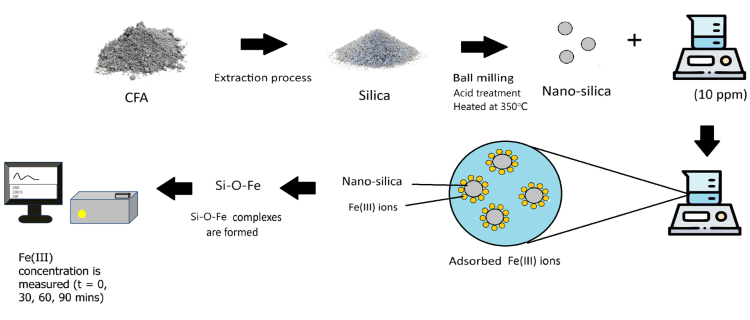
Silica was extracted using the precipitation method according to the literature with some modifications [8]. Thirty grams of the prepared CFA was mixed with 200 mL of 4 N NaOH solution. The mixture was heated at 90°C under constant stirring for 2 hours to dissolve the silica content. After cooling, the mixture was filtered to separate the liquid phase. Hydrochloric acid was then added to the filtrate to precipitate silica as a solid sediment. The precipitated silica was collected and dried in an oven at 105°C. Finally, it was crushed by ball milling using Planetary Ball Mill PM 300 (RETSCH, Germany) and filtered using a 200-mesh. The chemical composition of the CFA used in this study is presented in Table 1, where silicon dioxide (SiO₂) was identified as the dominant component, confirming the material’s suitability as a silica precursor.
Preparation of Si-Nanoadsorbent
The dried silica was calcined in a furnace at 350°C for 1 hour to improve its purity and structure. After cooling, the calcined silica was stored in a desiccator to remove its water content. The silica was then ground into a fine powder using a planetary ball mill. The powder was passed through a 325-mesh type (45 µm) sieve to obtain nano-silica with a uniform particle size.
The materials were characterized using Fourier-transform infrared spectroscopy (Agilent, USA). The structural and crystalline properties were identified using XRD D8 Advance (Bruker, USA). The size and particle size distribution were analyzed using a particle size analyzer (PSA, Nanotrac Wave II, Microtrac, USA).
Fe (III) Waste Adsorption Experiment
For the adsorption test, the Fe (III) standard solution was used to imitate contaminated wastewater. A total of 2 g nano-silica was mixed with 250 mL of 10 mg/L Fe (III) solution. The mixture was stirred at 1500 rpm for 30, 60, and 90 minutes. After mixing, it was filtered to separate the solid and liquid phases. Atomic absorption spectroscopy (AAS, AA-6300, Shimadzu, Japan) was performed on the Fe (III) solution before and after treatment to measure the reduction in Fe (III) concentration. The pH of the solution was also recorded before and after the adsorption process. The Fe (III) removal percentage was calculated using the formula below [9][10].
 (1)
C0 (mg/L) is the initial concentration of Fe (III) before the absorption test, and Ct (mg/L) is the concentration of Fe (III) after adsorption at t minutes.
The size of silica and SiNPs was measured using a laser diffraction particle size analyzer (PSA). As shown in Fig. 1a, the particle size distribution of silica extracted from CFA indicates a larger average size of 1192 nm, whereas the SiNPs displayed a much smaller average size of 85.7 nm, as illustrated in Fig. 1b. Nevertheless, both samples showed a homogenous size distribution, with polydispersity index (PDI) values lower than 0.5, as presented in Table 2. The significant reduction in particle size of the SiNPs can be attributed to physical treatments, including high-temperature processing and ball milling. Achieving nanoscale size is beneficial, as it increases the surface area, thereby enhancing the material’s reactivity and physicochemical properties.
Fourier Transform Infrared Spectroscopy (FTIR)
The FTIR spectra of CFA, SiNPs, and Si-Nanoadsorbent are presented in Fig. 2. All samples exhibit absorption at similar wavenumbers. The broad absorption band at 3400 cm⁻¹ corresponds to the vibration of hydroxyl groups. These materials tend to adsorb moisture from the environment due to their high surface area and form silanol (Si-OH) groups and are identified as the 1631 cm⁻¹ peak. The characteristic of symmetric Si–O-Si stretching vibration appears as a strong absorption band in the 800–740 cm⁻¹ range, while asymmetric stretching of Si-O-Si appeared at 988 cm⁻¹, which typically appears between 1000-1200 cm⁻¹, representing the main absorption of the siloxane bond.
The FTIR spectra display CFA’s similarity to its derived materials. Nevertheless, the SiNPs and nano adsorbent have lower intensity, proving that these derived materials conserved silica characteristics while facing structural modifications.
XRD diffractogram of the crystallinity pattern of CFA, SiNPs, and Si-nanoadsorbent is shown in Fig. 3. CFA has a distinct pattern at 26.52° (2θ), indicating the presence of amorphous silica. Si-nanoadsorbent shows strong diffraction peaks at 20.85° and 26.62° (2θ), which proves a more determined structure compared to CFA after physical and chemical treatment. Nevertheless, three peaks are observed in the SiNPs pattern, specifically at 26.62°, 31.71°, and 45.45°(2θ), which are the main characteristics of crystalline silica. This showed a more organized structure compared to Si-nanoadsorbent and CFA. From the diffractogram, Si-nanoadsorbent displayed characteristics, which were the combination of CFA and SiNPs. It showed the highest peak, indicating increased crystallinity.
Adsorption is considered a competitive technology for groundwater, wastewater, and industrial effluent purification and treatment. This process of separation may provide a cost-effective trade-off to combat water pollution. In this study, the percentage of Fe (III) removal was recorded over time. The contact time between the adsorbent and Fe (III) ions was varied at 30, 60, and 90 minutes. The Fe (III) concentration was determined based on the absorbance measured using an atomic absorption spectrophotometer (AAS). Fig. 4 shows that the Fe (III) concentration (mg/L) depletes as the percentage removal drastically rises.
The principle of adsorption depends on whether the solid surface that comes into contact with liquids tends to accumulate a surface layer of solute molecules due to the imbalance of existing surface forces, increasing the need for adsorbents that can provide complex and effective abilities toward these metal ions [11]. The surface of the silica adsorbent material is composed of oxygen atoms and bonds confirmed on the tetrahedral part of silica and hydroxyl groups that bind to the specific edge of the silicate structure units. These useful groups provide superficial sites for metal ions. The surface of hydroxyl groups separates into natural water and acts as a Lewis base toward metal ions. The reaction of the metal surface bonding (adsorption) is usually preferred by metals due to the hydrolysis properties [12]. Moreover, silica exhibits a range of unique properties that distinguish it from other inorganic compounds. These include chemical inertness, high adsorption capacity, and ion exchange ability. Additionally, silica can be readily modified with various chemical compounds to enhance its performance. It also possesses notable mechanical and thermal stability, and its reversible characteristics make it suitable for use in analyte separation processes [13].
The adsorption process is influenced by functional groups, functional group positions, double bonds, and chain structures of the adsorbed compounds. In addition, the diameter of the adsorbed metal also affects the adsorption process. Several other factors that can also affect the adsorption rate include adsorbent characteristics, solution pH, temperature, adsorbent size, and stirring time [14][15]. Silica is a porous solid. This porous structure is related to the surface area. The smaller pore size of the silica results in a larger surface area, so that the adsorption capacity increases. In addition, silica has unique properties that are not possessed by other inorganic compounds, such as inert properties, good adsorption and ion exchange properties, easy to modify with certain chemical compounds to improve its performance, high mechanical stability and thermal stability, be used for preconcentration or separation of analytes because the binding process of analytes on the silica surface is reversible [16]. The silica used in this study is silica from characterization. The characterized silica surface causes the presence of silanol (-SiOH) and siloxane (Si-O-Si) groups that allow it to bind metal ions more selectively with certain mechanisms [17]. In SiO₂, the high electronegativity of oxygen renders the silicon atom more electropositive, leading to the formation of an unstable intermediate species, (SiO₂OH)⁻. This instability promotes dehydrogenation, during which a second hydroxyl ion captures a hydrogen atom, resulting in the formation of water. Subsequently, two Na⁺ ions compensate for the negative charge and interact with SiO₃²⁻ to form sodium silicate [18]. The stirring time or interaction time of metal ions and absorbents is an important parameter to determine the rate of absorption reaction. The shorter the interaction time, the faster the reaction rate, which also means the higher the absorption rate [19]. In this study, the stirring time was carried out for 30-90 minutes. The results of the decrease in Fe metal waste levels against the effect of contact time are presented in Fig. 4.
The pH of the Fe (III) solution was measured before the application of the Si-nanoadsorbent. Initially, the solution exhibited strong acidity with a pH of 4. After the adsorption process, the pH increased to 6. This result aligns with findings from previous studies that investigated the effect of nano-silica on pH levels during the adsorption of heavy metals, including Fe (III). A study performed by Samani et al. (2024a) found that applying nano-silica to contaminated soil increased the soil pH by 6% compared to the control [20]. Furthermore, her other research showed that the addition of 1000 mg/kg of nano-silica resulted in a 6% rise in soil pH, emphasizing nano-silica’s ability to modulate acidity [21]. Marć et al. (2024) reported that modifying silica surfaces with dopants or nanomaterials improved adsorption performance at acidic pH levels, suggesting potential applications in heavy metal remediation [22]. Collectively, these findings indicate that nano-silica not only enhances the adsorption efficiency of heavy metals like Fe (III) but also increases the pH during the treatment process.
The pH of Fe (III) wastewater can increase after treatment with nano-silica due to several factors. Nano-silica contains silanol groups (-Si-OH) that can interact with H+ ions in the solution. The adsorption of H+ ions by nano-silica can raise the pH, as H+ ions are acidic and contribute to lowering the pH. Additionally, nano-silica can release OH- ions into the solution, which are basic and can further increase the pH. This release occurs because the silanol groups can interact with water, leading to the dissociation of OH- ions. Another contributing factor is the precipitation of Fe (III) from the solution. Since Fe (III) is an acidic ion, its removal through precipitation reduces its contribution to acidity, thereby increasing the pH. Furthermore, nano-silica can undergo chemical reactions with Fe (III) to produce compounds with a higher pH. This interaction occurs due to the reactivity of the silanol groups with Fe (III), leading to less acidic products. In this study, the increase in the pH of Fe (III) wastewater treated with nano-silica is attributed to a combination of these processes. This is in accordance with the findings of Irawan and Ain (2018), who stated that within the pH range of 2 to 5, there is an increase in the percentage of Fe²⁺ ion adsorption, whereas a decrease is observed between pH 5 and 7. At low pH levels, adsorption occurs primarily due to the protonation of the active silanol groups under these conditions. This implies that if silanol has a pKa of 3.5, then at pH values lower than the pKa, the silanol groups are protonated and thus unable to bind with Fe(II). At the optimal pH of 5, the active silanol groups undergo deprotonation (forming SiO⁻), where the negative charge of the silanol groups facilitates binding with the positively charged Fe(II) ions. This indicates that when the pH exceeds the pKa, the silanol groups become negatively charged and exist in an anionic form, thereby enhancing the interaction between Fe(II) ions and SiO⁻ groups [23]. However, the results may vary depending on experimental conditions and the specific characteristics of the nano-silica used [24].
This study shows that coal fly ash (CFA) can be effectively used as a source of silica to produce nano-silica, which works well for iron (Fe (III)) adsorption. The silica was successfully extracted through a precipitation method by adding NaOH and HCl, and then converted into nano-silica using heating using an oven and furnace, and ball milling. The resulting nano-silica was characterized using FTIR, XRD, and PSA, confirming its structure and particle size. When tested for Fe (III) adsorption, the nano-silica achieved a removal efficiency of 94.48%, as shown by AAS analysis. These results suggest that using CFA to produce nano-silica is a practical and cost-effective way to reduce iron contamination while also addressing the issue of coal fly ash waste. This approach not only provides a useful method for heavy metal removal but also offers an environmentally friendly way to manage industrial by-products.
The authors do not have any conflicts of interest.
