
Document Type : Original Research Paper
Graphical Abstract
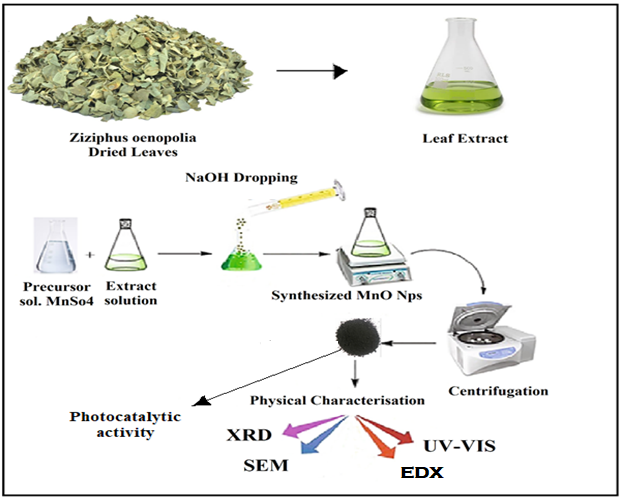
INTRODUCTION
The world’s rapid industrial and economic expansion, one of the main challenges facing developing nations is industrial wastewater treatment. Due to their hazardous and non-biodegradable by-products, the dye and pigment industries are among the most concerning of all the industries [1]. Residual dyes from textile, pharmaceutical, and dye intermediate industries are non-biodegradable organic contaminants that invade natural water sources and wastewater treatment systems [2-4]. Discharging dye-containing effluents into water is harmful as they produce hazardous chemicals through hydrolysis, oxidation, and other chemical processes during the wastewater process [4-6]. The dye degradation using the nanoparticles is more effective than using organic chemicals that are toxic to the living environment due to their sedimentation in the aquatic systems. Purifying textile waste effluents, especially dyes, is vital for both human health and the environment. Textile dyes can be purified using a variety of processes, including biological, filtration, adsorption, sedimentation, ion exchange, UV treatment, and ozonation [7-12]. However, many of them are expensive, scarce, and useless in certain instances. At the moment, scientists are drawn to photo degradation as a potential method for these uses due to its high accessibility and efficiency compared to other conventional techniques [13]. But in order to fully benefit from these advantages, a photo catalyst with a high surface area, stability, photocatalytic activity, and biocompatibility is required. Nanomaterial-based photo catalysts have been identified as capable of efficiently degrading textile colours due to their unique characteristics. Metal (Ag, Au) and metal oxide (ZnO, TiO2) nanoparticles (NPs) have been examined for their potential use as photo catalysts for textile dye degradation [13-14]. Numerous types of nanoparticles have been used to battle pollution in the air, water, and soil. Environmental issues brought on by synthetic colours, halogenated hydrocarbons, and heavy metals have been effectively mitigated by nanoparticles [16]. Hybrid nanomaterials have garnered increasing interest in recent years because of the initial compounds’ synergistic qualities and their use in functional materials [17-20]. Different dyes are employed for a variety of reasons in a variety of industries, including the paper, rubber, textile, food, printing, cosmetics, pharmaceutical, plastic, and concrete sectors [21-23]. Methylene blue (MB) (Scheme 1), a common colorant for silk, wool, cotton, and paper, is one of the most consumed ingredients in the dye industry. A catalyst (usually photoactive materials of Nano-level size) and solar energy are used in the sophisticated and cost-effective process of photo degradation, contaminants found in the environment [24-25].
MATERIALS AND METHODS
Materials and Chemicals
The chemicals sodium hydroxide (NaOH) and Manganous sulphate monohydrate (MnSO4.H2O) were procured from Merck. The Material Ziziphus oenopolia leaves had been collected at Sathyamangalam, Tamil Nadu, Erode District.
Preparation of leaf extract
The Z. Oenopolia leaves were collected, washed with tap water, followed by distilled water to remove the impurities. Washed leaves were collected and dried at room temperature for 50 days. Then the dried leaves were ground into fine powder. The powdered leaves of 25 g of leaf powder were taken and added to 250 mL of distilled water and stirred using a magnetic stirrer for 4 hours. Then the stirred solution was filtered, stored, and further used for the synthesis of nanoparticles.
Synthesis of MnO2 nanoparticles
MnO2 nanoparticles were prepared using Z. Oenopolia leaf extract. About 40 ml of extract was taken in a beaker and 60 ml of 1M aqueous solution of manganese sulphate, stirred for 1 hour. To this mixture, NaOH was added drop by drop until the pH of the mixture reached 9, and the colour change was noticed. The solution was kept overnight without any disturbance. The mixture of the solution was centrifuged at 10000 rpm for 5 times. The solution containing the pellet was washed with distilled water several times. The centrifuged precipitate was washed several times to remove the impurities. The precipitate was dried in a hot air oven and to maintain a temperature of 80℃. The dried nanoparticles were used for further characterization and Photocatalytic dye degradation.
Photocatalytic activity of MnO2 NP’s
Approximately 25 mg of dye had been taken and 250 mL of distilled water in a Standard flask. Different dye solutions (10,20,30, and 40ppm) have been prepared from the 250ml dye solution. Separately, 0.005 g of MnO2 NPs were added to each beaker containing 100 ml of a 10,20,30, and 40 ppm Methylene Blue dye solution. For about one hour, they were left in the dark place to reach the adsorption–desorption equilibrium. After that, each combination was left in the sun for a variety of lengths of time. A UV-visible spectrophotometer has been used to investigate the Methylene blue dye.
To ascertain the effect of pH on the degradation of MB dye, the pH medium was evaluated using a range of pH solution concentrations of 5, 7, and 9. Before creating the dye solution, distilled water was mixed with 1M HCl and 1M NaOH solutions to produce basic and acidic solutions. For the catalyst dosage study, various grams of synthesized nanoparticles (0.005,0.007,0.009,0.011,0.013g) and 20 ml of Methylene blue dye solution were added to different glass containers. The mixture was kept in the presence of sunlight for one hour. The following investigations were conducted at various time intervals (5, 15, 30, 45, 60, 75, 90, 105, and 120 minutes).
Characterization of MnO2 Nanoparticles
The following techniques were used to successfully characterize the synthesized MnO2 Np’s. X-ray diffraction (XRD) analysis was used to characterize the crystal structures of the synthesized samples. Scanning electron microscopy (SEM) was used to investigate morphology and structures (SEM). Using EDX examinations, the elemental composition of NPs was examined. Fourier transform infrared spectroscopy (FTIR) was used to identify the functional groups that were present in the samples. A UV-visible spectrometer has been used to document the nanoparticles’ absorption readings.
RESULTS AND DISCUSSION
UV-Visible Spectroscopy
UV-Vis spectroscopy is among the most practical methods for characterizing nanoparticles. UV-visible spectroscopy, which operates at room temperature in the optical range of 300–900 nm, was used to carry out the characterization. The strong broad absorption peak at about 358 nm affirmed the presence of the synthesized nanoparticle. Figure 1, which led to the formation of MnO2 nanoparticles.
X-ray diffraction analysis
XRD is used to analyse the crystalline nature (Figure 2). XRD analysis, the pattern was attributed to the tetragonal phase of MnO2 NPs, JCPDS card (File no: 14-644). The lattice planes of (200), (211), (212), and (430) were represented by the major peaks seen during the XRD examination at Bragg angles of 32.4°, 44.6°, 51.0°, and 60.1° [26].
Scanning electron microscopy and EDX analysis
A scanning electron microscope was used to examine the surface morphology of MnO2 NPs. From the SEM analysis, the shape obtained from the synthesized MnO2 nanoparticles was Spherical (17). Figure 3(a) shows the SEM analysis of synthesized MnO2 nanoparticles. Using EDX analysis, the elemental composition of MnO2 NPs was ascertained (Figure 3 (b)). Manganese oxide is represented by the elemental composition of the nanoparticles, which exhibits 33.2 weight percent Manganese and 66.8 weight percent oxygen.
Mechanism for photo degradation of methylene dye using MnO2 nanoparticles
When exposed to sunlight, electrons (e⁻) in the metal oxide photo catalyst (MnO2) are excited to the conduction band (CB), leaving behind positive holes in the valence band (VB). These excited electrons are then captured by the holes, facilitating the photocatalytic process. The positively charged holes facilitate the oxidation of dye molecules with strong oxidative properties. Additionally, these holes can react with water molecules (H₂O) to generate hydroxyl radicals (.OH), which contribute to the degradation process. When the electrons in the conduction band of the synthesized MnO2 nanoparticles interact with O₂ molecules, superoxide anions are generated.
MnO2-NPs + hν → MnO2-NPs (h+ + e-) (1)
h+ + MB Dye → oxidation of dye molecules (2)
h++ OH- / H2O → •OH(3)
e- + O2 → •O2- (4)
•OH + •O2- + MB dye → degradable / less-toxic (5)
The band gap of the material determines the energy differential between the oxidation and reduction processes. The photocatalytic degradation is determined by the metal’s band gap. A narrow band gap indicates increased photocatalytic dye degradation activity [27].
Effect of the concentration of dye for synthesized MnO2 nanoparticles on photocatalytic degradation
MB dye’s photocatalytic dye breakdown mechanism was first investigated at concentrations between 10 and 40 ppm. Figure 4 shows the various concentrations of the MB dye’s dilution. The degradation procedure was carried out for 1 hour. At 10 ppm, the dye’s hue and intensity did not alter; as the levels rose to 20, 30, and 40 parts per million, the hue became intensified. As the degradation percentage increased from 10-40 ppm concentration decreased. According to Beer-Lambert’s law, poor photon absorption and photo degradation occur when the concentration of dye increases because fewer photons penetrate the path length. According to the UV-visible graph, degradation diminishes as dye concentration rises. For 10, 20, 30, and 40 ppm, the corresponding percentage degradation during 60 minutes is 85, 73, 61, and 49%.
Effect of time for synthesized MnO2 nanoparticles on photocatalytic degradation
Over time, MnO2 NPs were used to degrade the dye in the solution containing 10 ppm MB dye solution. During durations of 0,15,30,45,60 minutes, the MB dye degradation diminishes with the prolonged exposure to sunlight. For 5,15,30,45, and 60 minutes, the dye fell down at the rates of 51,63,74,85,90% respectively. Figure 5(a) shows the photographic images of colour diminish at various periods. The constant degradation of molecules of dye is confirmed by the progressive increase in the number of molecules of dye degradation.
Effect of pH on synthesized MnO2 nanoparticles on photocatalytic degradation
For the values of pH 5,7,9, the photocatalytic degradation was carried out. The generation of hydroxyl ions during the degradation of textile dyes is influenced by pH. Figure 6 (a) shows the colour diminishes from before degradation to after degradation at various The generation of hydroxyl ions during the degradation of textile dyes is influenced by pH. Levels. When the pH increases, the colour becomes less, because of the more generation of OH radicals, the MB dye molecules are degraded. At pH 5,7,9 the degradation shows the percentages of 68,72,91, respectively. The pKa value of the adsorbate and the pH of the adsorbent should be used to explain the pH-dependent adsorption performance of methylene blue dye. Since methylene blue has a pKa of 3.8, the methylene blue species in solutions are cationic at pH values greater than 3.8[28].
Effect of catalyst dosage for synthesized MnO2 nanoparticles on photocatalytic degradation
Figure 7 shows the catalyst dosages (0.005,0.007,0.009,0.011,0.13) for MB dye degradation. The catalyst increases from 0.005 to 0.013g the degradation of the catalyst is noted. Catalyst can be agglomerated; the MB dye molecules were degraded. When the catalyst dosage increases, resulting that percentage of degradation, the dye can be removed at a better percentage. For 0.005,0.007,0.009,0.011,0.013g catalyst dosage, the percentage degradation is 51,62,74,83,91%. Therefore, a greater dosage of photocatalyst is appropriate for MB dye degradation. MB dye degrades in a dose-dependent manner that is entirely consistent with first-order kinetics.
CONCLUSION
Based on the current work, methylene blue dye was degraded by the synthesized MnO2 nanoparticles that have substantial photocatalytic activity. The bio-fabricated nanostructures manifest the characteristic SPR bands, which attest to the formation of Manganese Oxide Np’s. The powder X-ray diffraction studies reveal the tetragonal phase. The SEM revealed the unique spherical morphologies of Manganese oxide nanoparticles. The respective EDX spectra authenticate the elemental composition with high-intense metallic Manganese and low-intense oxygen peaks. At 40 ppm, the methylene blue dye was degraded when compared to 10 ppm. Almost 90% of the dye was effectively degraded in 60 minutes. In addition, 91% of the dye had disappeared in 60 minutes, indicating that dye degradation was successful. Using 0.013g of the photo catalyst for 60 mins,91% of the dye was produced. The optimum conditions for photocatalytic dye degradation using MnO2 as the photocatalyst were achieved by maintaining pH levels. The pH 9 gave the result of 91% degradation, and a time range of 60 minutes was maintained throughout the dye degradation. Finally, the synthesized MnO2 nanoparticles exhibit good photocatalytic degradation for methylene blue dye.
The authors declare no conflict of interest.
