
Document Type : Original Research Paper
Graphical Abstract
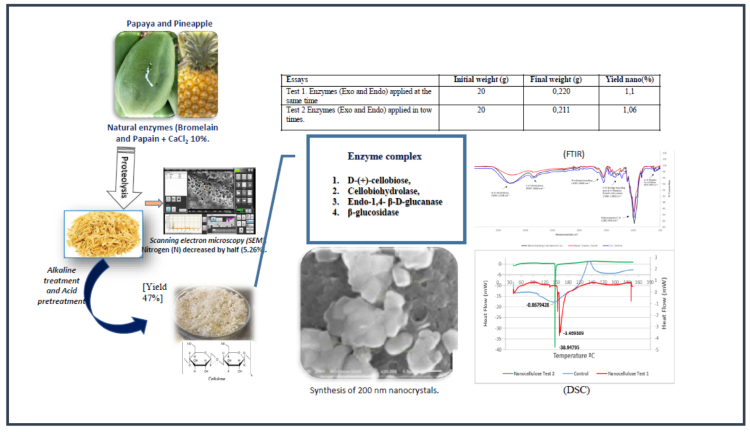
Introduction
Mexico obtained the origin designation (OD) for rice from the state of Morelos in 2012, which was the result of a close and very long-term relationship between producers, federal and local government agencies, through the INIFAP. Experimental Field Zacatepec [1].
Rice is among the most widely consumed foods worldwide and is one of the most complete cereals in terms of calorie content. However, the large-scale rice industry generates significant quantities of rice husk (Oryza sativa L.), which has become a major environmental pollutant.
Production of low-cost products from natural material as carrot waste, is an important case mentioned by different authors [2]. In recent years, rice husk has gained a lot of value due to the discovery that cellulose can be extracted from this biomass for the synthesis of nanocellulose through enzymatic hydrolysis, a method that is less harmful to the environment.
Initially, research utilizing enzymes such as exoglucanases and endoglucanases has shown promising results in cellulose extraction, demonstrating the advantages of enzymatic methods and their potential for large-scale industrialization [3].
To maximize cellulose yield, alternative methods for converting rice husk into cellulose must be explored. Traditional techniques typically involve three steps: alkaline chemical treatment with sodium hydroxide (NaOH) [4], bleaching with sodium hypochlorite (NaClO) [5], and acidic pre-treatment with hydrochloric acid (HCl) [6].
Despite these applications in animal tissues, little is known about its effect on plant tissue. Used to coagulate milk and form cheese, as well as in the beer clarification process. However, despite these applications in animal tissue, little is known about its effect on plants.
Precisely, its elasticity and rigidity depend on many factors such as the type of polymer and its concentration. The concentration of salts and pH also influence, which accelerates the gelation of polymers such as pectins and some proteins S. [7]. It has been a common practice to treat meats with papain and bromelain, proteolytic enzymes extracted from plants [8], to tenderize meats [9]. In the case of papain, it has a broad specificity, that is, it digests the vast majority of proteins, and treated meats tend to become softer and softer.
Recent studies have reported that it was possible to modify the structure of the hull when natural enzymes with proteolytic activity were applied, favoring the final cellulose yield between 49.1%-56.3%.
An environmentally friendly biological way has been used in recent times to obtain nanocellulose from rice husk. Enzymatic hydrolysis is used for the production of nanoparticles with low energy consumption [10] (Pääkkö, 2007). This procedure results in crystalline nanofibers linked to the amorphous phase [11]. The enzyme cocktail has the function of breaking down the cellulose polymer into smaller molecules [12,13]. The added buffer ensures constant enzymatic activity [14, 15]. In comparison of both routes, enzymatic and chemical [3], it was found that evident results recognize the synthesis of nanocellulose (NC) by both routes, generating greater contaminants in the medium due to acid hydrolysis, being more feasible and faster with enzymatic hydrolysis using a couple of enzymes (D-(+) cellobiose and endo-1,4-ꞵ-D glucanase) with which there is less aggression to the environment and greater performance.
Based on the above, the objectives of these assays were to evaluate the combined effect of natural proteolytic enzymes applied to rice husk, before obtaining Cellulose, in addition to verifying the effectiveness of the enzymatic hydrolysis composed of four enzymes: (D -(+)-cellobiose, endo-1,4-ꞵ-D glucanase, ꞵ-glucosidase and cellobiohydrolase), for the synthesis of (CNCs) with two different procedures.
Evaluation of the effect of proteolytic enzymes on rice husk
Before assessing the effect of proteases on rice hulls, the conditions for their application were tested in comparison with different tissues, which offered references on the best circumstances to apply the enzymes [9].
A solution of 200 mL of natural enzymes Bromelain + Papain (Brom./Pap.) was prepared in a 50/50 w: :p ratio, applied to 10 g of rice husk, under constant stirring for 72 h.
To obtain cellulose, rice hulls from the Morelos A-2010 variety were used. Husk was washed with distilled water at a temperature of 65°C for 90 minutes with constant agitation, to eliminate dirt and harmful fauna.
Subsequently, it was placed on metal trays and dried in an oven at 45°C /24 h. Once dry, it was crushed in a conventional blender, turning it into a fine powder.
It was weighed and sieved with the # 30 sieve, after which it was weighed again and separated into 250 mL flasks in five repetitions of 20 g for two treatments [3].
In a volumetric flask, the solution for the cooking treatment was prepared with 5% NaOH, taking a ratio of 1:10 shell/solution, and added to the flask of each treatment, subsequently placed on a grill at 102°C for 90 minutes. In constant agitation.
After cooking, the samples were cooled for 20 minutes, filtered, and washed with distilled water to achieve a neutral pH. The biomass was dried in an oven at 80°C for 180 minutes, weighed [4].
Two bleaching solutions were compared: 1% hydrogen peroxide (H2O2) solution for the first treatment and 1% sodium hypochlorite (NaClO) solution.
Each solution was added to the biomass or fiber and stirred on a grill at 80°C for 90 minutes.
After cooling, the samples were filtered, washed to neutral pH, dried at 80°C for 180 minutes, and weighed [5].
Once the bleached fiber was obtained, a pre-treatment with hydrochloric acid (HCl) was carried out for both products, at a concentration of 0.65% w/w in a volumetric flask.
These glasses were placed on a grill at 80°C for 90 minutes. In constant agitation.
After cooling, the samples were filtered, washed to neutral pH, dried at 80°C for 180 minutes, and weighed [16]. (García et al., 2009).
After drying, the samples were cooled at room temperature and then weighed on an analytical balance, in order to record the weight obtained for each stage [17]. (Martelli-Tosi et al, 2016).
The Cellulose yield was calculated as follows:
C (%)=C /CA(100)
C: Cellulose weight
CA: Rice husk weight
To obtain nanocellulose, two tests were carried out (Test 1) using all the enzymes together (exo and endoglucanases) on cellulose, applied at the same time. (Test 2) The enzymes are applied in pairs, exo or endoglucanases, in two different phases or times.
The enzyme complex consisted of D-(+)-cellobiose, endo-1,4-β-D-glucanase, β-glucosidase, and cellobiohydrolase, each prepared as stock solutions based on supplier specifications [9] (Martínez et al., 2016).
Therefore, four mother or stock solutions were prepared, considering the enzymatic activity described by the supplier. As follows: 5 mg of D-(+)-cellobiose diluted, 1 mL of endo-1,4-β-D-glucanase, 3 mg of β-glucosidase, and 5 mL of Cellobiohydrolase, each diluted in 50 mL of sterile deionized water. Finally, keep refrigerated until use.
Two tests were carried out with the use of all the enzymes together on the cellulose, applied at the same time.
Test 1: 20 g of Cellulose were taken and 46 mL of buffer (C2H3NaO2 and CH3COOH), pH 4.65, was added to a flask, to which 1 mL of the stock solution of the following enzymes was added: D-(+)-cellobiose, cellobiohydrolase, endo-1,4-β-D-glucanase, and β-glucosidase.
Subsequently, it was covered and a water bath was used at a constant temperature of 30°C for 72 h with stirring.
At the end of the time, the pH was verified, which should be between 4-5. [18].
Test 2 with enzymes applied to Cellulose in a couple of exo and endoglucanases in two different phases or times. In a 300 mL flask, 5 g of Cellulose and 46 mL of C2H3NaO2 and CH3COOH buffer with a pH of 4.6 (Sigma-Aldrich) were added, followed by 1 mL of the D-(+)-cellobiose stock solution and cellobiohydrolase.
The flask was covered, and a water bath was applied at a temperature of 50°C for 72 h [14](Albernas et al, 2014; Martelli-Tosi et al, 2016).
After cooled at room temperature (RT), and pH verified in the range od 4-5\ which was left stirring at room temperature (RT) for 24 h, 1 mL of stock solution of endo-1,4-β-D-glucanase and β-glucosidase were added to flask, and it was left 72 h at 30°C and constant stirring [18](Castillo et al., 2019).
Dialysis of nanocellulose samples
Upon completing the hydrolysis, the products of each test were poured into dialysis membrane tubes (14000 Da).
The tubes were suspended in a 2000 mL beaker containing deionized water and left under constant stirring for 72 h, with water changes every 24 h to maintain neutral pH [9]. Once dialysis was completed, the neutral pH was verified in each case.
In each trial, a supernatant was obtained, which was separated and centrifuged at 3000 rpm for 10 min [20].
At the end of the centrifugation, the content was dried in an oven at a temperature of 80°C for 24 h, and then the obtained powder was weighed.
But in the case of Trial 2, the supernatant was taken and placed in a 50 mL flask to apply sonication at 28 Herz for 30 minutes [21]. The ultrasonic cleaner has been used for the synthesis of nano-sorbent (40 kHz) with good results [22]. Subsequently, the supernatant was taken, and centrifugation was repeated at 3000 rpm for 10 min. At the end, the sample was dried in an oven at 80°C for 24 h, and then the product was weighed.
Nanocellulose yield
At the end of the drying process, the nanocellulose yield was calculated in the same way as for cellulose, according to [17].
Figure 1 shows a resume, step-by-step process for the nanocellulose production using all the enzymes in each treatment.
The process begins with the maceration of cellulose to prepare it for subsequent steps. This is followed by enzymatic hydrolysis and dialysis. Centrifugation is performed after the second test to separate components. The sonication of the product, which allowed the size of the nanoparticles to be reduced, the product to be dried and weighed.
Fourier transform infrared spectroscopy (FTIR).
For this analysis, the Fourier transform infrared spectroscopy (FTIR) technique was used, employing a Perkin Elmer spectrophotometer (Model Spectrum Two). The crystallinity of the nanocellulose samples was determined in both tests.
Once the nanocellulose samples were completely dry, they were placed on the spectrophotometer’s reading grid, with readings taken at 16 scans in a range of 4000 to 500 cm-1, as described by [23].
Scanning electron microscopy (SEM)
A JEOL brand JSM-6010 LA scanning electron microscope was used to determine the morphology and size of the nanocellulose obtained in both tests.
A reinforcement of the exposed membranes was carried out with colloidal gold for 2 min. To then transfer the samples to the microscope. Micrographs of the microcrystal structure of each sample were taken at 20 kV [24].
Differential scanning calorimetry (DSC)
The DSC thermal analysis was carried out in collaboration with Dr. Apolonio Vargas Torres from the UAEH campus, Tulancingo, Hidalgo (Mexico).
In this characterization, the degree of crystallinity and stability of the nanocellulose obtained in the tests was determined by measuring the heat changes associated with the thermal denaturation of the cellulose molecule, when heated at a constant rate in aluminum trays as described [25].
Effect of proteolytic enzymes on rice husk
Table 1 shows the data obtained for the quantification of proteins from the sample of untreated rice husk (Absolute Control), husk with water (Control), and hull treated with proteases (Brom/Pap), using the reference equation of the straight line obtained from the standard solution.
Comparing the information obtained for each measurement in the table, it is possible to appreciate the decrease in concentration (g.mL-1) of the sample treated with proteolytic enzymes compared to the control sample.
Proteases can cause protein digestion and are therefore used for the synthesis of new compounds, as mentioned [27].
This shows the effect that the enzymes produce in the rice husk by producing a decrease in the protein concentration, corroborating with the procedure of [26] when quantifying proteins through Lowry.
Scanning electron microscopy (SEM) of rice husk
Figure 2 shows the effect of proteases on rice husk biomass before being processed to obtain cellulose. Image 1a shows the untreated surface of the husk, displaying a smooth appearance, without any modification.
Image 2b reveals a portion of the shell with some cavities due to mechanical effects. While images 3c and 4d indicate the degradation of the tissue or total softening of the cells, due to the action of the proteolytic activity of natural enzymes (Brom/Pap), which allow the emptying of the cavities that store starch and proteins of the wall, which cause a lightening of the fabric and facilitate the subsequent action of pretreatment or cooking.
These findings align with the observation of [28], where untreated husk tissue exhibited starch granules and proteins gelatinized and covering parts of the cells.
Untreated samples also showed intact cell layers with no damage.
When the enzymatic treatment has been given, empty cavities with remains of starch are distinguished. These observations in the tissue confirm the previous results, detected by protein removal that favors the greater subsequent yield of cellulose.
In the case of papain, it has a broad specificity, that is, it digests most proteins, and in the case of treated meats, they tend to become increasingly softer. These proteases have also been used to coagulate milk, in the form of cheese production and the beer fining process.
Despite this, it is the first evidence in plant tissue that contributes to obtaining cellulose [29].
A spot analysis using a scanning microscope (SEM) of the Cascarilla, where an element analysis (EDS) was performed (Table 2), shows Nitrogen (N) values in the control sample (10.90%). In the following Table 3, corresponding to the husk treated with enzymes (Brom/Pap), the values of this element decreased by half (5.26%).
The previous results confirm the loss of proteins, which are denatured with the protease treatment. This aligns with values previously reported by some authors: 11.77% in the polishing (pericarp and tegument) and between 12.09 and 10.66%, for three polishing fractions of different sizes [28;30].
However, Valverde et al [31] mentioned 3.8% in peel. Precisely, its elasticity and rigidity depend on many factors such as the type of polymer and its concentration.
This treatment ultimately produces a better fiber structure before cellulose synthesis, which subsequently improves yield, corroborating previous findings [32].
The average yield of cellulose obtained from rice husks after initiating the process with 20 g of material. The cellulose extraction process, as shown in Table 4, was satisfactory. Traditionally, it involves three steps: alkaline chemical treatment with NaOH [4], bleaching with NaClO [5], and acidic pretreatment with HCl [6]. The results show the average weight loss in each stage.
When comparing cellulose obtained from husks pretreated with proteolytic enzymes (Brom/Pap) to a control sample, a yield of 44.51% was obtained.
Furthermore, the treatment using proteolytic enzymes (Brom/Pap) and 10% calcium chloride (CaCl2) achieved even better results. The presence of calcium chloride enhanced the activity of proteolytic enzymes. As shown in Table 4, this method yielded 47.41%.
The increase in cellulose production by applying natural enzymes such as Papain and Bromelain before the cellulose production process is an innovative advance that could be used compared to other biomasses to improve industrial yields.
Nanocellulose characterization
Fourier transform infrared spectroscopy (FTIR).
The IR spectrum shows the functional groups detected when comparing the nanocellulose synthesized from the fiber or biomass before using the proteolytic enzymes, taking as reference a standard microcrystalline cellulose control, versus a cellulose control, scanning from 4000 to 550 cm-1 (Figure 3).
The bands located in the region of 3500-3100 cm-1 indicate the stretching vibration of the O-H group in cellulose. This increase can be attributed to a greater number of O-H groups exposed by the treatment in the nanocellulose obtaining.
These findings are consistent with [33], who observed a similar increase in O-H groups when obtaining nanocellulose via acid hydrolysis from wood waste.
The functional groups observed in a range of 2999 to 2850 cm-1 identify a stretching of the C-H bonds, with greater intensity in the nanocellulose sample. One of the most important peaks is observed in the range of 1650-1600 cm-1, which indicates the bending of hydrogen bonds (H) and consequently the characteristic absorbed water that indicates the differences between the controls and the nanocellulose obtained above 96 %.
Some reports have explained that within the range of 1500 to 1380 cm-1, in-plane O-H bending and C-H bridge bending are obtained. Also, a particular signal was observed, which is the stretching of C-O within a range of 1200 to 900 cm-1. And finally, you have the out-of-plane O-H bending that is within a range of 660 to 600 cm-1.
According to the spectral data, there is a similarity between the groups that characterize the cellulose samples obtained from rice husk with water and rice husk treated with proteolytic enzymes (Brom/Pap), compared to the commercial cellulose standard. These results align with the cellulose spectra that were obtained by other authors [36].
Scanning Electron Microscopy (SEM)
Images of nanocellulose samples were captured using an
Electron Microscope (Figure 4).
The structure and morphology of these particles allow us to compare the nanocellulose treated with enzymes in tests 1 and 2 (5 A-B) against the untreated control sample (5C).
Nanoparticles with 200 nm are observed, dispersed across the surface. These images were visualized at magnifications of 5000X (line 5 µm) and magnifications of 30000X.
It has been reported that nanocellulose particles obtained
from tunicates are longer compared to those obtained from wood or cotton [34], with lengths ranging from 100–500 nm.
Such results agree with [35], who demonstrate that with nanoscale dimensions, cellulose nanoparticles isolated from rice husk through acid hydrolysis are promising and contribute to preventing environmental pollution from these sources of biomass. Similar results had been obtained by some authors [32].
Differential Scanning Calorimetry (DSC)
An analysis of the samples with scanning calorimetric differentiation (DSC) offers evidence of the crystallinity and thermal stability of the particles (Figure 5).
The nanoparticle sample, according to the applied protocol, shows the crystallization temperature with a well-defined peak at 150°C, typical of crystallization for nanocellulose. While the control nanoparticles offer three peaks, with transition stages, at 100°C, second at 125°C, and finally the final crystallization at 149°C.
This corroborates what was obtained by [39], who showed melting points of nanocellulose obtained from rice husk, after acid hydrolysis, close to 207°C.
While, through the enzymatic route, they showed two
endothermic peaks between 209 and 219°C. This confirms the greater crystallinity and thermal stability.
Other authors have explained that nanocellulose exhibits a decomposition pattern in three steps attributed to: the first loss of water through vaporization, second, the pyrolysis of cellulose, which involves a combination of the decomposition and depolymerization of glycosilic units, and the third stage, the degradation of carbon residues into lower molecular weight components.
Similar results were also reported by [2, 4] for nanocelluloses extracted from peanut shells and rice shells, respectively. While [2,4], they infer that they obtained peaks below 150°C.
In Table 5, we show the yields of nanocellulose produced when applying Trial 1 (all Exo and Endo enzymes applied at once) and Trial 2 (Exo and Endo enzymes applied in two times).
The results were lower in both cases (1,1 and 1,06 %) than those obtained with other previously applied protocols. Of course, production could be higher if we have an optimal yield of raw materials and losses due to handling during the process are minimized.
These results do not coincide with those reported by [37], who obtained a nanocellulose yield (6,9%). But they were similar to those obtained by [32], when they used two enzymes (1,8%).
Although it was higher (4,2%), when they used four enzymes together, exo and endo were applied in two different phases or times.
As in any enzyme-mediated process, the production of CNCs can be affected by several parameters; some of them directly influence the efficiency of cellulose (like pH, temperature, binding affinity), while others can dictate the way the enzymes will act on the cellulose, thus affecting the performance of the process and the properties of the final CNCs [38].
On the other hand, the manipulation carried out in this manual process is not ruled out, where washing and changes to achieve adjusted pH can lead to losses of nanoparticles.
The validation of these protocols confirms that both can be capable of obtaining nanocellulose. Therefore, the complex of four enzymes tested in this trial does not surpass the previous results when using the enzyme complex, such as cellobiose and endo-1,4-β-D-glucanase (Zinge and Kandasubramanian, 2020). In all cases, these enzymes degrade the lignin and hemicellulose regions, which further help the biodegradability of cellulose (Hernandez et al, 2022). However, they do not have the optimal performance to be profitable in the industry. It would be worth considering whether rice husk is finally an accepted biomass for being a contaminant, rather than as a viable alternative to compete with other agro-industrial waste.
The application of proteolytic enzymes (Brom/Pap) on rice husk allows the denaturation of the structural proteins that are part of the plant tissue and facilitates obtaining a higher yield of 44 - 47%.
During the validation of the protocol to obtain Cellulose, it was verified that it is possible to replace sodium hypochlorite with commercial hydrogen peroxide (H2O2) as a bleach.
When validating the applied protocol to produce Nanocellulose through enzymatic hydrolysis, effective activity was assessed for the synthesis of 200 nm nanocrystals.
However, further adjustment of the protocol is still needed to achieve performances higher than those proposed for an industrial stage.
The authors declare that they have no known competing financial interests or personal relationships that could have appeared to influence the work reported in this paper.
This work was supported by the National Council of Science and Technology (CONACYT), Mexico; [Project Ref. 6401/2020].
We thank Conacyt for the scholarship awarded for the Postdoctoral Stay through the project Ref. 6401/2020, and the General Direction of the TecNM/ITZacatepec, for the support the execution of the project. We thank Dr. Apolonio Vargas Torres de la (UAEH/ Institute of Agricultural Sciences, Tulancingo Hgo. Mexico.) for the realization of the thermal analyses.
