
Document Type : Review Paper
Graphical Abstract
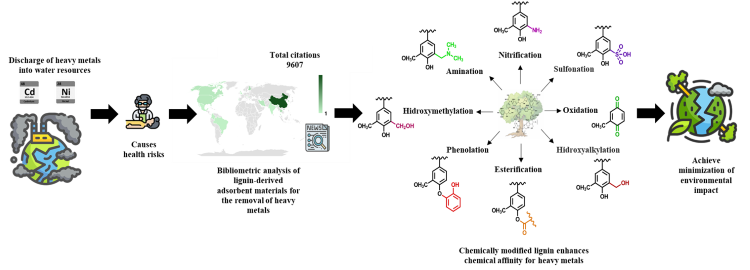
INTRODUCTION
Water is a strategic resource for a country’s social and economic development. Nowadays, requirements are multiplying, and access to water is essential for health and progress issues [1,2]. It has been shown that hygienic conditions and adequate water supply can produce economic benefits due to reduced adverse health effects, such as decreased healthcare costs [3-6]. However, human actions have caused the discharge of inorganic compounds such as heavy metals, which constantly and widely enter water bodies [7]. These pollutants are a concern for health and environmental agencies, as they have relatively high solubility in water, are non-biodegradable, are toxic, and organisms adsorb large amounts of these metal ions, tending to bioaccumulate in tissues, causing damage to human and animal health. In addition, they are resistant to degradation, which poses a risk to the ecosystem, food safety, and, therefore, public health [8-11]. This process requires tertiary systems such as advanced oxidation processes (AOPs), nanofiltration (NF), ultrafiltration (UF), and reverse osmosis (RO), among others. These systems can be effective for removal [12]; however, they are not technologically feasible in implementation due to procedural problems such as maintenance, high investment cost, and generation of sludge and toxic byproducts, among others [9]. Adsorption is considered one of the most appropriate water treatment methodologies for the removal of metal ions [8] because it has multiple advantages, such as simple design and operation, low investment cost, continuous and batch operation, possibility of reuse and regeneration of the adsorbent [3].
The adsorption process allows accessibility to a wide range of biodegradable, locally available, low-cost, non-toxic, and stable adsorbent materials that interact and have affinity with pollutants. Lignin is a material that meets these characteristics due to its physicochemical properties [13]. This material has been studied in the last decade since it is one of the most abundant after cellulose
and is obtained from renewable resources; i.e., it is a natural raw material, and around 70 million tons are produced each year as the main by-product of the pulp and paper industry in the world [14]. By 2030, lignin is estimated to increase to 225 million tons per year [15]. However, 95% of the amount generated is not used, becoming waste and causing ecological damage. Lignin contains a variety of functional groups in its macromolecular structure, making it an attractive raw material as an adsorbent material for removing contaminants present in water. Its affinity for heavy metals has been demonstrated in the literature [2,3,9,12,14]. However, lignin has restricted functional sites, causing a lower adsorption capacity. One of the strategies is to chemically modify it through amination, sulfonation, hydroxymethylation, and oxidation, among others [7]. These modifications achieve significant bonds between lignin and metal ions, improving selectivity and adsorption capacity. In addition, they provide better resistance to lignin at high pH since it tends to solubilize, which would generate secondary contamination in the adsorption process [16,17]. It is important to note that the literature offers different approaches to the adsorption of pollutants and the development of advanced chemical sensors, such as nanomaterials based on nano bentonite, ZnO, and magnetite nanoparticles. These materials, improved by thermal activation, doping, or structural design, show high efficiency, reactivity, and stability. Further work will study this area of research [18-22].
This work presents a bibliometric review in the multidisciplinary Scopus database from 2018 to 2024, addressing recent scientific research on the applicability of modified lignin for the adsorption of metal ions present in water as an efficient and sustainable alternative to conventional treatments. Likewise, the goal is to achieve goal 6 (Clean water and sanitation: Ensure availability and sustainable management of water and sanitation for all) and 14 (Life below water: Conserve and sustainably use the oceans, seas, and marine resources for sustainable development), established by the United Nations [23] to comply with the 2030 agenda for sustainable development.
In this order of ideas, this work reviews the capacity of several types of lignin to adsorb heavy metals. It is important to note that this study carries out a bibliometric analysis using the PRISMA methodology [24]. The above includes quantitative synthesis, or meta-analysis, as a knowledge tool to understand the results of different studies, key countries in publications, most relevant journals, and publishers [25]. This approach allows for combining numerical data and qualitative variables from multiple investigations using statistical techniques, which facilitates the generation of estimates such as comparative analysis and statistics such as the average, range, and deviations, among others [25,26].
The following research questions (RQ) are applied and will be answered during the development of this work.
RQ1: What representative research has been developed that uses lignin in heavy metal adsorption processes?
RQ2: What types of lignin are used to carry out heavy metal adsorption processes?
RQ3: What metals are usually used to carry out adsorption processes?
RQ4: What process conditions are used in adsorption in the laboratory and the wastewater treatment?
RQ5: Which countries or institutions have the highest academic productivity when using lignin as a metal adsorbent medium? Are there significant differences in their contributions at a 95 % confidence level compared to total citations?
RQ6: Which authors publish the most in this area of this field of research?
RQ7: What keywords are used by different authors to associate their articles?
RQ8: How long does it take for a manuscript on lignin and heavy metal adsorption to be published after being submitted and accepted?
RQ9: What are the groupings (clusters) between universities, publishers, and journals compared to total citations?
The PRISMA (Preferred Reporting Items for Systematic Reviews and Meta-Analyses) methodology [24] is used to answer each research question and contextualize the countries, institutions, and representative works, among others, that make it possible to have an overview of the research on the adsorption processes of modified lignin with heavy metals. It is important to note that the PRISMA methodology is used in constructing systematic reviews and meta-analyses, providing transparency and quality to the search process [24]. This methodology is based on a series of selection and exclusion steps and guidelines to identify and analyze the representative works of the research topic in a more transparent and organized way. In this way, the PRISMA methodology makes it easier for researchers to present and analyze the most relevant documents with rigor and quality, highlighting the most important countries, research centers, authors, journals, and publishers in the academic production of the field of study. The documents include articles, conferences, and books [24,27].
Below are some observations that are considered in the construction of the PRISMA methodology:
• The selected documents must relate to the use of several types of modified lignin for the adsorption of heavy metals. For this reason, works are included since the following keywords appear: adsorption, lignin, modification, heavy metals, water pollutants, removal, wastewater treatment, and biomass.
• The documents were searched using the Scopus database, which is the most widely used database in review processes and ensures the comprehensiveness of our search [28].
• The selected search years were 2018 to 2025, covering the period of the COVID-19 pandemic to the present. This choice corresponds to identifying adsorption processes with lignin in the post-pandemic period. This hypothesis will be validated according to the information reported by Scopus and described in the previous sections.
• Keywords provide greater visibility to the topics evaluated in an article, improving its searchability in databases and search engines and increasing the probability that a researcher will find it. In addition, they define the topic and focus of the article. They also contribute to structuring the document and guiding research and writing. Finally, an appropriate selection of keywords can increase the citations that the article receives, strengthening its impact on the academic community. The AND connector was used to combine the following keywords: lignin, heavy metals, and adsorption.
• Journals, working documents, review articles, and conference documents must be peer-reviewed and belong to universities or institutional research centers. All PRISMA steps were carried out manually, without artificial intelligence.
The authors reviewed the title, abstract, and conclusions and then read the papers in detail. Fig. 1 shows the number of documents extracted using the PRISMA methodology.
As can be seen in Fig. 1 of the initial 558 records taken up to October 2024 in the Scopus databases, a first data cleaning was carried out based on the year and the English language, obtaining 176 records. Notably, of the total number of records (558), 382 documents were obtained from 2018 to the present date, corresponding to 68.5%, indicating the relevance of research in the years following the COVID-19 pandemic. Of the remaining 382 documents (filtered by year and language), those in which cellulose, metal ion reactions, chemistry, pH, Fourier transform infrared spectroscopy, scanning electron microscopy, lead, kinetics, kinetics, controlled study, nonhuman, hemicellulose, x-ray diffraction are excluded. After applying this filter, 353 records were obtained. From here, careful reading of the title and abstract was manually carried out, and 242 articles were identified as meeting the objectives. However, after reading the conclusions and results of each document, a total of 42 records were selected. This rigorous selection process ensures the quality and relevance of the chosen documents. These 42 records will be subject to comparative analysis. In addition, a bibliometric extraction will be carried out to answer the research questions.
Statistical analyses are performed using the information collected manually, with the results of articles derived from the PRISMA methodology. To this end, a table that groups some key variables to answer the research questions is constructed. The variables analyzed are the title of the journal, its quartile, year of publication, keywords, days from submission to publication, total number of citations, institutions involved, publisher, country, and number of participating countries. Subsequently, the information is organized in frequency tables of statistical graphs and inferential analysis. The statistical analysis and graphs used in this work are described below:
• Principal Component Analysis (PCA), especially biplot and dendrogram graphs, is used to analyze relationships between variables and visualize the aggregation. It is important to note that PCA is used in different processes to facilitate visualization, view the information in main groupings, and describe patterns and similarities [29].
• Frequency tables of the variable educational institutions, countries, and authors allow visualization of the most important patterns in the total number of citations. For their construction, the variables were ordered from highest to lowest in the total number of citations. Also, statistical figures are constructed based on the frequency tables to illustrate those behaviors and trends.
• The analysis of variance (ANOVA) compares the total number of citations between countries, universities, journals, and publishers (analysis factors) with a confidence level of 95%. This analysis allows us to compare, based on certain factors, whether or not there are statistically significant differences. It is important to note that the total number of citations is a key variable since it reflects the impact of research and its use in other publications [30]. On the other hand, this analysis is carried out so that if a pair of means overlap, there are no significant differences; if not, a significant difference is considered at 5% significance [31]. In addition, the normality test will be carried out with the residuals to analyze whether it meets this requirement; if it does, Fisher’s LSD intervals will be constructed (this type of test is known as a parametric test). If normality is not fulfilled, other nonparametric tests, such as Kruskal-Wallis, are evaluated, which evaluates whether three or more independent groups come from the same distribution [31].
Results on the PRISMA methodology
Table 1 shows the set of papers selected using the PRISMA methodology. It contains ten columns distributed as follows: Number of papers (column 1), authors (column 2), title of the document (column 3), journal (column 4), year of publication (column 5), publisher (column 6), total number of citations collected from Google Scholar (column 7), number of institutions involved in the document (column 7), quartile of the journal according to Scimago (column 8), and h-index (column 10). The following observations can be drawn from Table 1.
• The studies are primarily collaborative, noting the trend toward interdisciplinarity in scientific research. The papers include authors from different academic backgrounds and institutions, indicating joint efforts and international collaborations.
• Research is published in high-impact journals, such as the International Journal of Biological Macromolecules and the Chemical Engineering Journal, which reinforces the relevance of the studies in their respective fields. 42% of the publications are Q1, indicating that the published studies are highly relevant in this field of research. On the other hand, 31% of the publications are in unclassified journals, and the other percentage corresponds to Q2 (8%), Q3 (12%), and Q4 (8%) journals.
• Elsevier, Springer, and MDPI are positioned as the leading publishers, with 36 % of the publishing papers demonstrating their influence in this area of research.
• Most studies involve between 2 and 5 institutions, reinforcing the importance of inter-institutional collaborations to generate meaningful and far-reaching research.
• Citations vary widely, from articles with more than 300 citations (article number 14) to others with no citations (article number 41), which may be related to the article’s age and relevance to the scientific community.
• The h-index, proposed by Hirsch in 2005, is a widely used metric to assess the productivity and impact of researchers and scientific journals [32]. Thus, a researcher or a journal with an h-index of 10, for example, has published 10 articles cited at least 10 times each [32,33]. The h-index has become standard within bibliometrics and is used in individual evaluations and comparisons of scientific journals [33]. The H-indices of journals vary significantly, suggesting that some articles are in highly recognized journals (H-indices above 300), while others are in less influential journals. The above implies the answer to RQ1. Other statistical analyses related to the authors and journal trends are shown in the section below.
On the other hand, Table 2 summarizes the main characteristics used by the articles to carry out the adsorption process depending on the lignin types and their modification. This table is constructed using 12 columns, as follows: document number (it is the same article reported in table 1, column 1), type of lignin used in the modification and the process (columns 2 and 3), substance that modifies (column 4), type of metal analyzed (column 5), maximum adsorption capacity (column 6), sorbent concentration (column 7), pH (column 8), temperature used in the adsorption process (column 7), adsorption model used (column 9), time elapsed in the adsorption process (column 10), adsorption model (column 11), kinetic model used (column 12). The following observations are taken from Table 2.
• The most common types of lignin used are alkaline lignin, kraft lignin, lignosulfonate lignin, and native lignin. Alkaline lignin is the most common, representing around 34% of cases (RQ2 is answered).
• The most common techniques for modifying lignin include amination, sulfonation, and chemical functionalization. Amination is the most widely used, with at least 20 records.
• Heavy metals such as Pb²⁺, Cu²⁺, Cr⁶⁺ , and Cd6+ are the main adsorption targets, representing 60% of the reviewed studies. Pb²⁺ is the most adsorbed metal, followed by Cr⁶⁺, highlighting the concern for its environmental toxicity. Chromium (Cr⁶⁺) reaches 1264.8 mg/g at maximum adsorption, while lead reaches 349.7 mg/g (RQ3 is answered).
• Adsorption capacities vary significantly, with values ranging from 7.42 mg/g to 1264.8 mg/g, depending on the metal and the type of modification. The highest values correspond to Cr⁶⁺ with modified lignosulfonate (1264.8 mg/g) and As⁵⁺ with unmodified lignin (681.59 mg/g). On average, the maximum capacity is between 200 and 300 mg/g.
• In the studies, the adsorbent mass or concentration spans from 0.01 g and 2 g of modified lignin per 50-100 mL of solution, with the quantity-volume ratio varying depending on the experimental design. However, a proportion of 0.1 g in 50 mL is commonly used (RQ4 is answered).
• The operating conditions typically include a pH ranging from 2 to 8, with the optimal range being 5 to 7. Table 3 presents the average conditions used by the authors, as well as the corresponding standard deviation. The adsorption processes with modified lignin depend on the type of metal. Thus, Cr6+ works in an acidic pH of 4.3 ± 2.1. The other metals work in a pH close to neutral (pH = 7) with standard deviations between 0.7 and 1.2. In this table, the metals with standard deviations of 0.0 correspond to Ca2+ and Co2+ because little has been studied in removing heavy metals using modified lignins (only one work is reported). Each metal has no standard pH since it will depend on the metal interaction type, the lignin modification, and its electrostatic attraction capacity [8]. The temperature spans from 298.15 K to 323.15 K (preferred room temperature), and contact times from 0.16 hours to 24 hours, with an average of 3 to 5 hours. Studies with high adsorption capacity generally achieve efficiencies in less than 5 hours (RQ4 is answered).
• The Langmuir model predominates in more than 85% of the cases, followed by the Freundlich model and combinations of both, indicating that adsorption occurs mainly in a uniform monolayer. This predominance suggests that the adsorbents used in the studies present homogeneous surfaces.
• According to the revisit documents, all reports are in the pseudo-second-order of the kinetic model. The above implies that chemical processes, such as covalent bond formation or electrostatic interactions, control adsorption [8,56].
• Literature uses distilled, deionized, or ultrapure water. Future work will require applying modified lignins to remove heavy metals in water sources and industrial wastewater.
Descriptive statistical analysis of the bibliometric report
Fig. 2 shows the countries with the highest number of citations. China leads in the total number of citations, with a percentage close to 57%, reflecting the impact of this country in research on removing contaminants using lignin. In second, third, and fourth place are the Republic of Korea, Finland, and Thailand, respectively. The above shows that Asian countries have high academic production and citations. On the other hand, Finland (Europe) and the United States (America) have low citation values, indicating that, although they have recent research articles, it is necessary to wait longer for them to reach a higher number of citations. On the other hand, Africa, Latin America, and some Asian countries have significantly fewer citations, indicating a lower contribution or recognition in the international academic literature. These results allow us to answer RQ5.
Fig. 3 shows the distribution of the total citations. The first institution with the highest number of citations is Khon Kaen University, with 1304 citations, closely followed by Åbo Akademi University, with 1272. These universities show high academic visibility compared to the others. Third is Northeast Forestry University, which has 1020 citations. The institutions come from diverse regions, including Asia (such as Khon Kaen University in Thailand and North University of China), Europe (such as Åbo Akademi University in Finland and University of Belgrade in Serbia), and South America (with the University of Santiago de Chile). The above reflects a diversity of countries that actively contribute to academic research, although most institutions with the highest citations are concentrated in Asia. These results allow us to answer RQ5.
Fig. 4 shows the most cited authors and the number of publications. Tsang, D. C., is the author with the highest number of citations, exceeding 500. He is followed by Zhang, Y., and Wang, C., with approximately 400 and 350 citations, respectively. From these authors onwards, the number of citations decreases; the remaining authors (Hunt, A. J., Jetsrisuparb, K., Knijnenburg, J. T., Supanchaiyamat, N., Jin, Y., Lü, Q. F., and Yu, Y.) have between 200 and 300 citations each (these results allow us to answer RQ6).
Figure 5 shows the distribution of the keywords used in academic publications. The main keywords used to select documents are “Lignin,” which stands out as the most mentioned, with a value of 22, followed by “Adsorption,” with 16, indicating its relevance. “Heavy metal,” “selective ads,” “Biosorbent,” “Lignosulfonate,” and “Biomass” between 2 and 5 appearances (these results answer RQ7).
Finally, the articles selected using the PRISMA methodology are analyzed for the time it takes to be published, from the submission of the manuscript to its acceptance and publication. The average time from submission to publication is 120 days (about four months), with a standard deviation of about 65 days. The maximum publication time is 268 days (9 months), and the minimum is 25 days (about one month). These results allow us to answer RQ8.
Principal Component Analysis (PCA) Results
Fig. 6 shows the gathered data’s PCA (principal component analysis). This figure is designed using the key variables (country-related as Fig. 6a or university-related as Fig. 6b) are listed next to the other variables, such as the number of institutions, the maximum year of publication, total citation, and number of articles in the top quartile as a Q1 or Q2 journal. On the other hand, Fig. 6a shows the country’s PCA analysis. The proximity between Q1 and Q2 suggests a relationship between these two variables in academic production. The number of institutions is between Components 1 and 2, indicating a possible influence on both dimensions. A country’s number of academic institutions is likely linked to total citations and the temporal evolution of academic production. Component 1 could be interpreted as a dimension related to the impact of academic production since both total citations and quartiles (Q1 and Q2) are strongly aligned in this direction, while Component 2 could represent a temporal or academic growth dimension since the variable “year” has a significant positive weight in this component.
Fig. 6b shows the university’s PCA analysis. In this analysis, Q1 and total citations are aligned in Component 1, suggesting a strong relationship and a focus on academic impact, whereas Q1 reflects high-impact publications and total citations and their relevance. The number of authors also influences Component 1, implying that collaboration could be related to the impact of publications. In contrast, year and Q2 align in Component 2, indicating a possible relationship with academic growth over time. Q2 and Q3, in opposite directions in this component, suggest different influences between the upper and lower quartiles. Thus, Component 1 represents academic impact and collaboration, while Component 2 is associated with temporal growth and impact diversity, grouping lower-impact publications and considering the temporal factor. The above suggests that collaborations and the number of authors are more closely linked to high-impact publications. At the same time, those in lower quartiles are influenced by time and the amount of production (these results allow us to answer RQ6).
A dendrogram is a key visual tool in hierarchical clustering analysis, as it allows a graphic representation of how different elements or variables are organized and related within a data set. The structure of a dendrogram facilitates the interpretation of patterns of similarity or dissimilarity between the variables analyzed [66]. Fig. 7 shows the dendrogram of the countries’ aggregation using the Nearest Neighbor Method and the Squared Euclidean. Distances on the vertical axis in Fig. 6 reflect the similarity between countries regarding academic variables: smaller distances imply more significant similarity in their profiles. Countries with small distances, such as the core group, share characteristics, while those with more considerable distances, such as China and Brazil, show differences in academic output. This core group, composed of Austria, India, the United Kingdom, the Republic of Korea, Canada, Finland, Thailand, Chile, Iran, the United States, and Colombia, indicates similar variables such as citations, publications, or institutions. Within this group, subgroups such as the Republic of Korea and Canada highlight particularly similar academic profiles. The dendrogram shows a hierarchical structure in which some countries present unique patterns of academic impact. In contrast, others are grouped by similarities, reflecting possible differences in research investment, academic priorities, or national policies (these results allow us to answer RQ9).
On the other hand, Fig. 8 shows the dendrogram of the universities using the Nearest Neighbor Method and the Squared Euclidean. In this figure, the universities are abbreviated as U1 to U15 according to the total citations as described as follows: Khon Kaen University (U1), Åbo Akademi University (U2), Northeast Forestry University (U3), North University of China (U4), The Hong Kong Polytechnic University (U5), Nanjing Forestry University (U6), Qilu University of Technology (U7), Fujian Province University (U8), Fuzhou University (U9), Sejong University (U10), University of Belgrade (U11), Lakehead University (U12), Shaanxi University of Science and Technology (U13), Universidad de Santiago de Chile (USACH) (U14) and ending with Nanjing Tech University (U15). The first group, formed by U1, U2, U5, U8, U9, U10, U12, U11, U13, and U14, is joined at approximately 3, which indicates a high relationship between these units in the variables analyzed. Within the first group, U1 and U2 stand out for their high similarity, as do the pairs U5-U8 and U9-U10. The second group, composed of U3, U4, U6, U15, and U7, shows similarity, although at a greater distance, suggesting a different profile from the first group’s. On the right, the second group has units with high internal similarities and differences from the first group. Within this, U6 and U15 are very close, as are U3 and U4, forming subgroups that highlight their similarity (these results allow us to answer RQ9).
Statistical Comparison Analysis
These analyses aim to determine whether there are statistically significant differences in some key study variables and to analyze the reasons for these differences. Initially, it is proposed to perform an ANOVA analysis, especially Fisher’s LSD analysis, which relates the ten countries with the highest citations. However, when performing the normality test with the residuals, it is found that this test is not fulfilled, which is why it represents a non-parametric analysis. Among the options for performing a non-parametric analysis is the Kruskal-Wallis test. This test analyzes the differences in the sums of ranks instead of the means, which allows for working with ordinal data. The null hypothesis maintains that all samples have the same central tendency, while the alternative states that at least one sample differs.
Fig. 9 shows a comparison analysis of means where the error bars correspond to the Kruskal-Wallis analysis against the hypothesis test that the top 10 ordered countries confirm that the number of citations does not have statistically significant differences at the 95% confidence level (significance level of 5%). In Fig. 8a, three main groups are observed. The first group is Thailand, the country with the highest average, and has statistically significant differences from the other two groups. On the other hand, Iran, Canada, Finland, the Republic of Korea, Chile, and Serbia do not present statistically significant differences and have fewer citations than Thailand. Finally, the countries comprised of China and the USA present a lower average of citations and have a statistically significant difference from the other two groups described above. It is important to note that this analysis allows us to compare which countries have the most citations and whether statistical differences exist between them. Although China has the highest number of citations and publications, many of its publications have no citation type or few citations, which affects the calculation of the central tendency measures, especially the mean. For these reasons, Thailand generates the most publications with widely cited articles compared to China and the United States.
In Fig. 9b, Khon Kaen University represents the institution with the highest number of citations and presents statistically significant differences with a significance level of 5%. On the other hand, Hong Kong Polytechnic University is the second institution with the highest number of citations. It presents a significant difference between the first institution and the other institutions. Finally, the group of institutions presents fewer citations than the previous ones and does not have statistically significant differences; the group of institutions is Korea Institute of Geoscience and Miner, Korea Institute of Science and Technology, Korea University, Sejong University, Tsinghua University, Lakehead University, Taishan University, Åbo Akademi University. The editorials’ analysis found no statistically significant differences in the 95% confidence level, as seen in Fig. 8c. It confirms that the main publishers on this topic are Elsevier, the Royal Society of Chemistry, Springer, and the American Chemical Society. Finally, in Fig. 8d, the statistical analysis of the journals shows three groups. The first group, the journal Bioresource Technology, has the highest number of citations on lignin and heavy metal adsorption processes and presents a statistical difference from the other journals.
On the other hand, the Chemical Engineering Journal is the second journal with the highest number of citations and presents statistical differences from the first and third groups of journals. The third journal group is the Journal of Hazardous Materials, Environmental Science: Nano. For this group, there are no statistical differences. However, there is a lower number of citations. These analyses allow the researcher to visualize the possibility of selecting journals and whether these present statistical differences between them (these results answer RQ7).
Heavy metal contamination represents a serious environmental and health challenge. Conventional treatments are not sufficient to eliminate these contaminants, which require the use of advanced treatment systems. Adsorption is presented as a viable technique, especially with materials such as chemically modified lignin. Due to its physicochemical properties and abundance, this material offers a promising and sustainable solution. Recent research shows the potential of modified lignin to improve its adsorption capacity, increasing selectivity and resistance. In addition, these studies contribute significantly to fulfilling the UN’s sustainable development goals, ensuring clean water, and protecting underwater life. Studies on the methods of regeneration and reuse of the adsorbent material derived from modified lignin demonstrate sustainable processes that generate environmentally friendly approaches and minimize operating costs in the treatment of contaminated waters.
The bibliometric analysis using the PRISMA methodology showed that China and Thailand are leading in research on heavy metal adsorption with lignin. At the same time, Khon Kaen University and Åbo Akademi University have more citations. It is important to note that Thailand leads in average citations per article, significantly outperforming countries such as China and the United States, which have higher publication volume but lower impact per publication. 42% of the studies were published in Q1 journals, with Elsevier, Springer, and MDPI as the lead publishers. The average publication time was 120 days, ranging from 25 to 268. The publishers Elsevier, Springer, MDPI, and Royal Society of Chemistry presented a homogeneous impact on citations without significant differences. Regarding journals, Bioresource Technology led in citations with significant differences compared to others, followed by Chemical Engineering Journal.
The reviewed studies highlight the versatility of different types of lignin (especially kraft and alkaline lignin) and modification techniques (such as amination and sulfonation) to enhance the adsorption of heavy metals such as Pb²⁺ and Cr⁶⁺. The results demonstrate that more complex modifications significantly increase the adsorbent capacity, reaching maximum values such as 1264.8 mg/g for Cr⁶⁺ with modified lignosulfonate.
The revised indicates that optimal conditions for adsorption include pH between 5 and 7, temperatures between 298.15 K and 323.15 K, and average contact times of 3 to 5 hours. Furthermore, the Langmuir model predominates in more than 85% of the cases, indicating uniform monolayer adsorption on homogeneous surfaces. In contrast, the pseudo-second-order kinetic model highlights the influence of chemical processes on the interaction between adsorbents and metals.
Further work can be done to assess the durability and regeneration capacity of lignin-based adsorbents over multiple cycles and evaluate the performance of modified lignin in real-world wastewater systems with complex mixtures of contaminants.
The authors thank their respective institutions for their permanent support. GQ is grateful for the support of the Universidad Pontificia Bolivariana through the Pulp and Paper research group. LFC and VGC are grateful for the ongoing support of the Universidad Católica Luis Amigó.
The authors declare no conflict of interest.
