
Document Type : Original Research Paper
Graphical Abstract
Introduction
Effluent treatment can represent a dynamic source that provides a large mass of suitable water required by living organisms. The treatment aims to convert polluted impractical water into useful one. Industrial effluent produces dyes, such as textiles, printing, leather, food, ceramics, paints, and pulps and paper industries, which produce great volumes of water containing high concentrations of organic dyes and other components [1, 2]. Photocatalysis refers to the process that uses light irradiation to activate a catalyst to initiate a chemical reaction. This process aids in the degradation of organic contaminants from wastewater and is beneficial for effluent treatment systems. Inorganic metal oxide semiconductors show excellent photocatalytic behavior for the elimination of organic contaminants from wastewater. Inorganic wide bandgap semiconductors, such as TiO2, ZnO, SnO2, ZrO2, Fe2O3, etc., have been widely used in the process of photocatalysis [3-7]. Among these wide bandgap semiconductors, the ZrO2 nanoparticles have shown significant consideration because of their several potential applications. ZrO2 is an important material due to its high refractive index, optical transparency, high corrosive resistance, high thermal expansion, low thermal conductivity, wide band gap excellent mechanical strength, and ability to exhibit both acid-base and redox functions as a catalyst [8-10]. Pure ZrO2 shows three different phases, namely a monoclinic, tetragonal, and cubic phase [11].
ZrO2 is also a very stable, efficient photocatalyst and belongs to an n-type semiconductor, displays abundant oxygen vacancies on its surfaces, and is capable of generating a large number of holes tends to better oxidation process, and moderate band gap energy (5 eV). However, the wide bandgap (5.0–5.85 eV) and the recombination of photogenerated electron-hole pairs prevent its photocatalytic application in the visible light region. The wide bandgap necessitates the use of UV light for the photogeneration of electrons and holes. UV light only constitutes <5% of the solar radiation, and thus the visible portion of the solar energy cannot be effectively harnessed. Efforts have been carried out to extend the visible light response (λ>400 nm) of large band gap semiconductors [12, 18]. Doping is a straightforward and effective approach for enhancing the photocatalytic activity of ZrO2, as it leads to alterations in optical, electrical, and magnetic properties. The doping of semiconductor results in (i) modifications to the band gap, (ii) improved photocatalytic efficiency through the creation of charge traps for photo-generated carriers that reduce charge carrier recombination, and (iii) the development of intrinsic defects such as Zr interstitials and oxygen vacancies.
Many transition metals have been used as dopants to metal oxide and studied for photocatalytic applications. Among the transition metal ions, copper (Cu) and zinc (Zn) have been selected as dopants to overcome the aforementioned limitations due to their superior charge carrier separation efficiency. They have similar sizes, offer increased surface area, reduce the optical band gap, and can induce lattice defects in the semiconducting photocatalyst, thereby enhancing its photocatalytic properties. Because of their narrow band gap, metal-doped ZrO2 nanoparticles have recently received a lot of scientific attention. A survey of the literature reveals that metal-doped ZrO2 nanoparticles (Ag/ZrO2, Cu/ZrO2, Fe/ZrO2, Co/ZrO2, Mg/ZrO2, Mn/ZrO2, and Ni/ZrO2) have been studied for their photocatalytic activity [19-25]. However, there are no reports on the synthesis of Cu, Zn doped ZrO2 nanoparticles or their utilization as a photocatalyst or as an effective tool in their removal of organic dyes from the aquatic environment.
In the present work, undoped and doped (Cu and Zn) ZrO2 nanoparticles were synthesized by a simple co-precipitation method. The photocatalytic activity of the undoped and doped ZrO2 nanoparticles was investigated for the degradation of an RB (Rose bengal) dye and correlated with the physicochemical properties of these samples which were evaluated by UV-vis-DRS, FTIR, XRD, and SEM analyses. The outcome of this work is to achieve the higher photocatalytic degradation (98 %) of metal dopants ZrO2-on the natural solar light irradiation.
Experimental methods and techniques
Experimental
Chemicals
All the above chemicals were purchased from Merck Chemicals (India) were of analytical grade and were used without purification. Double distilled water was used as a solvent in the photocatalytic experiments.
Preparation of ZrO2
In a typical experimental procedure, 5 g of ZrOCl2.8H2O was dissolved in 100 ml distilled water. This solution was stirred for 2 h. The pH of the solution was adjusted to pH-12 by adding 10% NaOH solution. The resulting suspension was refluxed and heated to 60 oC for 2h. The solution was gradually cooled to room temperature. The resultant white precipitates were washed several times and dried at 60 oC for 1h in a hot air oven. The above precipitate was calcinated in a muffle furnace at 600 oC for 2h [26].
Synthesis of Cu and Zn doped ZrO2 nanoparticles (Cu/Zn-ZrO2):
About 5g of ZrO2 and Cu and Zn was dispersed in 100 ml ethanol and sonicated for 30mins. Then the mixture was stirred for 3 h. The product obtained was washed with ethanol several times. The final product was filtered and dried in a hot air oven at 60oC for 1 h. Then it is calcinated in a muffle furnace at 600oC for 1h [27].
Measurement of Photocatalytic activity
The photocatalytic activity was evaluated by degradation of RB in aqueous solution under solar light irradiation. Typically, 0.1 g of catalyst powder was dispersed in 300 mL aqueous solution with an RB concentration of 10 µM. The pH of the solution was adjusted with HCl and NaOH as needed. The suspension was magnetically stirred in the dark for 30 minutes to obtain the adsorption-desorption equilibrium between RB and catalysts. Then the mixture was visible light illumination using Xe arc lamp as a visible light source. The RB concentration was measured using a UV-visible spectrophotometer JASCO at a wavelength of 548 nm.
Where Co is the concentration of RB before irradiation time, and C is the concentration of RB after a certain irradiation time.
Characterization
The synthesized nanoparticles were characterized by the following methods. The ultraviolet-visible (UV-Vis-DRS) light diffuse reflectance spectra of the samples were recorded on a UV-Vis spectrophotometer. The FT-IR analysis was carried out using the JASCO model FT-IR. The completely dried samples were treated with special grade KBr for pelleting in the ratio of 1:50 and were used for the FT-IR analysis. The spectra were recorded in the range of 4000 – 400 cm-1. X-ray diffraction (XRD) patterns of all prepared powders were collected using PANI XPERT PRO XRD with Cu Kα source operating at 40kV and 40mA over the range of 2θ = 100 to 800. The crystalline size was calculated according to the Scherrer Formula:
Where λ is the X-ray wavelength, β is the full width at half maximum and θ is the Bragg angle. The Scanning Electron Microscope (SEM) images were obtained on a JEOL JSM-7500F field emission scanning microscope. The elemental analysis was detected by an energy dispersive x-ray spectroscopy (EDX) attached to the SEM. pH was monitored using an Eutech instrument pH meter.
Results and Discussion
UV-Vis-DRS
The UV-Vis absorption spectra of the samples are shown in Fig. 1. The band gap energy of the prepared samples was calculated by Eq.(1) [28]
Where Eg is the band gap energy, hυ stands for photon energy, and K and A represent the proportionality constant and absorption coefficient, respectively. The normalized graphs of (αhν)2 for the photon energy of the samples. Tauc plot of ZrO2, Cu/ZrO2, Zn/ZrO2, and Cu/Zn-ZrO2 are shown in Fig. 1. (b), (c), (d), (e). The band gap (Eg) of Cu/Zn-ZrO2 nanoparticles was found to decrease (2.1 eV) when compared to ZrO2 (4.1 eV), Cu/ZrO2 (2.8 eV), and Zn/ZrO2 (2.5 eV)
Fourier Transformation Infrared Spectroscopy (FT-IR)
These results were assessed by FTIR data (Fig. 3) from which it was shown that there is no drastic change observed in band position in the FTIR spectrum of Cu/ZrO2, Zn/ZrO2, Cu/Zn-ZrO2 as compared to ZrO2. However, the intensities of some peaks concerning the OH bands were slightly reduced after activation of Zirconium Oxide by Copper and Zinc confirming probably the substitution of hydrogen by copper ions and zinc ions. The stretching vibration of the –OH group and physically adsorbed water found at around 3170 cm-1 may be due to the stretching vibration of P-OH [29]. The antisymmetric stretches of the crystal/interlayer water present as 3598 cm-1.
The bands at 3234 cm-1 and 1638 cm-1 are attributed to the surface hydroxyl groups of adsorbed water strongly bound to the ZrO2 surfaces. It is reported that surface hydroxyl groups play an important role in heterogeneous photocatalysis and act by capturing light-induced holes thereby, producing reactive hydroxyl radicals with high oxidation capacity. This result suggests that the surface of ZrO2 was probably covered by acetate groups, hydroxyl, and absorbed water.
X-ray Diffraction (XRD)
The crystallinity and crystalline phase of the as-prepared samples are shown in Fig. 4. The analysis demonstrates that the synthesized ZrO2, Cu/ZrO2, Zn/ZrO2, and Cu/Zn-ZrO2 nanoparticles are identical and correspond to standard ZrO2 with a monoclinic primitive structure. The peaks observed at 30.24°, 34.97°, 35.31°, 50.59°, 59.92°, 63.04°, and 74.34°, corresponding to the (011), (002), (110), (112), (013), (202), and (220) planes, respectively, are in good agreement with JCPDS card No. 89-9066. Furthermore, no incorporation of Cu and Zn atoms into the ZrO2 lattice was detected after doping, indicating that the original phase remained unchanged.
The results are summarized clearly, showing that the crystallite size of ZrO2, Cu/ZrO2, Zn/ZrO2, and Cu/Zn-ZrO2 decreases. The crystallite sizes of ZrO2, Cu/ZrO2, Zn/ZrO2, and Cu/Zn-ZrO2 were found to be 84.31 nm, 65.89 nm, 77.39 nm, and 75.84 nm, respectively [30].
SEM and EDX
The morphological structure of ZrO2, Cu/ZrO2, Zn/ZrO2, and Cu/Zn-ZrO2 was investigated by SEM, which is shown in Fig. 5. (a), (b), (c), and (d), shows the uniform flakes with plated like structure. The average crystalline size of ZrO2, Cu/ZrO2, Zn/ZrO2, and Cu/Zn-ZrO2 nanoparticles are in the range of 60- 100 nm which are in good agreement with XRD results. Energy Dispersive X-ray Analysis (EDX) has been carried out to find out the elemental analysis for the synthesized as shown in Fig. 5. (e) and the results are tabulated (Table. 1). The spectrum shows the presence of Zr, Cu, Zn, and O in their normal keV values [31].
Photocatalytic activity
Photocatalytic degradation of RB
The degradation of RB under solar light was carried out to evaluate the photocatalytic activity of as-prepared Cu/Zn-ZrO2 nanoparticles. For comparison, a blank experiment without a catalyst was also conducted under identical conditions. Fig. 6 (a). indicates that the RB concentration decreases with increasing irradiation time. When the solution was irradiated for 120 minutes without a catalyst, a small amount of RB was degraded. When the as-prepared agglomerated flakes with spheres Cu/Zn-ZrO2 were added into the solution, the degradation of RB increased up to nearly 98% in 120 mins. The excellent photocatalytic activity of agglomerated flakes with spheres Cu/Zn-ZrO2 nanostructures can be attributed to several factors. Firstly, the agglomerated flakes with spheres nanoparticles in Fig. 6 (b). may provide more adsorption sites and stronger surface adsorption ability to the RB molecules, so the photocatalytic reaction can take place efficiently. Secondly, the improved surface area may also contribute to the high photocatalytic activity of catalysts.
Kinetics of Photodegradation of RB
To obtain quantitative information on the photocatalytic activity of the as-prepared products, the kinetics of photocatalytic degradation of RB was also investigated [32]. The degradation of RB can be described using the pseudo-first-order kinetic model as shown below.
ln(C0-Ct)=kt (4)
Where k is the first-order apparent rate constant and t is the light irradiation time. C0 and Ct represent the concentrations of RB at the beginning and time t, respectively. The value of the apparent rate constant k and the correlation coefficient R2 are shown in Fig. 6 (c). The highest rate constant of Cu/Zn-ZrO2 (0.9847 min-1) is consistent with the results.
Effect of Catalyst dosage
The degradation of RB was found to be catalyst concentration dependent. To study the effect of concentration the experiment was carried out between 0.025 g/L to 0.125 g/L concentration of catalyst. As shown in Fig. 7 (a). It is observed that degradation efficiency increases with an increase in the concentration of catalyst up to 0.1g/L and after this, the effect is reversed. If the concentration increases beyond this the degradation is found to be decreasing. This may be due to the fact the particles start to agglomerate on the surface and light does not reach to dye solution efficiently. Also excess of catalyst prevents the formation of –OH radical essential for photodegradation [33]. Degradation time is reduced further using Cu/Zn-ZrO2 as a catalyst.
Effect of the initial RB concentration
The effect of initial RB concentration on the rate of degradation of the dye is illustrated in Fig. 7 (b). The influence of the initial concentration of RB on the rate of degradation was studied from 0 to 40 µM at a fixed concentration of catalyst 0.1g/L. Photocatalytic degradation increases with an increase in the concentration of dye up to 30µM. This may be attributed to the fact that as the concentration of the dye increases, more dye molecules will be available for excitation and energy transfer which increases the percentage of degradation. But beyond 30µM of the dye concentration, it may adversely affect the percentage of degradation. This is because at higher concentrations dyes start covering the surface of the photocatalyst from light intensity.
Mechanism of Cu/Zn-ZrO2
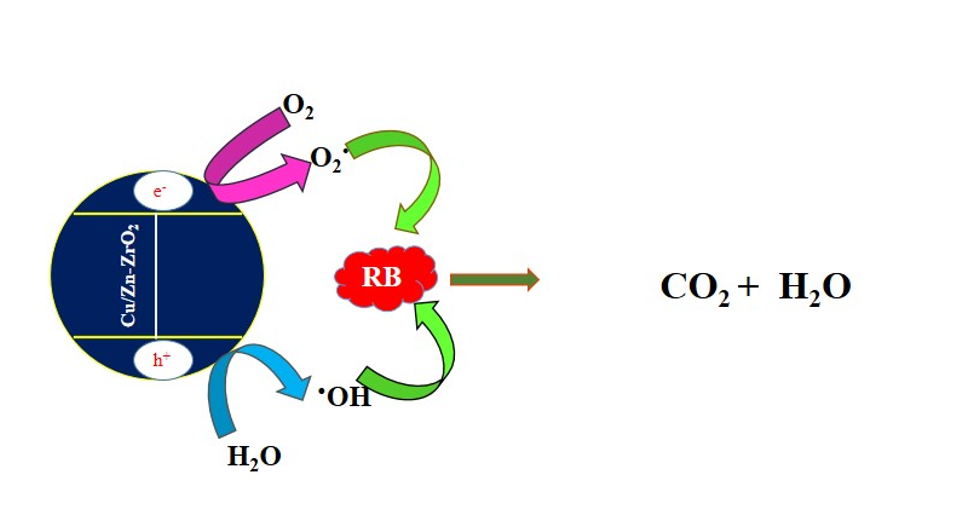
A mechanism for the photocatalytic activity of Cu/Zn-ZrO2 nanoparticles is shown in Fig. 7 (c) At the point when the semiconductor is lit up by visible light irradiation, a valance band electron (VB) goes to the conduction band (CB) leaving a hole in valance band. Generally, the recombination of electron holes reduces the photocatalytic activity of semiconductors.
However, the presence of Cu and Zr traps the electron from the conduction band of ZrO2 suppressing the electron-hole recombination. It is established that Cu traps the electrons from the conduction band of ZrO2. The Zn doping also suppresses the recombination of electrons and holes by electron trapping. It is shown that the photocatalytic activity of Cu/Zn-ZrO2 photocatalysts is higher than that of all other semiconductor photocatalysts. It appears that the trapping nature of Cu and Zn produced a greater number of superoxide radical anions and at the same time, valance band holes of ZrO2 react with water to produce highly reactive hydroxyl (•OH) radicals. The superoxide radical anion and hydroxyl radical are used for the degradation of dyes.
The results of this investigation are compared with previous research on the degeneration of Rose bengal, and Table 2 provides a summary [34–38]. In the current study, the rate of RB dye degradation was 98% for 120 minutes.
Recycle the used catalyst
Reuse of the catalyst that was previously used in the removal of RB from the aqueous solution was performed using solvents to wash the catalyst several times, with thermal treatment. The obtained material was used in the removal of rose Bengal using the same reaction conditions that were used initially and the obtained results are shown in Fig. 7 (d) From these results it was found that the first use catalyst to third use gave the removal efficiency for this dye 98% and 94% respectively. At the fourth time of use, the efficiency of dye removal was decreased to 80% the decreases in the efficiency of dye removal for the re-cyclized catalyst can be attributed to the reduction in the active sites on the surface of the catalyst after one use as well as sticking species that may remain adsorbed on the pores of the catalyst. These observations can lead to reduce the ability of adsorption and consequently reduce its catalytic activity.
Conclusion
In this present work, Cu/Zn-ZrO2 has been successfully synthesized and effectively utilized as a visible-light-driven photocatalyst for the degradation of Rose Bengal. The prepared nanoparticles have been characterized using UV-Vis-DRS, FT-IR, XRD, SEM, and EDX techniques. Cu/Zn-ZrO2 (98%) shows higher photocatalytic activity than Cu/ZrO2 (87%), Zn/ZrO2 (70%) and ZrO2 (50%). The result of this research work may be used for the remediation of organic dyes in the environment. Furthermore, the Cu/Zn-ZrO2 nanoparticles showed stable photocatalytic activity for the degradation of RB under solar light irradiation. The dispersion of photocatalysts in solution is an important factor that influences photocatalytic activity. In addition, this provides some insight into the design of new promising photocatalysts for the degradation of organic contaminants.
Conflict of Interest
The authors declare that they have no conflict of interest related to the publication of this article.
