INTRODUCTION
At present, there is a greater limitation on resources due to population growth, the quick expansion of industry, and lifestyle changes. As a result, appropriate management is required due to the growth in waste produced by industries and human activity. Researchers have concentrated on the ecological processes, which eventually call for waste reduction, reuse, and recycling to complete the material use cycle across the economy by contributing resources made from waste. One significant cause of environmental contamination is dye pollution from the textile and paper industries. During the conventional treatment of such wastewater, flocculation or coagulation is typically used. Reactive dyes exhibit the lowest exhaustion level among all technological classes of dyes applied to the dyeing of different textile fibers because they have a low substantivity to the substrate and are highly sensitive to hydrolysis at the necessary alkaline dyeing condition [1, 2]
Dyes belong to the organic materials that are always present in textile industry wastewaters, and when they come into contact with natural waters, they cause extra issues because they can overburden the body’s self-purification systems, inhibit or stop photosynthetic processes, and have harmful or cancer-causing effects on the aquatic environment [3] In addition, during the textile dyeing process, 10–15% of the colors are liberated. Research has been conducted in the past to break down dye in contaminated wastewater using physical and chemical techniques which include flocculation, UV-visible, and activated carbon sorption decrease. Among these limitations are difficulties with operational oversight, inadequate deterioration along exorbitant operational costs [4] additionally, because new toxins are formed, they are not environmentally sustainable. The development in nanoparticle technology has created new opportunities for wastewater treatment [5] clean water is necessary for the ecosystem, animals, and human life. Several methods exist, including coagulation, adsorption, and separation via permeable membranes; nevertheless, these methods are insufficient since some organic dyes are hard to degrade, while others are not readily adsorbed and avoid the treatment procedure [6] Through photocatalytic degradation, the organic compounds found in the contaminated effluent are completely broken down. This method results in high active hydroxyl (OH) radicals by using the appropriate photocatalyst and sunlight from the sun. These radicals transform the contaminants in the water into innocuous byproducts including CO2, H2O, and inorganic ions [7]. Methylene blue dyes are used in the food, cosmetics, and medical industries. However, the release of raw MB dye into waterways could pose a serious risk to public health [8] MB in water causes several health risks to people. Dyes have a high solubility in water, which allows them to flow through rivers and change the water’s quality. As MB is a cationic dye, it interacts and penetrates negatively charged surface cells easily [9]. Recently, there has been an increase in scientific interest in the various appropriate treatments of wastewater that reduce the harmful effects of dyes. Many methods, including adsorption, have been used to remove dye from wastewater [10].
Zinc Oxide (ZnO) nanoparticles are employed in the catalytic process because of their greater band gap and centric features among metals. ZnO with a band gap of 3.2 eV is capable of observing the UV radiation from the solar irradiation [11]. Zinc oxide (ZnO) is rapidly gaining interest as the most widely used semiconducting metallic oxide due to its numerous potential applications in technology [12]. Therefore, production of the semiconducting heterojunctions is a favored option to improve the photocatalytic performance of zinc oxide [13]. ZnO in the presence of sunlight has a good energy source [14]. To photo mineralization of the dyes, a variety of ZnO nanostructures have been used [15].
The factors that affect the effectiveness of dye degradation, such as time, pH medium, catalyst doses, dye concentration, and recovered catalyst, are ultimately the focus of the study. The study hopes to reveal specifics about dye degradation conditions by closely investigating these variables, which will improve our ability to eradicate water pollutants. This research solves issues with previous methods and achieves more effectiveness, it has the potential to make a significant contribution to the fields of water management and environmental sustainability.
MATERIAL AND METHODS
Materials required
The Merck grade Zinc sulfate heptahydrate (ZnSO4.7H2O). Sodium Hydroxide (NaOH), Ethanol (C2H5OH), and Methylene blue were purchased.
Preparation of Rivea hypocrateriformis plant Extract
The Rivea hypocrateriformis plant was first washed with tap water, then with distilled water, and then it was left to dry for 15 days at room temperature. These dehydrated plants were then ground into a powder. 50 grams of powdered plant material was set in a Soxhlet apparatus, ethanol was added, and the process was let to run for about 12 hours.
Synthesis Of Zinc Oxide (ZnO) Nanoparticles
The Coprecipitation method, which produces the nanoparticles, was used to produce the zinc oxide nanoparticles. An expected functional group found in plants functions as an effective surfactant during this process. After adding 100 mL of 0.1M aqueous solution [ZnSO4.7H2O] to the 60 mL of aqueous plant extract in a beaker, the mixture was placed in a magnetic stirrer for an hour, and then NaOH was added drop by drop until the pH level that was desired was reached.
After centrifuging the extract solution at 10,000 rpm for 15 minutes, the supernatant was discarded and the pellet containing zinc oxide (ZnO) nanoparticles was collected. It was then cleaned with ethanol to get rid of any remaining contaminants and placed into a China disc. For drying, the precipitate was maintained at 80 °C in a hot air oven. The dried fine powder is used for the characterization.
CHARACTERIZATION
The ZnO-NPs were characterized by many techniques. The absorbance spectra of the Zinc Oxide (ZnO) nanoparticles were studied using UV visible spectroscopy. The surface actualization of Rivea hypocrateriformis plant extract on the surface of Zinc Oxide nanoparticles was studied by FTIR (Shimadzu IR affinity model is a double beam spectrometer) with the wave number range of 4000 cm-1 to 400 cm-1. The crystalline nature and phase identification were studied by XRD. [Empyrean Malvern panalytical] method CuKα [λ=1.54Ǻ] radiation. Surface morphology and partial spectra of prepared nanoparticles were analyzed by Scanning electron microscopic technique [Carl Zeiss (USA)] model – sigma with Gemini column, EDS performed to know about the estimation of the elemental composition of Zinc Oxide nanoparticles. Transmission Electron Microscope (TEM) was used to analyze the morphological and structural characteristics of the RH-ZnONPs nanostructures that were produced (JEOL JEM 2100 TEM) operated at a 200 kV accelerating voltage.
Dye Degradation
A common cationic dye molecule in the textile and pharmaceutical sectors is methylene blue (MB). These compounds are incredibly stable and break down anaerobically to produce precursors that are mutagenic and carcinogenic.[16]. Additionally, hazardous dye molecules like MB are present in industrial effluent streams which mix with domestic and river water sources, hindering solar penetration and affecting water-based photosynthesis, which in turn damages water ecosystems and leads to food chain poisoning. Therefore, a simple, effective, and affordable approach for detoxifying these dye-polluted aqueous streams is quite alluring and promising for industrial use [17].
To investigate the photocatalytic activity of the RHZnONPs, a 50 mg/L solution of MB was used as a model pollutant dye, and its degradation was studied. In the presence of sunlight, 100 mL of dye solution was added, along with 5mg of RHZnONPs, to a glass beaker. To accelerate the attainment of adsorption equilibrium, the setup was magnetically agitated in a sealed box without any light for 60 minutes. The entire setup was then moved into the direct sunlight, along with the stirrer. Every 15 minutes, photocatalytic activity was measured until the aqueous dye solution had completely faded. To remove the suspended particles, an aliquot of 1 mL was taken at each interval and centrifuged for 15 minutes at 10,000 rpm. After that, the supernatant was cautiously transferred into a quartz cuvette, and the MB dye’s remaining concentration was measured at 664 nm.
Dye degradation UV-visible analysis
The photocatalytic dye degradation of Methylene blue dye was analyzed using a UV-visible spectrophotometer. The percentage degradation of dye was studied using the following formula,
Degradation rate (%) = (C0 – C / C0) x 100 (1)
Degradation rate (%) = (A0 – A / A0) x 100 (2)
Where C stands for dye concentration, C0 stands for initial dye concentration, A is the absorbance of dye after irradiation with sunlight, and A0 shows the initial absorbance.
RESULT AND DISCUSSION
UV – Visible spectroscopy
Using UV spectroscopy, the synthesized RHZnONPs compared to plant extracts are investigated. This method is used to assess the optical quality of the synthesized material. ZnO NPs from the reported data were confirmed by an apparent peak at 350 nm. It is explained by ZnO intrinsic bands-gap absorption, which is caused by electron transfers from the valence band to the conduction band [18]. Plant-mediated ZnO with precursor Zinc sulfate noted at 287 nm indicates the absorption towards lower energy with decreasing size of nanomaterial. It is clear that the absorption edge progressively advances to a lower wavelength or greater energy with decreasing nanoparticle size [19].
FT-IR of RHZnO Nanoparticles
The FT-IR spectrum observed peaks at 2997 cm -1, 2322 cm -1, 1723 cm -1,1541 cm -1, 1132 cm -1, and 560 cm -1 The intense peak at more than 3000 cm -1 associated to H bond hydroxyl group (–OH) stretching vibrational of phenol or alcoholic group [20] 2997cm-1 associated to OH stretching carboxylic group 2322cm-1 associated with O=C=O carbon dioxide,1723cm-1 and 1541cm -1 associated to N-O stretching nitro compounds 1132cm-1 associated to C-O tertiary alcohol group and 560cm -1 is a stretching vibration peak for ZnO denoted as metal oxide (M-O)[21]. Based on the FT-IR data, band shifts have either increased or decreased from their initial values. This Wavenumber shift may be produced by the different functional groups in the plant extract.[22]
XRD pattern of RHZnO Nanoparticles
The X-ray diffraction pattern was adopted to study the structural properties of the prepared sample. The results were compared with the JCPDS Data and the peaks were identified along the planes (100), (002), (101), (102), (110), (103) and (200) in 2θ 31.73°, 34.43°, 36.27°, 47.70°, 56.6°, 62.81° and 63.21° as shown in Fig. 3, indicating that RH-ZnO nanoparticles are crystalline. Along (101) was the location of the maximum intensity peak [23]. The XRD diffraction patterns revealed the hexagonal wurtzite structure of the nanoparticles, which were confirmed by the Joint Committee Powder Diffraction Standard Data (JCPDS card no.008, 82-1042 & 50,664) [24]. Particle sizes of the RHZnONPs were calculated using the Debye-Scherrer formula.
Where d is the crystallite size of synthesized zinc oxide nanoparticles, for (hkl) phase, k is Scherrer constant (0.9), λ is the X-ray wavelength of radiation (1.5406 Å), βhkl is the full-width at half maximum (FWHM) at (hkl) peak in radian, and θhkl is the diffraction angle for (hkl) phase.
SEM and EDX analysis
The EDX spectra and the flower-shaped RHZnONPs were displayed in the SEM micrographs at different magnifications. At lower magnifications, the formation of uniformly distributed RHZnO nanoflowers is visible.
Upon attentively examining the same material under a little bit higher magnification, a few leaf-like structures that resemble flowers become visible. These structures help to build the mechanical pathway that leads to the creation of nanoparticles in the form of flowers [24].
The formation of ZnO nanoparticles is confirmed by the chemical compositions analyzed by
EDX analysis. As in Fig. 6, the prepared nanoparticles contain Zinc and oxygen as major elements.
TEM images of RH-ZnO Nanoparticle
TEM micrograph that the flower-shaped RHZnONPs were made up of numerous leaf-like petals, each of which was composed clear arrangement of hexagon-shaped ZnO nanorods. This observation might be crucial in illuminating the growth mechanism once more. The lattice image of the flower-shaped ZnO NPs is displayed in Fig. 6 [24].
Mechanism for photodegradation of methylene dye using ZnO nanoparticles
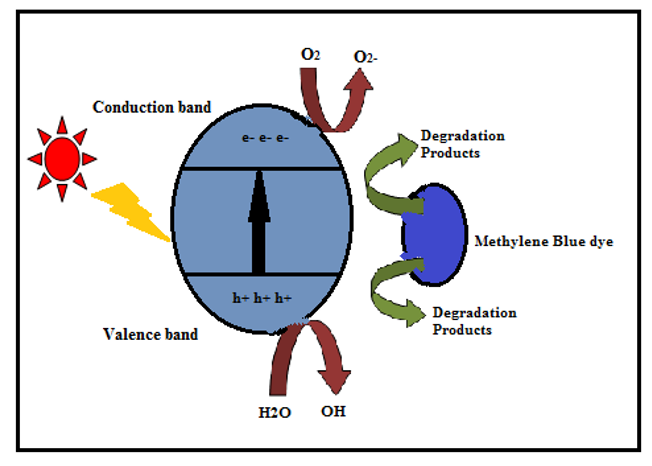
Numerous stages are entailed in the photocatalytic degradation of dyes including electron-hole pair formation, chemical reaction, and adsorptions-desorption process [25]. 1) structured adsorption by the MB dye molecules 2) Incident light adsorption, and 3) generation of charge-transfer reaction by oxidizing and reducing molecules [26]. On sunlight irradiation, the electrons (e-) are elevated from the surface of the metal oxide (ZnO) photocatalyst to the conduction band (CB), which are captured by the positive holes created in the valence band (VB). Through the positive holes, the reactive intermediates are directly oxidized by the dye molecules having a high oxidative nature, or in reaction with water molecules (H2O), hydroxyl radicals (.OH) are formed. On the reaction of electrons present in the conduction band of synthesized ZnO nanoparticles and O2 molecules reaction, the superoxide anions are formed.
ZnO-NPs + hν → ZnO-NPs (h+ + e-) (4)
h+ + MB Dye → oxidation of dye molecules (5)
h++ OH- / H2O → •OH (6)
e- + O2 → •O2- (7)
•OH + •O2- + MB dye → degradable / less-toxic (8)
The difference in energy between the oxidation and reduction process is determined by the material’s band gap. Metals band gap determines the photocatalytic degradation. Higher photocatalytic dye degrading activity is seen in narrower band gap
Effect of Irradiation on Time Photodegradation of MB
RHZnONPs were used as a photocatalyst in the study of MB degradation. The catalyst dosage was 5 mg/L, while the starting concentration of MB was 50 mg/L. The UV–vis spectra of the MB solution at various irradiation times are displayed in Fig. 7a. The colors of the solutions during degradation are shown in the enclosed image. The band 664nm in the UV-visible region acts as a chromophoric group in the MB molecule [27]. As a result, the MB solution’s color steadily lightened. Moreover, blue shifts of the two bands were seen as the illumination time increased, most likely as a result of the MB molecules becoming demethylated and turning into other intermediates [28]. After 165 minutes of degradation, the solution’s color changed from a bright blue to colorless, and its absorbance was almost zero shown in Fig. 7. This result showed that the MB molecules had been destroyed.
The aqueous solution becomes nearly colorless when MB is reactively adsorbed using RHZnONPs. Following 165 mins of operation, the color changed from bluish to light, most likely as a result of oxidative products of degradation. RHZnONPs color removal efficiency was found to be 93% after 165 mins. Fig. 7 displays the shifts in absorption spectra after 165 minutes of RHZnONPs degradation of the MB aqueous solution.
Effect of concentration of Dye on Photodegradation of MB
A key consideration for attaining an effective photocatalytic degradation process is catalyst loading. The number of active sites on the catalyst surface increased with catalyst concentration, increasing the amount of hydroxyl and superoxide radicals on the catalyst surface [29]. RHZnONPs catalyst (5–25 mg/L) was added to the MB solution (50 ppm) to study the impact of catalyst dosage on photocatalytic degradation of MB dye; the UV–visible spectra of the resultant solution are displayed in Fig. 8 (a, b). According to the graph, MB degradation is significantly influenced by the quantity of catalyst used. An increase in the catalytic dosage from 5 mg to 25 mg resulted in a percentage increase in MB dye degradation from 50.45% to 96.25%. Additional catalytic active sites and a larger adsorption area were probably suitable for the generation of active radicals to degrade the dye, which is likely the percentage of MB degradation increased as the dosage increased. Photon decreased as catalyst dosage increased. This results from an increase in particle aggregation and the light scattering effect [30]. Furthermore, it has been noted that the amount of catalyst affects the photodecomposition rate in both positive and negative ways. Simultaneously, as a result of the high dose of photocatalyst increasing the turbidity of the suspension, less UV light will penetrate, resulting in a decrease in the photoactivated volume of the suspension. [31]
Effect of pH on MB degradation
The effect of pH on different dyes’ photodegradation, a number have lower pH photocatalysis, while others have higher pH photocatalysis. The nature of the contaminant that needs to be degraded can be responsible for all these. Because of this, it’s important to understand the type of pollutants that need to be broken down and find out if pH is optimal for photo-catalyzed [32]. Considering pH gives information about the surface charge properties of a catalyst, it is an essential factor for studying the photocatalytic activity of a catalyst [29]. Therefore, the degradation of MB Dye solution at different pH values 5, 7, and 9 was investigated. The pH of the dye solution was varied by adding HCl and NaOH to the dye solution. The plot of the photodegradation activity of RHZnONPs on degrading of MB at pH-5, 7, and 9. Shown in Fig. 9.
Although RH-ZnO NPs dissolve at an acidic pH, the removal efficiency is reduced. ZnONP surface has a negative charge above this pH, but MB has a positive charge in an aqueous solution. In an alkaline solution, greater photodegradation efficiency is attained because of the electrostatic contact between the positively charged MB dye and the negatively charged RHZnONPs surface indicates that low pH has a negative impact on photocatalyst performance it may prevent NPS from hydrolyzing, which would decrease the size of the crystals in the nanoparticles that are produced.
Effect of Recovered dosage of the catalyst
As a recovered catalyst, the photocatalytic dye degradation activity of MB dye was carried out and investigated at 4 cycles, as shown in Fig. 10. finding a practical and inexpensive catalyst for pilot-scale removal systems, recovery, and reusability are essential factors to consider. After filtration, the recovered catalyst was regularly washed with distilled water to get rid of the dye molecules that had adsorbed, and it was then dried for an hour at 50°C in a hot air oven. They also received 50 ml of dye solution. The catalytic activity of catalysts in dye degradation affects the color change of the dye solution, indicating their potential for contaminants remediation.
The photocatalytic dye degradation activity of the recovered catalyst in degrading MB dye is shown in Fig. 10 (a) and is a UV-visible graph. The catalyst’s efficacy was lower than that of the original catalyst. The catalyst’s active regions that have been clogged by photosensitive hydroxide deposition indicate the amount the degrading activity decreased. The percentage of MB dye degradation by the recovered catalyst for cycles 1, 2, 3, and 4 was determined to be 82%, 77%, 70%, and 65% for 165 minutes, respectively, as shown in Fig. 10 (b). Material losses could happen during the washing and drying phases of the recovery process, resulting in a lower dose in the cycle after that, which could reduce the surface catalytic activity and decrease the performance [32]. After each cycle, catechol and its intermediates coated the pores and active sites, reducing the catalyst’s adsorptive catalytic surface activity gradually [33].
Application and Future Research Prospects
Incorporating safe and sustainable chemicals versus potentially dangerous ones, the ZnO nanoparticles obtained from the extract of the Rivea Hypocrateriformis plant that is utilized for photocatalytic dye degradation provide several advantages over standard removal methods that improve sustainability. The synthesized nanoparticle with good surface (flower-shaped NPs) with their shape and size which holds the greater adsorption and high reactiveness. Thus, in the future, these nanoparticles can be used in the removal of heavy metals, organic pollution, and treatment of industrial waste, these metal plays a good role in water management.
Conclusion
The present study showed that ZnO nanoparticles have significant photocatalytic activity for degrading the dye methylene blue. About 93% of the dye was successfully destroyed in 165 minutes. In addition, utilizing greater concentrations of the catalyst improved the degradation of the methylene blue dye, as demonstrated by the 96% dye degradation observed with 25 mg of the photocatalyst over 165 minutes. Furthermore, increasing the medium’s pH higher led the dye to degrade more effectively; at pH 9, 96% of the dye had disappeared. Moreover, a lower rate of photodegradation was seen with an increased dye concentration. For cycles 1, 2, 3, and 4, the recovered catalyst showed deterioration percentages of 82%, 77%, 70%, and 65%.
CONFLICT OF INTEREST
The authors hereby declare that there is no conflict of interest.