
Document Type : Original Research Paper
Graphical Abstract
Introduction
In recent years, pollution has emerged as a critical global concern, with water pollution particularly from industrial sources such as textiles, pharmaceuticals, dyes, paper and pulp, and distilleries, becoming a significant challenge [1]. Among these sources, the textile sector is identified as the most polluting due to its extensive water usage, resulting in effluents containing harmful substances such as toxic organic dyes, surfactants, minerals, solvents, heavy metal ions, detergents, electrolytes, and organic matter [2-4]. Addressing water pollution at its source necessitates treating these effluents before they are released into water bodies.
To mitigate the impact of industrial pollutants, various traditional methods, including solvent extraction, evaporation, coagulation-flocculation, membrane filtration, precipitation, ion exchange, oxidation, reduction, and biological techniques [5]. However, the widespread application of these conventional treatments on an industrial scale can be prohibitively expensive. As a result, researchers have developed alternative adsorbents, such as activated carbon, zeolite, carbon nanotubes, graphene, and polymer materials, for more cost-effective pollutant removal [6].
In recent years, nanoparticles, particularly metal oxides like TiO2, ZnO, MgO, SnO2, and WO3 have gained prominence for their efficacy and affordability in adsorption and catalytic degradation processes, specifically for removing organic dyes from industrial effluents [7]. Among these, TiO2 ZnO, MgO, SnO2, and WO3 have demonstrated catalytic ability in eliminating pollutants from textile industrial effluents, exhibiting sensitivity to various types of radiation, including visible light, UV-light, solar radiation, microwave radiation, and ultrasonic waves. Advanced oxidation processes such as photocatalysis, catalyst-assisted degradation, and ozonation have shown promise in breaking down complex dye molecules into harmless byproducts[8]. When exposed to radiation, these metal oxide nanoparticles facilitate electron jumps and subsequent chemical reactions, such as oxidation and reduction, with pollutants like organic dyes [9].
Various synthesis techniques, including precipitation, solvothermal processes, hydrothermal methods, electrochemical methods, sol-gel techniques sonification, microwave-induced combustion, aerosol combustion, flame metal combustion, and lysine nitrate combustion, are commonly employed to produce nanoparticles [10, 11, 12]. The size and morphology of the nanoparticles depend on factors such as the synthesis method, experimental conditions (temperature and pressure), precursor materials, and reaction conditions. Nano scale materials exhibit unique physical and chemical properties distinguishing them significantly from bulk materials and single atoms or molecules [13].
MgO, also known as magnesia, stands out as an abundant and natural material that can be produced synthetically. In research, MgO is considered a promoter for various types of reactions due to its distinctive characteristics, including high-surface-area, redox properties, crystal and electronic structure. MgO nanoparticles, with their high surface area to volume ratio that significantly enhances reactivity, are utilized in various reactions including dry reforming, dehydrohalogenation, oxidative dehydrogenation of butane, CCl4 decomposition, methane oxidative coupling, and dimerization reactions[14]. This characteristic is also crucial for dye degradation, as it provides additional active sites for interaction with dye molecules, resulting in more efficient degradation. Additionally, MgO NPs exhibit robust photocatalytic properties, particularly under UV light. Upon light exposure, they generate reactive oxygen species(ROS) like hydroxyl radicals, which are highly effective in breaking down complex dye molecules into simpler, non-toxic substances. Therefore, MgO serves as an effective support catalyst in a clean and reusable manner for dye degradation processes. Furthermore, MgO is less expensive, easy to synthesize, and also can be readily applied on a large scale[15]. It serves as a refractory material due to its excellent chemical and thermal stability, and its non-toxic and biodegradable nature makes it a desirable catalyst for many applications [16]. Despite its biodegradability, lower concentrations of MgO can be toxic to microbes due to its binding nature with intracellular protein [17]. MgO has also found applications as an adsorbent for vapors and gases and as a catalyst in various reactions, including oxidative degradation and photocatalytic degradation of organic dyes such as Methyl orange, Methylene blue, Congo red, Eriochrome Black-T(EBT), Malathion, Orange-G, and Reactive black dye [18,19,20,21].
Malachite Green (MG) and Crystal Violet (CV) are examples of triaryl methane dyes commonly used in various industries. MG, with the chemical formula 4-{4-(dimethylamino)phenyl methylidene}-N, N-dimethylcyclohexa-2,5-dien-1-iminium chloride [C25H30N3Cl], is employed in dyeing silk, cotton, leather, and paper. CV, with the chemical formula N-[4-[bis[4-dimethylamino]-phenyl]-methylene]-2,5-cyclohexadien-1-ylidine]-N-methylmethanaminium chloride [C23H25N2Cl], is used in ink production, printing, and has medical properties, although it poses risks of toxicity to both humans and the environment [ 23-28].
In the present study, our objective was to successfully synthesize, MgO nanoparticles using a hydrothermal process with readily available and non-toxic chemicals. Under highly controlled conditions of hydrothermal synthesis, spherical MgO nanoparticles(NPs) with uniform size and a high degree of crystallinity can be obtained. This method allows for the fabrication of highly precise crystallites with varying sizes by adjusting the synthesis conditions[22]. The major focus of our work is on microwave-assisted catalytic degradation experiments involving harmful dyes such as Malachite Green (MG) and Crystal Violet (CV) in the presence of hydrogen peroxide. The catalytic degradation efficiency of MgO nanoparticles on MG and CV dyes at varying concentrations was assessed using UV-visible spectroscopy with a Systronic model 119 spectrophotometer. The study explored several key parameters, including assessment of catalyst-reducing efficacy, the study of hydrogen peroxide enhancing activity, confirmation of MgO NPs and hydrogen peroxide efficacy, microwave-assisted degradation, effect of pH and reusability.
Experiment
Materials
Analytical grade chemicals magnesium sulfate (MgSO4·H2O), sodium hydroxide (NaOH), and urea, (s.d.fine, India) were used as precursors to obtain the MgO through a hydrothermal method. The precursor chemicals were mixed according to their calculated molecular weight to obtain the MgO, Malachite Green (MG), and Crystal Violet (CV) were used as dyes. All chemicals were used without further purification.
Synthesis of MgO Nanoparticles by Hydrothermal Process
In a standard procedure for the preparation of MgO nanoparticles, 0.3 M magnesium sulfate was dissolved in 50 mL of distilled water, followed by the addition of 20 mL of a 2% urea solution as a surfactant, with continuous stirring. The resulting clear solution obtained was subjected to incremental addition of 10 mL of a 10 % sodium hydroxide solution, added drop by drop, as a precipitating agent continuous stirring during this process produced a white mixed slurry solution. Subsequently, 80 mL of this mixed slurry solution was transferred to a 100 mL Teflon-lined stainless steel autoclave, where a hydrothermal reaction was conducted at 160 °C for 24 h in a preheated electric oven. After the reaction, the final products were sequentially washed with distilled water and ethanol to eliminate sulfate ions and other remnants through centrifugation. The obtained powder was then dried at 60 °C for 12 h in air. To achieve high crystallization, the MgO powder was calcined at 500 °C for 2 h in a muffle furnace, resulting in the desired MgO nanoparticles.
Characterization
The synthesized MgO nanostructures were characterized using a Rigaku D/max-IIIC X-ray diffractometer with Cu Kα radiation (λ = 0.15406nm, 40 kV, and 45 mA). The XRD analysis was conducted over a 2 theta range from 10° to 80° with a step size of 0.02. To calculate the size of the MgO crystallites, the Debye-Scherrer equation was applied to the primary XRD peak.
Where λ represents the X-ray wavelength (λ = 0.154nm), β is the full width at half maximum of the XRD major peak in radians, and θ is the diffraction angle in degrees. The sizes and shapes of the nanostructures were further analyzed using field emission scanning electron microscopy (SEM-EDS) with a ZEISS-EVO/18 instrument from Germany and, high-resolution transmission electron microscopy (HR-TEM) using JEOL from Japan.
Catalytic Degradation of MgO
The catalytic degradation ability of MgO nanoparticles on MG and CV dyes at varying concentrations was evaluated using UV-Visible spectroscopy with a Systronic model 119 spectrophotometer. The experiments were structured as follows, to evaluate the catalyst’s reducing ability, 0.05 mL of hydrogen peroxide was added to 5 mL of 10 ppm MG and CV dyes, and 0.01 g of MgO Nps was added to enhance reaction activity. To confirm the effectiveness of MgO Nps as a catalyst and hydrogen peroxide as an enhancer for degradation, 5 mL of MG and CV dye solutions with concentrations ranging from 10 ppm to 30 ppm were mixed with 0.01 g of MgO Nps and 0.05 mL of hydrogen peroxide, and to study 30 mL of 10 ppm MG and CV dyes solutions were separately prepared and irradiated in a microwave oven at 100 watts, both with and without 0.05 g of MgO Nps as a catalyst. The progress of dye degradation was monitored over time, using UV-visible spectroscopy. The results showed that microwave irradiation significantly enhanced the degradation process when MgO nanoparticles were used as a catalyst.
Result and Discussion
The synthesized MgO nanoparticles (Nps) were characterized using various techniques to study their morphology, crystallite size, and crystallinity. The results from these characterizations are detailed in the following sections.
X-Ray Diffraction (XRD)
Fig. 1 shows the XRD patterns of MgO powder synthesized through hydrothermal processing at 160 °C for 24 h, followed by heating at 500 °C for 2 h. The diffraction peaks observed for MgO are intense and sharp, indicating a high degree of crystallinity with no detectable impurity phases. The characteristic peaks correspond to crystal planes (111), (200), (220), (311), and (222) occurring at diffraction angles of 37.87°, 42.57°, 61.97°, 74.44°, and 78.35°, respectively. These diffraction peaks are consistent with the pure hexagonal phase of MgO (JCPDS No. 01-075-0447). The average crystallite size of the MgO nanoparticles, calculated using the Debye-Scherrer equation based on the most intense peak, was found to be 17.63 nm.
Scanning Electron Microscope (SEM)
SEM imaging showed that the pure MgO Nps synthesised using urea as a stabilizer, exhibited a spherical morphology. The detailed analysis of the morphology confirmed that the Nps were uniform in size ranging from 80 to 100nm, and exhibited a distinct bottleneck structure(Fig. 2a and Fig. 2b). Further confirmation of the purity and composition of the MgO Nps was provided by energy-dispersive X-ray spectroscopy (EDS). The EDS profile (Fig. 2c) displayed the distinct peaks corresponding to magnesium and oxygen at 1.25 keV and 0.58 keV, respectively, confirming the successful synthesis of MgO Nps. The analysis indicated that the mass percentages of magnesium and oxygen in the NPs were 27.57% and 49.12%, respectively, consistent with the expected stoichiometry of Mg O.
The presence of oxygen, carbon, and magnesium as provided in EDS mapping reconfirms the MgO[16].
High-Resolution Transmission Electron Microscopy (HRTEM)
TEM analysis was conducted at different magnifications providing a detailed examination of the synthesized MgO nanoparticles(NPs). The images revealed that the MgO Nps had a size of approximately 16 nm as depicted in Fig. 3a. The TEM images also clearly showed the spherical structure of the synthesized MgO Nps, confirming their uniformity in size and shape (Fig. 3a and 3b). Additionally, the selected area electron diffraction (SAED) pattern shown in Fig. 3c displays distinct diffraction reflections from the FCC structure of MgO such as (111),(200), (220), (222) planes.
These spot rings confirmed the crystalline nature of the MgO Nps, consistent with their characterization as high-purity MgO.
High-resolution TEM images (Fig.3a,3b, and 3c) of the MgO Nps confirmed their small crystalline size, which is indicative of a high surface area and abundant reactive sites. The images (Fig.3b) of MgO show lattice fringes corresponding to specific planes in the MgO crystal structure, allowing for direct measurement of lattice parameters. The observation of lattice fringes with a spacing of 0.21 nm between two adjacent planes in the HRTEM image confirms the presence of the (200) planes in MgO. This measurement is consistent with the XRD results, further affirming the crystalline structure of the material as MgO. These characteristics are crucial in enhancing the performance of dye degradation, as they facilitate greater interaction with the dye molecules. The selected area electron diffraction (SAED) patterns further affirmed the crystalline nature of the MgO nanoparticles, showcasing well-defined diffraction rings that corroborate the high crystallinity and purity of the synthesized material. This combination of small crystalline size and high crystallinity underscores the effectiveness of the MgO nanoparticles in catalytic applications.
Effect of Catalytic Activity of MgO
The study focused on evaluating the catalytic activity of MgO nanoparticles in degrading toxic MG and CV dyes, to mitigate environmental pollution caused by dye effluents in the textile industry. The peak absorption wavelengths for MG and CV dyes were identified at 616 nm and 578 nm, respectively. MgO nanoparticles demonstrated notable effectiveness in reducing these dyes, particularly when combined with hydrogen peroxide and microwave irradiation. This enhanced performance highlights the exceptional properties of MgO nanoparticles, making them far more effective than their bulk counterparts in catalytic applications.
Study of Hydrogen Peroxide Enhancing Activity
Fig. 4a and b demonstrate that in the absence of MgO and hydrogen peroxide, the dyes (MG and CV) showed no signs of degradation. The UV-Visible spectrophotometer measurements confirmed the absorption wavelengths of MG and CV dyes to be 616 nm and 578 nm, respectively, indicating that without catalytic assistance, the dyes remained stable and did not break down. This highlights the necessity of both MgO and hydrogen peroxide to effectively degrade these toxic dyes.
The schematic representation of the mechanism involved in hydrogen peroxide-assisted dye degradation is shown in Fig. 5. Upon the addition of 0.05mL hydrogen peroxide, the degradation efficiency of the dyes increased, as evidenced by the reduction in intensity of the 10 ppm dye solutions. The degradation was further improved with the introduction of 0.01 g of MgO Nps, particularly across dye concentrations ranging from 10ppm to 30ppm. Fig. 6, 7, and 8 depict the catalytic degradation efficiency assisted by hydrogen peroxide at different time intervals. The studies revealed that MG dye degraded more effectively than CV dye under the same concentration and time conditions. The degradation process was significantly accelerated when MgO Nps were combined with hydrogen peroxide. MG dye showed a high degree of degradation compared to CV dye under identical experimental conditions. This suggests that the synergy between MgO Nps and hydrogen peroxide plays a critical role in enhancing the breakdown of these dyes, particularly for MG dye.
The MgO Nps synthesized through the hydrothermal process demonstrated exceptional catalytic performance, effectively requiring only a minimal amount to achieve maximum dye removal in a short period, as illustrated in Fig.8.
This efficiency underscores the high reactivity and surface area of the MgO Nps, making them highly effective in rapidly breaking down dyes. The results indicate that even with a small dosage, the nanoparticles can significantly accelerate the degradation process, highlighting their potential for practical applications in environmental cleanup.
In this study, the combination of MgO Nps as a heterogeneous catalyst with H2O2 was investigated as an effective oxidative reagent. The process generates hydroxyl radicals, which effectively disrupts the conjugated pi-systems (-N=N-, -C=C-) present in the autochrome group responsible for the coloration of MG and CV dyes. This disruption leads to the decolorization and degradation of the dyes to occur. Interestingly, the degradation of CV dye, which contains 3 amino groups, was found to be slower compared to MG dye, which has 2 amino groups. The cleavage of pi systems in these dyes results in the breakdown of toxic components into smaller, less harmful molecules such as aryl amines, CO2, and H2O, facilitating their removal from the environment.
Effect of Microwave-Assisted Catalytic Activity
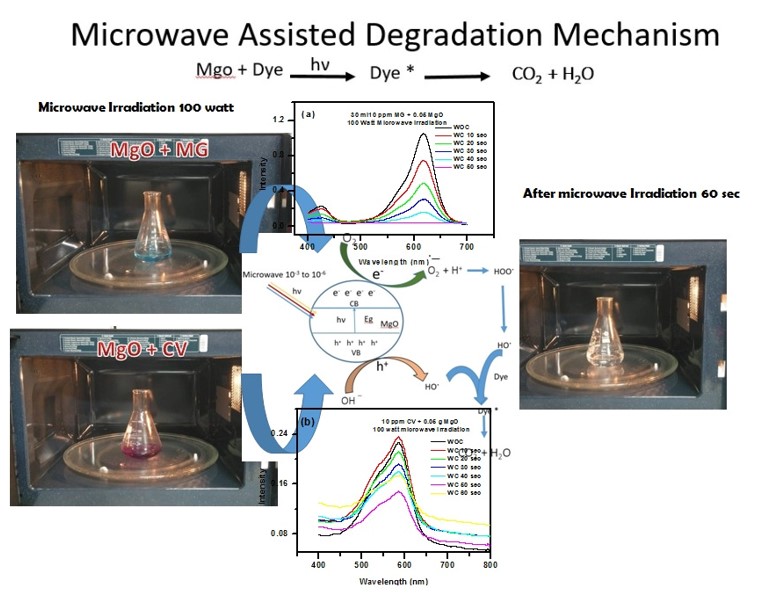
Microwave-assisted degradation for toxic dyes demonstrates considerable potential as a method that is not only efficient and rapid but also environmentally friendly, and cost-effective, adhering to the principles of green chemistry. This approach leverages microwave irradiation to achieve uniform and selective degradation, resulting in the complete breakdown of the dyes. The photographic representation in Fig. 9 illustrates the reaction process involved in the microwave-assisted degradation of MG and CV dyes, emphasizing the rapid and thorough degradation achieved through this method.
Figure 10 presents a schematic representation of the mechanism involved in the rapid decolorization of dyes under microwave irradiation at 100 watts. This illustration highlights how microwave energy accelerates the degradation process, leading to the efficient breakdown and removal of the dye molecules. The diagram visually conveys the key steps and interactions that occur during the decolorization process, demonstrating the effectiveness of microwave-assisted treatment in achieving rapid and thorough dye removal.
UV-Visible spectrophotometer measurements revealed a decrease in absorbance over time for both MG and CV dyes at 10 ppm. In this study, a 30 mL sample of 10 ppm MG and CV dyes were individually subjected to microwave irradiation at different time intervals. The experiment was conducted both in the absence and presence of 0.05 g of MgO Nps. The maximum absorption wavelength (λmax) was recorded using a UV-Visible spectrophotometer and is illustrated in Fig. 11a and b. The degradation percentage was calculated using the formula, demonstrating the efficiency of the process.
% Degradation = ( C0 - Ct ) / C0 × 100
Where C0 is the initial absorbance of the dye solution before microwave irradiation.
Ct is the absorbance of the dye solution at different intervals.
The enhanced degradation observed under microwave irradiation is primarily through thermal effects (such as rapid heating), non-thermal effects (like enhanced molecular interactions), and potentially the generation of reactive species.
This transition of these reactive species leads to the formation of hydroxyl and oxygen radicals, which play a crucial role in breaking down the dye molecules. Additionally, the increased light intensity under microwave irradiation accelerates the formation of electron-hole pairs in the valence band. This combined effect of electron transitions and radical generation under microwave irradiation results in a rapid and efficient degradation of the dyes.
Fig. 12 represents the degradation efficiency of MG and CV dyes based on the experimental data. The results show that MG achieved complete degradation (100%) within 50 seconds, whereas CV only reached a degradation level of 43.46% within the same time frame. This indicates that MG was degraded more rapidly and thoroughly compared to CV, highlighting the superior efficiency of the process in breaking down MG dye.
Analysis of Table 1 reveals that the combination of hydrothermally synthesized MgO with microwave irradiation and hydrogen peroxide as an enhancer results in significantly faster, degradation of MG and CV dyes compared to previously reported studies. A noteworthy aspect of this investigation is the minimal amount of catalyst required to achieve optimal dye removal in aqueous solutions. Additionally, the catalyst’s recoverability enables its reuse, offering a sustainable and highly efficient method for eliminating toxic dyes from textile industry effluents. This approach not only improves efficiency but also aligns with environmentally friendly practices.
Effect of pH
The effect of pH on dye degradation was explored using a pH range (7 to 12), with a dosage of 0.05g MgO and 30 mL of 10 ppm MG dye.
From Table 2, it is evident that the Malachite Green (MG) dye solution undergoes complete degradation at pH 7. This finding indicates that pH 7 is the optimal condition for the complete breakdown of MG dye, highlighting the importance of maintaining a neutral pH for maximum degradation efficiency. Given that, effluents from textile industries typically exhibit variable pH values, it is essential to identify a consistent pH level at which dye degradation occurs most rapidly. The study revealed that pH plays a significant role in the degradation rate, influencing the efficiency of the process. Understanding the optimal pH conditions is crucial for maximizing the degradation performance in real-world applications [37].
Optimising catalyst dosage
The degradation ability of MgO nanoparticles (Nps) was studied by varying their dosage. The dosage was optimized by conducting repeated degradation experiments under standard conditions, varying the dosage of MgO NP amounts to 0.01g, 0.03g, 0.1g, and 0.2g. The efficacy percentage was calculated for each dosage. Based on experimental results indicated that the optimal dosage for MgO Nps was 0.05g. At this dosage, the degradation of 10 ppm Malachite Green (MG) dye achieved 100% efficiency within 150 seconds, demonstrating a high removal rate and confirming the effectiveness of the optimized MgO NP dosage.
Efficacy of MgO nanoparticles compared with bulk MgO
An extensive study on the dye degradation capabilities of MgO nanoparticles (Nps) was conducted in comparison to bulk MgO. The results from the experimental studies are presented in Fig. 14 a, b, and 15 a,b. The results demonstrate that MgO Nps exhibit remarkable potential for dye degradation, showing significantly greater efficacy compared to bulk MgO. This exceptional degradation capacity of the Nps is attributed to their high surface-area-to-volume ratio and the abundance of reactive sites on the MgO nanostructure, which enhances their interaction with organic dyes. The study indicates that MgO Nps achieve a high percentage of dye removal efficiency.
Reusability of the synthesized Nanocatalyst
MgO is a typical basic oxide with low solubility, making it an ideal reusable catalyst due to minimal mass loss from leaching into the reaction mixture[15]. However, the reusability of the synthesized MgO Nps at pH 7 was tested over five repeated cycles as shown in Fig.16 a and b. In each cycle, 0.05g of MgO was mixed with 30 mL of 10 ppm MG dye and subjected to microwave irradiation at 100 watts for 150 seconds. The degradation percentages for MG in the consecutive cycles were 100%, 97.66%, 96.1%, 95.96%, and 84.11% respectively.
Fig. 16 a and b, results indicate a gradual decrease in the degradation efficiency of MgO over successive cycles, likely due to the loss of catalyst particles during the sampling, washing, and drying process[15]. Additionally, the accumulation of foreign particles on the reactive sites of MgO could reduce its degradation capability. However, increasing the catalyst dosage could enhance both degradation efficiency and the reusability of the nanocatalyst, helping to mitigate these effects. Also displays excellent stability and reusability over multiple cycles.
Conclusion
In conclusion, the significance of nanotechnology, especially in the synthesis of metal oxide nanoparticles, is crucial in material science due to their extensive surface area, high adsorption efficiency, and rapid fusibility. This study focused on hydrothermally synthesized nanocrystalline MgO nanoparticles, which exhibited a size of 80-100 nm particles, aggregated from the primary crystallites 17.63 nm and employed urea as a stabilizer. Details Structural, phase transformation, and morphology were thoroughly examined through XRD, SEM, and HRTEM. The study evaluated the catalytic potential of MgO nanoparticles by examining their performance in degrading MG and CV dyes under microwave irradiation and along with other parameters such as catalyst-reducing efficacy, hydrogen peroxide enhancing activity, the conformation of MgO Nps and hydrogen peroxide efficacy, microwave-assisted degradation, pH effects, and reusability. The results highlighted the innovative nature of our approach, demonstrating that under optimized critical parameters, the MgO nanoparticles exhibited exceptional catalytic efficiency with minimum dosage. This suggests practical applications for effectively eliminating toxic organic compounds. Furthermore, the use of non-toxic chemicals in MgO nanoparticle synthesis underscores the eco-friendly aspects of this method. This research not only enhances our understanding of MgO nanocomposites but also encourages further exploration into their catalytic efficacy in future studies.
CONFLICT OF INTEREST
The authors hereby declare that there is no conflict of interest.
