
Document Type : Original Research Paper
Graphical Abstract
INTRODUCTION
The textile industry is one of the most significant industries in the world but is responsible for the usage of large capacities of water, in addition to the disposal of toxic metals in the soil, the air, and the water. Therefore, one of the chief worries is to reach sustainability in the textile chain [1].
Reducing the application of chemical complexes in textile procedures like the scouring process, degumming process, and bleaching process can decrease this opposing influence [2, 3]. Table 1 displays some cleaner strategies in the textile industry.Scouring is a necessary pre-treatment for the subsequent finishing stages which contain bleaching, dyeing, and printing [10]. In textile manufacturing, finishing stages refer to the processes that convert the woven or knitted cloth into a usable material and more specifically to any process performed after dyeing the yarn or fabric to improve the look, performance, or "hand" (feel) of the finish textile or clothing. The scouring process can decolorize the fiber by removing dust, sticky pieces, and surface contaminations [3, 11, 12]. Making white fabrics by destroying the coloring material with the assistance of scouring chemicals with the least degradation of the fiber is the chief purpose of the scouring method [13-15].
New, conventional scouring systems, holding chemical, chemical-biological, and bio-enzyme methods, play a crucial role in eliminating dust and residues from the surface of fibers [2, 3, 16]. The objective of this effort was to improve an eco-friendly scouring procedure for polylactic acid knits in UV-O3.
In recent years, some cleaner techniques such as plasma, ultraviolet irradiation, and ozone treatment have been used in the treatment of polymeric fibers. In this study in an attempt to scour the surface of polylactic acid fibers, a new complex method through the UV-O3 process has been applied. UV-O3 process is a fast and environmentally friendly technique for the treatment of polymeric fibers [17, 18]. Different usages of the UV-O3 process in other applications are listed below.
Degradation of Ortho-Toluidine in petrochemical wastewater via O3, UV-O3, O3-H2O2 and UV-O3-H2O2 methods [19],
Degradation of ortho-toluidine from aqueous solution via TiO2-O3 method [20],
Degradation of 2-nitrophenol from petrochemical wastewater via O3 [21],
Degradation of 4-Nitrophenol from industrial wastewater via nano catalytic O3 method[22],
Degradation of terephthalic acid from petrochemical wastewater by O3 and O3-ZnO methods in semi-batch reactor [23],
Degradation of 4-Nitrotoluene in aqueous environment by MnO2-Clinoptilolite-O3 method [24].
This research was initiated in an effort for the scouring of fabrics produced from Polylactic acid fibers via the UV-O3 process. Polylactic acid (PLA) (Fig. 1), its stereo-isomers, such as PLLA and PLDA, and its famous co-polymer polylactic-co-glycolic (PLGA) are the biocompatible synthetic polymers extensively applied to fabricate biomedical textile knits [25, 26]. Polylactic acid is naturally processable, degrades, and reprobates to metabolites [26].
In this research, the performance mechanism of UV-O3 radiation on 100% polylactic acid fabric (with pique structure) has been investigated from various aspects (colorimetrical and physical). The whiteness index and tint distribution of samples in CIELAB space were evaluated for estimating the colorimetric characteristics of fabrics.
EXPERIMENTAL SECTION
Substrate
This examination employed a set of identically-constructed ‘piqué’ type of knitted fabric provided by Nature Works LLC, USA, and derived from 150/144 tex/filament yarns (Table 2).
These kinds of products are generally used for outerwear garments such as socks, sportswear, activewear, women’s dresses, fashion wear, and children’s wear. “IngeoTM fiber” is the trademark of NatureWorks LLC‟ ‘s polylactic acid polymer produced from corn starch.
Laundry procedure
The poly (lactic acid) knits were scoured with 2002.28 ppm anionic/non-ionic detergent, 1001.14 ppm Kieralon Jet B conc. (non-ionic surfactant, BASF) and 1001.14 ppm sodium carbonate (‘soda ash’) at 60 ºC for 900 s. at a liquor ratio of 10: 1, washed thoroughly. After washing, the piqué knits were rinsed with cold water for 600 s and dried in ambient conditions to remove mill dirt and lubricants.
Scouring in UV-O3
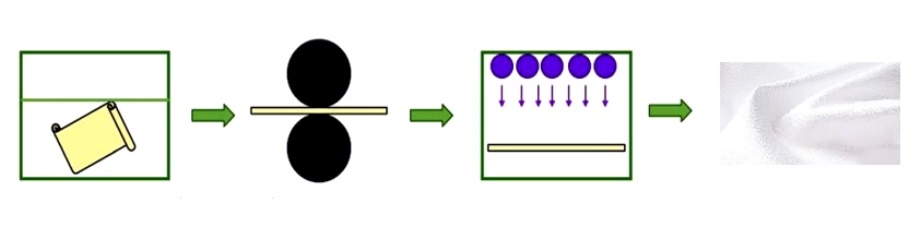
The scouring processing was conducted in a batch UV-O3 system. A piece of the knitted fabric (around 5.5 g) was immersed in the pre-impregnation solution (distilled water (0.001 m3)) and padded twice through a laboratory padder with a wet pick-up of 70 %, pressure of 1.1 bar, and speed of 4.47 mi/h. The poly(lactic acid) piqué knits were then irradiated in the UV-O3 radiation cabinet for 1800 s (900 s face up and 900 s face down), respectively. (UV-O3 radiation cabinet: 11 mW/cm2 intensity UV lamps without an outer envelope (6 Lamps, made in Poland) is placed in a cubic box with a side length of 60 cm. The schematic diagram of the apparatus is depicted in Fig. 2.The UV-O3 system (Fig. 3) produces ultraviolet light of two wavelengths, 254 and 185 nm simultaneously with very high photon energy of 470 and 647 kJ/mol, respectively [2, 27]. The bond energy of the organic contaminants C–C, C–H, C–O, and O–H are 346, 411, 358, and 459 kJ/mol, respectively [17, 28]. The photon energies irradiated from the UV-O3 system are much higher than the bond energies of contaminants [18, 29]. Therefore, the organic contaminant molecules are dissociated or excited by the irradiation of UV light. The atmospheric oxygen (O2) is irradiated with ultraviolet rays at 185 nm; after absorption, it converts to atomic oxygen (O*) and ozone (O3) (Eq. (1)), whereas O3 decomposes after irradiation with 254 nm UV light (Eq. (2)) [17, 28]. Strong oxidizing atomic oxygen (O*) is generated during the process of decomposition or formation of O3 [2, 17, 28, 29]. Atomic oxygen and O3 strongly react with organic materials to produce volatile molecules such as CO2, H2O, N2, etc [29]. The sample treatment was performed at normal atmospheric pressure and room temperature [28].
Rinsing and drying
After the radiation was finished, the fabric was rinsed sufficiently with cold water (30-40 ºC) at room temperature for 600 s in a liquor-to-goods ratio of 20:1, and then oven-dried under 60 ºC for 1800 s.
Acquisition of high-resolution images
The surface morphological investigations of polylactic acid fabric samples before and after the scouring process were carried out by scanning electronic microscopy (SEM) (XL30 MODEL/PHILIPS Company, Netherlands) at an acceleration voltage of 3.0 kV. Before the investigation, samples were sputtered with gold on an ion sputter (SCDOOS MODEL/Bal-Tech Company, Switzerland) at 10.0 mA for 60.0 s. The images were captured with magnifications of 1000, 3750, and 30000.
Fabric specifications
The scouring process in textiles can be assayed by the term of Whiteness. Whiteness is defined as an attribute by which an abject is judged to depart from a standard white towards yellow. To compare the whiteness characteristics of the scoured polylactic acid fabrics, their whiteness indexes (WI) were calculated by using a 0/d Tex-flash spectrophotometer as stated by AATCC test method 110-2015 based on a system of measuring CIE whiteness index (WI)[29]. The poly(lactic acid) fabrics were subjected to 0/d Texflash spectrophotometer under illuminant D65 light at 10 ̊ observation angle to measure the color coordinates in terms of CIE Lab system in visible spectrum region (400-470 nm).
RESULTS AND DISCUSSION
Colorimetric assays of polylactic acid-scoured fabrics
Scouring treating of polylactic acid piqué knits is generally carried out to advance luster, handling, dye-ability, and water absorbency [3]. In this effort, a novel eco-friendly technology (UV-O3 scouring procedure) is applied for the scouring of polylactic acid fabrics. The two polylactic acid piqué knits were applied as materials had been treated. In this paper, it is tried to state the spectral and colorimetric behaviors of the scoured poly (lactic acid) fabrics under different conditions and select the optimum route based on the whiteness index (WI) and tint factor (Tw).
Material 2 is scoured in the UV-O3 system. The other polylactic acid fabric (Material 1) was just normally laundered. Table 2 shows the specifications of polylactic acid piqué knits applied as substrates in this investigation. As stated in Table 2, the polylactic acid piqué knits have different whiteness and tint attributes.
To compare the whiteness characteristics of the poly(lactic acid) fabrics, their whiteness indexes as well as their tint factor were calculated by using the common CIE whiteness formula. Where samples with Tw=0 are defined as bluish whites, and those with positive (Tw>0) and negative (Tw<0) tint factors represent the greenish and reddish whites, correspondingly.
Based on Table 2, the polylactic acid piqué knits have a negative value of tint factor. Meanwhile, the scoured polylactic acid fabric with the highest whiteness index (WI=89.1) and lowest tint factor (Tw= -0.2) could be described as the whitest material.
Morphology investigation by SEM micrographs
The detailed SEM analysis of the surface of polylactic acid knitted materials before the scouring process is shown in Fig. 4 a, b, and c. The images were taken at different spots of the polylactic acid fabric. The morphology of all fabrics’ surfaces was examined using a magnification range of 1000 to 3750x.
In Fig. 4, SEM images of un-scoured raw polylactic acid piqué knits are shown. The SEM image in Fig. 4a belongs to the raw polylactic acid piqué knits at 1000x, and it is seen from the image that the fibers have homogeneous diameters. When looking at the image, it is observed that there are nano-scale remains that can consist of dust, waxes, pigments, and other organic and inorganic impurities, which are also indicated by red arrows among the polylactic acid fibers. Fig. 4b illustrates the SEM image of raw polylactic acid piqué knits at 3750x. Looking at the image, it is observed that there are remains in the polylactic acid fibers, which are also indicated by the red arrows. Fig. 4c demonstrates the SEM image of raw polylactic acid piqué knits at 30000x. The impurities on the surface of the fibers in nanometer size can be seen in this image. These nano-size materials are marked with red arrows on the figure.
Fig. 5a and 5b illustrate the SEM images of the experimental polylactic acid fabric scoured in UV-O3 at 1000x. In Fig. 4a, it is realized that the surface of the fibers is smoother than the raw fiber. In addition, it was observed that there was much less remains in the fabric compared to the SEM image of raw polylactic acid fabrics. In Fig. 4b, it is shown that the external surface of the polylactic acid fibers is considerably smoother than the raw fiber. Moreover, it was observed that there were notably fewer nano-sized remains in the fabric.
CONCLUSION
In recent years, textile engineering has focused on the use of innovative pollution-free, and ecologically friendly technologies. UV-O3 system is one of the top environmental techniques for these purposes. In this effort a new UV-O3 scouring process is applied to eliminate the contaminations of polylactic acid piqué knits under mild conditions. From the experimental findings, the following can be concluded:
Acknowledgment
The author would like to thank the Isfahan University of Technology-Iran for supporting this research study.
CONFLICT OF INTEREST
The authors hereby declare that there is no conflict of interest.
