
Document Type : Original Research Paper
Graphical Abstract
Introduction
The need for new energy sources is increasing due to the depletion of fossil fuels, global warming, and the demand for energy efficiency. Biofuels present a suitable alternative, as fossil fuels are unstable and their combustion generates greenhouse gases and other pollutants. Hydrogen, on the other hand, is a clean fuel [1]. New technologies have popularized the use of cost-effective substrates, with biomass, derived from plants and animals, being an excellent renewable energy source [2]. Current hydrogen production technologies such as natural gas reforming, coal and biomass gas conversion, water electrolysis, photoelectrolysis, photobiological production, and high-temperature thermochemical water splitting. The most common method for producing biohydrogen is through biological processes, which are divided into dark fermentation and photofermentation. Photofermentation involves hydrogen production by converting sunlight energy, but its high costs and low hydrogen production rates limit its practical application. In contrast, dark fermentation is more promising due to its low cost and high energy efficiency [3, 4].
Dark fermentation is more favored due to its stable performance, high efficiency, and simplicity [5,6]. However, this method has drawbacks such as reactor instability, high reactor costs, and slow microbial growth rates. The dark fermentation method increases the production and rate of hydrogen significantly without the need for light energy input, thereby overcoming the limitations of light energy factors. Hydrogenase, an important enzyme in hydrogen production pathways, exhibits the best performance in the dark fermentation method [7]. In this method, fermentative bacteria, photosynthetic bacteria, cyanobacteria, and green microalgae have been highlighted due to their biological metabolism, stability, and environmental compatibility [8]. Most previous studies have focused on hydrogen production under dark fermentation conditions using carbohydrate compounds such as sucrose, glucose, and starch [9]. For instance, in 2021, Singhvi et al. utilized potato starch and the dark fermentation method to produce hydrogen, achieving a cumulative production of 167 mL/h [10]. Anaerobic fermentation hydrogen production technology offers low energy consumption, simple processes, high hydrogen conversion rates, and is beneficial for recycling, drawing attention to the development and industrialization of hydrogen energy with promising prospects for the future. A wide range of biomass waste, both solid and liquid, can be used as substrates, with relatively extensive research and application. Despite its potential, biological hydrogen production has not been widely used for wastewater treatment due to cost constraints and hydrogen production efficiency [11].
Food waste materials are rich sources of organic matter, improper management of which can lead to numerous problems in communities [12]. The use of food waste in biohydrogen production through a biological process called anaerobic fermentation is highly intriguing because it reduces the amount of waste going to landfills, thus extending the lifespan of landfill sites. Additionally, utilizing inexpensive raw materials in hydrogen production provides a means of waste reduction and reuse. In biohydrogen production, factors such as pH, temperature, substrate concentration, pretreatment, retention time, etc., play vital roles [13]. Food waste (FW) is one of the most abundant and problematic organic solid wastes, comprising 15 to 63 percent of total municipal solid waste globally [14]. Food industry wastewater releases odor and wastewater due to its high solid content (85-95%) and moisture (75-85 %) during collection and transportation. However, since FW contains high energy content, producing fuels and chemicals with reduced waste seems ideal [15]. Particularly, if clean fuel (which can also serve as a raw material for chemical processing), hydrogen (H2), is recovered during the purification process, it could be even more valuable [16]. The effect of hematite nanoparticles (NPs) on biohydrogen production from sucrose was investigated and showed that a dose of 200 mg/L of hematite was optimal for the recovery of 9.34 mmol/g of hydrogen [17].
In addition, the use of nanoparticles alongside various microbial strains has mutual effects and improves performance in hydrogen production [18]. Fermentation in a dark environment in the presence of nanoparticles stimulates activity in anaerobic bacteria and enhances the expression of genes in the hydrogenase enzyme, inhibits the methanogenesis stage [19], and ultimately leads to hydrogen production [20,21]. Among nanoparticles, iron nanoparticles exhibit high reactivity and can therefore increase hydrogen production [22]. Due to its permeability and penetrability properties, suitable saturation magnetization, and high Curie temperature, Fe3O4 has been studied as an absorbent [23]. Lin et al. used iron oxide nanoparticles and Enterobacter aerogenes bacteria in dark fermentation conditions, in which the yield of hydrogen production reached 147.2 ± 2.54 mL/g [24].
Zeolites are among the most important mineral cation exchangers based on pore size and absorption properties, and they are used in various industrial applications such as water and wastewater treatment, catalysis, nuclear waste, agriculture, animal feed additives, and biochemical applications [25]. It is noteworthy that the presence of zeolites has a significant impact on microbial communities and fermentation product characteristics in continuous operations. Zeolite beds are a common type of absorbent used for gas and vapor removal. Zeolites belong to the class of porous beds that have been used for catalytic adsorption or removal from the past until now [26]. Silva et al.’s research in 2021 suggests that the effect of zeolite can be related to several properties, including its structure, porosity, and associated surface for bacterial adhesion, potential release of trace elements, ion exchange capacity, or ability to absorb various compounds (i.e., protons). These observations open up new prospects and stimulate further research not only in biohydrogen production but also extensively in the field of bacterial-mineral interactions [27]. In general, the presence of nanoparticles next to bacteria increases the activity of the ferredoxin oxidoreductase enzyme, which is considered important during dark fermentation [28]. In addition, the presence of iron increases the activity of the hydrogenase enzyme, thus improving the efficiency of the dark fermentation process. Also, the addition of nanoparticles effectively increases microbial activity and, therefore, helps to improve biohydrogen recovery [10].
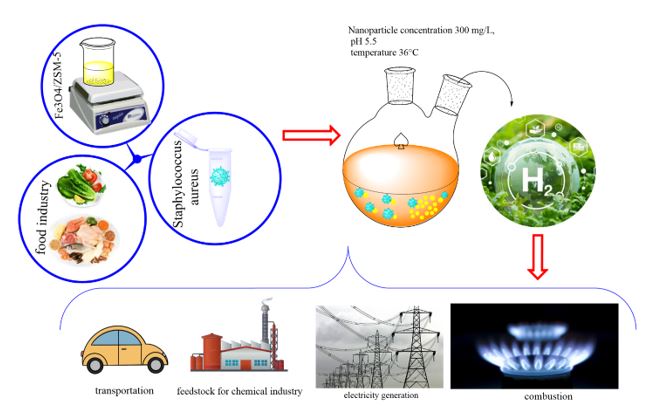
The research highlights the use of practical wastewater, including food waste, for hydrogen production with Fe3O4/ZSM-5. It emphasizes the innovative approach of inoculating microorganisms, such as Staphylococcus, with nanoparticles to improve the efficiency of hydrogen production. The primary goal of the study is to enhance hydrogenase activity and increase the efficiency of hydrogen production using nanoparticles.
Experimental
Chemical and Materials
The materials used include Iron chloride hexahydrate (FeCl3.6H2O, reagent grade, ≥98%, Sigma-Aldrich) and Iron sulfate heptahydrate (FeSO4.7H2O, 98% purity, Sigma-Aldrich), Ethanol (BioUltra, for molecular biology, ≥99.8%, (absolute alcohol, without additive, A15 o1)), NaOH (ACS reagent, ≥97.0%, pellets), and ZSM-5 (NIST®SRM®) purchased from Merck Germany.
Synthesis of Fe3O4/ZSM-5
To prepare magnetic zeolite, initially, 7.8 g of iron chloride and 3.9 g of iron sulfate were mixed with 400 mL of distilled water and mechanically stirred using a Magnetic Stirrer (Mtops Ms300hs Magnetic Stirrer, Korea) at 70 degrees Celsius and 120 rpm. Once the desired temperature was reached, 100 mL of 5 molar sodium hydroxide was added to the solution, and the solution was stirred for another 30 minutes. Then, 11.7 g of zeolite was added to the solution and stirred for 1h to obtain the Fe3O4-ZSM-5 mixture. Subsequently, the obtained nanoparticles were washed several times with water and ethanol and dried in an oven (RTC, nv_SD9002) at 100 degrees Celsius for 24 hours [29, 30].
Characterizations of synthesized Fe3O4/ZSM-5
Particle characterization of synthesized nanoparticles was conducted using various analytical techniques. X-ray diffraction (XRD, MiniFlex 600, Rigaku, Japan) was employed to determine the crystalline phase of the nanoparticles. UV-visible spectrophotometry (Shimadzu, UV-160 A) was utilized to analyze the absorption spectra. Scanning electron microscopy (FESEM-FEI Nanosem 450, Hillsboro, USA) was employed to identify the shape of the nanoparticles. Vibrating sample magnetometry (VSM, Lakeshore 7403, OH, USA) was used to characterize the magnetic properties. Thermogravimetric analysis (TGA, TGA8000, Waltham, MA, USA) was performed to determine the material properties under heat. Additionally, Brunauer–Emmett–Teller (BET, Microtrac BEL Corp., Osaka, Japan) analysis was conducted to investigate gas molecule adsorption on the solid surface.
Preparation of microbial strains
The bacterial strain Staphylococcus aureus ATCC 25923 was purchased in lyophilized form from the Pasteur Institute of Tehran and cultured in the laboratory using the streak plate method on selective mannitol salt agar plates. Five culture plates were inoculated and then incubated in an INFORS AG CH-4103 Botteringan incubator at the optimal temperature of 37 degrees Celsius for 24 hours to promote growth.
Hydrogen fermentation
In the initial optimization stage, the Response Surface Methodology (RSM) using Design-Expert 7.0.0 software was employed. Three parameters including the concentration of Fe3O4/ZSM-5 nanoparticles, temperature, and pH were input into the software environment. The software was set to run 20 experiments for replicating the tests. Subsequently, 20 vials were prepared, each containing 5 mL of Staphylococcus bacteria culture, 25 mL of wastewater from food industries, and 25 mL of distilled water. Different concentrations of nanoparticles (200, 300, 400, 500, and 600 mg/L), pH levels (4.5, 5.5, 6.5, 8.5, and 9.5) adjusted with 1 mol/L HCl or 1 mol/L NaOH, and temperatures (ranging from 30 to 50 degrees Celsius) in a total volume of 100 mL were prepared in each vial. Each vial was tightly sealed to prevent gas escape. Finally, all 20 vials were incubated for 24 hours under specified conditions in darkness in an INFORS AG CH-4103 Botteringan incubator. The amount of hydrogen produced within 48 hours was measured using a gas chromatograph (GC: 6890, Agilent).
Results and Discussion
Characterization of Fe3O4/ZSM-5 nanoparticles
XRD
XRD analysis, conducted using an Explorer diffractometer with a normal incident angle range (5-95 degrees), is employed for identifying the compounds present in the sample and determining the crystalline structure of the Fe3O4/ZSM-5 crystals. As depicted in Fig. 1, The intense peak observed in the spectrum indicates significant crystallinity present in the compound, According to the XRD analysis, the type of crystal structure of Fe3O4 is of the inverse torsion type with oxygen, which forms a cubic crystal system [31]. The size of Fe3O4 nanoparticles calculated using Scherer’s formula is 65nm. The characteristic peak at 23 corresponds to zeolite and matches the standard card (JCPDS 37-0359) [32]. Peaks at angles 27, 35.5, 43, 54, and 57 confirm the presence of Fe3O4 in these nanoparticles, consistent with the standard card (JCPDS 75-0449) [33].
UV-vis
The wavelengths of ultraviolet and visible light emitted from this device can interfere with the surface electrons of Fe3O4/ZSM-5 particles. Absorption peaks provide information about the scale, size, and distribution of particle shapes. Therefore, visible-ultraviolet spectroscopy (UV-vis) is used to examine the optical properties of nanoparticles, plotted in the range of 200 to 600. As depicted in Fig. 2, the highest absorption intensity is in the visible light region. Fe3O4 exhibits high absorption intensity in the range of 200 to 800 nm. However, due to its combination with zeolite, the absorption region is reduced and falls within the range of 200 to 350 nm [34].
BET
BET analysis is one of the methods used to measure and investigate surface porosities, where pore sizes are measured under pressures ranging from 0.99 to -0.05. The N2 adsorption and desorption isotherms of the prepared catalysts are shown in Fig. 3. As depicted in Fig. 3, ZSM-5 exhibits a Type I isotherm characteristic, indicating the presence of microporous structures. Fe3O4/ZSM-5 possesses a mesoporous structure, which is attributed to the use of an alkaline solution during synthesis, leading to a magnetic process. The addition of a small amount of alkaline solution results in the dealumination of ZSM-5 and the removal of silica and aluminum from its structure [35, 36].
SEM
SEM analysis, or scanning electron microscopy, is a type of microstructural analysis used for magnification and analysis of various components and samples. As shown in Fig. 4, Fe3O4/ZSM-5 shapes are irregular spheres, and due to Magnetic dipole interaction, surface charge, and their magnetic properties, they have aggregated together [37, 38, 39].
VSM
VSM analysis, or vibrating sample magnetometry, is used to measure the magnetic properties of materials. Fig. 5 (between -15000 Oe and +15000 Oe) illustrates the formation of a hysteresis loop for nanoparticles with coercivity and zero remanence. With an increase in applied field from 0 to 5000 Oe, magnetization increases and reaches saturation until around 15000 Oe. The saturation magnetization value for the material is within the range of 40. As Fig. 5 shows, due to its combination with zeolite, some of its magnetic properties have decreased, reaching a saturation magnetization value of 27 [40].
TGA
Thermal analysis (TGA) is performed to identify sample degradation under a nitrogen atmosphere and at specific temperatures and weights. Table 1 and Figure 6 show the different stages of sample decomposition and sample weight loss at different temperatures. The TGA curve in the range of 400 to 730 indicates sample decomposition. For Fe3O4/ZSM-5 composites, there are three main weight-loss processes. Partial weight loss below 200 degrees Celsius is attributed to the evaporation of absorbed water molecules or gases. Then, weight loss between 200 to 400 degrees Celsius can be attributed to the degradation of oxygen-containing functional groups. Severe weight loss occurs in the range of 400-760 degrees Celsius, and above 760 degrees Celsius, the sample weight remains almost unchanged with minimal losses [41].
Characterization of used food industry wastewater
Industrial food wastewater generally contains carbohydrates, yeast, mineral and organic salts, fats and oils, cleaning products, and high protein concentrations, sugar, starch, and yeast are among the main components of these wastes [42]. Table 2 presents the physicochemical characteristics of the wastewater. COD was measured using the standard reflux method, TSS with a TSS meter (LXV, 3229900002), BOD with a BOD meter (OxiTop IS6), and pH with a pH meter (Istek 915PDC).
Optimization experiments using Response Surface Methodology (RSM)
This method is one of the best approaches for obtaining responses in the shortest time [43]. It was conducted using RSM software and a central composite design (CCD) model, and the results are presented in Table 3.
According to the results of the software analysis, in Fig. 7a, the predicted responses exhibit a random distribution, and the variance is constant as they are positioned between two lines. In Fig. 7b, all the data points are nearly aligned along a straight line except for a few data points indicating the normality of the data, which is confirmed by Fig. 7d, suggesting a good fit of the model. Fig. 7c indicates the independence of the data as there is no specific trend observed.
Finally, optimal values and hydrogen production rates were obtained. According to the results, in 48h under optimal conditions with 5 mL of Staphylococcus culture, 25 mL of wastewater from food industries, and 25 mL of distilled water, with a nanoparticle concentration of 300 mg/L, pH of 5.5, and a temperature of 36 degrees Celsius in a working volume of 50 mL, the hydrogen production amount is 250.8 mL.
After optimal conditions, hydrogen production was carried out in the dark for 48 hours. Three important parameters in this test are temperature, pH, and nanoparticle concentration. Fermentation temperature affects the growth rate of bacteria. At mesophilic temperatures stable performance and low energy are commonly used for hydrogen production [44]. In addition, different bacteria use different routes to produce hydrogen in different temperature ranges [45]. When the pH is lower than 4.75, the amount of metabolism and growth of existing microorganisms is severely inhibited [9]. Hydrogen-producing bacteria can efficiently produce biohydrogen at pH 5.0-5.5 [46]. This is consistent with the findings of the present study. Also, increasing the concentration of nanoparticles increases the toxicity of these substances in the bacterial cell wall and causes oxidative stress that can lead to the death of bacteria [17] Meanwhile, at the optimal concentration, the ability to absorb electrons in bacteria increases, and with the increase in the concentration of nanoparticles, the process of hydrogen production decreases [47].
The addition of iron nanoparticles improves the speed of electron transfer by affecting microorganisms and also accelerates the production of metabolic products, which mainly include acetic acid, lactic acid, formic acid, and ethanol. In general, iron is a vital component for the activity of cytochromes in bacteria and is also responsible for the transfer of electrons to the hydrogenase enzymes necessary for hydrogen production. As a result, the addition of iron nanoparticles leads to the growth of microbes and an increase in hydrogenase activity [48]. Increasing the concentration of nanoparticles to more than 300 mg/L increases the formation of acetic acid. In general, an excessive increase of nanoparticles suppresses hydrogen production due to oxidative stress [28,47]. Therefore, the optimal level of nanoparticles by affecting microorganisms significantly affects the fermentation process and hydrogen production.
According to the existing advanced technologies, it is possible to implement hydrogen production on a large scale, but the point should be kept in mind that the production of H2 should be fast enough to provide enough power. Optimizing bioreactors, using different strains of bacteria, and using different substrates can be a prospect for more hydrogen production. Also, by changing some parameters, hydrogen production can be increased up to 10 times, which provides new opportunities for practical applications.
Conclusions
In this study, hydrogen production was carried out using green nanoparticles in the dark fermentation process. The results indicate that nanoparticles at a specific concentration have a positive effect on the activities of bacteria, increasing their efficiency by affecting intracellular enzymes. The results showed that dark fermentation is one of the influential processes in biohydrogen production, and the combination of nanotechnology with this process has an impact on production efficiency, making it a suitable alternative for fossil fuels.
Conflicts of interest
The author do not have any conflicts of interest.
